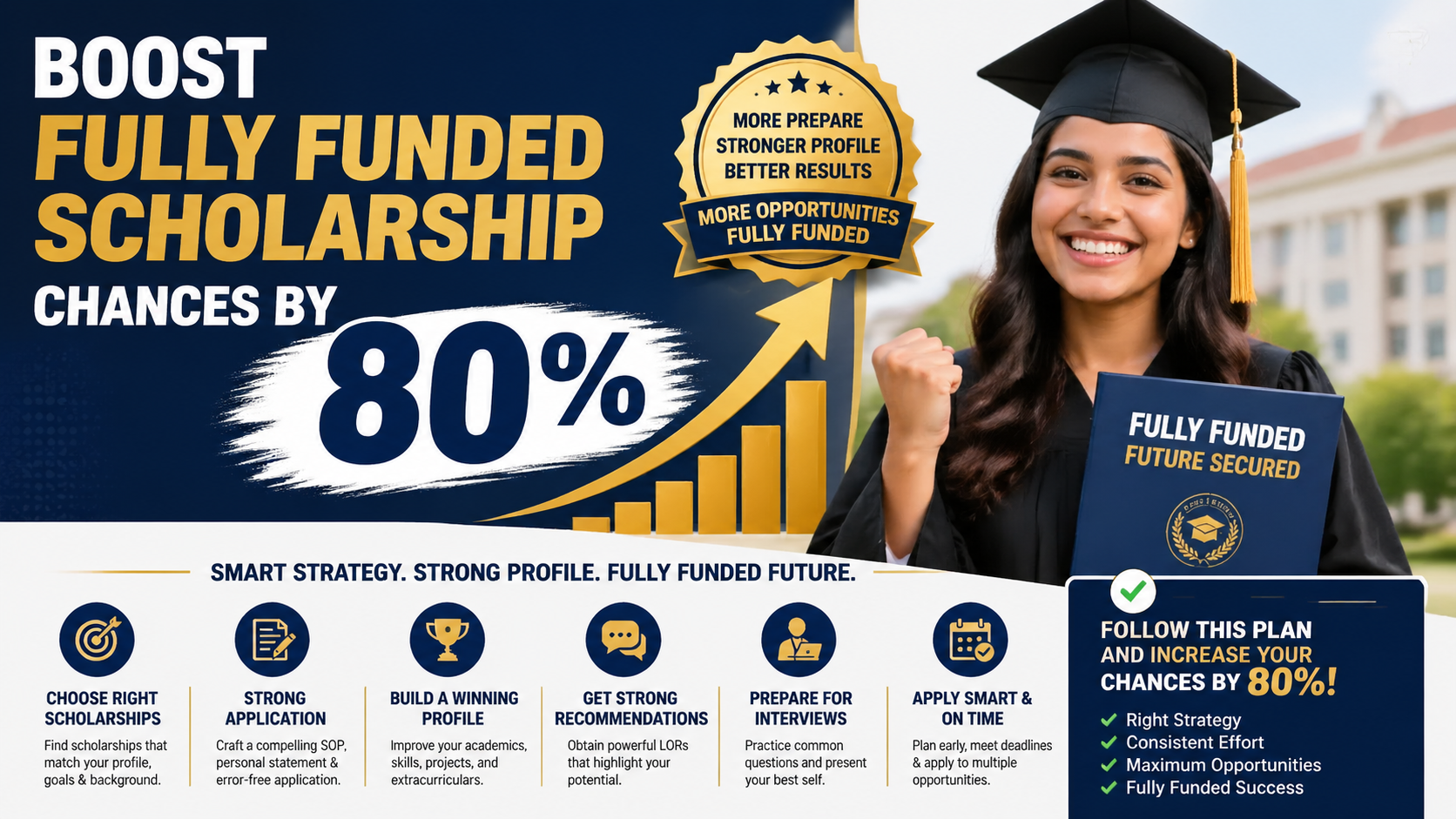
How to Increase Your Fully Funded Scholarship Approval Chances by 80% (Proven Strategies)
Introduction: The Gap Between “Applied” and “Awarded” Is Smaller Than You Think
You’ve found the scholarship. You’ve checked the eligibility. You’ve even started filling out the portal. And then—nothing. Silence. A rejection email that tells you absolutely nothing about why you weren’t selected.
Sound familiar?
Here’s the uncomfortable truth most scholarship guides won’t tell you: the difference between students who win fully funded scholarships and those who don’t is rarely about grades. It’s about strategy, positioning, and knowing exactly what selection committees are looking for before you even open the application.
Every year, thousands of African students miss out on life-changing funding—not because they aren’t qualified, but because they don’t know how to present their qualifications compellingly. The competition feels overwhelming, so many students apply the same way everyone else does: generic essay, rushed documents, vague motivation. And they get generic results.
This post changes that.
You’re about to learn the exact, proven strategies that push scholarship approval rates dramatically higher—for any funding level, any country, any field of study. Whether you’re applying for the Chevening Scholarship, a DAAD fellowship, or a Mastercard Foundation award, these techniques apply universally.
By the end of this guide, you’ll know how to find the right opportunities, build an application that committees can’t ignore, tell your story with authority, and avoid the silent mistakes that quietly disqualify most applicants.
📌 Quick Summary
- What this covers: End-to-end scholarship strategy from search to submission, including essay positioning, eligibility optimization, and application mechanics
- Key benefits: Higher approval odds, fewer wasted applications, stronger personal narrative, documented proof of eligibility
- How to use this post: Read it once for the full picture, then return to each section as you work through your application—treat it as your tactical handbook
1. Why Most Scholarship Applications Fail Before They’re Even Read
Before we talk strategy, you need to understand the enemy—and the enemy isn’t competition. It’s invisibility.
Most applications are eliminated in the first screening round, before a human ever reads the essay. Scholarship programs receive thousands of applications. The first filter is automated or administrative: incomplete documents, mismatched eligibility, formatting errors, missing requirements. Applicants who survive that filter still face a second cull: reviewers scanning for standout candidates.
If your application looks like the other 2,000, it disappears.
A 2023 study tracking international scholarship applicants found that over 60% of rejections occur due to incomplete documentation or failure to meet stated criteria—not because of weak essays or poor grades. You’re losing before the game even starts.
Here’s the good news: fixing these early-stage failure points is completely within your control.
This section alone could double your approval rate—because most of your competition isn’t reading guides like this one. They’re winging it.
2. Understanding What “Fully Funded” Actually Means (And Why It Matters for Strategy)
You need to know exactly what you’re applying for before you can position yourself to win it.
“Fully funded” is not a universal standard—it means something different for every scholarship program. Getting this wrong means you could win a scholarship and still face financial crisis during your studies.
Here’s the spectrum:
Full funding typically includes:
- Tuition fees (partial or complete, depending on the program)
- Monthly living stipend
- Return airfare (economy class, usually once per academic year)
- Health insurance (basic coverage—read the fine print)
- Research allowances (for graduate programs)
- Visa application fee coverage (not always—verify this)
Full funding typically excludes:
- Family relocation or dependent support
- Personal expenses beyond the stipend
- Technology equipment (some programs offer this—check carefully)
- Excess baggage or shipping costs
- Pre-departure medical examinations (often required but rarely covered)
Let’s make this concrete with two real examples.
The Chevening Scholarship (UK government) covers full tuition, a monthly living allowance, return flights, and a one-time arrival allowance. It does not cover accompanying dependants or pre-application medical tests. The stipend is structured around London-level costs, which is generous by most standards—but you’ll still need personal savings for incidentals.
The DAAD Scholarship (Germany) covers tuition exemption at public universities, a monthly stipend ranging from €861 to €1,200 depending on your qualification level, health insurance, and travel subsidy. What it doesn’t always cover is the cost of German language courses you may need pre-arrival—an expense that surprises many first-time applicants.
Reading between the lines is a skill. When you see “fully funded,” immediately ask: Does it cover dependants? What’s the stipend amount? Is health insurance included or a deduction? Does “travel” mean a one-time return trip or annual travel?
The more precisely you understand what each scholarship offers, the more precisely you can demonstrate you’re the right candidate for that specific program—not scholarships in general.
Making an informed choice is the foundation of a compelling application.
3. The Strategic Scholarship Search: Building Your Opportunity Database
Most students find one scholarship, apply for it, and wait. That’s not a strategy—that’s a lottery ticket.
The students who win scholarships apply strategically across a curated portfolio of 6–10 carefully selected opportunities. They’re not spraying applications everywhere. They’re identifying the programs where their profile is strongest, then concentrating their energy there.
Here’s how to build that database systematically:
Step 1: Start With the Platforms That Actually Vet Opportunities
Not all scholarship databases are equal. Some are genuinely useful; others are cluttered with outdated listings or outright scams. Start with these verified, high-authority sources:
- Mastercard Foundation Scholars Program — specifically designed for academically talented African students with demonstrated financial need; one of the most transformative programs on the continent
- DAAD (German Academic Exchange Service) — daad.de; extensive graduate and postgraduate funding for African students with one of the most transparent application processes globally
- British Council Chevening — chevening.org; UK government’s flagship international scholarship for emerging leaders; extraordinary network benefits beyond the funding
- African Union Scholarships — au.int; monitors continental scholarships and coordinates with member state programs; often overlooked but increasingly well-funded
- Opportunity Desk — opportunitydesk.org; one of the most consistently updated aggregators of scholarships, fellowships, and grants specifically tracked for African students
- Scholars4Dev — scholars4dev.com; focused exclusively on developing-country applicants with strong filtering tools
- University-specific funding offices — many universities (University of Edinburgh, University of Toronto, University of Cape Town) have dedicated international student funding pages with awards not listed anywhere else
Step 2: Filter for Programs That Match Your Profile—Not Just Your Dream
Here’s where discipline separates winners from wishful thinkers.
Filter every scholarship against three non-negotiables before investing time: citizenship eligibility, field of study restrictions, and academic level requirements. If you fail any one of these, move on immediately. Don’t apply hoping the committee will make an exception—they won’t.
Step 3: Search for Hidden Opportunities Using Specific Terminology
Scholarship databases use inconsistent language. The same program might be listed as a “bursary,” “fellowship,” “award,” “grant,” or “scholarship” depending on the institution.
Search using these terms: “fellowship for African students,” “bursary for developing country applicants,” “study grant sub-Saharan Africa,” “international award [your field],” and “Commonwealth funding [your country].” You’ll surface listings that generic searches miss entirely.
Step 4: Verify Every Opportunity Before Investing Time
A legitimate scholarship will never ask you to pay an application fee. It will have a verifiable institutional email address, an established website with a publication history, and contact information for an actual funding office. If any of these are missing, walk away.
Step 5: Create a Tracking Spreadsheet
Build a simple spreadsheet with these columns: Scholarship Name | Deadline | Eligibility | Documents Required | Status | Notes. Update it weekly. This sounds basic—but the students who win multiple scholarships are almost always meticulous record-keepers.
Your curated database is your competitive advantage—protect it.
4. The Eligibility Audit: Know Exactly Where You Stand Before You Apply
Applying to a scholarship you’re ineligible for doesn’t just waste time—it trains you to underestimate yourself. Every rejected application that shouldn’t have been submitted chips away at your confidence. Run an eligibility audit first.
Eligibility Checklist for Fully Funded Scholarships
Work through each category honestly:
Academic Performance
- Do you meet the minimum GPA or grade requirement (often 3.0/4.0 or equivalent)?
- If your undergraduate GPA was lower, do you have graduate-level work that compensates?
- Are your transcripts officially translated and certified if not in English or the host country’s language?
Language Proficiency
- Do you have a valid IELTS (typically 6.5+) or TOEFL (typically 90+) score if required?
- Does the scholarship accept alternative evidence of English proficiency (medium of instruction letter, work experience in English)?
- Is your score within the validity period (usually 2 years)?
Citizenship and Residency
- Are you a citizen of an eligible country (not just a resident)?
- Does the scholarship require you to return to your home country after studies?
- Are you currently residing in your home country, or does that matter for this scholarship?
Work Experience and Age
- Does the scholarship require minimum work experience (Chevening requires 2 years)?
- Is there a maximum age limit, and are you within it?
- Is professional experience weighted in your favor for this program?
Financial Status
- Does the scholarship require demonstrated financial need?
- If so, do you have documentation (bank statements, family income records) to support this?
- Does the scholarship restrict applicants who already hold other scholarships?
🔍 Are You Eligible? Quick Self-Assessment
Answer these four questions in 60 seconds:
- Can you submit official academic transcripts that meet the scholarship’s minimum grade requirements? Yes / No
- Do you hold a valid English language test score (or qualify for a waiver)? Yes / No
- Are you a citizen of a country listed in the scholarship’s eligible nations? Yes / No
- Do you meet the work experience requirement (if any) with verifiable documentation? Yes / No
If you answered Yes to all four: You’re eligible—now focus entirely on strategy and positioning.
If you answered No to one or more: Identify which gap is fixable (e.g., taking IELTS) versus disqualifying (citizenship), and prioritize accordingly.
Understanding “Required” vs. “Preferred”
This is one of the most valuable skills you’ll develop as a scholarship applicant.
“Required” means your application is discarded if you don’t meet it. “Preferred” means it’s a positive signal if you have it, but its absence won’t disqualify you. Many applicants self-eliminate from competitive scholarships because they see “preferred” criteria and treat them as mandatory.
For example, a scholarship description might say: “Applicants with leadership experience in community development are preferred.” This means your application won’t be rejected without it—but including relevant community experience will distinguish you from other finalists.
Clarity about where you stand is the foundation of confidence in every application.
5. The 5 Application Strategies That Actually Move the Needle
Now we get to the core of this guide. These five strategies, applied together, are what separate the 80th percentile of applicants from the 20th. Each one is actionable and learnable.
Strategy 1: Customize Every Application—No Exceptions
This is the rule most students know but don’t follow.
Generic applications are the number one reason qualified students get rejected. A committee reviewing 3,000 applications can spot a recycled essay in the first paragraph. The language is vague, the motivation is abstract, and the connection to the specific program is nonexistent.
Customize means: reference the specific scholarship by name in your essay. Name the professors at the host institution whose work aligns with yours. Mention the specific course modules that fill a gap in your expertise. Explain why this country, this university, this program—not “studying abroad” in general.
This level of specificity signals two things: you’ve done your research, and you’re serious. Both are exactly what committees want to fund.
Strategy 2: Lead With Your “Why Now” Story
Every strong scholarship application answers one unspoken question before the committee has to ask it: Why are you applying for this, at this moment in your life?
This is especially critical if you have any non-linear element in your background—a career change, a gap year, a late educational start, or a pivot between fields.
Don’t bury your reason in the third paragraph of your essay. Put it front and center. “After five years working in public health administration in Lagos, I watched policy failures cost lives that better data analysis could have prevented. That’s why I’m pursuing this MSc in Health Informatics now—not despite my professional experience, but because of it.”
That’s a story. That’s fundable.
Strategy 3: Engineer Your References Strategically
Most applicants ask whoever they know. Strategic applicants ask whoever can speak most specifically to the qualities the scholarship values.
Read the scholarship criteria, then work backward. If the scholarship prioritizes leadership potential, your best reference is the supervisor who watched you lead a team through a crisis—not the professor who gave you an A in first year.Brief your referees. Send them: the scholarship criteria, your personal statement draft, and two or three specific examples you’d like them to highlight. Strong referees write strong letters—but only when they have the right material to work with.
Request references at least 6 weeks in advance. Give them a firm, early deadline, then send one polite reminder. Referees who are surprised by tight deadlines write rushed letters.
Strategy 4: Treat Your Documents as Part of Your Application—Not Just Requirements
Your transcripts, certificates, and supporting documents aren’t administrative paperwork. They’re evidence that supports every claim your essay makes.
Ensure every document is current, complete, and authenticated. If your academic institution takes 4–6 weeks to produce official transcripts (many African universities do), start that process before you do anything else. Document delays are the most common reason for last-minute, incomplete applications.
If you have certifications, training records, or professional credentials relevant to your field of study, include them even if not explicitly required. They add depth to your profile without cluttering your application.
Strategy 5: Submit Early—Not Just On Time
Submitting on the deadline day is not the same as meeting the deadline. Many scholarship portals experience server crashes in the final 48 hours. Some programs begin reviewing applications as they come in, meaning early submissions receive more deliberate attention.
Aim to submit 10–14 days before the deadline. Use that buffer to have your application reviewed by at least one other person—a mentor, a faculty advisor, or a trusted peer who’ll give honest feedback, not just encouragement.
The 10-day buffer has saved hundreds of scholarships from technical disasters. Build it into your timeline without negotiation.
6. Writing a Scholarship Essay That Committees Actually Remember
The essay is where applications are won. Not just passed—won.
The goal of your personal statement is not to tell your life story. It’s to answer one question: why should we invest in you specifically?
Here’s how to structure an essay that does exactly that.
Framework 1: The Turning Point
This structure works exceptionally well for career changers, returning students, and anyone with a pivotal moment in their background.
- Paragraph 1: Open with the specific moment everything changed (a project, a failure, a realization, a person).
- Paragraph 2: Explain what that moment revealed about a gap in your skills or knowledge.
- Paragraph 3: Show what you’ve done since that moment to close that gap.
- Paragraph 4: Explain precisely why this scholarship program is the next necessary step.
- Paragraph 5: Paint the picture of what you’ll do with this education—specifically, for your community, field, or country.
Framework 2: The Problem-Solution Arc
This framework works brilliantly for applicants whose motivation is rooted in professional or community experience.
- Open with a problem you’ve witnessed firsthand in your field, community, or country—something specific, not abstract.
- Show your proximity to it—why you’re not just observing this problem from a distance, but living inside it.
- Position the scholarship as the tool that enables your solution.
- Close with impact—what changes because you pursued this education.
Framework 3: The Expertise Gap
This is the framework for professionals who know exactly what they lack and why getting it matters.
- “I have five years of [experience]. I’ve accomplished [specific achievement]. The one thing standing between me and [specific goal] is [specific knowledge/skill]. Here’s why this program closes that gap, and here’s what I’ll build with it.”
✍️ Generic vs. Strategic: A Side-by-Side Comparison
Generic: “I have always been passionate about environmental science and believe that education is the key to a better future for Africa. This scholarship will help me achieve my goals.”
Strategic: “In 2022, I watched a community I’d worked with for three years lose their primary water source to industrial runoff—a disaster that existing environmental policy had no mechanism to prevent. I’ve spent the two years since studying the legislative gap from inside a Nairobi-based NGO. This MSc in Environmental Law is the credential that turns my proximity to the problem into the authority to solve it.”
The second version is specific, personal, urgent, and fundable. Aim for that every single time.
The biggest essay mistake is writing to impress instead of writing to connect. Committees aren’t looking for perfect people. They’re looking for clear people—applicants who know who they are, where they’re going, and why this scholarship is the bridge between the two.
“When I stopped trying to sound like what I thought a scholar should sound like and just wrote honestly about the problem I was trying to solve, my application went from a rejection to a shortlist in one revision cycle.”
— Amara D., Chevening Scholar, 2023, age 29
Authenticity is not a soft skill in scholarship writing. It’s a competitive advantage.
7. Gathering and Presenting Your Documentation: The Professional Standard
Documentation is the infrastructure your application stands on. Even a perfect essay collapses under disorganized, incomplete, or improperly formatted supporting documents.
Here’s how to approach this like a professional:
Step 1: Build Your Master Document Checklist
Before touching the application portal, create a checklist of every required and recommended document. Typical requirements for fully funded scholarships include:
- Official academic transcripts (sealed and signed by registrar)
- Degree certificate(s) or graduation confirmation letter
- Proof of English language proficiency (IELTS/TOEFL/WAEC/medium of instruction letter)
- Valid passport (minimum 6 months validity beyond program end date)
- Two to three reference letters (on institutional letterhead where possible)
- Personal statement / motivation letter
- CV or resume (academic-professional hybrid format)
- Proof of work experience (offer letters, appointment letters, payslips—any official documentation)
- Financial need documentation (where required)
- Research proposal (for PhD or research-based programs)
Step 2: Authenticate Everything
“Official” has a specific meaning in scholarship applications—it doesn’t mean a photocopy you’ve signed yourself. Transcripts must bear the university’s official stamp and registrar’s signature. Certificates should be notarized if the scholarship requires notarization. Translations must be certified by a recognized translator.
Many African applicants lose scholarships at the document verification stage simply because they submitted unofficial copies assuming they’d be accepted. Read the requirements for each document exactly as stated.
Step 3: Create Your CV for an Academic-International Audience
Your scholarship CV is different from a job application CV. It should lead with education, not work history. It should include publications, conference presentations, community roles, and volunteer leadership—anything that demonstrates impact beyond employment.
Keep it to two pages maximum. Use clear section headers. List achievements, not just responsibilities. “Trained 40 health workers in community data collection” is an achievement. “Responsible for training activities” is a job description.
Step 4: Address Any Non-Linear Elements Head-On
If you have an employment gap, a year between degrees, or a field change, don’t leave it for the committee to notice and question. Address it briefly and confidently in your personal statement or additional information section.
“Between 2020 and 2022, I left formal education to care for a family member through a serious illness. During that period, I continued my professional development through [online courses, self-directed research, freelance work]. This experience deepened my commitment to [field] by showing me [specific lesson].”
Explain, contextualize, and move forward. Committees respect honesty far more than omission.
⚠️ 5 Mistakes That Cost Applicants Fully Funded Scholarships (Avoid These)
- Submitting without proofreading — A single typo in your personal statement signals carelessness. Have at least two people review your essay before submission.
- Generic motivation — “I am passionate about development” tells a committee nothing. Specific, situated motivation tells them everything.
- Missing or informal supporting documents — Unofficial transcripts, unsigned letters, and expired language scores are automatic disqualifiers in most programs.
- Weak reference selection — A reference who can’t speak specifically to your relevant strengths helps no one. Choose deliberately.
- Underestimating documentation time — Official transcripts from African universities can take 4–8 weeks. Start this process the moment you decide to apply.
8. After You Apply: Managing the Waiting Period Strategically
Most applicants go silent after submission. Strategic applicants use the waiting period to strengthen their position and prepare for the next stage.
Here’s how to manage the post-submission window:
Confirm receipt. Many scholarship portals send an automated confirmation. If yours doesn’t, email the scholarship office to confirm your application was received and complete. Keep this professional and brief.
Prepare for interviews now—not after you’re shortlisted. The most competitive scholarships (Chevening, Rhodes, Mastercard Foundation) include interviews in their selection process. Waiting until you receive an interview invitation to prepare is one of the most costly mistakes in scholarship strategy.
Common scholarship interview questions include:
- Why do you want to study in this country specifically?
- What will you do with this education when you return home?
- Tell me about a leadership challenge you’ve faced and how you navigated it.
- Why this university over others in the host country?
- Where do you see yourself in ten years?
Prepare structured answers using the STAR method (Situation, Task, Action, Result) for behavioral questions. Practice out loud—not just in your head—until your answers feel natural and conversational rather than rehearsed.
Keep applying. While your application is under review, continue building your portfolio. Scholarship selection is partly merit and partly timing—programs that weren’t a fit this cycle might open a new cohort six months from now. You should have 2–3 applications in progress at any given time.
Avoid the common post-submission spiral. Don’t obsessively refresh your email or second-guess every line of your essay. You submitted your best work. Now invest your energy in things you can still influence.
9. If You’re Rejected: The Strategy That Turns a No Into a Future Yes
A rejection is data, not a verdict. The students who ultimately win fully funded scholarships are almost never first-time applicants across the board. Most winning applications are the product of at least one previous rejection and the lessons extracted from it.
When you receive a rejection, do these things immediately:
Request feedback. Not all scholarship programs provide it, but many will if you ask professionally and promptly. A simple email—”Thank you for considering my application. I’m committed to reapplying and would be grateful for any feedback that could strengthen my future submission”—is enough. Some programs have formal feedback processes; take full advantage of them.
Audit your rejected application honestly. Compare it against the strategies in this guide. Where was it generic? Where were documents incomplete? Was your essay specific enough? Did your references align with the scholarship’s stated values?
Reapply stronger. Many of the world’s most prestigious scholarships explicitly encourage reapplication. The Chevening Scholarship notes that some awardees applied multiple times before succeeding. The DAAD has numerous scholars who were rejected in their first cycle. Persistence, paired with deliberate improvement, is genuinely one of the most powerful scholarship strategies available to you.
According to the Chevening official scholarship guidance, reapplicants often demonstrate stronger applications precisely because they’ve invested time in understanding the program’s expectations more deeply.
One rejected application refined into a winning one is worth more than ten simultaneous generic submissions.
10. The 2026 Scholarship Application Timeline
Planning is the unsexy strategy that wins scholarships. Use this timeline as your master calendar.
| Date Range | Milestone / Action |
|---|---|
| January – February 2026 | Research and shortlist 6–10 target scholarships; build tracking spreadsheet |
| February – March 2026 | Request official transcripts and begin language test preparation or registration |
| March – April 2026 | Contact potential referees; brief them with scholarship criteria and your materials |
| April – May 2026 | Draft personal statements for each target scholarship; begin customizing per program |
| May – June 2026 | Collect reference letters; authenticate all supporting documents |
| June – July 2026 | Submit early applications (many programs open April–July for September/October starts) |
| August – September 2026 | Rolling deadline submissions; follow up on pending applications |
| September – October 2026 | Shortlist announcements for most programs; begin interview preparation |
| October – November 2026 | Interview periods for shortlisted candidates |
| November – December 2026 | Final decision announcements; accept award and begin visa/enrollment process |
| January – February 2027 | Pre-departure preparation; some programs begin January/February 2027 |
Note on rolling applications: Programs like DAAD, some Commonwealth scholarships, and university-specific awards operate on rolling deadlines—they review applications as they arrive rather than waiting for a cutoff date. These are particularly valuable if your work schedule makes rigid deadlines difficult to meet. Prioritize rolling-deadline programs in your portfolio.
Set phone calendar reminders 6 weeks before every deadline you’re targeting. Adult applicants and working professionals consistently underestimate how long document gathering actually takes. Six weeks is the minimum safe runway.
Proactive planning transforms scholarship applications from stressful sprints into confident, organized processes.
11. Frequently Asked Questions
Can I get a fully funded scholarship if I’ve been working full-time for several years?
Yes—and in many programs, your work experience is a competitive advantage. Scholarships like Chevening and the Mastercard Foundation explicitly value professional experience and demonstrated leadership. Your career history can strengthen your application, especially if you can connect it directly to your proposed field of study and your post-scholarship goals.
What if there’s a gap between my last degree and this application?
A gap in your academic history is rarely disqualifying on its own. What matters is how you account for it. Briefly explain the gap in your personal statement—whether it was professional development, family responsibility, financial necessity, or a deliberate career focus—and emphasize what you learned or achieved during that period. Gaps explained confidently become part of your story.
Can I work while on a fully funded scholarship?
It depends entirely on the program and the host country’s visa regulations. Some scholarships (like DAAD) permit limited part-time work; others (like Chevening) have restrictions on concurrent employment. Your visa type will also govern this in the host country. Always check both the scholarship terms and the student visa conditions for your destination country before assuming either way.
Do I need to be living in my home country to apply?
Many fully funded scholarships—including Chevening and several Commonwealth programs—require that you apply from your home country and intend to return after completing your studies. Some programs are flexible for applicants studying or working abroad temporarily. Check the residency requirements specifically; they’re often listed in the FAQ section of each scholarship’s official website.
How long does it take from application to enrollment decision?
Most fully funded scholarship programs run on a 6–9 month cycle from application deadline to final decision. For example, Chevening applications typically close in November, with final decisions announced the following June—a 7-month process. Mastercard Foundation has a similar timeline. Plan accordingly, and do not hand in your notice at work or make major life decisions before receiving a formal award letter.
Can I reapply if my application is rejected?
Absolutely—and you should. Most scholarship programs explicitly permit and encourage reapplication. Many successful scholars applied two or three times before winning their award. The key is to treat each rejection as a diagnostic, identify specifically what to improve, and resubmit a meaningfully stronger application. The DAAD scholarship program notes that perseverance and continuous improvement are among the most common traits in successful long-term applicants.
Are applicants from smaller or less-represented African countries at a disadvantage?
Not necessarily—and in some programs, the opposite is true. Many scholarships specifically target underrepresented regions and countries to ensure geographic diversity in their cohorts. If you’re from a country with historically low scholarship representation, you may actually have a structural advantage in programs that track this. Research each scholarship’s geographic distribution goals; you may discover you’re a priority candidate.
Your application is a case you build—build it deliberately and the result will follow.
12. Your Action Plan: Start Here, Start Now
You’ve read this far, which means you’re not the kind of person who half-commits to things. That’s exactly the kind of person scholarship committees want to fund.
Maybe you’re still sitting with a quiet voice in your head that says: “But what if I’m not competitive enough? What if I’m too old, too inexperienced, too late?” That voice isn’t wisdom—it’s static. The evidence in this guide tells a different story: strategic, prepared, authentic applicants win scholarships every year. Not the most brilliant ones. Not the youngest ones. The most deliberate ones.
You now have the framework. Here’s exactly where to start:
1. Build your scholarship database today.
Open a spreadsheet right now—not tomorrow, today. Research 6 programs from the platforms listed in Section 3, and populate your tracker with deadline, eligibility, and document requirements for each. Give yourself 48 hours to complete this step.
2. Start your document audit this week.
Work through the eligibility checklist in Section 4. Identify your strongest scholarships and flag any document gaps (transcripts, language scores, authentication needs). Contact your university registrar immediately if official transcripts are required—this is always the longest step.
3. Map your personal timeline to the 2026 calendar.
Take the master timeline from Section 10 and assign specific dates based on the deadlines in your scholarship database. Set phone reminders 6 weeks before each deadline. Treat those reminders like non-negotiable appointments.
And when you’re ready to sharpen the most important part of your application, read our complete guide to writing scholarship personal statements that win—because a great strategy deserves an equally great story.
The scholarship that changes your life is waiting for an application that proves you’ve earned it. You have everything you need to write that application. Start today.
Last updated: January 2026. All scholarship information reflects current program guidelines. Verify details directly with each program before applying, as requirements can change between cycles.
