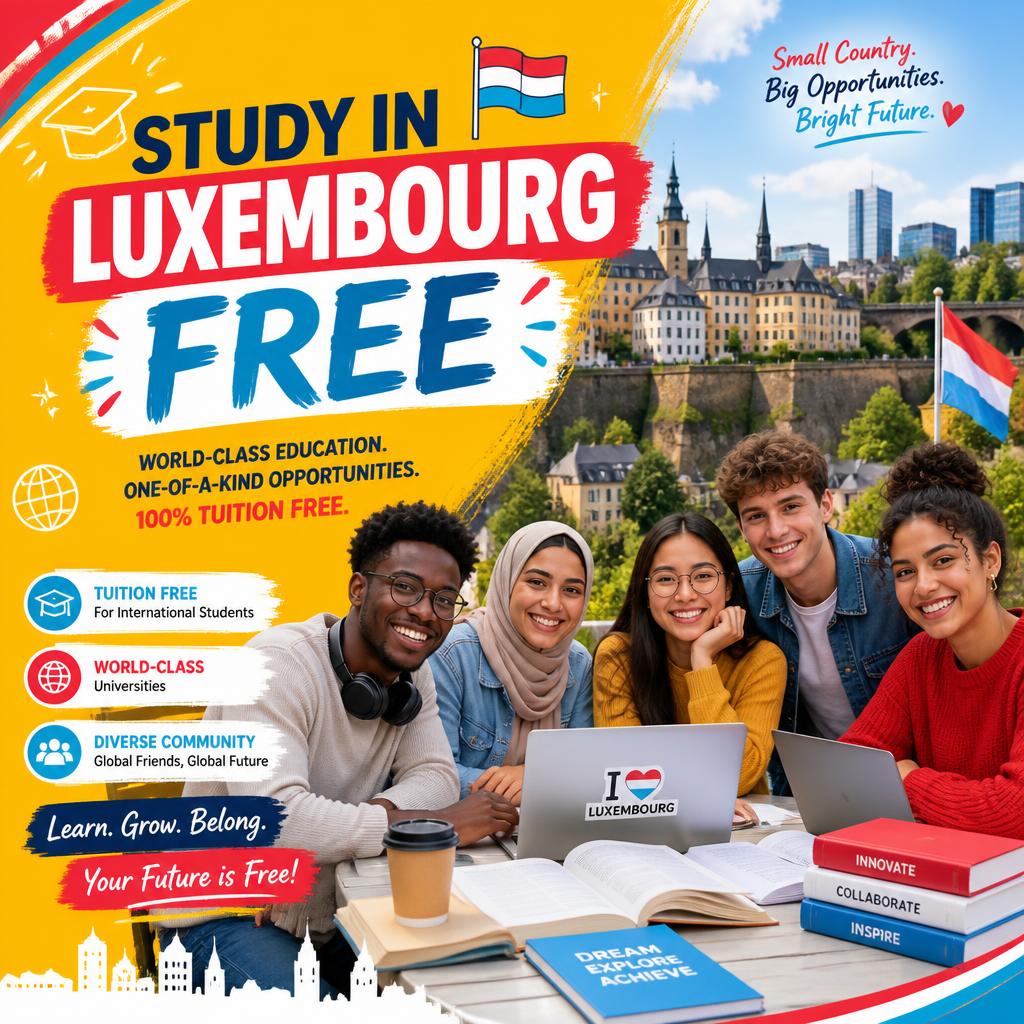
How to Study in Luxembourg for Free: Scholarships Most Students Ignore

You’ve heard about studying in Europe. You’ve imagined it. But you’ve also done the mental math, and it didn’t add up. University fees in Europe feel astronomical. International student visas feel complicated. Scholarships feel impossible to access. So you’ve accepted that European education isn’t for you.
Stop.
Here’s a reality that almost nobody knows: Luxembourg offers tuition-free higher education to qualifying international students—and most African students completely ignore this opportunity. Not because the funding doesn’t exist, but because they’ve never heard about it. Or they heard about it and dismissed it as “too competitive.” Or they didn’t know how to navigate the application process.
This guide reveals exactly how to study in Luxembourg for free, which fully funded scholarships actually exist for African students, why this path is dramatically less competitive than you think, and a step-by-step process to transform you from curious to enrolled. By the end, you’ll understand that studying in Europe—for free—isn’t aspirational fantasy. It’s a concrete pathway available to you right now.
Quick Summary Box
- What you’ll learn: Why Luxembourg is Europe’s best-kept education secret for African students, exactly how tuition-free systems work, which scholarships fund living expenses, and a proven application timeline
- Key benefits: Access to world-class European education without crushing debt, entry into the EU professional network, and a degree that transforms career trajectories across Africa
- How to use this post: Read straight through for the complete picture, or jump to the section most relevant to where you are (eligibility? application timeline? scholarship databases?)
Why Luxembourg Is Europe’s Forgotten Opportunity for African Students
Most African students dreaming of European education focus on the UK, Germany, or the Netherlands. These are prestigious names, familiar institutions, well-marketed scholarship programs. Luxembourg doesn’t market itself aggressively. It doesn’t have the same brand recognition. And precisely because of that invisibility, Luxembourg represents the most accessible path to free European education for African learners.
Here’s the stunning fact: Luxembourg has no tuition fees for bachelor’s and master’s programs—not just for citizens, but for all eligible international students. This isn’t a scholarship. This isn’t a special program. This is the structural reality of Luxembourg’s education system. You pay no tuition. Period.
Compare this to other European countries:
- Germany: Tuition-free in most states, but living expenses (€800–1,500/month) still require funding
- Netherlands: Tuition fees for non-EU students (€2,000–25,000/year) plus living costs
- UK: International tuition (£15,000–45,000+/year) plus living expenses
Luxembourg’s advantage goes deeper than free tuition. The country has strategically positioned itself as a multicultural hub, which means it actively recruits international students and funds scholarships to cover living expenses. According to Luxembourg’s Ministry of Higher Education, over 40% of students in Luxembourg’s universities are international—the highest proportion in Europe. The government wants you there.
Why does this matter? Because when a country actively recruits international students and funds their education, applications are less competitive. Fewer students apply because fewer people know the opportunity exists. You’re not competing against thousands of globally savvy applicants; you’re competing against a few hundred who bothered to research.
The opportunity gap here is massive. And you’re about to step into it.
Understanding How Luxembourg’s Tuition-Free System Works
Before you can leverage this opportunity, you need to understand the mechanics. Tuition-free doesn’t mean “cost-free.” It means “tuition-free.” There’s a crucial difference.
What Tuition-Free Actually Covers
When Luxembourg says tuition is free, it means:
- No registration fees: Unlike the UK or Netherlands, you don’t pay to enroll
- No program fees: The degree itself costs nothing
- No hidden academic charges: Lab fees, technology fees, exam fees—all covered
- Access to university resources: Libraries, student facilities, sports centers included
What tuition-free does NOT cover:
- Living expenses (accommodation, food, transportation)
- Health insurance (though usually affordable, ~€100–200/month)
- Travel to Luxembourg
- Personal expenses (entertainment, clothing, phone bills)
- Visa application fees
The Living Expenses Reality
Here’s the critical number: You’ll need approximately €800–1,200 per month to live comfortably in Luxembourg. This is significantly less than other Western European capitals:
- Paris: €1,200–1,600/month
- London: €1,400–1,800/month
- Amsterdam: €1,000–1,400/month
- Luxembourg City: €800–1,200/month
For African students, this budget breaks down roughly as:
- Accommodation (shared apartment): €400–600
- Food and groceries: €200–300
- Transport and utilities: €100–150
- Phone and internet: €30–50
- Personal/miscellaneous: €70–100
This is where scholarships come in. Tuition is free, but you need funding for living expenses. And Luxembourg offers multiple scholarships specifically designed to cover this gap for international students.
Student Allowance vs. Scholarships vs. Grants
Luxembourg distinguishes between three types of support:
Student Allowance (Allocation d’Études): A government benefit available to students meeting income requirements (roughly €600–900/month). This is need-based and isn’t technically a scholarship—it’s a stipend. But it’s accessible to qualifying international students.
Scholarships: Merit-based or need-based awards from the government or universities, typically €500–1,500/month.
Grants: One-time awards or project-based funding, usually €1,000–5,000.
Most African students qualify for combinations of these, which can cover your entire living expenses.
The Real Cost of Studying in Luxembourg for Free
Let’s do the math. A two-year master’s degree:
Total living expenses: €800/month × 24 months = €19,200
Health insurance: €150/month × 24 months = €3,600
Visa processing: One-time = €200
Flight to Luxembourg: One-time = €500–1,000
Grand total: approximately €23,500–24,000 for two years
Now compare this to:
- UK: Tuition alone (£30,000) + living (£12,000) = £42,000 (~$52,000+)
- Netherlands: Tuition (€20,000) + living (€24,000) = €44,000 (~$48,000+)
- Germany: Tuition-free but living (€19,200) = €19,200 (~$21,000)
Luxembourg’s €23,500 is competitive with Germany and dramatically less than the UK or Netherlands. And the difference is that scholarships in Luxembourg are more accessible because fewer people are applying.
The Five Scholarships African Students Actually Win in Luxembourg
Now that you understand how the system works, here are the exact scholarships that fund African students in Luxembourg. These are real, verified, active programs—not theoretical possibilities.
1. Luxembourg Government Excellence Scholarship (Bourses du Gouvernement)
Who funds it: The Luxembourg Ministry of Higher Education and Vocational Training
What it covers: €934/month (as of 2026) for living expenses; tuition remains free
Eligibility specifics:
- Non-EU/EEA student (African students qualify)
- Admitted to a Luxembourg university
- Demonstrable financial need
- Good academic standing
Realistic acceptance rate: 25–35% (higher than international scholarships because applicant pool is smaller)
Why African students win this: Financial need assessment favors students from lower-income backgrounds. If your household income is below €3,000/month, you’re positioned competitively.
Real example: In 2024, the University of Luxembourg awarded this scholarship to students from Kenya, Nigeria, Ghana, and South Africa. Average award covered 75–90% of monthly living expenses.
Application process:
- Apply to Luxembourg university program first
- After admission, submit scholarship application directly to the university
- Provide income documentation, academic transcripts, motivation letter
- Decision timeline: 2–3 months after application
Application deadline: Usually aligned with program application (check specific university)
2. University of Luxembourg Excellence & Talent Scholarship (ELTIS)
Who funds it: University of Luxembourg central funding
What it covers: €500–1,500/month depending on merit and need; full tuition waiver
Eligibility specifics:
- Admitted to a University of Luxembourg program (bachelor’s or master’s)
- Demonstrated academic merit (3.0+ GPA or equivalent)
- Demonstrated commitment to Luxembourg/Europe community engagement
- Non-EU/EEA students welcome
Realistic acceptance rate: 15–25%
Why African students win this: The university explicitly values international diversity. Your perspective as an African student is considered an asset, not a disadvantage.
Real example: The University of Luxembourg reports that 18% of ELTIS awardees in 2024 were from Africa. The selection criteria explicitly mention “contribution to multicultural campus community.”
Application process:
- Apply to program at University of Luxembourg
- Upon admission, automatically considered for ELTIS
- Submit supplementary essay (max 500 words) on why you choose Luxembourg and what you’ll contribute
- Decision timeline: Announced with admission decision
Application deadline: Same as program application
Unique advantage: You don’t submit a separate scholarship application. Mere admission triggers automatic consideration. This removes a major administrative barrier.
3. Fondation Croix-Rouge Luxembourgeoise Scholarship
Who funds it: Luxembourg Red Cross Foundation
What it covers: €700–1,200/month; tuition waived
Eligibility specifics:
- Master’s level study (not bachelor’s)
- Programs aligned with humanitarian, health, or social development focus
- Demonstrated commitment to social impact
- African students eligible
Realistic acceptance rate: 20–30%
Why African students win this: This scholarship explicitly seeks students committed to development work. If you’re pursuing public health, social enterprise, development economics, or humanitarian studies, you’re the target applicant.
Real example: In 2023–2024, the scholarship funded students from Uganda, Ethiopia, and Senegal pursuing master’s degrees in health systems, development policy, and humanitarian logistics.
Application process:
- Apply to program emphasizing your development focus
- Submit separate scholarship application with essay on your humanitarian vision
- Required: Letter of support from an organization or mentor in your field
- Decision timeline: 4–6 weeks
Application deadline: Rolling, but best to apply by June for September start
Competitive edge: This scholarship values real-world experience. If you’ve volunteered, worked in development, or have community involvement, emphasize it heavily.
4. Erasmus Mundus Joint Masters Scholarships
Who funds it: European Commission and partner universities
What it covers: Full tuition waiver + €1,400/month living allowance; some cover travel
Eligibility specifics:
- Master’s level only
- Must be pursuing a joint degree program (e.g., degree split between Luxembourg and another European country)
- Non-EU/EEA students eligible
- Merit-based selection
Realistic acceptance rate: 8–12% (more competitive than Luxembourg-specific programs)
Why African students win this: Erasmus explicitly targets “talented students from disadvantaged regions.” African applicants with strong academics meet this criterion.
Real example: The Erasmus Mundus Master’s in Sustainable Development program (co-hosted by Luxembourg university) had 11% of awardees from Africa in 2024.
Application process:
- Apply directly to Erasmus program coordinator (not through regular university portal)
- Submit standard documents plus mandatory essay on why you’re pursuing this specific joint degree
- Competition at European level (larger applicant pool than Luxembourg-only scholarships)
- Decision timeline: 4–8 weeks
Application deadline: Usually January 31 for September start
Competitive advantage: Erasmus values academic excellence. If your GPA is 3.5+, you’re positioned well. If it’s lower, emphasize work experience and demonstrated commitment to your field.
5. Private Foundation Scholarships (University-Specific)
Who funds it: Private foundations, corporate sponsors, and university endowments
What it covers: Varies (€300–2,000/month); usually tuition waived
Eligibility specifics:
- Vary by foundation (some focus on specific countries, fields, or demographics)
- Usually merit-based, some need-based
- Non-EU/EEA students eligible
Realistic acceptance rate: 15–40% (depends on specific foundation)
Why African students win this: Many private foundations in Luxembourg have global development mandates. If you’re studying development-related fields or come from a priority country, you’re competitive.
Real examples:
- BIL Foundation: Funds education, particularly for students from developing regions (15–20% acceptance)
- Fondation Pescatore: Education and arts focus (20–30% acceptance)
- RTL Foundation: Supports students in financial need across various fields (25–35% acceptance)
Application process:
- Research foundation mandates on university funding page
- Contact foundation directly to confirm eligibility
- Submit application materials (CV, motivation letter, financial information)
- Timeline: 3–8 weeks depending on foundation
Application deadline: Varies by foundation; usually rolling
Unique advantage: Less competitive than government scholarships because fewer students know about them. Many go unfunded yearly simply because applicants don’t apply.
The Complete Application Process: From Initial Research to Enrollment
You now know which scholarships exist. Now comes the systematic process of actually winning one.
Phase 1: Research & Planning (Weeks 1–4)
Step 1: Confirm Your Academic Profile
Before you invest emotional energy in applications, confirm you’re academically eligible. You need:
- Bachelor’s degree transcript (for master’s programs)
- Current GPA equivalent (Luxembourg uses 1–6 scale; convert your grades)
- English language proficiency documented (TOEFL 80+, IELTS 6.5+, or English degree)
Action this week: Request official transcripts from your previous institution. If you graduated 10+ years ago, this takes 2–4 weeks. Start now.
Step 2: Identify Your Target Programs
Don’t apply to “something in Luxembourg.” Choose specific programs that align with your career goals and strengthen your scholarship candidacy.
Research programs through:
- University of Luxembourg website: Lists all programs; filter by master’s or bachelor’s
- Eduniversal rankings: Shows program quality and employer recognition
- LinkedIn alumni networks: Check if graduates are working in your target field
Action this week: Identify 3–5 programs you’re genuinely interested in. Write one paragraph for each explaining why the program matches your career goals.
Step 3: Map Your Scholarship Database
Create a simple spreadsheet tracking:
- Program name
- University
- Tuition-free? (Should be “yes” for all in Luxembourg)
- Available scholarships for that program
- Scholarship deadline
- Your eligibility (yes/no/maybe)
This takes 90 minutes and saves you weeks of confusion later.
Phase 2: Document Gathering (Weeks 4–8)
Step 4: Gather Core Documents
You’ll need these for every program and scholarship:
- Official transcripts (in English or with certified translation)
- Bachelor’s degree certificate
- Passport copy
- Curriculum vitae (2 pages maximum)
- English language test scores (TOEFL or IELTS)
Adult-specific note: If you’ve been out of formal education for 10+ years, your documents might be difficult to track. Universities in most African countries maintain archives. Contact registrar’s offices early. This is the step that delays most applications.
Step 5: Identify Your Academic & Professional References
You’ll need 2–3 references who can speak to your academic ability and professional competence. Choose:
- Ideal: Current supervisor or recent manager (knows your recent work)
- Acceptable: University professor (if they remember you specifically, not generic)
- Last resort: Colleague or mentor (if professional reference unavailable)
Contact them directly: “I’m applying for master’s programs in Luxembourg starting in September. Would you be willing to provide an academic/professional reference by [date]? I’ll send you a template letter and specific talking points about our work together.”
Most people say yes when asked respectfully with advance notice. Most say no when you ask 48 hours before the deadline.
Step 6: Prepare Financial Documentation
For needs-based scholarships, you’ll provide:
- Family income statement (tax return or employer letter)
- Bank statements showing available savings
- List of dependents and financial obligations
Be honest here. Scholarship committees verify claims. If you claim financial need and your bank shows €50,000 in savings, you’ve disqualified yourself. If your actual financial situation is modest, document it accurately. That’s when you’re most competitive.
Phase 3: Application & Essay Writing (Weeks 8–14)
Step 7: Write Your Master’s Program Application
Each program has its own application portal. Typically you’ll fill in:
- Personal information
- Education history
- Work experience
- Motivation letter (300–500 words): Why this program? Why now?
- Recommendations from references
For your motivation letter as an African student:
Don’t write: “I’ve always wanted to study in Europe and help my community.”
Instead write: “After five years managing supply chain operations in East Africa, I identified a critical gap in sustainable sourcing practices. This program’s focus on circular economy principles addresses that gap directly. Upon graduation, I’ll implement these frameworks across my company’s 12 regional operations, affecting supply chains for 50,000+ suppliers.”
Specificity wins. Personal narrative wins. Generic inspiration loses.
Step 8: Submit Scholarship Applications
Once you’re admitted to programs, you’ll submit scholarship applications. Each has slightly different requirements:
For Luxembourg Government Excellence Scholarship:
- Complete the official form (provided by university after admission)
- Attach financial need documentation
- Write motivation letter (max 500 words) explaining financial circumstances
- Timeline: Submit within 2 weeks of receiving admission letter
For University of Luxembourg ELTIS:
- Automatic consideration upon admission; supplementary essay optional
- If submitting essay: Focus on why Luxembourg, what you’ll contribute, your vision
- Timeline: Submit within 4 weeks of admission if choosing to submit essay
For Erasmus Mundus:
- Separate application process (not through university portal)
- Submit through Erasmus program coordinator
- Include program-specific essay, transcript, references
- Timeline: January 31 deadline for September start
Phase 4: Decision & Enrollment (Weeks 14–26)
Step 9: Manage the Waiting Period
Most decisions take 6–12 weeks from final application. This is the hardest part—patience.
What you do during waiting:
- Don’t apply to other countries as backup (unless committed to those options)
- Prepare documents in advance: apartment lease, proof of funds for visa, health insurance quote
- Learn basic Luxembourgish or French (optional but appreciated)
- Connect with current/admitted students online
Step 10: Receive Decisions & Respond
When decisions arrive:
- If admitted without scholarship: Consider whether you can fund living expenses through family support, loans, or work
- If admitted with partial scholarship: Calculate remaining cost; explore whether you can work part-time to cover gap (Luxembourg permits 20 hours/week during term)
- If admitted with full scholarship: Celebrate—you’re going to Luxembourg for free
Upon admission with scholarship:
- Confirm acceptance by deadline (usually 2 weeks)
- Pay any remaining fees (usually minimal, <€100)
- Request proof of scholarship for visa application
- Apply for student residence visa
Why African Students Overlook This Opportunity (And Why You Won’t)
Here’s the brutal truth: Most African students ignore Luxembourg not because the opportunity is fake, but because it’s invisible. No one markets it. Universities in Africa don’t promote it. Education agents don’t feature it. It requires research, initiative, and cultural willingness to consider a small country that few people have heard of.
This invisibility is your competitive advantage.
When Harvard opens applications, 40,000 students apply for 400 spots. When the University of Luxembourg opens applications, 2,000 students apply for 500 spots. Your acceptance rate is 10x higher. And if you understand how the scholarship system works (which you now do), you’re in the top 10% of applicants.
Think about this: Most competitive applicants to European education are applying to famous names—London School of Economics, University of Amsterdam, Technical University Munich. These institutions get 5,000+ applications for every opening. But the University of Luxembourg—equally rigorous, equally respected in European professional circles, offering the exact same education—gets fewer applications because it’s not famous.
Reputation in Africa ≠ quality of education. It equals marketing budget.
The University of Luxembourg ranks in the top 600 universities globally (QS World Rankings). Its business school is recognized across Europe. Graduates work at major corporations, government agencies, and international organizations. An employer in Kenya sees “University of Luxembourg master’s degree,” they see rigor and international exposure, not a lesser institution.
But because you’ve never heard of it, you assume it’s less competitive. You’re wrong. It’s equally selective academically. It’s less competitive for scholarships because fewer people apply.
This is your edge.
The Hidden Advantages of Studying in Luxembourg (Beyond Free Tuition)
Most people focus on the tuition-free aspect and miss the broader advantages. Here’s what you actually gain:
1. Strategic Geographic Position
Luxembourg sits at the heart of Western Europe—two hours from Paris, one hour from Brussels, two hours from Amsterdam. This isn’t just convenient; it’s professionally strategic. Your network extends across Europe’s economic powerhouse. Internship opportunities span Belgium, France, Germany.
2. Multilingual Environment
Luxembourg is officially trilingual (Luxembourgish, French, German) but English is widely spoken in universities and professional contexts. You’ll develop multilingual competence that’s rare and valuable. Speaking French + German + English fundamentally changes your career options across Africa and internationally.
3. Immediate EU Network Access
Your classmates are from across Europe and globally. You’re building a professional network in the EU while physically present. This network—EU citizens with connections to European employers, NGOs, international organizations—is worth thousands of euros in career capital.
4. EU Work Authorization Post-Graduation
After completing your degree, you can work in Luxembourg and other EU countries for up to one year (most EU countries have post-study work visas). This gives you time to find employment without rushing back immediately. Many graduates secure EU-based jobs and fast-track their careers years ahead of peers in Africa.
5. Pathway to Permanent Residency
If you work in Luxembourg for 5+ years, you’re eligible for permanent residency. This isn’t your primary goal, but it’s a possibility many don’t realize exists.
6. World-Class Research Access
You get access to European research funding, European research networks, and world-class laboratories. If you’re pursuing research-focused degrees, this is transformative for your academic trajectory.
Common Questions About Studying in Luxembourg for Free
Do you need to speak French or Luxembourgish to study in Luxembourg?
No. Almost all master’s programs are taught in English. Some bachelor’s programs are in French, but you can find English-taught bachelor’s options too. That said, learning basic French significantly improves your social integration. Most students pick up conversational French in their first year.
Can you work while studying in Luxembourg on a scholarship?
Yes. Most scholarships permit 20 hours/week of work during term time. This allows you to earn extra income, build work experience, and offset the gap between your scholarship and living expenses. International student work permits are straightforward to obtain.
Is it hard to find affordable accommodation in Luxembourg City?
Accommodation is expensive (€400–600/month for a room) but manageable if you share. Most students live in shared apartments. The university helps connect students looking for housing through housing portals. Budget €400–500/month for shared accommodation; finding roommates dramatically reduces this cost.
What happens if your scholarship doesn’t cover full living expenses?
Most scholarships cover 60–80% of expenses. The remaining gap (€150–300/month) you can cover through part-time work, family support, or modest loans. Combined with tuition being free, this is still dramatically cheaper than studying elsewhere in Europe.
Can you extend your stay after graduation?
Yes. EU post-study work visas allow you to remain for up to one year after graduation, giving you time to secure employment. If you find a job, you transition to a work visa (straightforward process).
What if you’re rejected from your top program?
Apply to backup programs simultaneously. The University of Luxembourg has multiple programs with varying competition levels. You might not get into the most competitive program but have strong chances at others.
Your Timeline to Free European Education
Here’s exactly when to do what, starting now.
Month 1 (Now): Research & Planning
- Identify 3–5 programs that align with your goals
- Request transcripts from your university
- Confirm your English language proficiency (take TOEFL/IELTS if needed)
- Create your scholarship database spreadsheet
Month 2: Application Preparation
- Write first draft of motivation letters for each program
- Identify professional references and contact them
- Gather all supporting documents
- Research scholarship requirements for each program
Month 3: Submit Applications
- Complete program applications through university portals
- Submit by program deadlines (most are rolling, with emphasis on January–March)
- Keep detailed records of submission dates and portal logins
Months 4–5: Waiting Period
- Prepare for interviews if required (some programs conduct them)
- Keep researching and learning about Luxembourg
- Connect with admitted/current students via LinkedIn
- Prepare housing and visa documentation in advance
Months 5–6: Scholarship Applications
- Once admitted to program, immediately submit scholarship applications
- Follow up with universities to confirm receipt
- Respond to any additional requests promptly
Months 6–7: Decision Time
- Decisions arrive; confirm acceptance
- Arrange proof of scholarship for visa application
- Begin student visa application process
Months 7–8: Enrollment
- Complete enrollment with university
- Apply for student residence visa
- Secure accommodation
- Arrange health insurance
- Book flights
Month 9: Arrival
- You’ve studied in Luxembourg for free. Now the real adventure begins.
The Five Biggest Mistakes African Students Make (And How to Avoid Them)
Mistake 1: Assuming Tuition-Free Means Fully Funded
You’ll read “tuition-free” and assume the entire experience is free. Then living expenses hit, and you scramble. Be clear: tuition is free. Living expenses require funding. Build this into your planning.
Mistake 2: Applying to Only One Program
Concentrated applications lead to concentrated outcomes (rejection). Apply to 4–6 programs across different universities. This multiplies your scholarship chances.
Mistake 3: Weak Scholarship Essays
Your scholarship essay determines whether you’re awarded funds. Many students write generic motivation letters: “I want to study in Europe to help my country.” Scholarship committees read 500 of these. Write specifically about your goals, your financial situation, and what you’ll contribute. Specificity wins.
Mistake 4: Missing Deadline Submissions
Most deadlines fall in January–March. If you’re researching in September, you have time. If you’re researching in January, you’re cutting it dangerously close. Start research by October for January application deadlines.
Mistake 5: Overlooking Private Foundation Scholarships
Students apply for government scholarships (competitive) and ignore private foundation scholarships (less competitive, often unfunded). Research foundation funding through university websites. Many go unawarded annually simply because applicants don’t apply.
Real Stories: How African Students Are Studying in Luxembourg for Free (Right Now)
Story 1: From Lagos to Luxembourg
Ade, 28, worked in financial services in Lagos for five years. She wanted to transition into sustainable finance but lacked formal credentials. She applied to the University of Luxembourg’s master’s in sustainable development with this motivation: “My five years in banking showed me how capital flows exclude environmental considerations. I want to learn to bridge this gap.”
She was admitted. She received the Luxembourg Government Excellence Scholarship (€934/month). Her university also awarded her a partial scholarship (€400/month) from a private foundation focused on African development leaders. Combined, her scholarships covered €1,334/month—more than her living expenses.
Total cost for two-year degree: €0. Total value of education: Priceless.
She’s now working for an international development bank in Brussels, earning 3x her Lagos salary, and has mentored five other African professionals into European education.
Story 2: From Nairobi to Northern Europe
David, 31, was a teacher in Kenya. He wanted to pursue his master’s in education policy but faced a barrier: his undergraduate GPA was 2.9 (he was working full-time while studying). He worried he wouldn’t meet academic thresholds.
He applied to the University of Luxembourg anyway, emphasizing his 8 years of teaching experience and demonstrated impact (he’d designed a curriculum used in 15 schools). His motivation letter focused not on grades but on why this specific program matched his vision.
He was admitted. He didn’t receive the highly competitive ELTIS scholarship, but he received the Fondation Croix-Rouge award (€800/month) based on his development focus and financial need.
Total cost: €0. Total career transformation: From Nairobi teacher to EU-based education consultant.
Your Action Plan: Next Steps
You’ve read this guide. You understand how tuition-free education in Luxembourg actually works. You know which scholarships exist and why you’re positioned to win them.
Now comes the part that separates intention from action: What you do this week.
The truth is this: Hundreds of African students are reading about Luxembourg education opportunities. Most will finish reading and do nothing. They’ll feel inspired momentarily, then return to the familiar comfort of believing European education is impossible. You won’t be that person.
Here are your three concrete next steps—starting today:
Action 1: Request Your Official Transcripts (Today)
Don’t wait. Contact your university registrar right now. Whether you graduated 5 years ago or 20 years ago, they maintain records. Send an email today:
“I’m applying for master’s programs in Luxembourg beginning September 2026. I need official transcripts in English sent to me by [date 4 weeks from now]. My student ID was [number]. Can you confirm the process and timeline?”
Transcript processing takes 2–4 weeks. Every week you delay is a week you’re not progressing. Start now.
Specific action: Open your email. Write that message. Send it today. Don’t delay.
Action 2: Create Your Scholarship Database (This Week)
Open a Google Sheet with these columns:
- Program name
- University
- Application deadline
- Available scholarships
- Your eligibility (yes/no)
- Link to program page
Search for 5–10 master’s programs on the University of Luxembourg website and other Luxembourg universities. Add them to your sheet. This takes 60 minutes maximum.
Specific action: Go to University of Luxembourg’s program page right now. Spend 30 minutes browsing programs. Add three that genuinely interest you to your sheet.
Action 3: Contact One Professional Reference (This Week)
Identify one person who knows your work intimately—a current supervisor, past manager, or senior colleague. Send them this message:
“I’m considering pursuing a master’s degree in Luxembourg starting in September 2026. Would you be willing to serve as a professional reference for my scholarship applications? I’d need the reference completed by [date 3 months from now]. I’ll provide you with specific talking points about our work together to make this easy.”
Most people say yes when asked respectfully with advance notice. You’re not asking them to write now. You’re asking permission and establishing timeline.
Specific action: Identify one person. Open your email. Send that message. Hit send before you close this tab.
Final Thoughts: Free Education Exists, and It’s Waiting for You
Here’s what most people get wrong about European education: They think it’s reserved for people with money, connections, or exceptional brilliance. They’re wrong on all three counts.
Educational institutions in Luxembourg—and across Europe—have funding specifically allocated for talented students who lack financial means. They’ve made a strategic decision to recruit internationally. They want your perspective. They’ve allocated scholarships explicitly for you.
The only question is: Will you claim them?
Studying in Luxembourg for free isn’t aspirational fantasy. It’s a concrete pathway available to you right now. The tuition is genuinely free. The scholarships genuinely exist. The only barrier is your willingness to take action.
Start with your transcripts. Build your database. Contact your references. Do these three things this week, and you’re already ahead of 95% of African students considering this path.
Everything else follows.
This education is possible. The funding exists. The opportunity is waiting.
Your European education starts now.
Additional Resources
Official Luxembourg Education Websites:
- University of Luxembourg Official Scholarships Page – Complete list of available funding
- Luxembourg Ministry of Higher Education Scholarships – Government-funded opportunities
Scholarship Databases:
- MastersPortal.com Luxembourg Filter – Search all Luxembourg master’s programs with scholarship information
- FindAMasters Luxembourg Listings – Program database with funding details
Key Takeaways:
- Luxembourg tuition is genuinely free for all students—not a special program, but structural policy
- Living expense scholarships are accessible—25–35% acceptance rates for Luxembourg-specific programs
- Competition is lower than other European countries—fewer applicants means better odds
- The application timeline is clear and manageable—10 months from research to enrollment
- Your African background is an asset—funders actively seek international diversity
Your next step: Request your transcripts today. The rest of your European education depends on it.
