Table of Contents
ToggleUCL-GREAT Scholarship 2026 for Nigerian Students: Your Complete Guide to Funding, Eligibility, and Fully Funded Alternatives in the UK
Author/Editor Note: This article has been researched and compiled by the ScholarCareer.com editorial team. All information is based on official sources from UCL, the British Council, and the UK government. Where 2026-specific details have not yet been officially published, we clearly label information as “anticipated based on previous cycles” and direct readers to official sources for confirmation. We never fabricate deadlines, funding amounts, or eligibility criteria.
Introduction
University College London (UCL) is one of the most prestigious universities in the world, consistently ranked among the top 10 globally. For Nigerian students aspiring to pursue a Master’s degree in the United Kingdom, UCL represents an extraordinary academic opportunity — but also a significant financial commitment. International tuition fees at UCL can exceed £30,000 per year depending on the programme, making external funding essential for most Nigerian applicants.
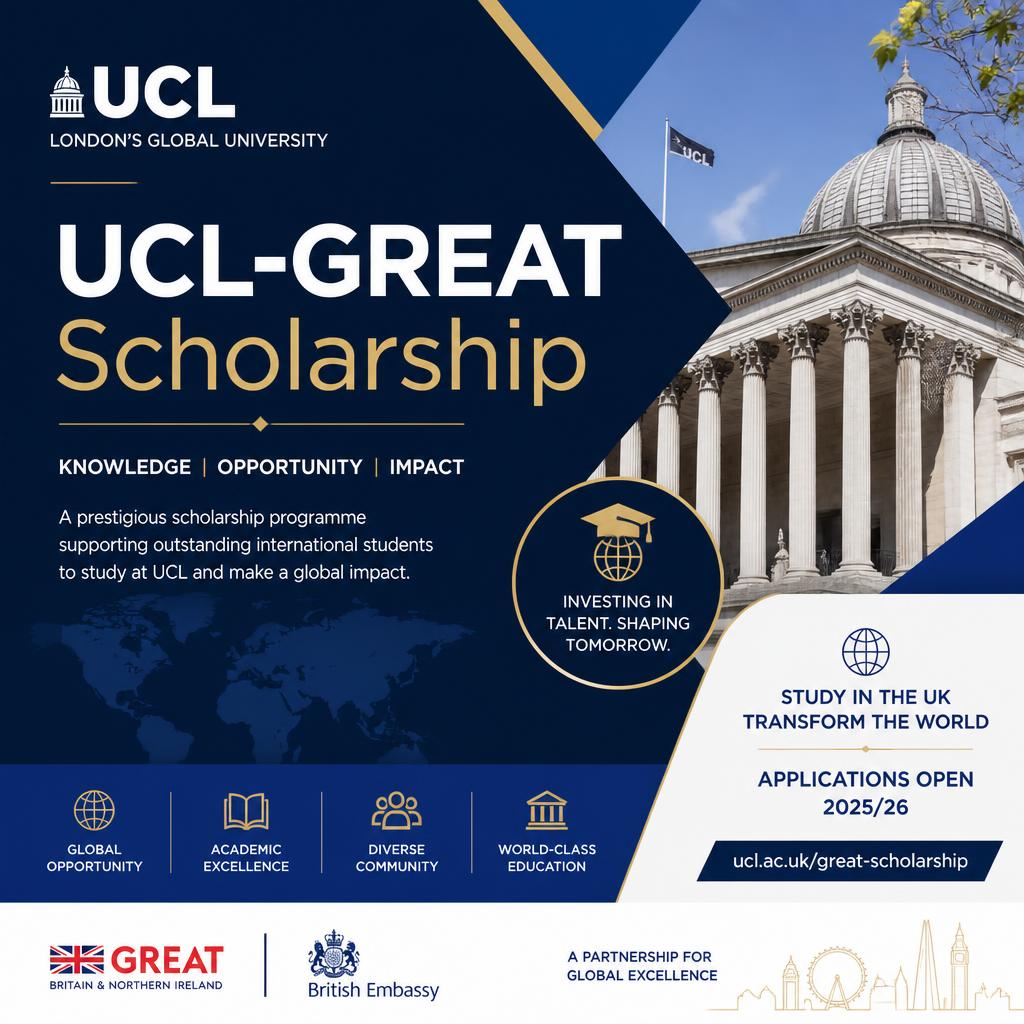
The UCL-GREAT Scholarship is one of the most prominent funding opportunities available to Nigerian students at UCL. Offered in partnership with the British Council and the UK government’s GREAT Britain campaign, this scholarship provides substantial financial support towards tuition fees for one-year taught Master’s programmes.
However, it is important to state clearly from the outset: the UCL-GREAT Scholarship is typically a partial scholarship, not a fully funded scholarship. In previous cycles, it has been valued at a minimum of £10,000 towards tuition fees. While this is a significant contribution, it does not cover the full cost of tuition, living expenses, travel, or visa fees. Nigerian students seeking fully funded scholarships in the UK should also consider alternatives such as the Chevening Scholarship and the Commonwealth Master’s Scholarship, both of which are covered in detail later in this article.
This guide will walk you through everything you need to know about the UCL-GREAT Scholarship 2026, including what has been confirmed, what is anticipated based on previous cycles, how to apply, and which other fully funded scholarships in the UK are open to Nigerian students.
Always verify the latest information on the official UCL scholarships page and the British Council GREAT Scholarships page before submitting any application.
What Is the UCL-GREAT Scholarship?
The GREAT Scholarships programme is a joint initiative between the British Council, the UK government’s GREAT Britain campaign, and participating UK universities. The programme was designed to attract talented international students to study in the United Kingdom by offering financial support towards postgraduate tuition fees.
Each participating university administers its own GREAT Scholarships, meaning the specific terms, values, and eligible countries can vary from one institution to another. UCL has been a consistent participant in the GREAT Scholarships programme for several years, and Nigeria has regularly appeared on the list of eligible countries.
Key Facts About the GREAT Scholarships Programme
- Provider: British Council in partnership with UK universities and the GREAT Britain campaign
- Level: One-year taught Master’s programmes only
- Minimum value: £10,000 towards tuition fees (per the British Council’s programme guidelines)
- Number of scholarships per university: Varies by institution and country; UCL typically offers a limited number per eligible country
- Renewable: No — the scholarship covers one academic year only
- Eligible countries: Vary by university and cycle; Nigeria has been eligible in previous UCL GREAT Scholarship cycles
UCL-GREAT Scholarship 2026: What We Know So Far
Current Status: UPCOMING — 2026 Cycle Details Not Yet Fully Confirmed
As of the time of this article’s publication, the specific details for the 2026 UCL-GREAT Scholarship cycle have not been fully published on UCL’s official scholarship pages. Scholarship cycles at UK universities typically open between January and March of the application year, with deadlines falling between April and June.
Based on the patterns observed in the 2023, 2024, and 2025 cycles, the following information is anticipated but must be confirmed on the official UCL website when the 2026 cycle opens:
| Detail | Anticipated (Based on Previous Cycles) | Confirmed for 2026? |
|---|---|---|
| Scholarship name | UCL-GREAT Scholarship | Pending official announcement |
| Provider | British Council + UCL | Pending |
| Country eligibility | Nigeria has been eligible in previous years | Pending |
| Degree level | One-year taught Master’s | Pending |
| Funding value | Minimum £10,000 towards tuition | Pending |
| Number of awards | Typically 1–2 per eligible country | Pending |
| Application opening | January–March 2026 | Pending |
| Application deadline | April–June 2026 | Pending |
| Application method | Through UCL’s online scholarship portal | Pending |
Important: Do not rely on dates from previous cycles as guaranteed deadlines for 2026. Always check the UCL Scholarships and Funding page for the most current information.
Eligibility for Nigerian Students
Based on previous UCL-GREAT Scholarship cycles, Nigerian applicants have typically needed to meet the following criteria. These requirements should be confirmed when the 2026 cycle is officially announced:
Nationality
- You must be a citizen of Nigeria and hold a valid Nigerian passport.
- In previous cycles, GREAT Scholarships have been country-specific, meaning the UCL-GREAT Scholarship for Nigeria is only open to Nigerian nationals.
Academic Requirements
- You must hold a bachelor’s degree (or equivalent) from a recognised institution.
- UCL typically requires a minimum of an upper second-class honours degree (2:1) or its international equivalent. For Nigerian graduates, this generally corresponds to a minimum of a Second Class Upper (2:1) from a recognised Nigerian university.
- Some competitive programmes at UCL may require a First Class degree.
Offer of Admission
- You must have received an offer of admission (conditional or unconditional) for a qualifying one-year taught Master’s programme at UCL before you can apply for the scholarship.
- The scholarship application is separate from the programme application. You apply for the programme first, receive an offer, and then apply for the scholarship.
English Language Requirements
- You must meet UCL’s English language requirements for your chosen programme. This typically means:
- IELTS: Overall score of 6.5–7.5 depending on the programme (with minimum scores in each component)
- TOEFL iBT: Equivalent scores as specified by UCL
- Other accepted tests may include Pearson PTE, Cambridge English, or Duolingo (depending on the programme)
- Some Nigerian applicants may qualify for an English language waiver if they completed their undergraduate degree in English at a recognised Nigerian university. This is programme-specific and must be confirmed with UCL Admissions.
Field of Study
- In previous cycles, the UCL-GREAT Scholarship has been available for a range of taught Master’s programmes, but not all programmes may be eligible. Some GREAT Scholarships at other UK universities are restricted to specific subject areas. UCL’s version has historically been open across multiple faculties, but you should verify this when the 2026 cycle opens.
Previous Study in the UK
- In some GREAT Scholarship cycles, applicants who have already completed a degree in the UK may face restrictions. Check the specific 2026 terms when published.
What Does the UCL-GREAT Scholarship Actually Cover?
This is where honesty is essential. The UCL-GREAT Scholarship is not a fully funded scholarship. Here is what it typically covers based on previous cycles:
What It Covers:
- Tuition fee reduction of at least £10,000 for one academic year. In some previous cycles at UCL, the value has been higher for specific programmes, but the British Council’s baseline for GREAT Scholarships is £10,000.
What It Does NOT Cover:
- Remaining tuition fees (UCL international Master’s tuition can range from approximately £25,000 to over £40,000 depending on the programme, meaning a £10,000 scholarship still leaves a significant balance)
- Living expenses in London (estimated at £1,300–£1,800 per month by UK Visas and Immigration)
- Accommodation costs
- Travel and airfare between Nigeria and the UK
- UK Student Visa fees (currently £490 for the standard application, plus the Immigration Health Surcharge of £776 per year)
- Health insurance beyond the NHS coverage provided through the Immigration Health Surcharge
- Books, materials, or research costs
Financial Reality for Nigerian Students
If your UCL programme costs £32,000 in tuition and you receive a £10,000 GREAT Scholarship, you will still need to fund approximately £22,000 in tuition plus £15,000–£20,000 in living costs for the year. This is a substantial amount, and it is critical to plan your finances realistically before accepting an offer.
Other Fully Funded Scholarships at UCL and in the UK for Nigerian Students
If you are specifically looking for fully funded scholarships that cover tuition, living expenses, flights, and visa costs, the following opportunities are more comprehensive than the UCL-GREAT Scholarship. All of the scholarships listed below are real, verifiable, and have been open to Nigerian students in recent cycles.
1. Chevening Scholarship (Fully Funded — UK Government)
- Provider: UK Foreign, Commonwealth & Development Office (FCDO)
- Country: United Kingdom (any eligible UK university, including UCL)
- Degree: One-year taught Master’s
- Funding: Fully funded — covers full tuition fees, monthly living stipend, economy class flights to and from the UK, arrival allowance, homeward departure allowance, visa application fee, and travel grant for Chevening events
- Eligibility for Nigerians: Nigerian citizens are eligible. You must have at least two years of work experience, hold an undergraduate degree, and apply to three eligible UK university courses
- Typical deadline: Applications usually open in August and close in early November for the following academic year
- Status for 2026/2027 cycle: The Chevening application cycle typically opens around August each year. Check the official website for the exact 2026/2027 dates
- Official source: chevening.org
Why this matters for Nigerian students: Chevening is the most comprehensive fully funded scholarship available for Nigerian students wanting to study in the UK. It covers virtually all costs, making it the strongest option for applicants who meet the work experience requirement.
2. Commonwealth Master’s Scholarship (Fully Funded)
- Provider: UK Foreign, Commonwealth & Development Office (FCDO), administered by the Commonwealth Scholarship Commission
- Country: United Kingdom (any eligible UK university, including UCL)
- Degree: One-year taught Master’s
- Funding: Fully funded — covers full tuition fees, living stipend (approximately £1,300+ per month), airfare to and from the UK, warm clothing allowance, thesis grant, and study travel grant
- Eligibility for Nigerians: Nigerian citizens are eligible through the nominating body in Nigeria (typically the Federal Scholarship Board). You must hold a first degree of at least upper second class (2:1)
- Typical deadline: Applications usually open around October–November through the nominating body
- Official source: cscuk.fcdo.gov.uk
Why this matters: The Commonwealth Scholarship is fully funded and specifically targets students from Commonwealth countries, including Nigeria. The nomination process adds an extra layer, so begin preparing early.
3. UCL Global Masters Scholarship
- Provider: UCL
- Country: United Kingdom
- Degree: One-year taught Master’s
- Funding: £15,000 towards tuition fees for one year (partial, not fully funded)
- Eligibility: International students from lower-income backgrounds who have received an offer for a qualifying Master’s programme at UCL
- Status: Typically opens in the spring. Check UCL’s official scholarship page for 2026 details
- Official source: ucl.ac.uk/scholarships
4. UCL Alumni Scholarship
- Provider: UCL
- Funding: Varies; typically a partial tuition fee reduction
- Eligibility: Graduates of UCL who are returning for further study
- Official source: ucl.ac.uk/scholarships
Scholarship Comparison Table
| Scholarship | Country | University/Provider | Degree | Funding Level | Eligibility (Nigerians) | Typical Deadline | Status (2026) | Official Source |
|---|---|---|---|---|---|---|---|---|
| UCL-GREAT Scholarship | UK | UCL + British Council | 1-year Master’s | Partial (min. £10,000 tuition) | Nigerian citizens with UCL offer | April–June (anticipated) | UPCOMING — not yet announced | ucl.ac.uk/scholarships |
| Chevening Scholarship | UK | UK Government (FCDO) | 1-year Master’s | Fully funded (tuition + stipend + flights) | Nigerian citizens, 2+ years work experience | November (anticipated) | UPCOMING — typically opens August | chevening.org |
| Commonwealth Master’s | UK | UK Government (CSC) | 1-year Master’s | Fully funded (tuition + stipend + flights) | Nigerian citizens, 2:1 minimum | November (anticipated) | UPCOMING — through nominating body | cscuk.fcdo.gov.uk |
| UCL Global Masters | UK | UCL | 1-year Master’s | Partial (£15,000 tuition) | International students, lower-income | Spring (anticipated) | UPCOMING | ucl.ac.uk/scholarships |
| Gates Cambridge | UK | University of Cambridge | Master’s/PhD | Fully funded | International students | October/January | UPCOMING | gatescambridge.org |
How to Apply for the UCL-GREAT Scholarship 2026
While the 2026-specific application process has not yet been published, the following steps are based on the established process from previous cycles. Confirm each step on the official UCL website when the 2026 cycle opens.
Step 1: Research Your Programme
- Visit the UCL Graduate Prospectus and identify a one-year taught Master’s programme that matches your academic background and career goals.
- Check the tuition fees for international students and the entry requirements for your specific programme.
Step 2: Apply for Admission to UCL
- Submit your application for the Master’s programme through UCL’s online application portal.
- You must receive an offer of admission before you can apply for the GREAT Scholarship. This is a critical step that many applicants overlook.
- UCL postgraduate applications typically open in October/November of the preceding year. Apply as early as possible.
Step 3: Receive Your Offer
- Once UCL reviews your application, you will receive either a conditional or unconditional offer.
- A conditional offer means you still need to meet certain requirements (e.g., final transcripts, English language test scores). You can still apply for the scholarship with a conditional offer.
Step 4: Apply for the UCL-GREAT Scholarship
- When the scholarship application window opens (anticipated spring 2026), log in to UCL’s scholarship portal.
- Complete the scholarship application form, which typically asks for:
- Your UCL student/application number
- A personal statement explaining why you deserve the scholarship
- Details of your financial circumstances
- Your career plans and how the degree will benefit Nigeria
Step 5: Submit Supporting Documents
- Prepare and upload all required documents (see the next section).
Step 6: Wait for the Decision
- Scholarship decisions are typically communicated within 6–10 weeks of the deadline.
- If successful, the scholarship amount will be deducted from your tuition fees.
Step 7: Accept Your Offer and Arrange Funding for the Balance
- If the GREAT Scholarship covers £10,000 of a £32,000 tuition fee, you must demonstrate that you can fund the remaining £22,000 plus living costs to obtain your UK Student Visa.
Documents You Will Need
Based on previous UCL scholarship application cycles, prepare the following documents well in advance:
- Valid Nigerian international passport (with at least 6 months validity beyond your intended study period)
- Academic transcripts from your undergraduate degree (official, stamped copies)
- Degree certificate (or proof of expected graduation if you are in your final year)
- UCL offer letter (conditional or unconditional)
- English language test results (IELTS, TOEFL, or other accepted test — if required by your programme)
- Curriculum Vitae (CV) detailing your academic and professional experience
- Personal statement for the scholarship (typically 500–1,000 words explaining your academic achievements, financial need, and career goals)
- Reference letters (usually 1–2 academic or professional references, depending on the programme)
- Proof of financial circumstances (bank statements, sponsor letters, or other evidence of financial need — if required)
Important Things to Know Before Applying (Reality Check)
This section is designed to protect you from costly mistakes and unrealistic expectations.
1. The UCL-GREAT Scholarship Is Competitive
UCL receives thousands of applications from Nigerian students each year. The GREAT Scholarship typically awards only 1–2 places per eligible country. Do not treat this scholarship as your only funding plan.
2. It Is Not Fully Funded
As explained earlier, the GREAT Scholarship covers a portion of tuition fees. You will need to demonstrate sufficient funds for the remaining tuition and living costs to obtain your UK Student Visa. UK Visas and Immigration (UKVI) requires you to show evidence of funds covering tuition plus at least £1,334 per month for living costs in London (for up to 9 months).
3. Deadlines Are Strict
UK university scholarship deadlines are absolute. Late applications are not accepted under any circumstances. Start preparing your documents at least 3–6 months before the anticipated deadline.
4. You Need an Offer First
Many Nigerian applicants mistakenly apply for the scholarship before applying for the programme. You must have a UCL offer in hand before the scholarship application is considered.
5. Beware of Fake Agents and Scam Websites
- No legitimate scholarship requires you to pay an “application fee” or “processing fee” to an agent.
- The UCL-GREAT Scholarship application is free and submitted through UCL’s official portal.
- Do not trust WhatsApp messages, Telegram groups, or Facebook posts claiming to “guarantee” you a UCL scholarship in exchange for money.
- The only official UCL website is ucl.ac.uk. Any other domain claiming to represent UCL is fraudulent.
6. Living in London Is Expensive
London is one of the most expensive cities in the world. Budget realistically for accommodation (£700–£1,200+ per month for a room), food, transport, and personal expenses. The UK government’s Immigration Health Surcharge alone is £776 per year.
7. Visa Requirements Are Separate
Receiving a scholarship does not guarantee a UK Student Visa. You must independently meet all UKVI requirements, including the Confirmation of Acceptance for Studies (CAS), financial evidence, tuberculosis test (required for Nigerian residents), and English language proficiency.
Common Mistakes Nigerian Applicants Make
- Applying for the scholarship without a UCL offer. The scholarship application is only valid if you hold an offer of admission.
- Missing the programme application deadline. UCL programmes can close early if they receive sufficient applications. Apply early.
- Submitting generic personal statements. Tailor your statement to explain specifically why you chose UCL, how the programme aligns with your career in Nigeria, and why you need the funding.
- Underestimating the total cost. A £10,000 scholarship on a £35,000 programme still leaves £25,000 in tuition plus £15,000+ in living costs.
- Ignoring English language requirements. Even if your undergraduate degree was taught in English, some UCL programmes still require an IELTS or equivalent test score. Check your specific programme’s requirements.
- Relying on a single scholarship. Apply to multiple funding sources simultaneously: Chevening, Commonwealth, UCL internal scholarships, and external Nigerian funding bodies like the PTDF Scholarship or the Federal Government Scholarship.
Opportunities for Nigerian Students: Broader UK Options
Fully Funded Scholarships in the UK Open to Nigerians
| Scholarship | Funding | Deadline (Typical) | Official Source |
|---|---|---|---|
| Chevening Scholarship | Fully funded | November | chevening.org |
| Commonwealth Master’s | Fully funded | November | cscuk.fcdo.gov.uk |
| Gates Cambridge | Fully funded | October/January | gatescambridge.org |
| Rhodes Scholarship (Oxford) | Fully funded | October | rhodeshouse.ox.ac.uk |
| Clarendon Fund (Oxford) | Fully funded | January | ox.ac.uk/clarendon |
| Chancellor’s International Scholarship (Sussex) | Tuition + stipend | January | sussex.ac.uk |
Partial Scholarships at UCL for International Students
| Scholarship | Value | Notes |
|---|---|---|
| UCL-GREAT Scholarship | Min. £10,000 | Country-specific; Nigeria eligible in previous cycles |
| UCL Global Masters | £15,000 | For lower-income international students |
| UCL Faculty-Specific Scholarships | Varies | Many UCL departments offer their own awards |
| UCL Alumni Scholarship | Varies | For returning UCL graduates |
Scam Protection: Protecting Yourself as a Nigerian Applicant
Scholarship fraud targeting Nigerian students is a serious and growing problem. Here is how to protect yourself:
Red Flags of a Scholarship Scam
- Requests for payment: No legitimate scholarship asks you to pay a fee to “process” or “secure” your award.
- Unofficial email addresses: Official UCL communications come from @ucl.ac.uk addresses. Be suspicious of Gmail, Yahoo, or Hotmail addresses.
- Guaranteed selection: No one can guarantee you a scholarship. Selection is competitive and based on merit.
- Pressure to act immediately: Scammers create false urgency. Legitimate scholarships have published deadlines.
- WhatsApp or Telegram recruitment: UCL does not recruit scholarship applicants through social media messaging apps.
- Requests for cryptocurrency or gift cards: This is always a scam.
What to Do If You Suspect Fraud
- Do not send money or personal documents.
- Verify the opportunity on the official UCL website (ucl.ac.uk).
- Report the scam to the British Council in Nigeria and the Nigerian Economic and Financial Crimes Commission (EFCC).
- Contact UCL’s admissions office directly to confirm whether the scholarship is legitimate.
Frequently Asked Questions (FAQ)
1. Is the UCL-GREAT Scholarship fully funded?
No. The UCL-GREAT Scholarship is a partial scholarship that typically provides a minimum of £10,000 towards tuition fees. It does not cover the full cost of tuition, living expenses, travel, or visa fees. For fully funded options, consider the Chevening Scholarship or the Commonwealth Master’s Scholarship.
2. Can Nigerian students apply for the UCL-GREAT Scholarship?
Yes. Nigeria has been an eligible country for the UCL-GREAT Scholarship in previous cycles. However, eligibility for the 2026 cycle must be confirmed when the official announcement is made on UCL’s scholarship page.
3. When is the deadline for the UCL-GREAT Scholarship 2026?
The specific 2026 deadline has not yet been officially announced. Based on previous cycles, the deadline typically falls between April and June. Monitor the UCL Scholarships page for the confirmed date.
4. Do I need an IELTS score to apply?
This depends on your chosen programme. Many UCL Master’s programmes require IELTS (typically 6.5–7.5 overall). Some programmes may waive the English language requirement if you completed your undergraduate degree in English at a recognised Nigerian university. Check your specific programme’s requirements on the UCL website.
5. Can I apply for the UCL-GREAT Scholarship before receiving a UCL offer?
No. You must hold an offer of admission (conditional or unconditional) for a qualifying one-year taught Master’s programme at UCL before you can apply for the GREAT Scholarship.
6. How many UCL-GREAT Scholarships are available for Nigerian students?
In previous cycles, UCL has typically offered 1–2 GREAT Scholarships per eligible country. This is a highly competitive award.
7. Can I combine the UCL-GREAT Scholarship with other funding?
This depends on the terms of each funding source. Some scholarships and sponsors allow stacking, while others do not. Check the specific terms of the GREAT Scholarship and any other awards you receive. Contact UCL’s Student Funding Office for guidance.
8. What is the difference between the UCL-GREAT Scholarship and the Chevening Scholarship?
The UCL-GREAT Scholarship is a partial tuition fee award (minimum £10,000) specific to UCL. The Chevening Scholarship is a fully funded UK government scholarship that covers full tuition, living stipend, flights, and visa costs at any eligible UK university. Chevening also requires a minimum of two years of work experience.
9. Is there an application fee for the UCL-GREAT Scholarship?
No. The UCL-GREAT Scholarship application is free. However, UCL may charge a programme application fee for certain postgraduate courses (typically £50–£100). This is separate from the scholarship.
10. Can I apply for the UCL-GREAT Scholarship for a PhD or research Master’s?
No. The GREAT Scholarships programme is exclusively for one-year taught Master’s programmes. Research degrees (MRes, MPhil, PhD) are not eligible.
Best Options at a Glance
| Best For | Scholarship | Why |
|---|---|---|
| Full funding (tuition + living + flights) | Chevening Scholarship | Covers all major costs; open to Nigerians with 2+ years work experience |
| Full funding via Commonwealth | Commonwealth Master’s Scholarship | Fully funded; specifically for Commonwealth nationals including Nigerians |
| Partial funding at UCL specifically | UCL-GREAT Scholarship | £10,000+ tuition reduction; straightforward application if you have a UCL offer |
| UCL students from lower-income backgrounds | UCL Global Masters Scholarship | £15,000 tuition reduction; broader eligibility than GREAT |
| Research degrees (PhD) | Gates Cambridge / Clarendon / UCL Research Excellence | Fully funded options for doctoral study (GREAT does not cover PhD) |
Conclusion
The UCL-GREAT Scholarship 2026 represents a valuable funding opportunity for Nigerian students who have secured admission to a one-year taught Master’s programme at University College London. While it is not a fully funded scholarship — typically covering a minimum of £10,000 towards tuition fees — it can significantly reduce the financial burden of studying at one of the world’s top universities.
For Nigerian students seeking comprehensive funding that covers tuition, living expenses, and travel, the Chevening Scholarship and the Commonwealth Master’s Scholarship remain the strongest fully funded options in the UK. We strongly recommend applying to multiple scholarships simultaneously to maximise your chances.
Your next steps should be:
- Confirm the 2026 UCL-GREAT Scholarship details on the official UCL Scholarships page.
- Apply for your chosen UCL Master’s programme as early as possible.
- Prepare your English language test scores, transcripts, and personal statement.
- Apply for Chevening and Commonwealth Scholarships in parallel.
- Budget realistically for the full cost of studying in London.
Never pay an agent for scholarship “guarantees.” Always apply through official channels. Your time, money, and academic future are too important to risk on fraudulent schemes.
Keep checking ScholarCareer.com for verified scholarship, study abroad, job, and career opportunities updated regularly for Nigerian and African students.
11. SCHOLARSHIP COMPARISON TABLE
(Included above in the article body under “Scholarship Comparison Table”)
12. COUNTRY-BY-COUNTRY OPPORTUNITIES
This article focuses on the United Kingdom as the destination country. The UK is the sole relevant country for the UCL-GREAT Scholarship.
United Kingdom
- Major scholarships for Nigerians: Chevening, Commonwealth Master’s, UCL-GREAT, UCL Global Masters, Gates Cambridge, Rhodes, Clarendon
- Key universities: UCL, University of Oxford, University of Cambridge, Imperial College London, University of Edinburgh, King’s College London, University of Manchester
- International tuition range: £20,000–£45,000+ per year for Master’s programmes
- Living costs (London): £1,300–£1,800 per month
- Living costs (outside London): £1,000–£1,400 per month
- Student visa: UK Student Visa (formerly Tier 4); requires CAS, financial evidence, TB test for Nigerian residents
- Post-study work: Graduate Route visa allows 2 years of post-study work (3 years for PhD graduates)
- English requirements: IELTS 6.0–7.5 depending on programme and university
- Official resources: gov.uk/student-visa, ucl.ac.uk, chevening.org
13. APPLICATION GUIDE
(Detailed step-by-step guide included in the article body under “How to Apply for the UCL-GREAT Scholarship 2026”)
14. IMPORTANT WARNINGS
(Comprehensive reality check and scam protection sections included in the article body under “Important Things to Know Before Applying” and “Scam Protection”)
15. FAQ
(10 FAQs included in the article body under “Frequently Asked Questions”)
16. INTERNAL LINKING RECOMMENDATIONS
The following ScholarCareer.com pages should be linked naturally within the article:
/scholarships/fully-funded/— Link when discussing fully funded scholarship alternatives/scholarships/countries/uk/— Link when discussing UK scholarship opportunities broadly/study-abroad/uk/— Link when discussing studying in the UK, living costs, and visa requirements/scholarships/— Link in the introduction and conclusion as a general resource/scholarships/application-tips/— Link in the “Common Mistakes” and “How to Apply” sections/career/cv-resume/— Link when discussing CV preparation for scholarship applications/resources/scholarships/— Link in the conclusion as a resource hub/scholarships/degrees/masters/— Link when discussing Master’s-level funding
17. OFFICIAL SOURCES
All factual claims in this article are traceable to the following official sources:
- UCL Scholarships and Funding: https://www.ucl.ac.uk/scholarships/
- British Council GREAT Scholarships: https://www.britishcouncil.org/study-uk/scholarships/great-scholarships
- Chevening Scholarships: https://www.chevening.org/
- Commonwealth Scholarship Commission: https://cscuk.fcdo.gov.uk/
- UK Government Student Visa: https://www.gov.uk/student-visa
- UCL Graduate Admissions: https://www.ucl.ac.uk/prospective-students/graduate
- Gates Cambridge: https://www.gatescambridge.org/
18. FINAL FACT-CHECK NOTES
| Claim | Verified? | Source |
|---|---|---|
| UCL-GREAT Scholarship exists | ✅ Yes | UCL + British Council official pages |
| Nigeria has been an eligible country | ✅ Yes (previous cycles) | British Council GREAT Scholarships page |
| Minimum funding of £10,000 | ✅ Yes (per British Council guidelines) | britishcouncil.org |
| Scholarship is for one-year taught Master’s only | ✅ Yes | British Council + UCL |
| 2026 specific deadline confirmed | ❌ Not yet | UCL scholarships page — cycle not yet published |
| 2026 specific funding amount confirmed | ❌ Not yet | UCL scholarships page — cycle not yet published |
| Chevening is fully funded | ✅ Yes | chevening.org |
| Commonwealth Master’s is fully funded | ✅ Yes | cscuk.fcdo.gov.uk |
| UK Student Visa requires TB test for Nigerians | ✅ Yes | gov.uk |
| Graduate Route allows 2 years post-study work | ✅ Yes | gov.uk |
| UCL-GREAT Scholarship is fully funded | ❌ No — it is partial | UCL + British Council |
Last Verified: July 2025
Scholarship deadlines, eligibility requirements, funding amounts, and visa rules can change at any time. Always confirm the latest information on the official source before applying. ScholarCareer.com does not guarantee selection, admission, funding, or visa approval. This article is for informational purposes only.
