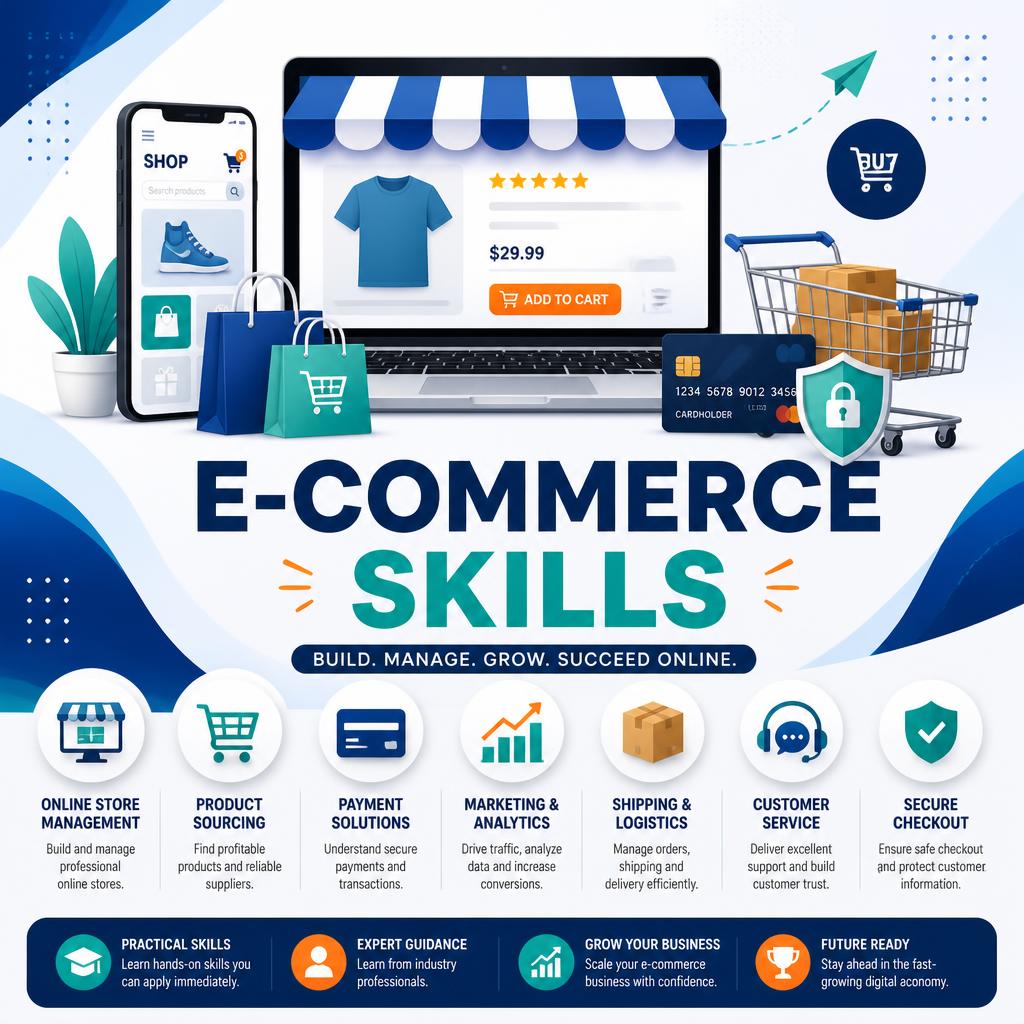
E-Commerce Skills in 2026: How to Start an Online Store and Build Sustainable Income
The barrier to starting an online store has never been lower. Platforms like Shopify, WooCommerce, and Etsy let almost anyone list products within a weekend. But here is the part most “start your store in 24 hours” articles skip: launching is easy, and sustaining income is hard.
This article is not about get-rich-quick schemes. It is a practical breakdown of the e-commerce skills that genuinely matter in 2026, the real costs involved, the store models that work for different budgets, and a step-by-step process for going from idea to first sale — and then from first sale to repeatable revenue.
Everything referenced here involves real platforms, real tools, and publicly available pricing. No income guarantees. No fake success stories. Just the information you need to make an informed decision about whether e-commerce is the right path for you, and how to start if it is.
Table of Contents
ToggleWhat You Need to Know About E-Commerce in 2026
E-commerce continues to grow globally, but the landscape has shifted significantly over the past few years. Several developments shape what it takes to succeed now:
Increased competition. More people than ever have online stores. Standing out requires more than listing a product and running a Facebook ad.
Rising customer expectations. Shoppers expect fast shipping, easy returns, mobile-optimized experiences, and responsive customer service. A clunky store with blurry photos will lose sales to competitors who invest in presentation.
AI integration. Artificial intelligence tools now assist with product descriptions, customer service chatbots, ad creative generation, email personalization, and inventory forecasting. Understanding how to use these tools — not just knowing they exist — is becoming a baseline skill.
Privacy and data changes. Tracking restrictions (such as Apple’s App Tracking Transparency and evolving cookie policies) have made traditional paid advertising less predictable. E-commerce operators need diversified traffic strategies.
Platform diversification. Selling on a single channel is risky. Successful sellers in 2026 typically combine their own website with marketplace presence (Amazon, Etsy, TikTok Shop, etc.) and social commerce.
The core takeaway: the technical skills to build a store are simpler than ever, but the marketing, analytical, and operational skills to make that store profitable are more important than ever.
The Most In-Demand E-Commerce Skills for 2026
Below are the skill categories that separate stores that survive from stores that shut down within six months.
1. Product Research and Validation
Before you build anything, you need to know whether people will actually buy what you plan to sell. Product research involves:
- Identifying niches with genuine demand (not just trends that peaked last year)
- Analyzing competitor pricing, reviews, and positioning
- Using tools like Google Trends, Amazon Best Sellers, Etsy search data, and keyword research tools to validate interest
- Understanding profit margins after accounting for product cost, shipping, platform fees, and advertising
Real tools for product research: Google Trends (free), Jungle Scout (paid, for Amazon data), Helium 10 (paid, for Amazon data), eRank (freemium, for Etsy data), and simple manual research on Amazon, Etsy, and TikTok.
2. E-Commerce SEO (Search Engine Optimization)
If your store only depends on paid ads, your profit margins will shrink every time ad costs rise. SEO brings organic (free) traffic over time. Key e-commerce SEO skills include:
- Keyword research for product pages and blog content
- Writing optimized product titles, descriptions, and meta tags
- Structuring your site with clear categories and internal linking
- Optimizing page speed and mobile experience
- Building backlinks through content, partnerships, and PR
Real tools: Google Search Console (free), Ahrefs (paid), SEMrush (paid), Ubersuggest (freemium), and Yoast SEO (free plugin for WooCommerce).
3. Paid Advertising and Media Buying
Paid ads remain one of the fastest ways to generate traffic, but they require skill to run profitably. Core competencies include:
- Setting up and managing campaigns on Meta Ads (Facebook/Instagram), Google Ads, and TikTok Ads
- Understanding audience targeting, retargeting, and lookalike audiences
- Reading ad metrics: cost per click (CPC), cost per acquisition (CPA), return on ad spend (ROAS)
- A/B testing ad creatives, copy, and landing pages
- Managing budgets to avoid burning money on underperforming campaigns
Important warning: Paid advertising can drain your budget quickly if you do not understand the fundamentals. Many beginners lose significant money in their first months. Start with small daily budgets and scale only when you see consistent returns.
4. Email Marketing and Customer Retention
Acquiring a new customer costs significantly more than retaining an existing one. Email marketing remains one of the highest-ROI channels in e-commerce. Skills include:
- Building an email list through pop-ups, lead magnets, and checkout opt-ins
- Setting up automated flows: welcome series, abandoned cart reminders, post-purchase follow-ups, win-back campaigns
- Segmenting your list based on purchase behavior
- Writing subject lines and email copy that drive opens and clicks
Real tools: Klaviyo (widely used for e-commerce, free tier available), Mailchimp (free tier available), Omnisend (e-commerce focused, free tier available), and ActiveCampaign (paid).
5. Conversion Rate Optimization (CRO)
Getting traffic to your store is only half the battle. CRO is the skill of turning visitors into buyers. It involves:
- Designing clear, trustworthy product pages with high-quality images and detailed descriptions
- Simplifying the checkout process to reduce cart abandonment
- Using social proof (reviews, testimonials, user-generated content)
- Testing different page layouts, button colors, pricing displays, and trust badges
- Ensuring your site loads quickly on mobile devices
6. Data Analytics and Financial Literacy
You cannot improve what you do not measure. Essential analytics skills include:
- Reading Google Analytics 4 (GA4) reports to understand traffic sources, user behavior, and conversion paths
- Tracking key metrics: conversion rate, average order value (AOV), customer lifetime value (CLV), and gross margin
- Understanding your true profit after all expenses (product, shipping, fees, ads, returns, software subscriptions)
- Making decisions based on data rather than gut feeling
Real tools: Google Analytics 4 (free), Shopify Analytics (built-in), Triple Whale (paid, for advanced attribution), and basic spreadsheet skills in Google Sheets or Excel.
7. AI-Assisted E-Commerce Operations
In 2026, AI tools are not optional extras — they are part of the standard workflow. Practical AI skills include:
- Using AI to draft product descriptions, blog posts, and ad copy (then editing for accuracy and brand voice)
- Implementing AI chatbots for basic customer service inquiries
- Using AI-powered tools for demand forecasting and inventory management
- Leveraging AI for image editing, background removal, and lifestyle photo generation
Real tools: ChatGPT or Claude for copywriting, Shopify’s built-in AI features, Canva’s AI tools for design, and Tidio or Gorgias for AI-assisted customer support.
8. Supply Chain and Fulfillment Basics
Even if you use a third-party fulfillment service, you need to understand:
- How to source products reliably (domestic suppliers, international manufacturers, print-on-demand services)
- Shipping cost structures and how they affect your pricing
- Inventory management basics to avoid stockouts or overstocking
- Return and refund processes
Online Store Models: Which One Fits Your Situation?
Not all e-commerce businesses look the same. The right model depends on your budget, skills, time, and risk tolerance.
Dropshipping
How it works: You list products on your store. When a customer orders, a third-party supplier ships the product directly to the customer. You never hold inventory.
Pros: Low startup cost. No inventory risk. Easy to test products.
Cons: Thin profit margins. Limited control over shipping times and product quality. High competition. Customer service challenges when suppliers make mistakes.
Real platforms and tools: Shopify + DSers (for AliExpress sourcing), Spocket (for US/EU suppliers), Zendrop, and CJ Dropshipping.
Realistic startup cost: Approximately $50–$200/month (Shopify subscription, domain, basic apps). Advertising budget is additional and often the largest expense.
Print on Demand (POD)
How it works: You create designs that are printed on products (t-shirts, mugs, phone cases, posters, etc.) only when a customer orders. A POD provider handles printing and shipping.
Pros: No inventory. Unique products if your designs are original. Good for creatives and niche brands.
Cons: Higher per-unit costs than bulk manufacturing. Limited product customization. Margins can be tight.
Real platforms and tools: Printful, Printify, Gooten, and Gelato. These integrate with Shopify, Etsy, WooCommerce, and other platforms.
Realistic startup cost: Approximately $30–$150/month (platform subscription, domain, design tools like Canva Pro).
Handmade and Craft Products
How it works: You make products yourself and sell them online.
Pros: High margins on unique items. Strong brand storytelling. Loyal customer base potential.
Cons: Difficult to scale. Time-intensive. Shipping and packaging are your responsibility.
Real platforms: Etsy (most popular for handmade), Shopify, Amazon Handmade, and local marketplaces.
Private Label and Wholesale
How it works: You source products in bulk from manufacturers (often through Alibaba or domestic suppliers), brand them with your own label, and sell them at a markup.
Pros: Higher profit margins. Full control over branding and quality. Easier to build a defensible brand.
Cons: Higher upfront investment (inventory, branding, packaging). Risk of unsold stock. More complex logistics.
Realistic startup cost: $1,000–$10,000+ depending on product type, minimum order quantities, and branding.
Digital Products
How it works: You sell downloadable or accessible digital goods — e-books, courses, templates, presets, software, printables, etc.
Pros: Extremely high margins. No shipping. No inventory. Scales without additional production cost.
Cons: Requires expertise or content creation skills. Piracy risk. Harder to build perceived value compared to physical products.
Real platforms: Gumroad, Shopify (with digital download apps), Teachable or Thinkific (for courses), and Etsy (for digital downloads).
Subscription Boxes
How it works: Customers pay a recurring fee to receive a curated box of products on a regular schedule.
Pros: Predictable recurring revenue. High customer lifetime value.
Cons: Complex logistics. High churn rates if the product does not consistently delight. Significant upfront curation and sourcing work.
Platform Comparison: Where Should You Build Your Store?
| Platform | Best For | Monthly Cost (Approx.) | Transaction Fees | Ease of Use | Customization |
|---|---|---|---|---|---|
| Shopify | All-in-one solution, beginners to advanced | From ~$39/month (Basic) | 2.9% + 30¢ (Shopify Payments); additional fees for third-party gateways | High | Moderate |
| WooCommerce | WordPress users who want full control | Free plugin; hosting ~$5–$30/month | Depends on payment gateway | Moderate (requires more technical setup) | Very High |
| Etsy | Handmade, vintage, craft supplies, digital downloads | Free to join; $0.20/listing + 6.5% transaction fee | Built into fee structure | Very High | Low (marketplace, not your own site) |
| Amazon FBA | High-volume sellers, existing product demand | Individual: $0.99/item; Professional: ~$39.99/month + referral fees | Varies by category (typically 8–15%) | Moderate | Low (marketplace) |
| BigCommerce | Growing brands, multi-channel sellers | From ~$39/month | No additional transaction fees | Moderate | High |
| Squarespace | Design-focused brands, small catalogs | From ~$27/month (Business) | 3% on Business plan; 0% on Commerce plans | High | Moderate |
Note: Pricing listed above reflects publicly available information as of early 2025 and is subject to change. Always verify current pricing on the official platform website before subscribing.
Step-by-Step: How to Start Your Online Store
Step 1 — Choose Your Store Model and Niche
Decide which model fits your budget and skills (see the models section above). Then narrow your niche. “Selling clothes” is too broad. “Selling sustainably made linen clothing for women over 40” is a niche. Specificity helps you target marketing and stand out.
Step 2 — Validate Your Product Idea
Before spending money on inventory or branding:
- Search for your product on Amazon, Etsy, and Google Shopping. Are people selling it? Are there reviews? That indicates demand.
- Check Google Trends for search interest over time.
- Look at social media (TikTok, Instagram, Pinterest) for organic interest.
- If possible, test with a small batch or a pre-order campaign before committing to large inventory.
Step 3 — Register Your Business and Handle Legal Basics
Requirements vary by country, but common steps include:
- Choosing a business name and checking trademark availability
- Registering your business (sole proprietorship, LLC, or equivalent in your country)
- Obtaining any necessary tax identification numbers
- Understanding sales tax/VAT obligations for online sellers
- Setting up a separate business bank account
Important: Consult a local accountant or business advisor for tax and legal requirements specific to your location. This article provides general guidance, not legal advice.
Step 4 — Choose Your Platform and Set Up Your Store
Based on the comparison above, select a platform. Then:
- Purchase a domain name (typically $10–$20/year through providers like Namecheap, Google Domains, or directly through your platform)
- Choose a clean, mobile-responsive theme
- Set up your store’s navigation, pages (About, Contact, Shipping Policy, Return Policy, Privacy Policy), and payment gateways
- Configure shipping zones and rates
Step 5 — Source or Create Your Products
Depending on your model:
- Dropshipping: Connect with suppliers through DSers, Spocket, or similar tools. Order samples before listing to verify quality.
- Print on Demand: Create designs using Canva, Adobe Illustrator, or hire a designer on Fiverr or Upwork. Connect your POD provider to your store.
- Private Label: Source from manufacturers via Alibaba, ThomasNet (for US suppliers), or attend trade shows. Always order samples first.
- Handmade: Establish your production workflow and calculate your time cost honestly.
- Digital Products: Create your files, test them thoroughly, and set up automated delivery.
Step 6 — Create High-Quality Product Listings
This is where many beginners fail. Your product page is your salesperson. Invest in:
- Professional product photography (or high-quality mockups for POD/digital products)
- Detailed, benefit-focused product descriptions (not just specifications)
- Clear sizing charts, material information, and usage instructions where relevant
- Customer reviews as soon as you start getting them
Step 7 — Set Up Your Marketing Foundations
Before driving traffic, ensure you have:
- Google Analytics 4 installed on your store
- A Facebook/Meta Pixel and TikTok Pixel (if you plan to advertise on those platforms)
- An email capture mechanism (pop-up, banner, or checkout opt-in)
- At least one automated email flow (welcome series or abandoned cart)
- Social media accounts on the platforms where your target customers spend time
Step 8 — Launch and Drive Initial Traffic
Start with a combination of:
- Organic social media: Post consistently on TikTok, Instagram, Pinterest, or YouTube — wherever your audience is
- SEO content: Write blog posts that answer questions your target customers are searching for
- Paid ads (optional, with caution): Start with small budgets ($5–$20/day) on Meta or Google to test which products and audiences respond
- Friends and family: Your first sales may come from your personal network. That is normal and useful for gathering initial reviews.
Step 9 — Analyze, Optimize, and Iterate
After your first 30–90 days:
- Review which products sell and which do not
- Analyze where your traffic comes from and which channels convert
- Identify where customers drop off in the buying process
- Test changes to your product pages, pricing, and marketing messages
- Double down on what works and cut what does not
Step 10 — Scale Sustainably
Sustainable growth means:
- Increasing your marketing budget only when your unit economics are profitable
- Expanding your product line based on customer demand, not guesswork
- Building an email list and focusing on repeat purchases
- Considering additional sales channels (Amazon, TikTok Shop, wholesale) once your primary channel is stable
- Reinvesting profits into the business rather than treating early revenue as personal income
Realistic Cost Breakdown: What Does It Actually Cost to Start?
| Expense | Estimated Cost | Notes |
|---|---|---|
| Domain name | $10–$20/year | Through Namecheap, Squarespace, etc. |
| E-commerce platform | $0–$39/month | WooCommerce is free (hosting extra); Shopify Basic is ~$39/month |
| Hosting (WooCommerce only) | $5–$30/month | SiteGround, Bluehost, Cloudways, etc. |
| Theme | $0–$180 (one-time) | Free themes available on most platforms |
| Product samples | $20–$200 | Varies widely by product type |
| Initial inventory (if applicable) | $200–$5,000+ | Not needed for dropshipping or POD |
| Design tools | $0–$15/month | Canva Pro is ~$13/month; free tier available |
| Email marketing | $0–$20/month | Free tiers available on Klaviyo, Mailchimp |
| Paid advertising (testing) | $150–$600/month | Start small; scale only with proven returns |
| Apps and plugins | $0–$50/month | Depends on your needs |
| Total estimated first-month cost | ~$100–$1,000+ | Var enormously based on model and choices |
Honest note: The “start for $0” claims you see online usually exclude advertising costs, product samples, and the value of your own time. Budget realistically.
Building Sustainable Income: What Separates Winners from Quitters
Most online stores that fail do so within the first year. The reasons are predictable:
- Unrealistic expectations. E-commerce is not passive income. It requires daily work, especially in the first 12–24 months.
- Undercapitalization. Running out of money for advertising or inventory before finding a winning product.
- Poor product-market fit. Selling what you like rather than what the market wants.
- Neglecting customer experience. Slow shipping, poor communication, and difficult returns destroy repeat business.
- Overdependence on one traffic source. If your entire business relies on Facebook ads and your ad account gets suspended, your revenue drops to zero overnight.
- Giving up too early. Most stores are not profitable in the first 3–6 months. The learning curve is real.
Sustainable income comes from building a brand that customers trust, return to, and recommend. That takes time, consistency, and a willingness to learn from data rather than emotion.
Important Things to Know Before Starting
Competition is intense. Millions of online stores exist. You will not succeed simply by being present. You need a clear value proposition.
There are no guaranteed incomes. Anyone who promises you will make $10,000/month within 90 days is selling a course, not running a store. Results vary enormously based on your niche, execution, budget, and market conditions.
Beware of expensive “guru” courses. Much of the information sold in $500–$2,000 e-commerce courses is available for free on YouTube, blogs, and platform documentation. Invest in education cautiously. Free resources from Shopify Academy, Google Digital Garage, and Meta Blueprint are excellent starting points.
Watch out for scams. Fake supplier websites, counterfeit product schemes, and fraudulent “done-for-you” store services are common. Always verify suppliers, read independent reviews, and never wire money to unverified contacts.
Tax obligations are real. Selling online creates tax responsibilities in most countries. Ignoring them can lead to penalties. Consult a tax professional.
Shipping and returns eat into margins. Factor in the cost of free shipping (if you offer it), return processing, and damaged goods when calculating your profit.
Common E-Commerce Mistakes to Avoid
- Launching without validating demand
- Competing solely on price (a race to the bottom)
- Using low-quality product images
- Ignoring mobile optimization (most e-commerce traffic is mobile)
- Not collecting emails from day one
- Spending heavily on ads before fixing a low-converting website
- Failing to calculate true profit margins (after all fees, shipping, returns, and ad costs)
- Trying to sell to “everyone” instead of a specific audience
- Neglecting customer service
- Copying competitor stores exactly instead of differentiating
E-Commerce Skills Learning Resources (Free and Verified)
| Resource | Provider | Cost | What You Will Learn |
|---|---|---|---|
| Shopify Academy (Shopify Learn) | Shopify | Free | Store setup, marketing, business fundamentals |
| Google Digital Garage | Free | Digital marketing fundamentals, data analytics | |
| Meta Blueprint | Meta | Free | Facebook and Instagram advertising |
| Google Analytics Academy | Free | GA4 setup and reporting | |
| HubSpot Academy | HubSpot | Free | Email marketing, content marketing, CRM |
| SEMrush Academy | SEMrush | Free | SEO, content marketing, keyword research |
| TikTok for Business | TikTok | Free | TikTok advertising and organic strategy |
All of the above are offered directly by the named companies through their official websites. Verify availability and current course offerings on each platform.
Opportunities for African and Nigerian Entrepreneurs
E-commerce is growing rapidly across Africa, and entrepreneurs in Nigeria, Ghana, Kenya, South Africa, and other countries have unique advantages and challenges.
Advantages:
- Growing mobile commerce adoption
- Expanding middle class with increasing purchasing power
- Less saturated niches compared to Western markets
- Opportunities in cross-border trade (selling African-made products to global audiences)
Challenges:
- Payment gateway limitations (though solutions like Paystack, Flutterwave, and M-Pesa are expanding)
- Logistics and delivery infrastructure in some regions
- Currency fluctuation affecting international sourcing
- Higher shipping costs for cross-border orders
Practical tips:
- Consider selling digital products or print-on-demand to avoid local logistics challenges
- Use platforms like Etsy or Shopify to reach global customers
- Explore Paystack or Flutterwave for payment processing
- Research local e-commerce marketplaces (Jumia, Konga, Takealot) alongside international platforms
- Factor in exchange rates when pricing products for international customers
Best Options at a Glance
| Best For | Recommendation | Why |
|---|---|---|
| Absolute beginners | Shopify + Print on Demand | Lowest risk, no inventory, guided setup |
| Tight budget | WooCommerce + Etsy | Minimal monthly costs; Etsy brings built-in traffic |
| Creatives and designers | Etsy + Printful/Printify | Built-in marketplace audience; POD handles fulfillment |
| Serious brand builders | Shopify + Private Label | Full control over branding, higher margins long-term |
| Digital product creators | Gumroad or Shopify + digital downloads | Near-zero fulfillment costs; high margins |
| High-volume sellers | Amazon FBA | Massive built-in audience; fulfillment handled by Amazon |
| African entrepreneurs selling globally | Shopify or Etsy + POD/digital products | Avoids local logistics bottlenecks; reaches international buyers |
Conclusion
Starting an online store in 2026 is genuinely accessible, but building sustainable income from e-commerce requires real skills, realistic expectations, and consistent effort. The platforms and tools available today are powerful, but they are just tools. Your success depends on your ability to research products, understand your customers, market effectively, manage finances, and adapt based on data.
Start small. Validate before you invest heavily. Learn the fundamentals of SEO, email marketing, and paid advertising before scaling. Use free educational resources from Shopify, Google, and Meta before spending money on expensive courses. And most importantly, treat your store like a real business — not a lottery ticket.
The e-commerce skills you build in 2026 will serve you for years, regardless of how the market evolves. The specific platforms may change, the algorithms will shift, and new tools will emerge, but the core competencies of understanding customers, creating value, and marketing effectively are timeless.
Keep checking ScholarCareer.com for verified skills guides, career development resources, and practical income-building strategies.
- COMPARISON TABLE: E-COMMERCE PLATFORMS AND MODELS
| Platform/Model | Type | Monthly Cost (Approx.) | Best For | Inventory Needed | Skill Level | Official Website |
|---|---|---|---|---|---|---|
| Shopify | Platform | ~$39+ | All-in-one store | Depends on model | Beginner–Advanced | shopify.com |
| WooCommerce | Platform | Free + hosting | Full control, WordPress users | Depends on model | Intermediate | woocommerce.com |
| Etsy | Marketplace | $0.20/listing + fees | Handmade, vintage, digital | Yes (or digital) | Beginner | etsy.com |
| Amazon FBA | Marketplace | ~$39.99+ | High-volume, existing demand | Yes | Intermediate–Advanced | sellercentral.amazon.com |
| Printful | POD Provider | Free (pay per order) | Custom printed products | No | Beginner | printful.com |
| Printify | POD Provider | Free (pay per order) | Custom printed products | No | Beginner | printify.com |
| Gumroad | Platform | Free + transaction fee | Digital products | No (digital) | Beginner | gumroad.com |
| DSers | Dropshipping Tool | Free tier available | AliExpress dropshipping | No | Beginner | dsers.com |
| Spocket | Dropshipping Tool | From ~$39.99/month | US/EU dropshipping | No | Beginner | spocket.co |
- REGIONAL CONSIDERATIONS FOR E-COMMERCE
United States
- Largest e-commerce market globally
- Access to all major platforms, payment gateways, and fulfillment services
- Sales tax obligations vary by state (use tools like TaxJar or Shopify’s built-in tax calculator)
- Strong consumer protection laws affect return policies
United Kingdom
- VAT registration required once turnover exceeds the threshold (currently £90,000 as of 2024/25 — verify on gov.uk)
- Strong e-commerce infrastructure and consumer adoption
- Brexit has introduced additional customs considerations for EU trade
Canada
- GST/HST registration required once revenue exceeds $30,000 CAD in a year
- Shipping costs can be high due to geography — factor this into pricing
- Shopify is headquartered in Canada, with strong local support
Nigeria and West Africa
- Paystack and Flutterwave are leading payment processors
- Jumia and Konga are major local marketplaces
- Cross-border selling via Etsy or Shopify is viable for digital products and POD
- Logistics remain a challenge for physical product delivery within the region
Kenya and East Africa
- M-Pesa integration is essential for local sales
- Growing e-commerce adoption, especially mobile commerce
- Opportunities in cross-border digital product sales
South Africa
- Takealot is the dominant local marketplace
- PayFast and Yoco are popular payment solutions
- Relatively developed logistics infrastructure compared to other African markets
European Union
- VAT rules for cross-border e-commerce (One-Stop Shop scheme) apply
- GDPR compliance required for customer data handling
- Strong consumer protection regulations (14-day return right is mandatory)
- APPLICATION/LAUNCH GUIDE
Step 1 — Assess your budget, skills, and available time honestly.
Step 2 — Choose a store model that matches your situation (dropshipping, POD, handmade, private label, digital products).
Step 3 — Research and validate your niche using Google Trends, marketplace data, and social media.
Step 4 — Register your business and set up a business bank account.
Step 5 — Select your e-commerce platform and purchase a domain.
Step 6 — Set up your store: theme, navigation, policies, payment gateways, shipping settings.
Step 7 — Source products or create your digital files. Order samples if selling physical goods.
Step 8 — Create professional product listings with quality images and detailed descriptions.
Step 9 — Install analytics (GA4, Meta Pixel) and set up email capture.
Step 10 — Launch your store and begin driving traffic through organic social media, SEO content, and small-budget paid ads.
Step 11 — Monitor your data weekly. Track conversion rates, traffic sources, and profit margins.
Step 12 — Optimize based on data. Scale what works. Cut what does not. Be patient.
- IMPORTANT WARNINGS
- No income is guaranteed. E-commerce involves real financial risk. You can lose money, especially on advertising and inventory.
- Beware of “done-for-you” store scams. Services that promise to build and run a profitable store for you in exchange for a large upfront fee are frequently fraudulent or deliver underperforming stores.
- Verify suppliers before ordering. Request samples. Check reviews on independent platforms. Never wire money to unverified contacts.
- Do not copy branded products. Selling counterfeit goods is illegal and will result in store shutdowns, legal action, and payment processor bans.
- Tax obligations are real. Register for the appropriate tax IDs and collect/remit sales tax or VAT as required in your jurisdiction.
- ScholarCareer.com does not guarantee business success, income, or results from any platform or strategy mentioned in this article. This content is for informational purposes only.
- FAQ
Q1: How much money do I need to start an online store in 2026?
You can start with as little as $50–$200 if you use dropshipping or print on demand with a Shopify or WooCommerce store. However, a realistic budget including advertising, samples, and tools is closer to $500–$2,000 for the first few months. Private label and wholesale models require significantly more capital.
Q2: Is dropshipping still profitable in 2026?
Dropshipping can be profitable, but margins are thinner than ever due to increased competition and rising ad costs. Success depends on finding underserved niches, providing excellent customer service, and building a brand rather than just listing generic products. It is a viable entry point but not a long-term strategy for most sellers.
Q3: Do I need technical skills to start an online store?
No advanced technical skills are required. Platforms like Shopify and Etsy are designed for beginners. However, you will need to learn basic digital marketing skills (SEO, email marketing, social media) to drive traffic and sales. These skills can be learned through free resources.
Q4: How long does it take to make money from an online store?
Most stores take 3–12 months to become consistently profitable. Some sellers see sales within the first week, but sustainable, reliable income takes longer. Be prepared to invest time and money without immediate returns.
Q5: Can I start an online store from Africa or Nigeria?
Yes. Many African entrepreneurs run successful online stores selling to global customers through platforms like Etsy, Shopify, and Gumroad. Print-on-demand and digital products are particularly practical because they avoid local logistics challenges. Payment processors like Paystack and Flutterwave facilitate international transactions.
Q6: What is the best e-commerce platform for beginners?
Shopify is the most commonly recommended platform for beginners due to its ease of use, extensive app ecosystem, and built-in payment processing. Etsy is also excellent for handmade and digital products because it provides built-in marketplace traffic.
Q7: Do I need to register a business to sell online?
Requirements vary by country. In many jurisdictions, you can start as a sole proprietor, but you will need to register for tax purposes once you reach certain revenue thresholds. Consult a local accountant or business advisor for specific requirements.
Q8: How do I find products to sell online?
Use tools like Google Trends, Amazon Best Sellers, Etsy search suggestions, TikTok trending products, and keyword research tools to identify products with demand. Look for niches where you can offer something differentiated — better quality, unique design, superior customer experience, or a specific audience focus.
Q9: Is it better to sell on my own website or on a marketplace like Amazon or Etsy?
Both approaches have advantages. Marketplaces provide built-in traffic but charge higher fees and limit your brand control. Your own website gives you full control and higher margins but requires you to drive your own traffic. Most successful sellers eventually use both.
Q10: What e-commerce skills should I learn first?
Start with product research, basic SEO, and email marketing. These three skills will help you find viable products, attract organic traffic, and retain customers. Add paid advertising and analytics skills as your store grows.
- OFFICIAL SOURCES
- Shopify: shopify.com (pricing, features, Shopify Learn)
- WooCommerce: woocommerce.com (plugin, documentation)
- Etsy Seller Handbook: etsy.com/seller-handbook
- Amazon Seller Central: sellercentral.amazon.com
- Printful: printful.com (pricing, product catalog)
- Printify: printify.com (pricing, product catalog)
- Klaviyo: klaviyo.com (email marketing platform)
- Google Digital Garage: skillshop.withgoogle.com
- Meta Blueprint: facebook.com/business/learn
- Google Analytics: analytics.google.com
- Paystack: paystack.com (African payment processing)
- Flutterwave: flutterwave.com (African payment processing)
- Gumroad: gumroad.com (digital product sales)
- DSers: dsers.com (dropshipping tool)
- Canva: canva.com (design tool)
- FINAL FACT-CHECK NOTES
✓ All platforms mentioned (Shopify, WooCommerce, Etsy, Amazon, Printful, Printify, Gumroad, DSers, Spocket, Klaviyo, Mailchimp, etc.) are real, operational services.
✓ Pricing figures are approximate and based on publicly available information as of early-to-mid 2025. Platform pricing changes frequently; readers must verify current prices on official websites.
✓ No income claims or guarantees have been made. The article explicitly warns against unrealistic expectations.
✓ No fake statistics have been used. Growth claims are qualitative and based on widely reported industry trends.
✓ Learning resources (Shopify Learn, Google Digital Garage, Meta Blueprint, HubSpot Academy, SEMrush Academy) are all real, free programs offered by the named companies.
✓ Payment processors mentioned for African markets (Paystack, Flutterwave, M-Pesa) are real and operational.
✓ Tax threshold examples (UK VAT at £90,000; Canada GST at $30,000 CAD) are based on publicly available government information but should be verified on official government websites as thresholds can change.
✓ No scholarships, jobs, or visa information was included because the topic is about e-ures, tax regulations, and tool availability can change. Always confirm the latest information on the official source before making financial decisions.
