


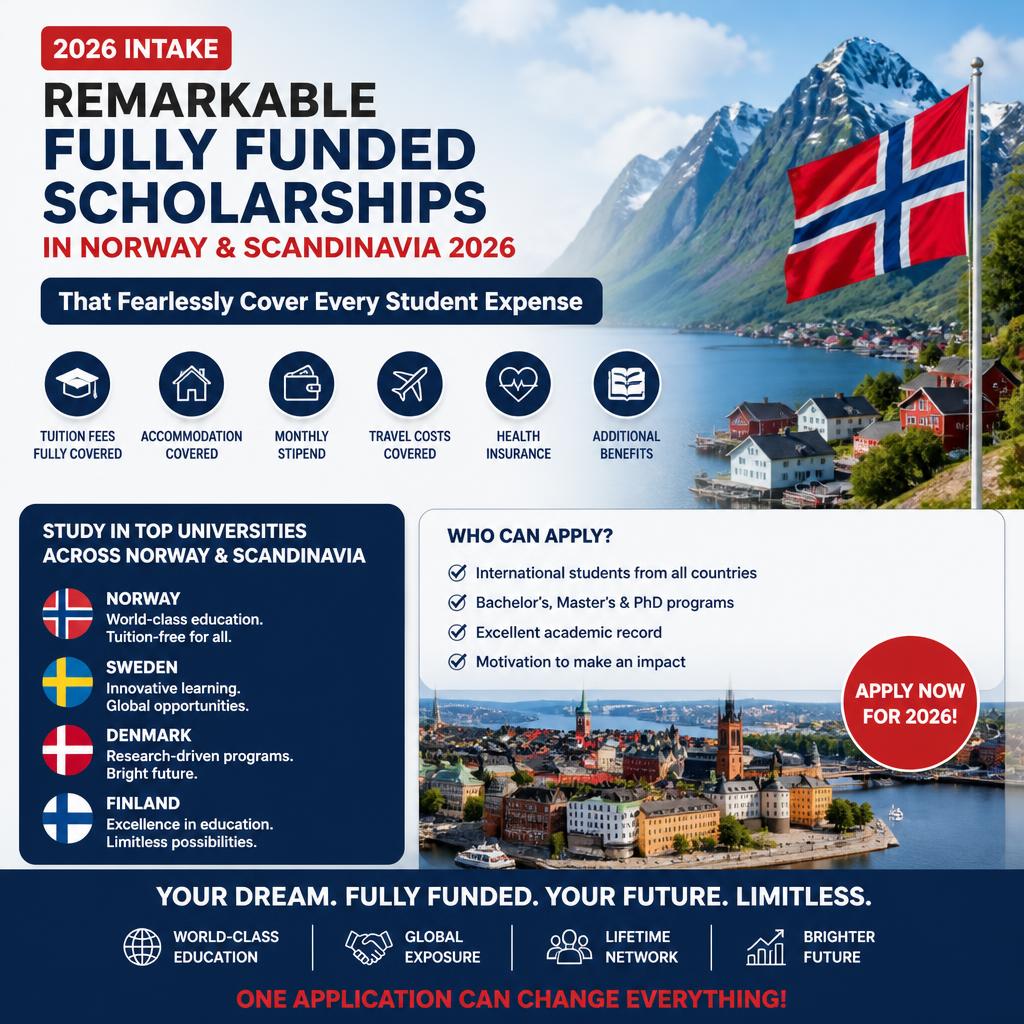
Remarkable Fully Funded Scholarships in Norway and Scandinavia 2026 That Fearlessly Cover Every Student Expense
You Deserve to Know About These Fully Funded Scholarships in Norway — Before the Deadline Passes You By
Picture this for a moment.
You’re sitting somewhere in Lagos, Nairobi, Accra, or Johannesburg, scrolling through your phone at midnight, dreaming of studying abroad. You’ve Googled “scholarships for African students” approximately forty-seven times this month alone. Every result either leads to a half-funded opportunity, a shady-looking website demanding an application fee, or a scholarship that closed in 2019.
You’re brilliant. You’re motivated. You’re ready. But the funding feels like the impossible wall standing between you and the education you deserve.
Here’s what nobody told you: Norway — yes, that breathtakingly cold, impossibly organised Nordic country — has some of the most generous, legitimate, and genuinely accessible fully funded scholarships available to African students in 2026. And Scandinavia as a whole? It’s quietly become one of the most scholarship-rich regions on the planet for international students from the African continent.
This guide exists to change everything about how you approach this opportunity.
By the time you finish reading, you’ll know exactly which scholarships are available, what they cover down to the last krone, how to determine whether you qualify, and precisely how to build an application that stands out in a competitive pool. You’ll walk away with a timeline, a checklist, answers to every question keeping you up at night, and — most importantly — the confidence to actually apply.
📋 Quick Summary Box
- What this guide covers: The top fully funded scholarships in Norway and Scandinavia for 2026, eligibility requirements, application strategies, and insider tips for African students
- Key benefits you’ll gain: A complete understanding of what “fully funded” really means, a curated list of verified scholarships, and a step-by-step action plan you can start today
- How to use this post: Read straight through for the full picture, or jump to any section using the headings — the FAQ and Action Plan sections alone are worth bookmarking
Why Norway and Scandinavia Should Be Your First Choice — Not Your Last Resort
Let’s be honest about something most scholarship guides won’t say out loud.
When African students think about studying abroad, the usual suspects dominate the conversation — the UK, the US, Canada, Australia. Norway and Scandinavia barely enter the picture, and that silence is costing talented African students a fortune in missed opportunities.
Here’s the reality that changes everything: Norway, Sweden, Denmark, and Finland collectively offer hundreds of millions of dollars in scholarship funding annually, much of it explicitly targeted at students from developing nations — including a significant and growing focus on sub-Saharan Africa. The Norwegian government alone allocates billions of Norwegian krone every year to international education partnerships with African institutions.
And because fewer African students apply to Nordic countries compared to English-speaking destinations, your competition is dramatically lower even when the quality of opportunity is dramatically higher.
Norway has a particularly compelling story. Public universities in Norway charge zero tuition fees — not reduced fees, not fees-with-a-scholarship, but literally zero — to all students regardless of nationality. That structural generosity is the foundation on which these scholarships build. When a scholarship says “fully funded” in a Norwegian context, it often means they’re covering living expenses, travel, and materials on top of a baseline that already includes free tuition.
That is a deal unlike almost anything else in international education.
Scandinavia also offers a quality of life, research environment, and international network that rivals or surpasses any Anglo-American destination. If your dream is to study in a place that takes education seriously, values international perspectives, and treats you like an adult capable of contributing to the world — you’re already thinking about the right region.
Understanding “Fully Funded” in the Norwegian and Scandinavian Context
Before you start applying for anything, you need to understand exactly what you’re applying for.
The phrase “fully funded” gets thrown around loosely in scholarship circles, and the gap between what it promises and what it actually delivers can be the difference between thriving abroad and struggling through every semester.
In the Norwegian and Scandinavian context, “fully funded” typically means one of three things, and it’s your job to know which one applies before you commit months of effort to an application.
Level One — Tuition Waiver Only: Some scholarships simply exempt you from fees that may not exist in the first place (remember, Norwegian public universities charge no tuition). These aren’t really “fully funded” in any meaningful sense. Be sceptical of any scholarship that leads with tuition coverage as its primary benefit when Norwegian public institutions already offer free tuition to everyone.
Level Two — Tuition Plus Living Stipend: This is the more common and genuinely valuable category. These scholarships cover your living expenses — typically between 10,000 and 15,000 Norwegian krone per month (approximately USD 900 to USD 1,400) — alongside your academic costs. This is meaningful support that makes studying in Norway financially viable.
Level Three — Comprehensive Coverage: The gold standard. These fully funded scholarships cover round-trip airfare, monthly living stipends, health insurance, book and materials allowances, and sometimes even a settlement grant to help you navigate your first weeks in a new country. When a scholarship reaches this level, it removes virtually every financial barrier to your participation.
Now here’s what even comprehensive fully funded scholarships in Norway often don’t cover: visa application fees (typically USD 100–300 for a Norwegian student visa), personal expenses beyond the stipend, optional travel within Europe, and family relocation costs if you’re bringing dependants. These aren’t dealbreakers, but they’re costs you need to plan for before you arrive.
Reading scholarship descriptions carefully is a skill, and it’s one you need to develop right now. When you see “fully funded,” immediately look for four specific phrases in the award details: “monthly stipend,” “return airfare,” “health insurance included,” and “materials allowance.” If at least three of those four appear, you’re looking at a genuinely comprehensive award.
If the scholarship only mentions “tuition covered” for a Norwegian institution, ask harder questions.
Two scholarships illustrate this spectrum clearly. The Norwegian Quota Scheme (now evolved into newer partnership funding models) historically covered full tuition, living expenses, and travel — a Level Three award. The Erasmus+ programme, available at Scandinavian partner institutions, typically covers tuition and a monthly stipend but handles airfare differently depending on your distance from the host country. Both are legitimate and valuable; they simply cover different things, and knowing the difference helps you plan your finances accurately.
The goal isn’t to find any scholarship — it’s to find the scholarship that actually covers your life, not just your classes.
The 2026 Fully Funded Scholarships in Norway and Scandinavia You Need to Know
This is the section you’ve been waiting for.
Below are the most significant, verified, and actively open or opening scholarships available to African students for the 2026 academic cycle. Each one has been selected based on its funding comprehensiveness, its accessibility to African applicants, and its legitimacy. These are real scholarships with real money behind them — not curated hopes.
1. The Norwegian Government Scholarship Programme (NORPART)
What it is: The Norway Partnership Programme for Global Academic Development (NORPART) is a Norwegian government initiative that funds collaborative academic exchanges between Norwegian institutions and universities in the Global South — with Africa as a primary focus.
What it covers: Full tuition at partner Norwegian universities, monthly living stipend of approximately NOK 12,000–14,000 (USD 1,100–1,300), round-trip airfare, and health insurance coverage.
Who can apply: Students enrolled at or accepted to Norwegian partner institutions, typically at the master’s or PhD level. The programme focuses heavily on students from eligible African partner countries including Ethiopia, Tanzania, Uganda, Mozambique, and South Africa, among others.
Why you’re competitive: NORPART explicitly values students who demonstrate how their Norwegian education will contribute to development challenges back home. If you can articulate a clear connection between your studies and your community’s needs, you are exactly the applicant this programme was designed to fund.
Application opens: Typically October–November for the following academic year. Check your target Norwegian institution’s international office for NORPART-specific deadlines, as they vary by university.
How to find it: Visit the Norwegian Agency for International Cooperation and Quality Enhancement (Diku) official website, which administers NORPART funding.
2. Erasmus+ Scholarships at Scandinavian Universities
What it is: The European Union’s flagship international education programme offers fully funded scholarships to students from partner countries — including many African nations — to study at European universities, with Norway, Sweden, Denmark, and Finland all participating as host institutions.
What it covers: Full tuition waiver, monthly living allowance (typically EUR 700–1,000 depending on host country), and a top-up travel grant calculated by distance from your home country. African students generally qualify for the maximum distance-based travel supplement.
Who can apply: Students from countries with which the EU has active Erasmus+ agreements. Most African nations qualify. Awards are typically for master’s programmes, though some PhD and undergraduate opportunities exist.
Why you’re competitive: Erasmus+ is enormously competitive globally, but the sub-Saharan Africa applicant pool for Nordic destinations specifically is smaller than for Western European destinations. Choosing a Norwegian or Swedish host institution over a UK or German one can meaningfully improve your odds.
Application opens: Varies by institution, but most Erasmus+ International Credit Mobility awards open between November and February for autumn intake.
3. Swedish Institute Scholarships for Global Professionals (SISGP)
What it is: Sweden’s most prestigious government-funded scholarship for international students, offered through the Swedish Institute. It’s designed specifically for professionals who want to develop leadership capacity and return home to create impact — and it has a dedicated Africa strand.
What it covers: Full tuition at Swedish universities, monthly living stipend of SEK 11,000 (approximately USD 1,050), travel grant, and insurance. The programme also includes a rich leadership development curriculum alongside academic study.
Who can apply: Professionals from eligible countries (most African nations qualify) who have at least three years of full-time work experience after their undergraduate degree and are applying for master’s programmes at Swedish universities.
Why you’re competitive as an African applicant: Work experience is not just acceptable here — it’s mandatory. This is a scholarship designed for people with real careers behind them. Your ten years in public health, your six years in civil engineering, your decade in financial services — these are assets, not background noise.
Acceptance rate: Approximately 5–8% globally, but significantly higher within the dedicated Africa cohort.
Application opens: October each year for programmes beginning the following autumn. The 2026 cycle typically opens October 2025.
Official resource: Swedish Institute Scholarships Official Page
4. Denmark Government Scholarships (IHF Programme)
What it is: The Danish government, through partnerships with Danish universities, offers a range of full scholarships to students from developing countries. The International Humanitarian Foundation (IHF) and government-backed university scholarships are among the most accessible for African students.
What it covers: Full tuition at Danish partner universities, monthly living allowance, and in many cases travel support. Danish universities often supplement government scholarship awards with their own institutional funding, making combined packages particularly generous.
Who can apply: Students applying to master’s programmes at participating Danish universities. Specific eligibility varies by institution and programme, but most awards are open to African citizens.
Why it matters: Denmark’s scholarship ecosystem is less publicised internationally than Norway’s or Sweden’s, which means the ratio of available funding to number of applicants tilts attractively in your favour.
5. University of Oslo International Scholarships
What it is: Norway’s oldest and most prestigious university offers its own institutional scholarship programme for outstanding international students, separate from government-level funding.
What it covers: Full tuition (already zero at UiO for all students), monthly living stipend of NOK 10,000–12,000, and support with housing placement.
Who can apply: Students admitted to master’s or PhD programmes at the University of Oslo, with preference given to applicants from developing countries including those across sub-Saharan Africa.
Why it’s worth pursuing: UiO has one of the strongest research environments in Northern Europe, particularly in environmental science, human rights law, education, and public health — fields with enormous relevance to African development contexts. Studying here doesn’t just fund your degree; it builds a network with genuine global reach.
6. University of Bergen Quota-Replacement Scholarships
What it is: Following changes to Norway’s Quota Scheme, the University of Bergen — one of Norway’s leading research universities and a UNESCO creative city — developed its own funding streams for students from the Global South.
What it covers: Comprehensive financial packages including living stipends, academic fees for any remaining costs, and integration support.
Who can apply: Students from developing nations, including across Africa, admitted to master’s or PhD programmes. Strong academic records are essential.
Why Bergen specifically: Bergen’s international student community is disproportionately African compared to other Norwegian cities, meaning you’ll find an existing community, cultural familiarity, and peer networks from day one — which matters enormously for your wellbeing during the first year.
7. Finnish Government Scholarship Pool
What it is: Finland’s scholarship pool, administered through EDUFI (the Finnish National Agency for Education), provides grants to students and researchers from specific partner countries, many of which are in Africa.
What it covers: Monthly living grant of EUR 1,500 for graduate students and EUR 1,800 for postdoctoral researchers, covering the cost of living in most Finnish cities comfortably.
Who can apply: Students and researchers from eligible countries who have been accepted to Finnish universities. You must already have an acceptance letter before applying for the scholarship.
Why Finland deserves attention: Finland’s universities — particularly the University of Helsinki and Aalto University — rank among the world’s best in education, technology, and design. The Finnish scholarship community is among the least tapped by African applicants, which creates a statistically advantageous application environment.
8. Nordic Council of Ministers Scholarships
What it is: The Nordic Council of Ministers, the official intergovernmental body for Nordic cooperation, funds a range of educational programmes connecting Nordic institutions with partners in Africa, Asia, and Latin America.
What it covers: Varies by specific programme, but typically includes tuition, stipend, and travel support for collaborative research and postgraduate study.
Who can apply: Students at postgraduate level from partner institutions with active Nordic collaboration agreements.
Why it matters for your long-term career: Nordic Council scholarships don’t just fund a degree — they embed you in a network of Nordic-African institutional partnerships that can shape your professional trajectory for decades. The relationships you build through this programme are often worth more than the degree itself.
Building Your Scholarship Search: A Systematic Approach for African Students
Finding these scholarships isn’t a matter of luck — it’s a matter of having the right system.
Here’s the step-by-step approach that actually works, rather than the random Googling that most applicants rely on.
Step 1: Build your target list before you do anything else.
Open a spreadsheet right now and create columns for: Scholarship Name, Host Country, Deadline, Award Level, Eligibility Requirements, Application Link, and Status. You’re going to track every scholarship you encounter in this document. This single habit separates organised, successful applicants from those who miss deadlines and double-apply inefficiently.
Step 2: Start with official government portals, not aggregator sites.
Aggregator sites (those that list dozens of scholarships on one page) are helpful for discovery but notoriously unreliable for accuracy. Always verify scholarship information directly at the source. For Norwegian scholarships, that means Diku.no. For Swedish scholarships, si.se. For Danish scholarships, um.dk. For Finnish scholarships, edufi.fi.
Step 3: Use your target institutions’ international offices strategically.
Every Norwegian and Scandinavian university has an international office dedicated to exactly this — helping international students find funding. Email them directly. A polite, specific email asking “What fully funded scholarships are available for African students applying to [specific programme] starting autumn 2026?” will get you information that doesn’t appear on any public website. This is an underused strategy that consistently delivers results.
Step 4: Search for scholarships using Nordic-specific terminology.
When searching, go beyond “scholarships Norway” and try these specific search terms: “development scholarship Norway,” “quota scholarship Scandinavia,” “NORPART eligible countries,” “Nordic scholarship Africa,” “institutional scholarship [university name] international.” Each of these surfaces different opportunities from different search algorithms.
Step 5: Verify every scholarship against three criteria before investing time.
Is the scholarship administered by a named institution or government body? Does it have a clear application portal with specific deadlines? Does it appear on the official website of the awarding institution? If any of these three fail, pause before applying.
Step 6: Set up Google Alerts for real-time updates.
Create Google Alerts for “Norway scholarship Africa 2026,” “Scandinavia fully funded scholarship 2026,” and “Nordic scholarship international students.” These alerts will deliver relevant new opportunities directly to your inbox the moment they’re published, ensuring you never miss an opening application window.
Step 7: Connect with existing Scandinavian-based African student communities.
Find Facebook groups, WhatsApp communities, and LinkedIn networks of African students studying in Norway, Sweden, Denmark, and Finland. These communities share scholarship information in real time — including institutional awards that never appear on public databases — and can provide honest, firsthand accounts of the application process.
The power of a well-maintained database isn’t just organisation — it’s the competitive advantage of knowing what’s available when most applicants are still Googling.
For a broader, vetted database of international scholarship opportunities, the UNESCO scholarship portal maintains one of the most comprehensive and officially verified listings of global funding opportunities across member states, including Scandinavian-partnered programmes.
The African Student Eligibility Checklist for Scandinavian Scholarships
Before you invest weeks into a single application, make sure you actually qualify. This checklist covers the eligibility criteria that matter most for Norwegian and Scandinavian scholarship programmes in 2026.
Academic Credentials:
- ☐ You hold an undergraduate degree (bachelor’s level or equivalent) for master’s programme applications
- ☐ Your undergraduate GPA meets the programme’s minimum (typically 3.0/4.0 or 60% equivalent — check each scholarship’s specific threshold)
- ☐ Your degree was awarded by a recognised institution (most accredited African universities qualify automatically)
Language Requirements:
- ☐ For English-taught programmes (the majority at Norwegian and Scandinavian universities), you have IELTS 6.5+ or TOEFL iBT 90+ — OR you hold a degree from an English-medium institution (many African universities qualify for automatic exemption)
- ☐ For Norwegian-taught programmes, you have documented Norwegian language proficiency (these are rare at postgraduate level; most graduate programmes in Norway are English-taught)
Nationality and Residency:
- ☐ You are a citizen of an eligible developing nation — most sub-Saharan African countries qualify for the majority of Norwegian and Scandinavian funding streams
- ☐ You are not a permanent resident or citizen of the host country (you’re applying as an international student, not a domestic one)
Financial and Work Experience:
- ☐ For merit-based scholarships: no specific work experience required, but demonstrated academic excellence is essential
- ☐ For professional development scholarships (like SISGP): you have at least three years of post-undergraduate work experience
- ☐ For need-based components: you can document financial need through official means
Programme Alignment:
- ☐ Your intended field of study is offered by your target institution
- ☐ The scholarship you’re targeting supports study in your chosen field (some scholarships are restricted to STEM, development studies, or specific sectors)
Are You Eligible? Quick Self-Assessment
Answer these four questions honestly before you begin any application:
- Do you hold, or will you hold before the scholarship start date, an undergraduate degree from a recognised institution? Yes / No
- Is your home country listed as an eligible country for your target scholarship? Yes / No
- Can you demonstrate English language proficiency through an accepted test score, or through your degree institution’s teaching language? Yes / No
- Is your intended programme of study available at a Norwegian or Scandinavian institution that participates in your target funding scheme? Yes / No
If you answered Yes to all four, you meet the foundational eligibility criteria for most major Scandinavian scholarship programmes. If any answer is No, don’t panic — address the specific gap (country eligibility, language test, programme availability) before you invest further energy.
Clarity about your eligibility isn’t a limitation — it’s the foundation of a confident application.
The 5 Scholarship Types African Students Actually Win in Scandinavia
Understanding the landscape of scholarship types helps you diversify your applications intelligently rather than placing all your hopes on a single opportunity.
Type 1: Government-to-Government Development Scholarships
Who funds it and why: Nordic governments fund these as part of their international development commitments — Norway, Sweden, Denmark, and Finland are consistently among the world’s largest donors of development aid as a percentage of GDP.
What makes African applicants competitive: Your nationality is an explicit asset here. These scholarships exist specifically to support students from developing nations — and African students represent some of the most competitive applicants given the depth of development challenges and the strength of academic institutions across the continent.
Typical award amount: NOK 120,000–180,000 per year (USD 11,000–17,000) inclusive of all expenses.
Realistic acceptance rate: 10–20% for eligible applicants (much higher than many applicants assume, particularly within Africa-specific streams).
Real example: The Swedish Institute Scholarships for Global Professionals reports that African applicants make up one of its largest awarded cohorts, with East African nations particularly well-represented in recent award cycles.
Type 2: University Institutional Scholarships
Who funds it and why: Norwegian and Scandinavian universities fund these from their own budgets to attract talented international students who enhance campus diversity and research output.
What makes African applicants competitive: African students tend to bring interdisciplinary perspectives, field-based research experience, and connections to global development challenges that European universities find genuinely valuable — not as a token gesture, but as real intellectual contribution to their research communities.
Typical award amount: Varies enormously — from partial stipend top-ups to comprehensive packages covering all costs.
Realistic acceptance rate: 15–30% among admitted international students who apply.
Real example: The University of Oslo’s institutional scholarships have historically favoured applicants whose research interests align with UiO’s Africa-facing research clusters, particularly in health systems, climate adaptation, and human rights.
Type 3: Research and PhD Funding Schemes
Who funds it and why: Norwegian and Scandinavian research councils (Research Council of Norway, Swedish Research Council, Academy of Finland) fund PhD positions that come with full salary — not just a stipend, but an actual employment contract as a researcher.
What makes African applicants competitive: If you’re pursuing a PhD, you’re not just a student in Norway — you’re an employee. Norwegian PhD candidates receive full employment contracts with salary, pension contributions, parental leave, and union representation. African applicants who reach this level find the competition fierce but the reward genuinely life-changing.
Typical award amount: NOK 500,000+ per year (USD 45,000+), equivalent to a professional salary.
Realistic acceptance rate: PhD positions are advertised individually and competition is based on research fit. Rates vary enormously by field and supervisor.
Real example: Several Nigerian, Kenyan, and South African researchers have obtained Norwegian Research Council-funded PhD positions in environmental science, public health, and energy technology over the past five years.
Type 4: Erasmus+ International Credit Mobility
Who funds it and why: The European Union funds Erasmus+ as its cornerstone international education programme. Nordic universities participate actively and receive EU funding specifically to host students from partner countries.
What makes African applicants competitive: Erasmus+ has formal partnerships with many African universities, meaning if your home institution has an Erasmus+ agreement with a Nordic university, you may be able to access funding that isn’t even publicly advertised — it flows directly through institutional relationships.
Typical award amount: EUR 700–1,200 per month plus travel supplement.
Realistic acceptance rate: Varies by institutional partnership — some corridors are well-used, others are essentially untapped.
Real example: Several Kenyan and Ghanaian universities have active Erasmus+ partnerships with Norwegian and Danish institutions that African students at those universities can access with relatively straightforward applications.
Type 5: NGO and Foundation Scholarships for Scandinavian Study
Who funds it and why: Foundations including the African Capacity Building Foundation, the Mo Ibrahim Foundation, and various Nordic philanthropic organisations fund scholarships targeting African students for study at Nordic institutions.
What makes African applicants competitive: These scholarships often have the most explicit Africa focus and the most holistic evaluation criteria — including leadership potential, community impact, and vision for return.
Typical award amount: USD 15,000–30,000 per year, often with additional leadership development components.
Realistic acceptance rate: 5–15%, but application quality matters enormously — a compelling narrative about your vision for impact can outweigh marginally weaker academics.
Real example: The Mo Ibrahim Foundation Scholarship Programme specifically targets African students pursuing governance and leadership studies, with Nordic institutions increasingly on its approved host institution list.
Winning a Scandinavian scholarship as an African student is not a long shot — it’s a realistic outcome for applicants who prepare systematically and apply strategically.
Crafting Your Application: A Step-by-Step Guide for African Applicants
The application process is where brilliant candidates either shine or stumble. Here’s exactly how to move through it without losing momentum.
Step 1: Identify your target scholarship and read every word of its requirements.
Spend one full hour reading the scholarship description, the FAQ, and any supporting documents before you do anything else. Underline what’s required, what’s preferred, and what’s disqualifying. Understanding the requirements better than most applicants is itself a competitive advantage.
Step 2: Gather your foundational documents — early.
You’ll need at minimum: certified copies of all academic transcripts, your undergraduate degree certificate, a valid passport (check expiry — it must be valid at least six months beyond your intended programme start date), your language test results, and your CV. If you’re applying for professional development scholarships, you’ll also need employer letters, contracts, or certificates confirming your work experience.
Give yourself three to four weeks just for document gathering, because certified copies from African universities can take longer than expected.
Step 3: Request references before you need them — by a lot.
Contact your referees at least six weeks before the application deadline. Give them a brief document explaining the scholarship, why you’re applying, and two or three specific things you’d like them to highlight about your work. The quality of your references can be the deciding factor when your academic record is similar to other shortlisted candidates.
Step 4: Draft your personal statement with your life experience front and centre.
This is where African applicants often undersell themselves catastrophically. You’ll write more about this in the positioning section below, but the core principle is this: your path to this application is your most compelling content. Start with the moment you knew this degree was necessary. Connect it clearly to what you’ve already done and what you intend to do. Make the scholarship committee feel that funding you is an investment in something consequential.
Step 5: Complete the application portal in stages — never in one sitting.
Create your account on the scholarship portal and fill in sections over several sessions, not in one frantic night. Each time you complete a section, save it and return to it the next day with fresh eyes. Errors caught during review are errors that don’t cost you the scholarship.
Step 6: Conduct a pre-submission audit.
Twenty-four hours before your deadline, go through every uploaded document and every typed response once more. Verify that uploaded files are the correct versions. Confirm that your name appears consistently across all documents. Check that every required field is complete. Submission errors are more common than selection committees publicly acknowledge, and they disqualify otherwise excellent candidates.
Step 7: Submit with time to spare — then track your application.
Submit at least 48 hours before the deadline. Note the confirmation number or reference ID. Mark the expected notification date in your calendar. If the scholarship allows status checking, do so once a week — no more.
⚠️ 5 Mistakes That Cost African Applicants Scandinavian Scholarships (Avoid These)
1. Generic motivation letters that could be for any scholarship, anywhere.
“I have always wanted to study abroad” is not a motivation. Connect your specific goals to the specific programme at the specific institution.2. Failing to explain why Norway or Scandinavia specifically.
Scholarship committees in Nordic countries ask why you chose their country and institution. If your answer doesn’t reflect genuine knowledge of what makes their environment unique, it reads as desperation, not ambition.3. Ignoring the “contribution to home country” question.
Most Nordic development scholarships require you to articulate how you’ll use your education to contribute to your home country. This isn’t optional rhetoric — it’s a selection criterion.4. Submitting language test scores that fall below the minimum.
Some applicants apply hoping the committee will overlook a score slightly below the stated minimum. They won’t. Meet the requirement or defer your application cycle.5. Choosing weak referees for the sake of convenience.
Your supervisor from a recent position who knows your work deeply is worth ten times more than a well-titled person who barely knows you. Choose referees who can write with specific, credible detail about your actual abilities.
Positioning Your Story: Why Being an African Applicant Is Your Competitive Advantage
Here’s a truth that most scholarship guides dance around: in a Scandinavian scholarship context, your African identity, your lived experience, and your understanding of development realities are genuine competitive advantages — if you know how to present them.
Nordic scholarship programmes are, at their core, investments in global development. The Swedish Institute, the Norwegian government, Danish foundations, Finnish universities — they’re not funding your degree as charity. They’re funding it because they believe students from your context will take what they learn and build something meaningful with it back home. That belief system is the lens through which every committee member reads your application.
This means your story matters more here than in almost any other scholarship context.
Frameworks for Your Personal Statement
Framework 1: “The Turning Point”
Identify one specific moment — a patient you couldn’t adequately treat, a policy decision you watched fail, a community problem you lacked the technical knowledge to solve — and use it as the opening of your statement. Then explain how this programme gives you the tools to address that specific failure. Committees remember the candidate who opened with a specific hospital ward in Kampala far longer than the one who opened with “I have always been passionate about development.”
Framework 2: “The Gap Between What I Know and What I Need”
This framework is powerful for applicants with significant professional experience. You’ve been working for five, eight, twelve years. You know exactly what you’re missing. Your personal statement names that gap with precision and explains how this specific master’s programme closes it. Specificity is trust. The more precisely you can name what you need to learn and why, the more credible your application becomes.
Framework 3: “The Bridge Builder”
If your career goal involves connecting African contexts with international expertise — whether in policy, research, engineering, health, or business — build your entire statement around the role you’re positioning yourself to play. “I want to be the person in my ministry who understands both the local water table dynamics and the international funding mechanisms that can address them” is the kind of clarity that makes Nordic scholarship committees reach for the approval stamp.
Here’s something that a past winner said that captures this perfectly:
“When I stopped apologising for being from a small town in rural Ethiopia and started explaining what I’d seen there that most researchers had only read about in journals, everything shifted. The committee wasn’t interested in me despite my background — they were interested in me because of it.”
— Tigist W., Swedish Institute Scholar, 2024, MSc Environmental Science, Uppsala University
The temptation to sand down your African experience — to make yourself sound more “internationally standard” — is one you must resist. Authenticity about where you come from and what you’ve seen is exactly what distinguishes you in a pool of excellent candidates from thirty countries.
The 2026 Scandinavian Scholarship Timeline: Key Dates for African Applicants
| Date Range | Milestone |
|---|---|
| August–September 2025 | Research phase: Identify target scholarships, target institutions, and target programmes |
| October–November 2025 | Application windows open for most major Nordic government scholarships (Swedish Institute, NORPART, Danish government awards) |
| November 2025 | Request official transcripts and reference letters from your institution and referees |
| December 2025 | Draft personal statement (first version); take or retake language tests if needed |
| January 2026 | Submit university applications to Norwegian and Scandinavian institutions (most have January–February deadlines) |
| February 2026 | Scholarship application deadlines for most Erasmus+ ICM programmes and several Finnish and Danish awards |
| March 2026 | Follow up with referees; confirm document receipt with scholarship bodies |
| April–May 2026 | Shortlist notifications for most government and institutional scholarships |
| May–June 2026 | Interview rounds (conducted virtually for most Nordic scholarships) |
| June–July 2026 | Final award decisions; visa application process begins immediately upon acceptance |
| August–September 2026 | Programme start dates across Norwegian and Scandinavian universities |
Note: Rolling applications exist for some institutional scholarships and Erasmus+ partnerships — these are particularly advantageous for applicants with professional commitments, as they allow more flexible submission timing. Check each scholarship’s specific format carefully.
Set calendar reminders six weeks before every major deadline. Document collection from African institutions — certified transcripts, attestation letters, official stamps — routinely takes longer than applicants from other regions anticipate. Build that buffer deliberately.
Proactive planning isn’t optional for Scandinavian scholarship success — it’s the prerequisite.
Frequently Asked Questions: Fully Funded Scholarships in Norway and Scandinavia 2026
Can I get a fully funded scholarship in Norway if I’ve never lived outside my home country?
Absolutely. The majority of successful African scholarship applicants to Norwegian and Scandinavian programmes have never lived abroad before. Scholarship committees evaluate your academic record, your professional background, and your stated goals — not your travel history. Living experience outside Africa is neither required nor consistently rewarded over strong candidates who’ve stayed home and built depth of impact there.
What if there’s a gap in my education — does that disqualify me?
No. Educational gaps are common among African applicants and Nordic scholarship bodies understand this. What matters is how you account for the gap. If you worked, cared for family, or pursued non-formal education during that period, say so clearly. Gaps presented transparently — with an explanation of what you learned or built during that time — rarely disqualify applicants.
Can I work part-time while on a fully funded Scandinavian scholarship?
It depends on your scholarship agreement and your visa category. Most Norwegian student visas permit part-time work of up to 20 hours per week. However, some scholarship agreements explicitly prohibit or limit employment during the funded period. Read your award terms carefully. Many scholarship stipends are designed to be liveable without additional income, so this may be less necessary than you expect.
Do I need to be living in my home country at the time of application?
Generally, yes — most Norwegian and Scandinavian development scholarships require you to be resident in your home country at the time of application and to commit to returning home after your programme. This return commitment is a core requirement, not a suggestion. It reflects the development mission of the scholarship and is taken seriously during selection.
How long does it take from application to knowing if I’m enrolled?
For most major Norwegian and Scandinavian scholarships with October–November opening dates, the full timeline from application to final decision runs approximately seven to eight months. You’ll typically receive a shortlisting notification by April, complete interviews in May or June, and receive your final decision by June or July for programmes beginning that September.
Can I reapply if I’m rejected in the first cycle?
Yes — and you should. Most rejected applicants who reapply with a strengthened application succeed within two cycles. Request feedback from the scholarship body if it’s offered. Strengthen the weakest element of your previous application — usually the personal statement or reference quality — and apply again. Persistence is a documented predictor of eventual success in scholarship applications.
Are African applicants at a disadvantage in Nordic scholarship competitions?
The opposite is often true for the right programmes. Development-focused Norwegian and Scandinavian scholarships are explicitly designed to fund students from the Global South, and African applicants bring exactly the lived context these programmes value. The disadvantage isn’t your identity — it’s applying without sufficient preparation. The applicants who lose are those who treat Nordic scholarships as backup options and apply with less effort than they’d invest in a UK or US application.
Wherever you are in your journey right now, the information you’ve just read is enough to take your first real step — so take it.
Your Action Plan: What You Do Next
You’ve just spent time with one of the most comprehensive guides to fully funded scholarships in Norway and Scandinavia written specifically for African students.
And here’s what that means now: the gap between where you are and where you want to be is smaller than it was an hour ago. You know which scholarships exist, what they cover, how to qualify, and how to apply strategically. The information isn’t the barrier anymore.
What remains is action.
Three things you do in the next 72 hours:
1. Build your personal scholarship database today.
Open a Google Sheet right now and create your tracking document with these columns: Scholarship Name, Host Country, Deadline, Covers (tuition/stipend/travel/insurance), Eligibility Summary, Application Link, Status. Add every scholarship from this post. Then spend thirty minutes on the Diku.no, si.se, and edufi.fi official portals finding any new 2026 openings and adding those too. You now have a living document that governs your entire 2026 application season.
2. Request your official transcripts and reference letters within the week.
Don’t wait until December. Email your university’s registrar today requesting certified copies of your transcripts. Identify your two or three strongest potential referees and send them a warm, specific request explaining the scholarships you’re targeting. Give them the context they need to write something compelling — your CV, your goals, the specific scholarship criteria. Doing this now removes the most common cause of late applications.
3. Map every deadline onto your phone calendar with six-week advance reminders.
Using the timeline table in this post, enter every relevant deadline into your calendar today. Set two reminders for each — one six weeks before and one two weeks before. Norwegian and Scandinavian scholarship deadlines are firm; there are no extensions, no late submissions, no grace periods. Your calendar is your scholarship strategy made visible.
You came to this post with a question — “Is this actually possible for someone like me?” — and the honest, evidence-based answer is yes. Thousands of African students study in Norway and Scandinavia right now on fully funded awards. They weren’t smarter than you, luckier than you, or more connected than you. They simply knew where to look, prepared with intention, and applied.
You now know everything they knew — and you have the guide they wish they’d had.
Go build your future in Scandinavia. The application window is open, the funding is real, and the only thing left to do is begin.
Published for the 2026 scholarship cycle. Scholarship details are accurate as of publication date. Always verify current requirements directly with awarding institutions, as terms and deadlines may be updated.