


Table of Contents
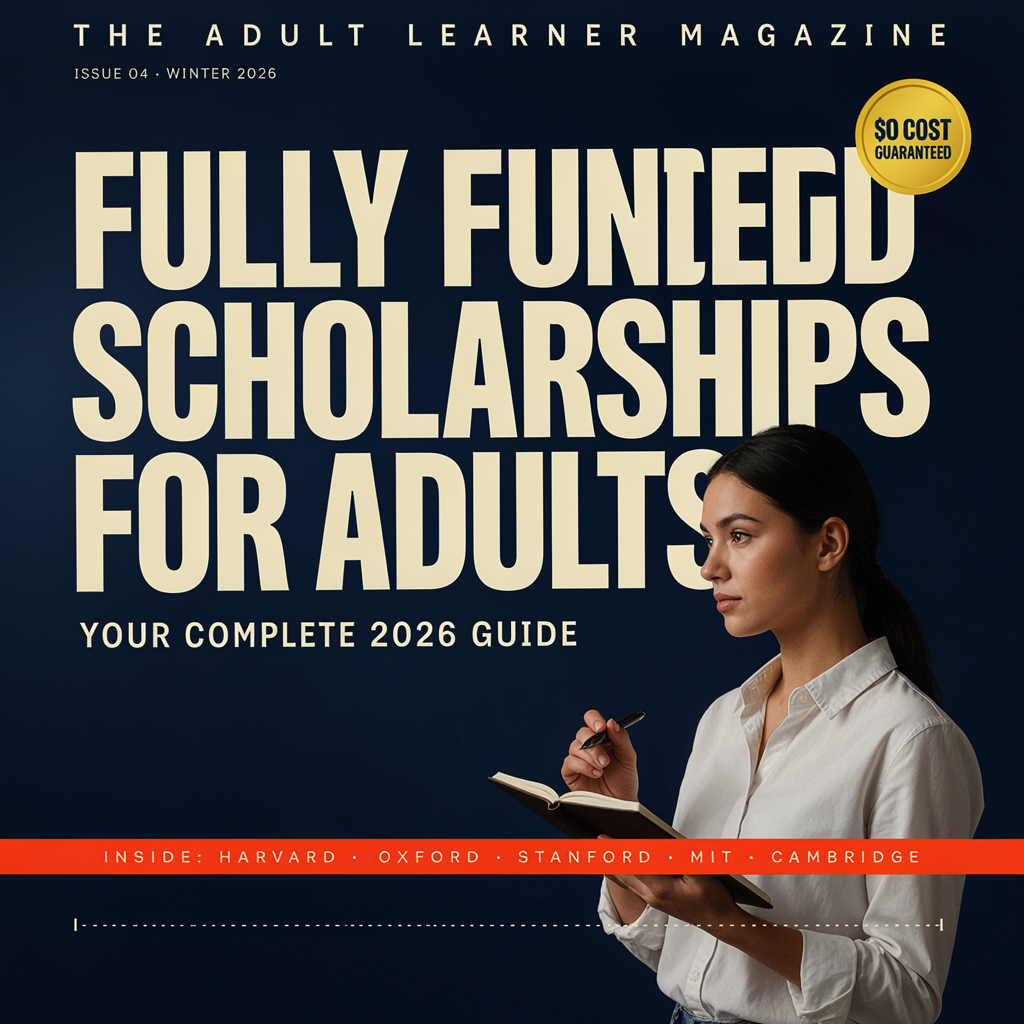
ToggleFully Funded Scholarships for Adults: Your Complete 2026 Guide
You’re 28, 35, or maybe 45—and you’re thinking about going back to school.
You’ve probably convinced yourself it’s too late, too expensive, or too complicated to compete with fresh high school graduates for funding. That assumption is costing you opportunities you genuinely qualify for.
The truth is that fully funded scholarships for adult learners are more abundant than most African students realize. Programs from the Mastercard Foundation, DAAD, Chevening, and dozens of African Union-backed initiatives actively seek applicants with work experience, life clarity, and demonstrated purpose—qualities you already have.
This guide exists to dismantle every myth keeping you from applying. You’ll learn exactly where to find legitimate fully funded scholarships, how to decode eligibility requirements that seem designed to confuse you, and how to position your adult experience as the competitive advantage it truly is. By the time you finish reading, you’ll have a concrete database of opportunities, a clear eligibility picture, and a step-by-step application roadmap tailored to your non-traditional path.
Quick Summary Box
- What this guide covers: Finding, qualifying for, and winning fully funded scholarships as an African adult learner in 2026
- Key benefits you’ll gain: A curated scholarship database, eligibility clarity, and a proven application strategy built around your experience
- How to use this post: Read straight through for the full picture, or jump to the section matching your current stage—searching, qualifying, or applying
Why Age Should Never Stop You From Applying
Let’s kill the biggest myth in scholarship hunting right now: the idea that funding only exists for 18-to-22-year-olds fresh out of secondary school.
That belief is outdated, and it’s keeping thousands of qualified African adults from accessing billions in available funding every year.
Here’s a number that should change your perspective entirely. According to UNESCO’s 2024 Global Education Monitoring Report, non-traditional students—those over 25—now represent nearly 40% of all tertiary enrollment in sub-Saharan Africa, up from 22% just a decade ago. The funding landscape has shifted to match this demographic reality.
So why do so few adults actually apply? The answer is simple and frustrating. Most adult learners assume they’re ineligible before they ever read a single scholarship description. They see “scholarship” and mentally file it under “that’s for younger people.” This self-disqualification creates a massive opportunity gap. When fewer adults apply, the competition you face shrinks dramatically.
Across the continent, the cultural narrative around adult education is also evolving rapidly. In Nigeria, Ghana, Kenya, and South Africa, returning to university after years in the workforce is increasingly viewed as a sign of ambition rather than failure. Employers, governments, and scholarship committees recognize that adult learners bring discipline, clarity, and real-world problem-solving skills that younger applicants simply haven’t developed yet.
Consider Ama, a 34-year-old nurse from Kumasi who won a fully funded Chevening Scholarship in 2025 after convincing herself for years that she’d “missed her window.” Or Tunde, a 41-year-old logistics manager in Lagos who secured DAAD funding for a master’s in supply chain management despite a 15-year gap since his undergraduate degree.
Your age is not a liability on your application—it’s evidence of the maturity and purpose that selection committees actively reward.
Understanding “Fully Funded” vs. Other Scholarship Types
Before you spend hours applying, you need to understand exactly what “fully funded” means—because the term gets thrown around loosely, and misunderstanding it can leave you scrambling to cover costs you didn’t anticipate.
A truly fully funded scholarship covers your tuition, living stipend, round-trip airfare, health insurance, and often a settling-in allowance for books and materials. That’s the gold standard, and it’s what programs like Chevening, the Mastercard Foundation Scholars Program, and the Commonwealth Shared Scholarships deliver.
But the scholarship universe exists on a spectrum, and you should know the differences. A full scholarship covers tuition completely but may leave living expenses to you. A partial scholarship covers a percentage of tuition—anywhere from 25% to 75%. Grants are typically need-based and don’t require repayment, while loans do. Work-study arrangements offset costs through campus employment rather than direct funding.
Here’s what catches most adult applicants off guard. Even “fully funded” awards rarely cover visa application fees, dependent family costs, personal travel, or pre-departure medical exams. You should budget an additional $500–$1,500 for these hidden expenses even when you win a comprehensive award.
Learning to read between the lines of scholarship descriptions will save you enormous frustration. When a listing says “full tuition scholarship,” that means tuition only—nothing more. When it says “comprehensive award” or “full cost of attendance,” you’re looking at the real deal. Always check the “Benefits” or “Coverage” section of every scholarship page before investing application time.
Take two real examples. The Chevening Scholarship covers full tuition at any UK university, a monthly living stipend of approximately £1,300, economy flights, and an arrival allowance. The Mastercard Foundation Scholars Program covers tuition, accommodation, books, a stipend, and even leadership development programming—but the specific package varies by partner university.
Knowing exactly what “fully funded” means for each program ensures you make informed decisions and avoid financial surprises after acceptance.
Building Your Scholarship Database: A Systematic Approach
Scattering applications randomly across the internet is a recipe for burnout. You need a systematic approach to building a curated database of fully funded scholarships that genuinely fit your profile as an adult learner.
Follow these five steps to create a scholarship pipeline that works for you.
Step 1: Start with major international scholarship portals. The official DAAD scholarship database is one of the most comprehensive resources available, with filters for age, field of study, and country of origin. Bookmark it and check it monthly—new opportunities appear year-round.
Step 2: Explore government-funded programs targeting African professionals. The British Council’s Chevening Scholarship, the Australian Awards, and the Swedish Institute Scholarships all maintain dedicated portals with transparent eligibility criteria. The African Union also operates scholarship programs through its Department of Education, Science, Technology, and Innovation—these are specifically designed for continental applicants and often have higher age ceilings.
Step 3: Check national education ministry databases in your home country. South Africa’s National Research Foundation, Nigeria’s Federal Scholarship Board, and Ghana’s Scholarship Secretariat all list fully funded opportunities that many adult learners overlook because they assume these programs only target secondary school leavers.
Step 4: Search university-specific mature student funding offices. Many universities in the UK, Canada, Germany, and Australia maintain dedicated funding pages for “mature students” or “non-traditional applicants.” Use search terms like “mature student scholarship,” “adult learner funding,” and “non-traditional student award” to surface hidden opportunities that don’t appear on major aggregator sites.
Step 5: Verify every opportunity before you apply. Scams targeting African scholarship seekers are rampant. A legitimate scholarship will never ask you to pay an application fee, request bank details upfront, or communicate exclusively through WhatsApp or personal Gmail accounts. Cross-reference every listing with the official website of the sponsoring organization.
A well-curated database of 15–20 vetted opportunities will outperform a scattergun approach of 100 random applications every single time.
Adult Applicant Eligibility Checklist
Eligibility requirements can feel like a maze designed to exclude you. They’re not—but you do need to read them with an adult applicant’s lens to avoid disqualifying yourself prematurely.
Use this checklist to evaluate your standing across the most common eligibility categories.
- Citizenship/residency: Most fully funded scholarships require you to hold citizenship in an eligible African country. Dual citizens should apply under the nationality that offers the strongest eligibility match.
- Academic performance: A minimum GPA or degree classification is standard (usually 2:1 or equivalent). If your grades are older, many programs accept work experience as a compensating factor.
- Language proficiency: TOEFL or IELTS scores are required for English-medium programs. However, if you completed prior education in English, many scholarships grant automatic waivers—check before paying for an exam.
- Work experience: This is where adult applicants shine. Many scholarships require 2–5 years of professional experience, which automatically filters out younger competitors.
- Age limits: Some programs cap eligibility at 30, 35, or 40. Others have no upper limit whatsoever. Always check the specific age policy—never assume you’re too old.
- Prior education timeframes: A few scholarships require your last degree to have been completed within the past 5–10 years. If yours is older, look for programs that explicitly welcome career returners.
- Field of study restrictions: Some funding is tied to specific disciplines (STEM, public health, governance). Match your intended program to the scholarship’s priority areas.
- Financial need thresholds: Need-based awards may require income documentation. Be honest—underreporting can void your award later.
Employment gaps deserve special attention. Many adult applicants panic about years spent raising children, recovering from illness, or navigating career transitions. Here’s the reality: most selection committees view these gaps as evidence of resilience and life experience, not disqualification. Address them honestly in your personal statement and connect them to your current motivation.
Are You Eligible? Quick Self-Assessment
Answer these four questions honestly. If you check three or more, you’re a strong candidate for multiple fully funded scholarships.
- Do you hold citizenship in an African Union member state?
- Do you have at least two years of professional work experience?
- Have you completed an undergraduate degree (even if it was years ago)?
- Can you articulate a clear reason for returning to school now?
Clarity about your eligibility is the foundation of confidence—and confidence is what separates applicants who submit from those who only dream.
The 5 Scholarship Types Adult Learners Actually Win
Not all scholarships are created equal, and some categories are dramatically more accessible to adult applicants than others. Understanding which types align with your profile will help you focus your energy where it actually pays off.
1. Government-Funded Adult Education Scholarships
These are funded by foreign governments seeking to build diplomatic and economic ties with African nations. Programs like Chevening (UK), DAAD (Germany), and the Australian Awards fall into this category. What makes adult applicants competitive here is demonstrated leadership potential and a clear plan to contribute to your home country’s development upon return. Typical awards cover full tuition, living stipends of $1,200–$1,800 monthly, and airfare. Acceptance rates hover around 5–10%, but adult applicants with strong professional track records consistently outperform fresh graduates. The Chevening Scholarship, for instance, requires a minimum of two years’ work experience—automatically favoring older candidates.
2. University-Specific Mature Student Programs
Individual universities often maintain dedicated funding pools for non-traditional students. The University of Edinburgh’s Mature Student Bursary and the University of Toronto’s Continuing Education Awards are prime examples. Your advantage here is that you’re competing in a smaller, self-selected pool of adult applicants rather than against the entire global applicant base. Awards range from partial tuition waivers to full cost-of-attendance packages. Acceptance rates vary widely but tend to be higher than flagship government scholarships because fewer applicants know these programs exist.
3. NGO and Foundation Scholarships for Career Changers
Organizations like the Mastercard Foundation, the Aga Khan Foundation, and the Mo Ibrahim Foundation fund education as a development tool. These programs actively seek applicants who can demonstrate how advanced education will amplify their existing community impact. The Mastercard Foundation Scholars Program reports that over 30% of its recent graduate cohort were career changers over age 28. Awards are typically comprehensive, covering tuition, housing, stipends, and leadership development. Acceptance rates are competitive (around 3–7%) but heavily weighted toward demonstrated purpose rather than raw academic metrics.
4. Merit-Based Scholarships Open to All Ages
Some scholarships evaluate candidates purely on academic achievement and test scores, with no age restrictions whatsoever. The Fulbright Foreign Student Program and the Erasmus Mundus Joint Master Degrees fall into this category. Your adult advantage is that you can pair strong academic records with professional accomplishments that younger applicants simply cannot match. Awards are generous—Erasmus Mundus covers tuition, travel, and a €1,400 monthly stipend. Acceptance rates are low (2–5%), but your combined academic and professional profile can make you exceptionally competitive.
5. Employer-Sponsored Education Scholarships
If you’re currently employed, your organization may offer tuition reimbursement or fully funded study leave. Many multinational companies operating in Africa—including MTN, Standard Bank, and Dangote Group—maintain education sponsorship programs for mid-career employees. Your advantage is built-in: your employer already knows your work ethic and potential. Awards typically cover full tuition and may include a salary continuation during study. Acceptance rates are significantly higher than external scholarships because the applicant pool is limited to internal candidates.
Winning a fully funded scholarship as an adult isn’t about competing with younger applicants on their terms—it’s about choosing the scholarship types where your experience is the decisive advantage.
Crafting Your Adult Applicant Application: Step-by-Step
The application process can feel overwhelming when you haven’t submitted an academic application in a decade or more. Breaking it into manageable steps removes the paralysis and gives you a clear path from “interested” to “submitted.”
Step 1: Create accounts on all relevant scholarship portals. Start this process at least 10 weeks before your earliest deadline. Use a dedicated email address for scholarship applications to keep communications organized and avoid missing critical updates buried in your personal inbox.
Step 2: Gather your documentation early. You’ll need official academic transcripts (contact your previous university’s registrar if it’s been years), a current CV highlighting professional achievements, language test scores (or waiver documentation), and a valid passport. If your transcripts are from an institution that has since merged or closed, contact your country’s national education accreditation body for certified replacements.
Step 3: Draft your personal statement with your adult experience front and center. This is where most adult applicants either shine or self-sabotage. Address your career trajectory honestly. Explain why you’re returning to school now, not ten years ago. Connect your professional experience to your academic goals with specificity. A vague statement like “I want to further my education” will lose to a precise one like “After eight years managing public health logistics in rural Malawi, I need advanced epidemiological training to design the intervention frameworks my community requires.”
Step 4: Secure strong references. Choose recommenders who can speak to your professional capabilities and growth potential—a current supervisor, a former professor who remembers your work, or a community leader you’ve collaborated with. Give your recommenders at least four weeks’ notice and provide them with a brief summary of the scholarship’s goals and your key achievements.
Step 5: Review your entire application with fresh eyes. Read every response aloud. Check for consistency between your CV, personal statement, and reference letters. Ask a trusted friend or mentor to review for clarity and tone.
Step 6: Submit at least one week before the deadline. Portal crashes on deadline day are real and disproportionately affect applicants in regions with unstable internet connectivity. Don’t let a technical failure undo months of preparation.
5 Mistakes That Cost Adult Applicants (Avoid These)
- Spelling and grammar errors — They signal carelessness and undermine your professional credibility instantly
- Generic motivation — Failing to explain why NOW, at this specific point in your career, destroys your narrative
- Missing work experience details — Leaving your professional achievements vague when they’re your strongest asset
- Weak reference selection — Choosing a prestigious name over someone who actually knows your work well
- Unrealistic timeline expectations — Rushing an application in two weeks when adult documentation takes longer to assemble
Give yourself 8–10 weeks minimum from start to submission—adult applicants consistently need more time to gather work-related documentation than they initially estimate.
Thorough preparation doesn’t just improve your application quality; it eliminates the uncertainty that keeps qualified adults from hitting “submit.”
Positioning Your Story: Why You’re the Right Candidate
Your personal statement is the single most important component of your application, and as an adult learner, you have raw material that younger applicants would envy. The key is reframing your age and experience as compelling strengths rather than awkward footnotes.
Start by understanding what selection committees actually want to see. They’re not looking for perfect, linear trajectories. They’re looking for clarity of purpose, demonstrated resilience, and evidence that you’ll use the scholarship to create meaningful impact. Your years of work, family responsibility, and navigating real-world challenges give you a depth of perspective that a 22-year-old simply cannot fabricate.
When articulating your career-change story, resist the urge to apologize for your timeline. Don’t write, “Although I’m older than most applicants…” Instead, write, “My decade in financial services taught me exactly which regulatory gaps I need advanced legal training to address.” The first sentence defends your age; the second sentence weaponizes it.
Translate your life experience into application gold. Managed a household budget through economic crisis? That’s financial acumen under pressure. Raised children while working full-time? That’s time management and prioritization at an elite level. Navigated a career pivot after industry disruption? That’s adaptability and strategic thinking. Every experience you’re tempted to minimize is actually evidence of the qualities scholarship committees reward.
Be ruthlessly authentic. The temptation to sound younger, more conventionally academic, or less “complicated” is strong—but it backfires. Selection committees read thousands of polished, generic essays. Yours will stand out precisely because it’s honest and specific.
“When I stopped apologizing for being 32 and started explaining why I was ready, everything changed. My essay went from defensive to compelling the moment I owned my journey.” — Kwame A., DAAD Scholar, 2024, age 32
Use one of these proven essay frameworks to structure your personal statement:
- The Turning Point: Open with the specific moment or experience that crystallized your decision to return to school. Build backward to show how your career led there, then forward to show what the scholarship will enable.
- The Gap That Led Here: Frame your time away from academia not as lost years but as an extended research period. Show how real-world experience revealed the knowledge gaps that only advanced study can fill.
- From Stability to Ambition: Acknowledge that you’ve built a comfortable life, then explain why comfort is no longer enough. This framework works powerfully for mid-career professionals seeking to pivot into impact-driven fields.
Compare these two opening lines. Generic: “I have always been passionate about education and I believe this scholarship will help me achieve my goals.” Adult-specific: “After twelve years teaching in underfunded Lagos public schools, I know exactly which policy interventions work—and which ones fail because they were designed by people who’ve never stood in a classroom of 80 students.”
Authenticity isn’t just a nice-to-have in your application—it’s the differentiator that separates funded candidates from forgotten ones.
The 2026 Adult Scholarship Timeline
Planning your application calendar is non-negotiable, especially when you’re balancing a job, family, and the logistical complexity of gathering years-old documentation. Use this timeline as your 2026 roadmap.
| Date Range | Milestone |
|---|---|
| January – March 2026 | Major scholarship portals open (Chevening, DAAD, Commonwealth); begin document gathering |
| March – May 2026 | University-specific mature student deadlines; request transcripts and references now |
| June – August 2026 | Rolling application windows for Australian Awards and Erasmus Mundus; submit early for priority review |
| September – October 2026 | Shortlist announcements for spring-cycle programs; prepare for interviews |
| November – December 2026 | Final decision announcements for most government-funded programs |
| January – September 2027 | Program start dates vary by institution and hemisphere |
Note for working adults: Programs with rolling deadlines (Australian Awards, several Erasmus Mundus tracks, and most employer-sponsored scholarships) offer the flexibility you need to apply around your work schedule rather than racing against a single cutoff date.
Set phone reminders six weeks before each deadline. Adult applicants consistently underestimate the time required to obtain official transcripts, notarized documents, and professional references—start earlier than you think you need to.
Proactive planning transforms the application process from a source of anxiety into a series of manageable, achievable tasks.
Frequently Asked Questions
Can I get a fully funded scholarship if I’ve been working for 10 years?
Absolutely. Many fully funded scholarships specifically require professional work experience, and a decade in the workforce makes you highly competitive. Programs like Chevening and the Mastercard Foundation Scholars Program actively seek mid-career professionals. Your work history is an asset, not a barrier.
What if there’s a gap in my education?
Education gaps are common among adult applicants and rarely disqualify you. Most selection committees evaluate your most recent academic performance and professional trajectory rather than penalizing time away from school. Address the gap honestly in your personal statement and connect it to your current motivation for returning.
Can I work while on a full scholarship?
It depends on the scholarship and host country’s visa regulations. Most fully funded scholarships provide a living stipend designed to eliminate the need for employment. Some programs permit limited part-time work (typically 10–20 hours weekly), while others restrict it entirely. Check your specific award conditions before making employment plans.
Do I need to live in my home country to apply?
Most fully funded scholarships for African students require you to be resident in your home country at the time of application. If you’re currently working abroad, check whether the scholarship accepts applications from the diaspora. Programs like the African Union scholarships and some DAAD tracks have specific provisions for applicants living outside their home countries.
How long from application to enrollment decision?
The typical timeline ranges from 4 to 8 months. Government-funded scholarships like Chevening follow a structured cycle: application in August, interviews in February, decisions by June, and enrollment in September. University-specific programs may move faster, with decisions within 6–10 weeks of the deadline.
Can I reapply if I’m rejected?
Yes, and you should. Most fully funded scholarships welcome reapplications, and many successful candidates were rejected on their first attempt. Use the feedback from your initial application to strengthen your personal statement, update your references, and refine your program alignment before reapplying.
Are adult applicants at a disadvantage?
No. Adult applicants often have a significant advantage in scholarships that value leadership, professional experience, and clarity of purpose. While some programs have age caps, the majority evaluate candidates on merit and potential impact—areas where your life experience gives you a genuine edge over younger competitors.
Every question you’ve asked yourself in doubt has an answer that points toward possibility—trust the evidence and apply.
Your Action Plan: Next Steps
If you’ve read this far, you already know more about fully funded scholarships for adult learners than the vast majority of your peers. The gap between knowing and doing is the only thing standing between you and the funding you deserve.
You might be feeling a mix of excitement and anxiety right now. That’s completely normal. Returning to school as an adult is a bold decision, and the application process can feel daunting when you’re juggling work, family, and responsibilities that younger applicants don’t yet carry. But that same complexity is exactly what makes your story compelling to the committees reviewing your application.
Here are three specific actions you can take this week to move from contemplation to momentum.
- Build your scholarship database today: Open a spreadsheet and add at least five fully funded scholarships from the portals mentioned in this guide—start with DAAD, Chevening, and the Mastercard Foundation. Record each program’s deadline, eligibility criteria, and coverage details in one place.
- Request your academic transcripts this week: Contact the registrar’s office at your most recent institution and request official transcripts. If you graduated more than five years ago, this process can take 2–4 weeks—starting now prevents a last-minute scramble.
- Block three hours on your calendar for personal statement drafting: Choose one of the essay frameworks from this guide and write a rough first draft of your story. Don’t edit, don’t polish—just get your experience and motivation onto the page. You can refine it later.
You are not too old, too late, or too far from the finish line—your next chapter is fully funded and waiting for you to claim it.