


Fully Funded Scholarships in Albania 2026: Lesser-Known Programs Worth Applying For
Introduction: The European Scholarship Destination Nobody Is Talking About
Every year, hundreds of thousands of African students compete for the same shortlist of European scholarships — Erasmus Mundus, Chevening, DAAD, Campus France. The competition is brutal, the rejection rates are high, and deserving applicants miss out simply because they focused on the most visible programs.
Here’s what those students don’t know: fully funded scholarships in Albania 2026 represent one of the most underutilized study abroad opportunities in Europe today.
Albania — a small, rapidly developing country on the Adriatic coast of Southeastern Europe — is not the first name that comes to mind when you think of European higher education. That’s precisely the opportunity. While thousands of applicants flood programs in Germany or the UK, Albania’s scholarship programs receive a fraction of that traffic, meaning your application lands in a far less crowded field.
But this isn’t about settling. Albania is an EU candidate country, its universities are increasingly internationally accredited, its government has made higher education internationalization a national priority, and its cost of living is among the lowest in Europe. A degree from an Albanian institution — supported by international funding — can open doors across the EU, the African continent, and beyond.
In this guide, you will find:
- Every significant scholarship program in Albania for 2026 — including programs most applicants have never heard of
- Full funding coverage details for each program
- Eligibility requirements broken down clearly for African students
- A step-by-step application roadmap with real portal links
- Honest advice on common pitfalls that sink otherwise strong applications
- A downloadable application checklist to keep you on track
Whether you’re a fresh undergraduate from Lagos, a master’s student from Nairobi, or a development professional from Accra pursuing a second postgraduate degree, Albania in 2026 deserves serious consideration.
Let’s get into it.
Why Albania? Understanding the Strategic Value of This Destination
Before diving into specific programs, you need to understand why Albania is worth your strategic attention in 2026. This context will also strengthen your Statement of Purpose when you apply.
Albania’s EU Candidacy and Academic Alignment
Albania was granted EU candidate country status and has been in active accession negotiations since 2022. This means Albanian universities are actively aligning their curricula, quality standards, and research frameworks with EU norms. A degree earned in Albania today is increasingly recognized across the European Union — a significant career advantage for African students seeking EU-recognized qualifications without EU-level tuition fees or competition.
The Bologna Process and International Recognition
Albania is a signatory to the Bologna Process, the European framework that standardizes higher education across 48 countries. This means Albanian degrees follow the same Bachelor’s (3 years) / Master’s (2 years) / PhD (3 years) structure used across Europe, and credits are transferable across participating institutions.
Language of Instruction
Many Albanian universities now offer programs — particularly at the postgraduate level — in English. This is a critical detail for African students: no Albanian language requirement, and in many cases, no IELTS required if your previous education was conducted in English.
Cost of Living
| Expense Category | Monthly Cost in Albania (Approx.) | Monthly Cost in UK (Approx.) |
|---|---|---|
| Accommodation (shared) | USD 150–250 | USD 800–1,200 |
| Food | USD 100–180 | USD 400–600 |
| Transport | USD 20–40 | USD 150–250 |
| Communication | USD 10–20 | USD 30–50 |
| Total Estimate | USD 300–500 | USD 1,400–2,100 |
Albania offers a genuinely European academic experience at a fraction of the cost of Western European destinations.
The Major Fully Funded Scholarships in Albania 2026
This is the core of this guide. Below you will find every significant scholarship opportunity available to international students in Albania for the 2026 academic cycle — with funding details, eligibility criteria, and application links.
1. Albanian Government Scholarships for Foreign Citizens (Ministry of Education and Sports)
Overview:
This is the flagship fully funded scholarship in Albania 2026 administered directly by the Albanian Ministry of Education and Sports (MAS). The Albanian government offers a designated number of scholarship slots to citizens of countries that maintain diplomatic relations with Albania — which includes the vast majority of African nations.
These scholarships are allocated through bilateral agreements between Albania and partner countries. The program is designed to attract international talent, build academic partnerships, and advance Albania’s global higher education profile.
Funding Coverage:
- ✅ Full tuition waiver
- ✅ Monthly living stipend (approximately ALL 25,000–35,000/month — roughly USD 250–350)
- ✅ University accommodation or housing allowance
- ✅ Health insurance coverage
- ✅ One-time settlement allowance upon arrival
Available Degree Levels:
- Bachelor’s (3 years)
- Master’s (2 years)
- PhD / Doctoral programs (3 years)
Eligible Fields:
All fields offered at accredited Albanian public universities — including medicine, engineering, economics, law, social sciences, arts, and natural sciences.
Eligibility Requirements:
- Citizen of a country with a bilateral agreement with Albania
- Age limit: Under 35 years (postgraduate); Under 25 years (undergraduate)
- Strong academic record — minimum GPA equivalent of 3.0 or 60%
- Medical fitness certificate
- No criminal record
- English proficiency (waivable for English-medium education graduates)
- Must not hold another government-funded scholarship simultaneously
Application Route:
Applications are submitted through your home country’s Ministry of Education or Ministry of Foreign Affairs, which nominates candidates to the Albanian MAS. You do not apply directly to Albanian universities at this stage.
Key Deadline: Typically March–April 2026 (confirmed through your national scholarship authority)
🔗 Albanian Ministry of Education and Sports: www.arsimi.gov.al
🔗 Albanian Ministry of Foreign Affairs: www.punetejashtme.gov.al
African Students — Check Your National Authority:
- Nigeria: Federal Scholarship Board — scholarships.fme.gov.ng
- Kenya: Government Scholarships via Ministry of Education — www.education.go.ke
- Ghana: Ghana Scholarship Secretariat — www.scholarships.gov.gh
- Ethiopia: Ministry of Education Ethiopia — www.moe.gov.et
- South Africa: DHET International Scholarships — www.dhet.gov.za
2. Erasmus+ Scholarships at Albanian Universities (Inbound Mobility for Africans)
Overview:
This is the most underused pathway for African students to access Albanian universities with EU funding. Here’s how it works:
The Erasmus+ Programme funds academic exchanges between EU/partner country universities and Albanian institutions. Under the Erasmus+ International Credit Mobility (ICM) stream, African universities that have signed partnership agreements with Albanian institutions can send students and staff to Albania with full Erasmus+ funding.
This means: if your home university in Africa has — or can establish — a partnership agreement with a university in Albania, you could access an Erasmus+ funded semester, academic year, or full degree program.
Funding Coverage (Erasmus+ ICM):
- ✅ Monthly mobility grant (EUR 700–900 for Africa-to-Europe mobility)
- ✅ Travel contribution (lump sum based on distance — typically EUR 275–360 for Africa)
- ✅ Tuition waiver at host institution
- ✅ Insurance coverage
Key Albanian Universities with Active Erasmus+ Partnerships:
- University of Tirana (UT)
- Polytechnic University of Tirana (UPT)
- University of Shkodra “Luigj Gurakuqi”
- University of Vlora “Ismail Qemali”
- Agricultural University of Tirana
How to Access This as an African Student:
- Check if your current university has an active Erasmus+ partnership with an Albanian institution
- If not, encourage your university’s international office to apply for ICM funding — it’s a formal grant application made by the institution, not the student
- Once a partnership is established, apply for the exchange slot through your home university’s Erasmus+ coordinator
Application Timeline:
Erasmus+ ICM applications for 2026–27 mobility periods close for institutions in January–February 2026. Student applications follow institutional deadlines — typically March–May 2026.
🔗 Erasmus+ Official Programme Guide: erasmus-plus.ec.europa.eu
🔗 University of Tirana International Office: www.unitir.edu.al
3. University of Tirana Scholarships for International Students
Overview:
The University of Tirana (UT) — Albania’s largest and most prestigious institution, founded in 1957 — offers direct scholarships for international students at the postgraduate level. These awards are primarily merit-based and research-focused.
Programs Available in English (2026):
- MSc in Business Administration (MBA track)
- MSc in Environmental Management
- MSc in Political Science and International Relations
- MA in Cultural Heritage and Tourism
- PhD programs across faculties (Sciences, Social Sciences, Law, Economics)
Scholarship Types:
| Award Type | Coverage | Eligibility |
|---|---|---|
| Full Merit Scholarship | Tuition + stipend | Top 5% of applicant pool |
| Partial Tuition Waiver | 50% tuition reduction | Top 20% of applicant pool |
| Research Assistantship | Stipend + tuition | PhD applicants with strong proposals |
Eligibility:
- Bachelor’s degree with minimum 3.2 GPA (or equivalent) for master’s scholarships
- Master’s degree for PhD research assistantships
- Research proposal required for PhD applicants
- English language proficiency (IELTS 6.0+ or English-medium education proof)
- Two academic references
Application Portal: Apply directly through UT’s admissions system.
🔗 University of Tirana Admissions: www.unitir.edu.al/en/admissions
Application Deadline: March 31, 2026 (expected — verify on official portal)
4. RYCO — Regional Youth Cooperation Office Scholarships
Overview:
The Regional Youth Cooperation Office (RYCO) supports youth mobility and cooperation across the Western Balkans, including Albania. While primarily serving Western Balkan youth, RYCO has expanding programs that support international youth engagement with Western Balkan institutions through mobility grants and project-based scholarships.
Relevance for African Students:
RYCO’s youth exchange and mobility grants can fund short-term research stays, summer schools, and capacity-building programs at Albanian institutions. These are ideal for:
- Students in conflict resolution, peacebuilding, or governance
- Youth leaders in civil society organizations
- Early-career researchers in social sciences
Funding:
Grants range from EUR 1,000–5,000 depending on program duration and type.
🔗 RYCO Official Portal: www.rycowb.org
5. CEI — Central European Initiative Scholarships
Overview:
The Central European Initiative (CEI) is an intergovernmental forum of 17 countries — including Albania — that funds postgraduate scholarships through its CEI Know-How Exchange Programme (KEP). CEI scholarships support Master’s and PhD students from CEI member and partner states studying at institutions in CEI member countries, including Albania.
Who Qualifies:
African students are eligible if they are enrolled in or applying to a CEI member country institution and their research aligns with CEI priority areas:
- Digital transformation
- Climate change and environment
- Sustainable development
- Innovation and entrepreneurship
Funding Coverage:
- Monthly stipend of EUR 500–1,000
- Duration: 6–12 months (research stays or course-based)
Application:
Submit through the CEI Secretariat online portal.
🔗 CEI Fellowship Programme: www.cei.int/scholarships-fellowships
6. Open Society Foundations — Albania-Based Research Grants
Overview:
The Open Society Foundations (OSF) has historically maintained strong programming in Albania and the Western Balkans. Their academic exchange and research grants support scholars working in human rights, democratic governance, transparency, media freedom, and rule of law — all areas where Albania-based research has unique regional relevance.
Relevance for African Students:
African postgraduate students and researchers whose work focuses on governance, civil society, anticorruption, or judicial reform can apply for research grants that fund 3–12 month stays at Albanian institutions or with Albanian civil society organizations.
Typical Grant Value: USD 5,000–20,000 (project-based)
🔗 Open Society Foundations Grants: www.opensocietyfoundations.org/grants
7. DAAD Scholarships — Germany-Albania Study Links
Overview:
While DAAD is Germany’s scholarship agency, it funds programs at partner institutions globally — including Albanian universities. DAAD’s Development-Related Postgraduate Courses (EPOS) program funds master’s degrees for students from developing countries (most African nations qualify) at DAAD-partnered institutions. Some DAAD-partnered programs are delivered in collaboration with Albanian universities.
Additionally, DAAD’s Research Grants fund short-term research stays that can be conducted in Albania if the host institution qualifies.
Coverage:
- Monthly stipend of EUR 861 (master’s) or EUR 1,200 (doctoral)
- Travel subsidy
- Health insurance
- Study and research allowance
🔗 DAAD Scholarships for Africans: www.daad.de/en/study-and-research-in-germany/scholarships
Top Universities in Albania for International Students
Understanding where you’ll study matters as much as knowing your funding source. Here are Albania’s leading institutions for international students.
University of Tirana (UT)
Albania’s oldest and largest university, established in 1957. Offers the broadest range of programs and has the most developed international partnerships. Strong faculties in law, social sciences, economics, and natural sciences.
Polytechnic University of Tirana (UPT)
The leading technical university in Albania. Offers engineering, architecture, mathematics, and applied sciences at bachelor’s, master’s, and doctoral levels. Strong Erasmus+ network across Europe.
University of Shkodra “Luigj Gurakuqi”
Located in northern Albania, this university is strong in education, social sciences, and natural sciences. Notably active in Erasmus+ partnerships and increasingly welcoming international students.
Agricultural University of Tirana (AUT)
Specializes in agriculture, environment, veterinary medicine, and biotechnology. Excellent choice for African students focused on food security, sustainable agriculture, and natural resource management.
Epoka University (Private)
Albania’s most internationally oriented private university, with a strong focus on computer engineering, architecture, business, and political science. Delivers programs in English and has a notably diverse international student body. Offers merit scholarships directly to applicants.
Step-by-Step Application Guide: How to Apply for Scholarships in Albania 2026
Now that you know what’s available, let’s walk through the application process phase by phase.
Phase 1: Research and Scholarship Matching (January 2026)
Step 1: Identify Your Best Pathway
Use this quick-match framework before writing a single word of your application:
| Your Profile | Recommended Pathway |
|---|---|
| Strong academic record, government-nominated | Albanian Government Bilateral Scholarship |
| Enrolled at African university with EU links | Erasmus+ ICM via Home University |
| Postgraduate researcher, independent applicant | University of Tirana Direct Scholarship |
| Youth leader, governance/peacebuilding focus | RYCO Mobility Grant |
| PhD researcher, CEI priority fields | CEI Know-How Exchange Programme |
| Development-focused master’s applicant | DAAD EPOS Programme |
Step 2: Confirm Bilateral Relationship
For government scholarships, contact your national Ministry of Education or Foreign Affairs to confirm that your country has an active bilateral agreement with Albania. This is non-negotiable for this pathway.
Step 3: Research Your Target University and Program
Spend at least one week researching:
- Your target program’s curriculum, faculty, and research focus
- Active professors whose research aligns with your academic interests
- Any recent publications, projects, or partnerships that connect to your goals
- The university’s current international student community and support services
This research will directly inform your Statement of Purpose — the most critical document in your application.
Phase 2: Document Preparation (January–February 2026)
Start document collection at least 3 months before any deadline. Here is your master checklist:
📋 Albania Scholarship Documentation Checklist (2026):
- Valid international passport (minimum 18 months validity beyond study start)
- Certified and notarized academic transcripts (all institutions attended)
- Original degree certificate(s) — notarized copies
- Birth certificate — notarized
- National ID card (both sides)
- 2–3 academic or professional reference letters (on institutional letterhead)
- Statement of Purpose / Personal Statement (700–1,000 words)
- Research Proposal (for postgraduate/PhD applicants — 1,500–2,000 words)
- Updated CV / Curriculum Vitae (2 pages maximum)
- Medical fitness certificate (from certified government hospital)
- Police clearance certificate / Certificate of Good Conduct
- Passport-sized photographs (white background — 4–6 copies)
- English proficiency certificate (IELTS 6.0+ OR English-medium education proof letter)
- Financial statement (for partial scholarship / self-fund supplement programs)
- Portfolio (for architecture, design, or arts programs)
- Proof of community service or extracurricular achievement (strengthens application)
🔑 On the IELTS Question:
This is one of the most important points in this guide. Many Albanian university programs — particularly those delivered in English — accept a letter from your previous institution’s registrar confirming that your education was conducted entirely in English, in lieu of an IELTS certificate. This no IELTS scholarship 2026 pathway is especially valuable for applicants from:
- Nigeria (English-medium education throughout)
- Ghana (English-medium education throughout)
- Kenya (English-medium from secondary school)
- Uganda, Tanzania, Rwanda, South Africa, Zambia, Zimbabwe
Request this letter from your registrar’s office early — processing can take 2–4 weeks.
Phase 3: Writing Your Statement of Purpose
Your SOP for Albanian scholarships should address five core elements:
Element 1 — Your Academic and Professional Story (2–3 paragraphs):
Explain your academic journey and professional experience concisely. Quantify achievements where possible. Avoid listing credentials — tell a story that shows progression and intentionality.
Element 2 — Why Albania and Why This Institution:
This is where many applicants fail — they write a generic “why Europe” essay instead of a specific “why Albania” essay. Show that you understand:
- Albania’s position as an EU candidate country and what that means for your degree’s recognition
- The specific academic strengths of your target institution
- Any faculty members, research centers, or specific programs that align with your goals
Element 3 — Why This Program:
Connect your past experience to the specific courses, research areas, or methodologies offered in your target program. Be specific — name modules, name faculty, name research initiatives.
Element 4 — Your Research/Academic Goals:
What questions are you trying to answer? What skills are you building? For postgraduate applicants, this section should preview your thesis or research direction.
Element 5 — Post-Graduation Impact Plan:
How will your Albanian degree advance your career? How will you contribute to your home country or region? Albanian scholarship committees, like most European institutions, value applicants who demonstrate a clear plan to create impact after graduation.
Word Count: 750–1,000 words. Single-spaced. Use clear paragraph breaks. No jargon.
Phase 4: Reference Letters — Strategic Approach
Who to Choose:
- Primary Academic Referee — A professor who supervised your thesis, dissertation, or significant research project
- Secondary Academic or Professional Referee — A senior colleague, employer, or project supervisor who can speak to applied competence
- Optional Character Referee — For government-level applications, a community or organizational leader adds credibility
What to Give Your Referees:
- Your most recent CV
- The scholarship’s stated values and priorities
- A summary of your SOP (so their letter reinforces, not contradicts, your narrative)
- The exact deadline — with a personal deadline 2 weeks earlier
- A template or key talking points (most referees appreciate this)
Format Guidance:
Reference letters should be:
- On official institutional letterhead
- Signed and dated
- No more than one page (two pages for detailed research evaluations)
- Scanned and submitted as PDF
Phase 5: Submitting Your Application
For Albanian Government Bilateral Scholarships:
Submit through your national scholarship authority (Ministry of Education or Foreign Affairs). They will nominate you to Albania’s MAS. You cannot bypass this route.
For University of Tirana Direct Applications:
- Visit www.unitir.edu.al/en/admissions
- Create an applicant account
- Select your program and degree level
- Upload all documents in PDF format (typically max 5MB per file)
- Complete the online application form in full — no blank fields
- Submit and save your confirmation email and application reference number
For Erasmus+ ICM:
Contact your home university’s International Relations Office or Erasmus+ Coordinator. The application process runs through your home institution — not through the Albanian university directly.
For DAAD Programs:
Apply through the DAAD online portal: 🔗 www.daad.de/en/study-and-research-in-germany/scholarships
Pre-Submission Final Checklist:
- Every field in the application form completed
- All uploaded documents clearly scanned and legible
- File names follow required format (e.g., Firstname_Lastname_Document.pdf)
- Application submitted at least 5 business days before deadline
- Confirmation email received and saved
- Screenshot/PDF of submitted application archived
Phase 6: Albania Student Visa Application
Once you receive your scholarship offer letter, the visa process begins.
Albania Student Visa (Type D Long-Stay):
- Receive official admission and scholarship letter from Albanian institution or government authority
- Apply for the long-stay student visa (Type D) at the Albanian embassy or consulate nearest to you — check www.punetejashtme.gov.al for the nearest mission
- Submit visa documents:
- Valid passport (6+ months validity)
- Completed visa application form
- Official scholarship/admission letter
- Proof of accommodation in Albania
- Medical fitness certificate
- Travel insurance (minimum 30,000 EUR coverage)
- 2 passport-size photographs
- Visa fee payment receipt
- Processing time: 2–4 weeks standard; apply early
- Upon arrival in Albania: Register with local civil registration authorities within 30 days
Important: Some African countries do not have Albanian embassies or consulates locally. In such cases, visas are processed through the nearest Albanian diplomatic mission — often in a regional capital. Check this well in advance and factor travel time and costs into your planning.

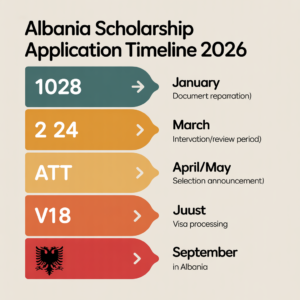
Albania 2026 Application Timeline — At a Glance
| Milestone | Recommended Date |
|---|---|
| Begin scholarship research and profile matching | January 2026 |
| Contact national scholarship authority (bilateral route) | January 2026 |
| Begin document collection and certification | January–February 2026 |
| Request reference letters from referees | January 2026 (early) |
| Draft and refine Statement of Purpose | January–February 2026 |
| Submit application (before deadline) | February–March 2026 |
| Follow up with admissions/scholarship office | 1 week after submission |
| Interview preparation (if shortlisted) | April–May 2026 |
| Scholarship/admission decision | May–June 2026 |
| Visa application and processing | June–August 2026 |
| Arrival in Albania | September 2026 |
| Academic year begins | October 2026 |
Common Mistakes to Avoid When Applying for Scholarships in Albania
Even strong candidates make these errors. Read each one carefully.
Mistake #1: Treating Albania as a Fallback, Not a Choice
Scholarship committees can tell when an applicant hasn’t genuinely researched their destination. If your SOP reads like you chose Albania because you didn’t get into Germany, your application will struggle. Write with genuine conviction about why Albania’s academic environment, EU candidacy trajectory, and specific institutional strengths align with your goals.
Mistake #2: Ignoring the Bilateral Agreement Requirement
The government bilateral scholarship — arguably the most generous program on this list — requires your country to have a formal agreement with Albania. Applicants who submit directly to Albanian institutions expecting government scholarship funding, without first verifying this, waste months of preparation.
Mistake #3: Submitting Unverified Document Translations
Any document not originally in English or Albanian must be accompanied by a certified translation. Hiring an uncertified translator or using Google Translate for official documents is grounds for immediate disqualification.
Mistake #4: Writing a Research Proposal That’s Too Broad
For postgraduate and PhD applicants, a research proposal that tries to solve everything solves nothing. A focused, methodologically sound 1,500–2,000 word proposal with a clear research question, literature review, and methodology section outperforms a sprawling 3,000-word conceptual essay every time.
Mistake #5: Applying to Programs Not Offered in English
Not all Albanian university programs are delivered in English. Some are exclusively in Albanian. Before you apply, confirm the language of instruction for your specific program. Applying to an Albanian-language program with an English-language application package signals poor research and wastes everyone’s time.
Mistake #6: Not Preparing for a Potential Interview
Some scholarship programs — particularly government bilateral awards and university direct scholarships — include an interview stage. Applicants who haven’t prepared are caught off-guard by questions about Albanian history, the GNH — wait, that’s Bhutan — about Albania’s EU accession process, Balkan regional dynamics, and how their research contributes to Albania’s development priorities. Prepare specifically.
Mistake #7: Missing the Follow-Up Window
After submitting your application, send a brief, professional email to the admissions office confirming receipt and expressing continued interest. Many applicants never do this. It signals seriousness and helps you identify and correct any document gaps before the review period closes.
Frequently Asked Questions: Scholarships in Albania 2026
Q1: Are there genuinely fully funded scholarships in Albania for African students?
Yes. The Albanian Government Bilateral Scholarship program offers full funding — covering tuition, accommodation, stipend, and health insurance — to students from countries with bilateral agreements with Albania. Many African nations qualify. Erasmus+ ICM also provides full funding for exchange students from partner African universities.
Q2: Do I need to speak Albanian to study in Albania?
Not for most international programs. Many postgraduate programs at Albanian universities are delivered entirely in English. However, learning basic Albanian phrases is culturally appreciated and will make daily life significantly easier. Free Albanian language learning resources are available on platforms like Duolingo and the Language Transfer project.
Q3: Is Albania safe for international students, particularly African students?
Albania ranks consistently as one of the safest countries in the region. Crime rates are low, and Tirana — the capital and main university city — is a vibrant, cosmopolitan city. As with studying anywhere abroad, standard personal safety awareness applies. The international student community in Albania is growing and generally well-supported.
Q4: Is an Albanian degree recognized internationally?
Yes. As a Bologna Process signatory and EU candidate country, Albanian degrees follow European academic standards and are increasingly recognized across Europe and internationally. Graduates from programs at the University of Tirana and Polytechnic University of Tirana have gone on to postdoctoral positions, employment in EU institutions, and advanced careers in international organizations.
Q5: Can I work part-time while studying in Albania on a scholarship?
Albanian student visa regulations generally permit limited part-time work — typically up to 20 hours per week during term time and full-time during holidays. Verify the specific conditions of your scholarship award, as some programs include clauses requiring full-time academic engagement.
Q6: What is the no IELTS scholarship pathway in Albania?
Several Albanian universities and scholarship programs accept English-medium education certificates from recognized institutions as an alternative to IELTS. If all your previous formal education was conducted in English, request a letter from your registrar’s office confirming this. Submit it as your English proficiency evidence. This pathway is specifically available at the University of Tirana, Epoka University, and under the Albanian Government Bilateral Scholarship program.
Q7: How competitive is the Albanian Government Scholarship compared to Erasmus or Chevening?
Significantly less competitive. Albania receives far fewer international scholarship applications than Western European destinations. If your profile is strong — good GPA, clear research focus, well-written SOP — your chances of selection through the Albanian bilateral scholarship program are considerably higher than through equivalent programs in the UK, Germany, or France.
Q8: What fields are most in demand at Albanian universities for international postgraduate students?
Environmental management, political science and international relations, business administration, engineering, agriculture, and legal studies are among the strongest fields with English-language availability at the postgraduate level. Agricultural University of Tirana is particularly relevant for African students focused on food systems, rural development, and natural resource management.
💬 Your Question Not Answered Here? Drop it in the comments section below. Our ScholarCareer.com team responds to every question, and the best questions get featured in our next content update.
What a Successful Albania Scholarship Application Looks Like
To make this guide actionable, here are two composite profiles representing successful scholarship pathways — drawn from the types of applications that resonate with European and Albanian scholarship committees.
Profile 1 — Fatima, Master’s Applicant in Environmental Management from Morocco
Fatima completed her BSc in Environmental Science with a GPA of 3.6. She worked for two years with an NGO focused on coastal erosion management in North Africa. She identified the Agricultural University of Tirana’s Master’s in Environmental Management as a strong fit — particularly because of the faculty’s published work on Mediterranean and Adriatic coastal ecosystems.
Her SOP drew direct connections between North Africa’s coastal challenges and Albania’s Adriatic environmental policy frameworks. She contacted the ICCR — wait, wrong program — she contacted Morocco’s national scholarship authority, confirmed a bilateral agreement with Albania, and was nominated for the Albanian Government Scholarship.
What made her successful: Deep program-specific research, a compelling comparative regional analysis in her SOP, strong academic references, and early document preparation (started 4 months before the deadline).
Profile 2 — Emmanuel, PhD Researcher in Political Science from Nigeria
Emmanuel completed his master’s in Governance and Development at a Nigerian university with a first-class result. His research focused on EU accession processes and democratic institution building in candidate countries — making Albania a uniquely fitting research site.
He applied through the University of Tirana’s PhD research assistantship program, submitted a 2,000-word research proposal specifically focused on Albania’s EU accession trajectory and its implications for Western Balkan democratic governance, and cited three current UT faculty members whose work directly overlapped with his research questions.
He also submitted an English-medium education certificate from his Nigerian university, successfully navigating the no IELTS scholarship pathway.
What made him successful: Hyper-specific research alignment, a rigorous research proposal, a strong narrative connecting his Nigerian governance experience to the Western Balkan context, and a genuine intellectual investment in Albania as a research site — not merely a scholarship destination.
Your 2026 Albania Scholarship Action Plan
Start This Week:
- Identify which scholarship pathway matches your academic profile
- Contact your national Ministry of Education or Foreign Affairs to verify Albania bilateral agreements
- Explore programs at University of Tirana, Polytechnic University of Tirana, and Agricultural University of Tirana
- Check whether your current university has Erasmus+ partnerships with Albanian institutions
This Month:
- Begin collecting and certifying academic documents
- Request your English-medium education letter from your registrar (if pursuing IELTS waiver)
- Identify and approach your reference letter providers
- Draft your Statement of Purpose (first version)
Next Month:
- Finalize and refine SOP based on feedback from mentors or advisors
- Complete application form on relevant portal
- Submit application with at least 2 weeks to spare
- Send confirmation follow-up email to admissions office
📥 Download: Your Free Albania Scholarship Application Checklist (2026)
Every document, every deadline, every portal link from this guide — compiled into one printable, shareable PDF checklist. Download it, print it, and check off each item as you complete it.
Final Word: The Students Who Win in 2026 Will Be the Ones Who Look Where Others Don’t
Albania is not the obvious choice. It won’t trend on Twitter next week. It won’t be featured in a viral LinkedIn post about “the best European countries to study in.”
That’s your advantage.
The fully funded scholarships in Albania 2026 catalogued in this guide are real, undersubscribed, and accessible to qualified African students who are willing to do the research, prepare the documents, and write applications that demonstrate genuine alignment — not just desperation.
You’ve done the research. You have the list. You have the roadmap.
Now you have to decide: will 2026 be the year you choose the bold, strategic move — or the year you competed for the same programs as everyone else?
📣 Share This Guide:
Know a student who’s been searching for European scholarship opportunities? Forward this guide to one person today. A single share could redirect someone’s entire academic trajectory — and it helps ScholarCareer.com continue producing free, research-backed scholarship resources for African students worldwide.🔖 Bookmark this page — we update it as new 2026 Albanian scholarship announcements are confirmed.
💬 Comment below: Which Albania scholarship pathway are you considering? Tell us your field of study, degree level, and country — our team will respond with targeted guidance.
Published by ScholarCareer.com | Last Updated: 2025 | Category: Fully Funded Scholarships by Country
Sources: Albanian Ministry of Education and Sports (arsimi.gov.al) | University of Tirana (unitir.edu.al) | Erasmus+ Programme (erasmus-plus.ec.europa.eu) | CEI Fellowship Programme (cei.int) | DAAD Scholarships (daad.de)
Disclaimer: Scholarship availability, funding coverage, eligibility criteria, and application deadlines are subject to change. Always verify current details directly through official institutional and government portals before submitting your application. ScholarCareer.com provides informational guidance only and is not affiliated with any scholarship awarding body.