


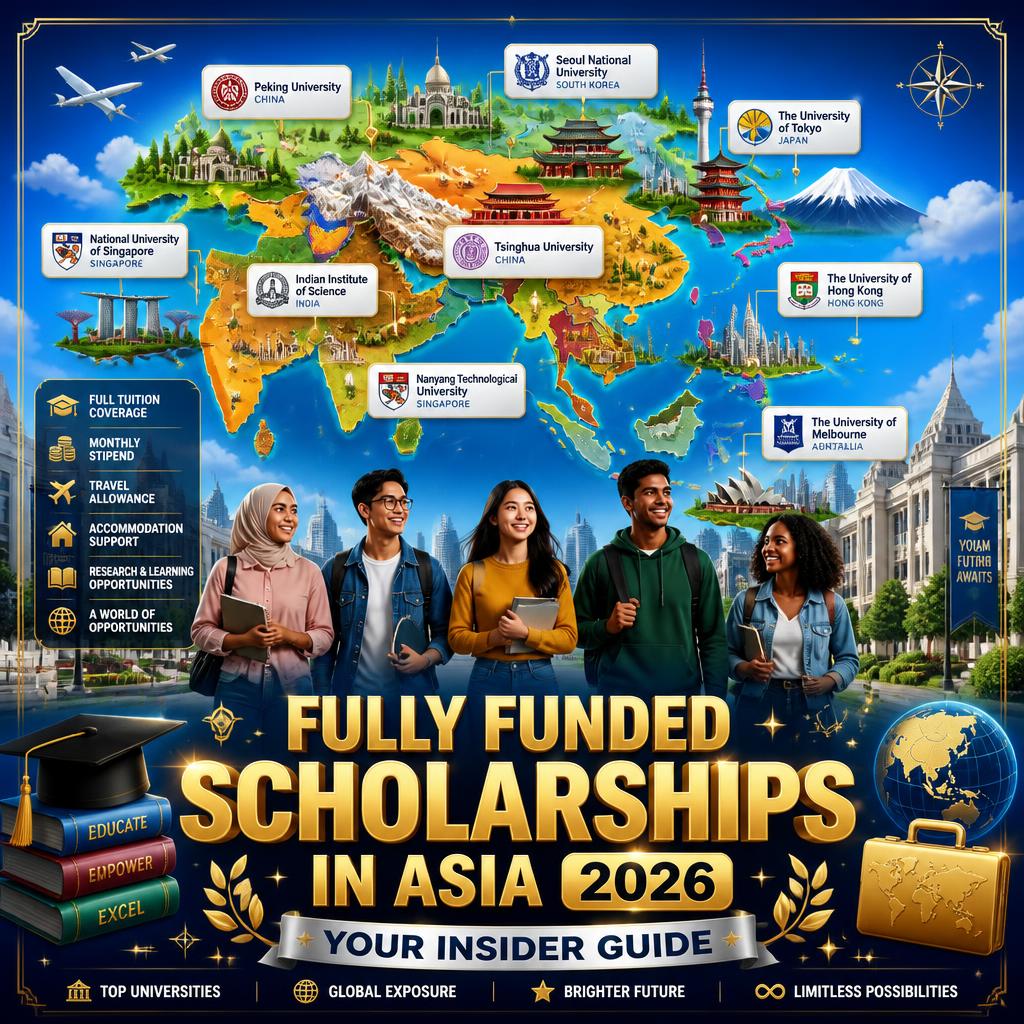
Jaw-Dropping Fully Funded Scholarships to Study in Asia That Most Brilliant African Students Dangerously Overlook in 2026
Table of Contents
ToggleIntroduction: Asia Is Calling—and Almost Nobody From Africa Is Picking Up
You’ve applied for Chevening twice. You’ve refreshed the Fulbright portal every October like it owes you money. You’re talented, motivated, and absolutely serious about studying abroad—but every scholarship feels like a lottery with 50,000 tickets and five prizes.
Here’s what nobody has told you clearly enough: some of the most generous fully funded scholarships in the world right now are sitting in Asia, waiting for African applicants who never show up.
We’re talking about programs funded by Japan, China, South Korea, Malaysia, Thailand, Indonesia, and Singapore—governments with serious money, serious ambitions for international students, and a remarkable shortage of African applicants relative to the funding available. While your peers are fighting for 15 Chevening spots alongside 80,000 other applicants, students who know about these Asian scholarships are walking through doors that are practically wide open.
This guide will show you exactly which scholarships those are, what they cover, whether you qualify, and how to build an application that wins. You’ll finish this post knowing more about fully funded study-abroad opportunities in Asia than 95% of African students currently applying for international scholarships.
That’s not an exaggeration. It’s just an information gap—one you’re about to close.
Quick Summary Box
✅ What this guide covers: Verified, fully funded scholarships in Asia for 2026 that African students consistently overlook, plus step-by-step application guidance
✅ Key benefits you’ll gain: A curated list of low-competition opportunities, an eligibility checklist, and a complete action plan you can start today
✅ How to use this post: Read straight through once to understand the landscape, then return to bookmark the specific scholarships that match your field, level, and nationality
Why Asia Should Already Be on Your Scholarship Radar—and Why It Isn’t
Let’s be honest about something. For many African students, “study abroad” means one of three places: the UK, the US, or sometimes Canada. Europe occasionally makes the list. Asia? It feels distant—culturally, linguistically, and logistically.
That psychological distance is costing African students millions of dollars in unclaimed scholarship funding every single year.
The misconception driving this gap is that Asian universities are somehow second-tier. They are not. The University of Tokyo, National University of Singapore, Peking University, Seoul National University, and KAIST (Korea Advanced Institute of Science and Technology) all rank consistently among the top 50 universities in the world. These are not consolation prizes. These are world-class institutions offering fully funded places to African students who apply.
According to UNESCO’s 2023 Global Education Monitoring Report, international student mobility to East and Southeast Asia has grown by over 40% in the past decade—yet African student participation remains disproportionately low, hovering under 8% of total international enrollment in most Asian countries. The funding is there. The welcome mat is out. The African applicants simply aren’t arriving.
The reason isn’t lack of qualification. It’s lack of information.
Consider Chidi O., a 29-year-old civil engineer from Enugu, Nigeria, who applied to the Japanese Government MEXT Scholarship in 2022 after stumbling across it in a Facebook group. He was the only applicant from his state that year. He got in. He’s now completing his master’s degree at Osaka University—fully funded, with a monthly stipend that covers his living costs comfortably.
Or Fatima N., a 33-year-old public health officer from Dar es Salaam who applied for the Chinese Government Scholarship (CSC) after her colleague mentioned it in passing. She applied in a field—health informatics—where the CSC receives fewer African applications than almost any other discipline. She’s now at Sun Yat-sen University in Guangzhou, stipend intact, tuition paid, future bright.
Both of them will tell you the same thing: the hardest part wasn’t the application. It was finding out these scholarships existed.
You’ve already cleared that hurdle. Now let’s go further.
What “Fully Funded” Actually Means When Asia Is the Destination
Before you fall in love with a scholarship listing and invest weeks into an application, you need to understand precisely what “fully funded” means—because the phrase means different things in different programs, and the gap between expectation and reality can be financially painful.
A genuinely fully funded scholarship covers, at minimum: full tuition fees, a monthly living stipend, round-trip international airfare, and health insurance. The best Asian programs add research allowances, language training before the program begins, accommodation in university housing, and arrival settlement grants.
Here’s how the scholarship landscape breaks down:
- Fully funded: Everything above, included; you arrive with nothing and live comfortably
- Partially funded: Tuition covered, but living costs, accommodation, and travel are your responsibility
- Tuition waiver only: Academic fees removed; you fund everything else entirely
- Research grant: A lump sum for research costs only; not a living or tuition award
- Work-study: You earn your living expenses through campus employment during your studies
The scholarships profiled in this guide are fully funded in the genuine sense—not the optimistic marketing sense.
Take the Japanese Government MEXT Scholarship as a real example. It covers full tuition at a Japanese national university, a monthly stipend of approximately ¥117,000–¥145,000 (roughly $780–$970 USD depending on your level), and round-trip economy airfare. Accommodation is typically in university housing at subsidized rates. Health insurance is covered under Japan’s national system with a small co-pay structure.
Now compare that to the Chinese Government Scholarship (CSC). It covers full tuition, accommodation in university dormitories, comprehensive health insurance, and a monthly stipend ranging from CNY 2,500 to CNY 3,500 (approximately $345–$485 USD). It also includes a settling-in allowance on arrival.
Both are genuinely fully funded. But the stipend levels, accommodation quality, and health coverage differ meaningfully. The informed choice is the one made after reading the fine print on both.
When scanning any scholarship description, look specifically for these four words: “accommodation,” “stipend,” “travel,” and “health.” If any of those are absent from the award description, dig into the program’s FAQ or contact the program coordinator directly before investing time in your application.
What “fully funded” typically does not cover: your visa application fee (usually $100–$350), personal spending beyond the stipend, family dependant costs, and any academic materials or equipment your department doesn’t supply. Plan for these costs separately so they don’t catch you off guard.
An informed applicant is an empowered one—and empowered applicants win.
How to Build Your Asia Scholarship Database Before the Crowd Arrives
Finding rare, low-competition scholarships isn’t about luck. It’s about having a better search system than everyone else. Here is the exact process for building a curated database of fully funded Asian scholarship opportunities in 2026.
Step 1: Start with official government scholarship portals, not aggregator websites.
Aggregator sites like Opportunity Desk, Scholars4Dev, and AfricaScholarships.net are useful, but they often publish scholarship information weeks after the official portals do. By the time a scholarship trends on social media, competition has already spiked. Go directly to the source:
- Japan: MEXT official scholarship portal for the Japanese Government Scholarship
- China: China Scholarship Council (CSC) at csc.edu.cn for the Chinese Government Scholarship
- South Korea: National Institute for International Education (NIIED) portal for the Global Korea Scholarship (GKS)
- Malaysia: Education Malaysia Global Services (EMGS) portal for Malaysian government scholarships
- Thailand: Royal Thai Government Scholarship Program portal
- Indonesia: Beasiswa Indonesia Bangkit and LPDP International programs
- Singapore: ASEAN Scholarships and NUS/NTU university-specific international funding pages
Step 2: Filter by your nationality before anything else.
Not every Asian scholarship is open to every African country. Some programs operate on bilateral agreements—meaning your home country must have a formal education partnership with the host country. Check this first to avoid wasting time on programs you’re ineligible for. Your home country’s Ministry of Education website or the host country’s embassy in your capital city will have the definitive list.
Step 3: Use field-specific search terms to surface hidden opportunities.
Don’t just search “scholarships in Japan.” Search “scholarships in Japan for agriculture,” “scholarships in South Korea for public health,” or “scholarships in China for urban planning.” Many niche-field programs receive dramatically fewer applications than general programs—and the funding is equally generous.
Step 4: Set up Google Alerts for hyper-specific terms.
Create alerts for phrases like “scholarship Africa Japan 2026 open,” “CSC scholarship African countries deadline,” and “MEXT scholarship Nigeria 2026.” You’ll receive email notifications the moment new information is published—often before any scholarship influencer has seen it.
Step 5: Join the right online communities.
Search Facebook for groups like “MEXT Scholars Africa,” “CSC Scholarship African Students,” and “GKS Scholarship Nigeria/Ghana/Kenya.” These communities share insider tips, application feedback, and real-time deadline updates that you won’t find on any official portal.
Step 6: Verify legitimacy before you invest time.
A real scholarship never asks for money upfront—not for application processing, not for “registration fees,” not for courier costs. Verify every scholarship by cross-referencing the program name on the host country’s official government or university website. If you can’t find the scholarship there, treat it as a potential scam until proven otherwise.
Your scholarship database is your competitive moat—the deeper you dig, the further ahead you get.
Are You Eligible? The Complete Checklist for Asian Scholarships in 2026
Eligibility requirements vary by program, but most fully funded Asian scholarships share a common framework. Use this checklist to assess your position before you invest time in any application.
Standard Eligibility Categories:
- ✅ Citizenship: You must hold citizenship of an eligible developing country—most African nations qualify for Japanese, Chinese, Korean, and Malaysian programs
- ✅ Academic performance: Most programs require a minimum of second-class upper (2:1) or GPA 3.0/4.0 equivalent; some accept lower GPAs where professional experience compensates
- ✅ Language proficiency: English-taught programs require IELTS 6.0–6.5 or TOEFL iBT 79–90; Chinese-taught programs may require HSK certification; Japanese programs may require JLPT or accept applicants into language training pre-program
- ✅ Prior education: Completed bachelor’s degree for master’s programs; completed master’s degree for doctoral programs
- ✅ Age range: MEXT has a maximum age of 34 for research students; CSC has no formal age cap for most tracks; GKS caps at 40 for graduate applicants—these ranges actively favor non-traditional adult applicants
- ✅ Work experience: JJ/WBGSP and some Korean government programs require 2–5 years of professional experience; others treat it as a bonus
- ✅ Field of study: Check whether your intended discipline is available at partner universities in your chosen country
- ✅ Financial need: Some programs (Taiwan ICDF, certain ASEAN scholarships) assess financial background alongside merit
Adult-Specific Flags to Note:
Employment gaps: Programs like MEXT and CSC do not penalize applicants for time spent working between degrees. They evaluate the totality of your profile—not whether you followed a linear academic path.
Prior work certifications: Professional certifications, licenses, and workplace training records count as supporting documentation in programs that value applied expertise alongside academic achievement.
Community leadership: Scholarship committees for Korean Government Scholarships specifically note leadership experience and community service as evaluation criteria. Your years of professional and community engagement are scoring categories, not background noise.
Are You Eligible? Quick Self-Assessment
Answer these four questions in 60 seconds:
- ✅ Is my country listed as eligible on the official scholarship portal? (Yes/No)
- ✅ Do I hold the required degree level for the program I’m targeting? (Yes/No)
- ✅ Do I meet the minimum GPA requirement—or have strong professional experience to supplement a lower GPA? (Yes/No)
- ✅ Is my intended field of study available through this program’s partner universities? (Yes/No)
Four yes answers: Proceed to a full application. Three yes answers: Investigate the one gap—it may be bridgeable. Two or fewer: Research alternative programs before investing further time.
A real example of how eligibility works: The Korean Government Scholarship (GKS) evaluates graduate applicants on a composite score that includes academic achievement (30%), language ability (20%), and a personal statement and interview (50%). That means a student with a 3.1 GPA and compelling professional experience and a strong personal statement can outperform a 3.9 GPA student with a generic application. The weighting explicitly rewards depth of story over raw grades.
Knowing your eligibility precisely is the difference between a wasted application and a winning one.
The Rare Fully Funded Scholarships in Asia for 2026 You Need to Know
Here are the programs that most African students are walking right past. Each one is verified, currently operational, and significantly undersubscribed by African applicants relative to the funding available.
1. Japanese Government MEXT Scholarship
Why it’s overlooked: Japan feels intimidating. The language barrier myth stops most applicants before they even read the eligibility criteria. The reality? Many MEXT programs are delivered entirely in English, and even Japanese-taught programs include a fully funded language preparation year before your academic program begins.
Who funds it and why: The Japanese Ministry of Education, Culture, Sports, Science and Technology funds this program as part of Japan’s international education diplomacy strategy. Japan specifically targets students from Asia, Africa, and the Middle East to diversify its universities and strengthen bilateral relationships.
What it covers: Full tuition at a Japanese national university, monthly stipend of approximately ¥117,000 (undergraduate) to ¥145,000 (doctoral), round-trip economy airfare, and health insurance through Japan’s national system.
Fields available: Engineering, science, agriculture, medicine, social sciences, humanities, and education. The breadth is exceptional.
Why African applicants are competitive: Japan’s universities are actively trying to increase African enrollment. In many African countries, the MEXT scholarship receives fewer than 200 applications for 5–15 spots. Your odds are materially better than almost any Western scholarship.
Application channels: Apply either through the Japanese Embassy in your country (embassy-recommended track) or directly through a Japanese university (university-recommended track). The embassy track is typically open from May to August in most African countries. Visit the official MEXT scholarship information page to confirm your country’s specific cycle.
2. Chinese Government Scholarship (CSC — Full Scholarship Track)
Why it’s overlooked: Most African students who know about the CSC scholarship apply for it through the university self-recommendation track—meaning they contact universities directly. Far fewer know about the Chinese Government’s bilateral agreement track, where applications go through your home country’s Ministry of Education and competition is dramatically lower.
Who funds it and why: The Chinese Scholarship Council (CSC), under China’s Ministry of Education, funds this program as part of China’s “Belt and Road” educational engagement strategy. Africa is an explicit priority region.
What it covers: Full tuition, on-campus accommodation, comprehensive health insurance, monthly stipend (CNY 2,500 for undergraduates, CNY 3,000 for master’s students, CNY 3,500 for doctoral students), and a one-time settling-in allowance.
Fields prioritized: Science, technology, engineering, mathematics, medicine, agriculture, and economics—though humanities and arts programs exist at select universities.
The bilateral track advantage: In countries like Ghana, Ethiopia, Kenya, Nigeria, and South Africa, the Ministry of Education nominates candidates for a set quota of CSC bilateral slots. Competition happens at the national level—often involving hundreds rather than thousands of applicants. If your ministry is under-nominating its full quota (common in several African countries), your chances improve further.
Practical action: Contact your home country’s Ministry of Education scholarship unit directly to ask about CSC bilateral quota slots for 2026. Don’t assume this information will come to you—it often doesn’t.
3. Korean Government Scholarship (GKS / KGSP)
Why it’s overlooked: South Korea’s scholarship programs are moderately known globally, but African applicant numbers remain disproportionately low relative to other regions. Korea has been actively increasing its African recruitment targets since 2022, meaning the moment of maximum advantage for African applicants is right now—before competition catches up.
Who funds it and why: The National Institute for International Education (NIIED) under South Korea’s Ministry of Education funds GKS as part of Korea’s “Study Korea 300K” initiative, which aims to attract 300,000 international students by 2027. Africa is a stated growth market.
What it covers: Full tuition, round-trip economy airfare, monthly stipend of KRW 900,000–1,000,000 (approximately $650–$750 USD), arrival allowance, departure allowance, health insurance, and one year of Korean language training before your program begins.
Fields available: All major disciplines at over 60 partner Korean universities, with particular strength in engineering, IT, business, and Korean studies.
Embassy track vs. university track: Apply through the Korean Embassy in your country (embassy track) for better odds if you’re an African applicant. The embassy track has a smaller applicant pool and gives preference to countries with strong bilateral relationships with Korea—which includes most African nations.
Adult applicant note: GKS graduate programs accept applicants up to age 40. If you’re a working professional in your late 20s or 30s, you’re squarely within the target profile—especially if your field aligns with Korea’s development cooperation priorities.
4. Malaysian International Scholarship (MIS)
Why it’s overlooked: Malaysia rarely appears on the African student’s scholarship map, and that invisibility is one of the most expensive blind spots in the scholarship-hunting world. Malaysia’s universities—particularly UTM, UM, UPM, and UKM—deliver world-class education in English, in an environment that’s culturally diverse, relatively affordable, and significantly less competitive than Western destinations.
Who funds it and why: The Malaysian Ministry of Higher Education funds MIS to attract outstanding international students and position Malaysia as a global education hub. The program specifically targets students from OIC (Organisation of Islamic Cooperation) member states and Commonwealth nations—both categories that include most African countries.
What it covers: Full tuition, monthly stipend of RM 1,500 (approximately $320 USD), a one-time book allowance, and health insurance. Accommodation support is provided through the university.
Fields prioritized: Science, technology, engineering, mathematics, Islamic studies, agriculture, and environmental management.
Why competition is low from Africa: Most African scholarship hunters don’t think of Malaysia. That means the African applicant pool for MIS is genuinely thin, even though eligibility is broad. Your application will not get lost in a pile of 50,000 competing files.
Application process: Apply through the Malaysian Ministry of Higher Education’s scholarship portal, which typically opens in early 2026. Your country’s Malaysian High Commission also provides application guidance.
5. ASEAN Scholarships — Singapore (for Non-ASEAN Nations via Partner Programs)
Why it’s overlooked: Most people assume ASEAN scholarships are only for Southeast Asian students. While the core ASEAN scholarship targets ASEAN member nations, the National University of Singapore (NUS) and Nanyang Technological University (NTU) offer separate, fully funded scholarships to international students from developing nations—including African countries—that are dramatically undersubscribed.
NUS Research Scholarship and NTU Research Scholarship fund doctoral and research master’s students with full tuition, monthly stipends of approximately SGD 2,000–2,500 (roughly $1,500–$1,850 USD), and health insurance.
Why this matters: Singapore is consistently ranked among the top five most competitive education systems in the world. An NUS or NTU doctorate is globally recognized at the very highest level. Yet African PhD applicants to these universities remain vanishingly rare.
How to apply: Apply directly through NUS Graduate Admissions or NTU’s Graduate Studies Office. The research scholarship is linked to your doctoral application—when you apply for a PhD place, you simultaneously apply for the funding. Admission and scholarship are evaluated together.
Fields prioritized: Data science, engineering, environmental science, public policy, biomedical sciences, and business.
Your competitive edge: NUS and NTU actively seek to diversify their doctoral cohorts geographically. An African applicant with strong research credentials and a compelling proposal is a rare and welcome addition to a department that sees mostly Asian and European applications.
6. Thailand International Postgraduate Programme (TIPP) and Royal Thai Government Scholarships
Why it’s overlooked: Thailand is primarily on Africa’s radar as a travel destination, not an education destination. That’s a misconception worth correcting urgently.
Royal Thai Government Scholarships are offered annually to students from countries that have diplomatic relations with Thailand—which includes most African nations. The program is administered through Thailand’s Ministry of Foreign Affairs and the Office of the Higher Education Commission.
What it covers: Full tuition at Thai public universities, monthly living allowance, accommodation support, health insurance, and round-trip economy airfare.
Fields available: Science and technology, agriculture, natural resources, engineering, and health sciences—with strength in tropical medicine and agricultural biotechnology.
Why this is particularly valuable for African students: Thailand has world-leading research programs in tropical agriculture, aquaculture, tropical medicine, and food science—fields that are directly relevant to African development challenges. Studying these disciplines at their source gives you expertise that’s both globally recognized and locally applicable when you return home.
TIPP (Thailand International Postgraduate Programme): Separately, TIPP funds international students to pursue master’s and doctoral degrees at leading Thai universities including Mahidol, Chulalongkorn, and Kasetsart. Applications typically open in October–November for the following academic year.
7. Indonesian Government Scholarship (Beasiswa Indonesia Bangkit — KNB Scholarship)
Why it’s overlooked: Indonesia is the fourth most populous nation on earth, has a rapidly growing economy, and hosts universities with genuinely strong programs in Islamic studies, agriculture, marine science, and engineering. Yet the KNB (Kemitraan Negara Berkembang) scholarship—specifically designed for students from developing countries including African nations—receives almost no attention from African applicants.
Who funds it and why: Indonesia’s Ministry of Education and Culture funds KNB as part of its South-South cooperation educational diplomacy. Africa is explicitly listed as a priority region.
What it covers: Full tuition, monthly living allowance, accommodation in university housing, health insurance, round-trip economy airfare, and Indonesian language training before the academic year begins.
Fields available: Agriculture, marine science, Islamic education, economics, engineering, and environmental science.
Why the competition is almost nonexistent from Africa: The KNB scholarship is simply not on the African scholarship conversation radar. In some participating African countries, fewer than 50 students apply for 5–10 available spots. That’s a 10–20% acceptance rate—a figure that would be unthinkable for most Western scholarships.
Application process: Apply through the Indonesian Embassy in your home country or directly through the KNB portal managed by Indonesia’s Ministry of Education. Applications typically open in January–March.
8. ADB-Japan Scholarship Program (ADB-JSP) — Multiple Asian Countries
Why it’s overlooked by Africans: The Asian Development Bank scholarship is typically discussed in the context of Asian applicants. What many people don’t know is that ADB-JSP is open to nationals of ADB developing member countries, and several African nations are classified as ADB members—including South Africa, Nigeria, Egypt, and others. Check your country’s ADB membership status carefully.
What it covers: Full tuition at ADB-designated postgraduate institutions across Asia (Japan, Philippines, Thailand, India, Sri Lanka, and others), monthly living allowance, economy airfare, health insurance, and examination and thesis preparation fees.
Fields prioritized: Economics, management, science and technology, and other development-related fields.
Why it’s valuable: ADB partner universities include prestigious institutions like the University of Tokyo, Asian Institute of Technology in Bangkok, and the National University of Singapore. The ADB network itself—connecting you to one of the world’s most influential development finance institutions—is a career asset beyond the degree.
Eligibility note: You must be under 35 at the time of application, hold a bachelor’s degree, have at least two years of professional development-related work experience, and be employed at the time of application. This is explicitly a scholarship for working development professionals.
Crafting Your Application for Asian Scholarships: A Step-by-Step Guide
The good news about low-competition scholarships is that you’re not anonymous. The selection committee reads every application carefully. The better news is that careful, thoughtful applications win. Here is your complete step-by-step process.
Step 1: Create your official account on the program portal—immediately.
Don’t wait until a week before the deadline. Create your account the moment the portal opens. For MEXT, that means registering with your Japanese Embassy’s scholarship office in May. For GKS, it means preparing your Korean Embassy application package in February. Early registration ensures you receive deadline reminders and system updates directly.
Step 2: Gather your documents before the portal opens—not after.
You’ll need: official academic transcripts (allow 2–4 weeks for certified copies), certified translations where required, your international passport (valid for at least 18 months beyond your program start date), two or three reference letters from academic supervisors or professional supervisors, proof of language proficiency (IELTS, TOEFL, or equivalent), and a current curriculum vitae.
For adult applicants, you’ll also need: professional certifications, employment reference letters, and any community leadership documentation. Start collecting these eight weeks before your deadline—not the week of.
Step 3: Draft your personal statement or research proposal first—before you fill in the form.
The personal statement is where Asian scholarship applications are won or lost. For MEXT, you’ll write a research plan that must be specific, feasible, and clearly connected to your academic background and future goals. For GKS, your statement must demonstrate why Korea specifically, why this program specifically, and what you’ll contribute to Korea-Africa relations.
A generic statement fails every time. Write specifically: name the professor you want to work with, name the research gap you’re addressing, name the community you’ll serve when you return home.
Step 4: Request your reference letters at least six weeks before the deadline.
Brief your referees on the scholarship’s specific values. If GKS prioritizes community leadership, explicitly ask your referee to address your community work. If MEXT prioritizes research potential, ask your academic supervisor to speak directly to your research capabilities. Don’t leave your referees to guess what matters.
Step 5: Review every document for formatting requirements before uploading.
Many Asian scholarship portals have strict file size limits, format requirements (PDF only, specific DPI for scanned documents), and naming conventions. A technically rejected document can disqualify an otherwise perfect application. Read the submission guidelines three times.
Step 6: Submit at least 72 hours before the deadline.
Portal crashes happen. Upload failures happen. Time zones cause confusion. Build in three days of buffer and submit early.
Step 7: Follow up to confirm receipt.
Send a brief, professional email to the scholarship coordinator confirming your application was received and asking if there’s anything additional they need. Few applicants do this. It signals genuine interest and professionalism—both of which selection committees notice.
⚠️ 5 Mistakes That Cost Applicants (Avoid These)
- Writing a generic personal statement that doesn’t mention the specific country, university, or field of research—committees read thousands of these and spot them instantly
- Ignoring the research proposal requirement for MEXT and ADB-JSP—a vague research idea signals unpreparedness more loudly than a low GPA
- Choosing referees based on seniority rather than knowledge of your work—a department head who barely knows you is weaker than a direct supervisor who can speak specifically to your strengths
- Missing the national nomination deadline—many Asian scholarships have two deadlines: one at your Ministry of Education and one at the scholarship body; miss the first and the second becomes irrelevant
- Applying for programs without confirming your country’s bilateral agreement—ineligibility discovered after submission wastes weeks of your time and all of your effort
Give yourself 8–10 weeks minimum from decision to submission—adult applicants especially need time to gather professional documentation, coordinate with former supervisors for references, and arrange certified translations of work certifications.
Preparation doesn’t guarantee success, but it eliminates the mistakes that guarantee failure.
Positioning Your Story: Why Your African Professional Background Is a Winning Asset
Every scholarship committee is asking one fundamental question when they review your file: “Why is this person the right choice for our program?”
Your answer cannot be “because I’m smart and hardworking.” Every applicant is smart and hardworking. Your answer must be specific, personal, and grounded in a story only you can tell.
For Asian scholarships, that story has a particularly powerful shape: you are an African professional or emerging leader with firsthand experience of the development challenges your country faces, and you are seeking world-class Asian expertise to address those challenges when you return home.
That narrative lands. It’s precisely what Japan, China, Korea, and Malaysia are hoping to fund through their scholarship programs. Your African context isn’t just relevant—it’s the entire point.
Here’s how to build that narrative across three practical essay frameworks:
Framework 1: “The Problem I Cannot Solve Yet”
Describe a specific development challenge you’ve encountered in your work or community. Explain precisely what expertise you lack to solve it. Then show how this specific program, in this specific country, provides exactly that expertise. This framework works powerfully for MEXT research applications and ADB-JSP.
Framework 2: “The Bridge Between Two Worlds”
Position yourself as the connection point between your African community’s needs and the Asian innovation or knowledge that addresses them. Explain what you’ll carry back home and how you’ll deploy it. This framework resonates with GKS and Malaysian International Scholarship committees who are explicitly funding future bilateral bridges.
Framework 3: “From Practitioner to Expert”
If you have professional experience, this framework is yours. Show how your years of on-the-ground practice have given you a precise understanding of what theory and research you still need. Explain why a graduate degree is the logical next step in a career already in motion. This framework is particularly strong for CSC bilateral track applications and MEXT research student programs.
“I stopped writing about what I wanted to achieve and started writing about what I already knew from working in healthcare for six years. The moment I centered my community’s needs instead of my personal ambitions, the personal statement finally felt true.”
— Blessing E., MEXT Scholar, 2023, age 33, Public Health, Osaka University
Generic statement: “I am applying for this scholarship because I want to further my education and contribute to my country’s development.”
Adult perspective statement: “Seven years of managing nutrition programs in rural Zambia have taught me what textbooks cannot: that food insecurity in our region is not a supply problem—it’s a postharvest loss problem. I am applying to Kasetsart University’s Food Science doctoral program specifically because Thailand’s research on low-cost cold-chain solutions for tropical agricultural systems is directly applicable to the challenge I face every single day at work.”
One of those statements wins. The other gets filed away.
Authenticity is the one differentiator that cannot be faked, copied, or manufactured by any competitor.
The 2026 Asia Scholarship Application Timeline
| Date Range | Milestone |
|---|---|
| September–October 2025 | Research phase: Confirm bilateral agreements, identify target programs, request academic documents |
| October–November 2025 | KNB (Indonesia) and Thailand scholarship portals open; contact referees now |
| November 2025 | Malaysian International Scholarship portal opens; CSC bilateral track inquiry to your Ministry begins |
| January–February 2026 | Korean Embassy track applications open in most African countries; KNB final deadlines |
| February–March 2026 | CSC Chinese Government Scholarship bilateral track applications open |
| March–April 2026 | ADB-JSP applications open; ASEAN/NUS/NTU doctoral applications open (rolling) |
| May–August 2026 | MEXT Embassy-recommended scholarship applications open in most African countries |
| June–July 2026 | GKS shortlisting and interview notifications; CSC first-round decisions |
| August–September 2026 | Final offer letters from MEXT, GKS, and Malaysian programs |
| September–October 2026 | Program commencement for most Asian scholarship cohorts; language training begins for MEXT and GKS |
Rolling application note: NUS and NTU research scholarships are evaluated on a rolling basis alongside doctoral admissions—apply as early as September 2025 for the best consideration. ADB-JSP also processes applications on a rolling basis within its window.
Set phone reminders six weeks before every deadline. Documentation for Asian scholarships often requires embassy notarizations, certified translations, and ministry-level endorsements—each running on its own bureaucratic timeline, not yours.
The applicants who plan ahead don’t just submit on time—they submit better applications.
Frequently Asked Questions
Can I apply for Asian scholarships if I’ve never studied outside my home country?
Yes, absolutely. MEXT, CSC, GKS, and Malaysian International Scholarship do not require prior international study experience. What matters is your academic qualification, your language proficiency, and your clearly articulated motivation for choosing that specific country and program. First-time international applicants often write the most compelling motivation letters precisely because their journey is genuinely new and specific.
What if there’s a gap between when I finished my degree and now?
Most Asian government scholarships do not penalize applicants for time gaps between degree completion and application. What they care about is what you did during that time. If you worked, led projects, or contributed to your community, frame those years as deliberate professional development—not a pause. MEXT and CSC specifically evaluate work experience positively.
Can I work part-time while on a fully funded Asian scholarship?
It depends on the host country. Japan allows limited part-time work (up to 28 hours per week) on a student visa with a work permit endorsement, though MEXT scholars are generally expected to focus full-time on their studies. South Korea permits up to 20 hours per week for graduate GKS scholars. China restricts paid employment for CSC scholarship holders. Always verify both the scholarship terms and the host country’s visa work permissions before accepting.
Do I need to live in my home country to apply for these scholarships?
For most programs, your citizenship matters—not your current address. However, scholarships processed through your country’s embassy or Ministry of Education (like the GKS embassy track and MEXT embassy-recommended track) require you to apply through those channels, which may involve in-person steps. If you’re currently based abroad, contact the relevant embassy directly to confirm whether they can process your application remotely.
How long does it take from application to receiving a final enrollment decision?
Expect four to eight months for most programs. MEXT typically takes five to seven months from application through final notification. GKS runs a four to five month cycle from embassy application to final NIIED decision. CSC bilateral track decisions often arrive within three to four months of ministry submission. Build your personal timeline—and your work or family arrangements—around these windows.
Can I reapply for these scholarships if I’m rejected the first time?
Yes—and you absolutely should. Most programs explicitly permit reapplication in subsequent cycles. The critical step after rejection is revising your weakest documents. MEXT applicants who reapply with stronger research proposals and better faculty contact preparation succeed at meaningfully higher rates. Rejection is information about what to improve, not a permanent verdict on your potential.
Are African applicants at a disadvantage compared to Asian applicants for these scholarships?
For the programs in this guide, no—and in most cases, the advantage runs the other way. Japan, China, Korea, Indonesia, and Malaysia are actively trying to increase African enrollment in their scholarship programs. Your African nationality places you in a smaller, more targeted applicant pool for bilateral programs, and your firsthand development experience aligns directly with what these programs are designed to fund. You are not a long shot. You are exactly who these scholarships are looking for.
Every question you’ve been afraid to ask about studying in Asia has a workable, encouraging answer. Now you have them all.
Your Action Plan: The Side Door Is Open—Walk Through It
You just learned about scholarship opportunities that most African students won’t discover until it’s too late to apply in 2026. That’s not a small thing. That’s a genuine edge—and edges only matter if you use them.
Here’s what you’re probably feeling right now: a mix of excitement and that familiar anxiety of “where do I actually start?” Both feelings make complete sense. But excitement without a plan fades. Anxiety without action compounds. So let’s convert both into movement.
Your three immediate action steps:
- Today—open the official portals for your top two target scholarships. Choose based on your field and nationality. If you’re in engineering or science, start with MEXT and CSC. If you’re in public health or agriculture, start with the Thai Royal Government Scholarship and KNB. Create your account or save the page now. Don’t let “I’ll do it later” steal your opportunity.
- This week—request your official academic transcripts and identify two referees. Contact your university’s registrar for official transcript copies today. Certified translations take 2–4 weeks in most African countries. Then identify two people who know your work well enough to write specific, detailed reference letters—and contact them by Friday. Both steps have long lead times that will kill your application if you start them late.
- This month—build your 2026 scholarship calendar using the timeline table in this guide. Enter every relevant deadline into your phone calendar with a six-week pre-reminder. Treat these dates the way you’d treat a job interview—immovable, serious, and worth protecting your time for.
Asia has the funding. Asia has the welcome mat out. Asia is waiting for exactly the kind of applicant you already are.
The only question is whether you’ll show up.
All scholarship details in this guide reflect publicly available 2025–2026 program information. Verify current eligibility criteria, award values, and application deadlines directly on each program’s official website before applying, as program details are subject to revision by awarding bodies.