


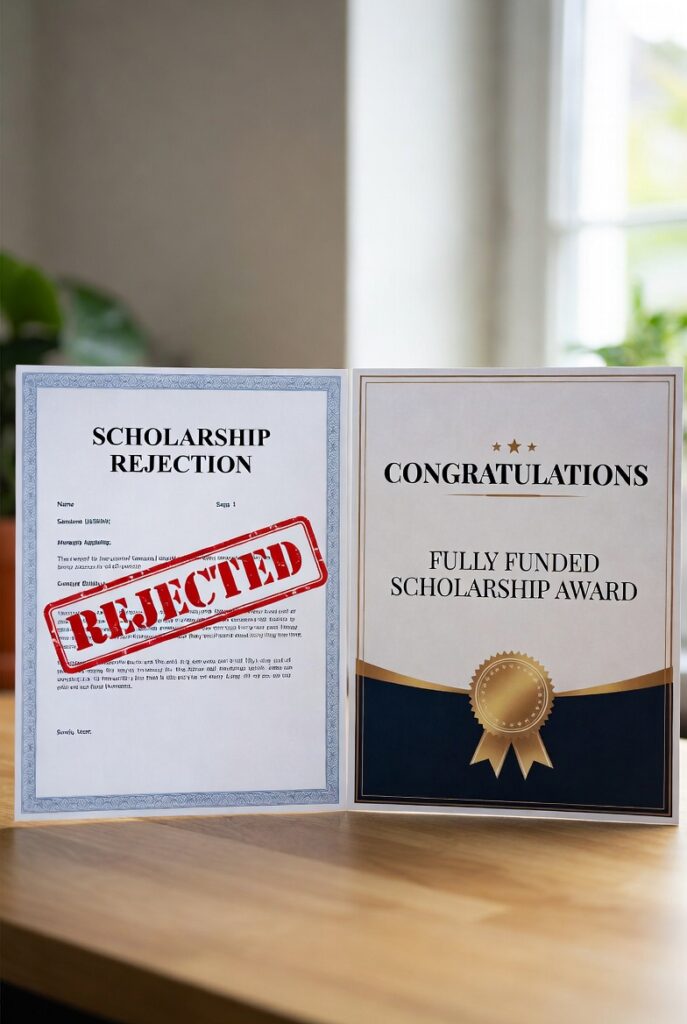
How to Get a Fully Funded Scholarship After Rejection: Real Stories
You applied. You waited. Then the email came — and it wasn’t the one you hoped for.
If you’ve ever been rejected for a fully funded scholarship, you know that specific, hollow feeling. You refreshed your inbox a hundred times. You told your family you were applying. And now you have to tell them it didn’t work out — again.
Here’s what nobody tells you: rejection is not the end of your scholarship journey. It is often the beginning.
In this post, you will discover exactly how real students — including Nigerians and other African applicants — turned multiple rejections into fully funded offers at world-class universities. You’ll learn what they changed, what they wish they’d known earlier, and the specific steps you can take right now to transform your next application.
By the end, you’ll understand why rejection happens, how to diagnose your weak spots, and how to build an application that scholarship committees cannot ignore.


📦 Quick Summary Box
What this guide covers: Strategies to win a fully funded scholarship after previous rejection — including real success stories, application fixes, and insider tips
Who this is for: Any student — especially Nigerian and African applicants — who has been rejected at least once and wants a proven roadmap to succeed
Action deadline: Don’t wait. Major scholarship windows (Chevening, Commonwealth, DAAD, MasterCard Foundation) open between August and November each year. Start preparing NOW.
Your comeback story starts today. Let’s build it together.
SCHOLARSHIP OVERVIEW: Why Rejection Is More Common Than You Think
Let’s talk numbers — because the statistics will both shock you and encourage you.
The Chevening Scholarship receives over 65,000 applications annually for roughly 1,500 awards worldwide. That’s an acceptance rate of barely 2%. The Commonwealth Scholarship accepts fewer than 1 in 20 eligible applicants. The MasterCard Foundation Scholars Program at the University of Toronto admits students from a pool where the majority are first-time applicants who previously applied elsewhere and were turned down.
Rejection, in other words, is the norm — not the exception.
The fully funded scholarship landscape was not designed to reward the most brilliant people on the first try. It rewards the most prepared, most persistent, and most self-aware applicants. That distinction matters enormously.
Here’s a brief overview of the major fully funded scholarships that African and Nigerian students target most — and the scale of competition you’re entering:
- Chevening Scholarship (UK): Funded by the UK Foreign, Commonwealth & Development Office. ~1,500 awards yearly. Open to over 160 countries including Nigeria.
- Commonwealth Scholarship (UK): Funded by the UK government. Targets low- and middle-income Commonwealth countries — Nigeria is specifically eligible.
- DAAD Scholarship (Germany): Funded by the German Academic Exchange Service. Over 100,000 scholars supported globally each year.
- MasterCard Foundation Scholars Program: Targets young Africans with demonstrated leadership. Operates across 30+ universities.
- Gates Cambridge Scholarship (UK): ~80 awards per year globally. Extraordinarily competitive. Past scholars have reapplied 2–3 times before winning.
At a Glance
| Host Country | Funded By | Available To | Typical Deadline |
|---|---|---|---|
| United Kingdom | UK FCDO / Commonwealth | 160+ countries incl. Nigeria | October – November |
| Germany | DAAD / German Federal Gov. | Worldwide | October – January |
| USA | Various (Fulbright, etc.) | Selected countries | October – December |
| Global (Africa-focused) | MasterCard Foundation | African students | Varies by university |
The point is simple: you are competing against thousands of brilliant people, and most of them have also been rejected before. Knowing that should not discourage you — it should liberate you.
Your rejection letter was not a verdict. It was feedback. Now, let’s read it properly.
WHAT FULLY FUNDED ACTUALLY COVERS
Before you apply again, make sure you understand exactly what you’re applying for — because knowing the full value of a fully funded award sharpens your motivation and strengthens your essays.
Here’s what a typical fully funded scholarship covers:
- ✅ Full tuition fees — 100%, regardless of your programme cost (some UK programmes cost £30,000+ per year)
- ✅ Monthly living stipend — typically £1,300–£1,600/month for UK scholarships (Chevening: ~£1,100; Commonwealth: ~£1,300); €850–€1,200/month for DAAD
- ✅ Return airfare — economy-class flights from your home country to the host country, and back
- ✅ Health insurance / NHS surcharge — fully covered; you won’t pay the UK’s £776/year immigration health surcharge
- ✅ Visa application fees — reimbursed or covered directly
- ✅ Arrival allowance — a one-off payment (often £500–£1,000) to help you settle in
- ✅ Thesis/dissertation grant — some awards (DAAD, Gates Cambridge) provide extra funding for fieldwork or research
- ✅ Conference and networking funding — certain programmes fund attendance at academic conferences
- ✅ Study materials — some MasterCard Foundation universities include a laptop grant
What does this mean in practical terms for a Nigerian student?
It means you can study at a top UK or European university for 12–24 months and spend literally ₦0 of your own money on tuition or accommodation. Your stipend — roughly £1,100–£1,600 monthly — covers a shared student flat (£400–£700/month in most UK cities outside London), groceries, and transport, with money left over. Many Nigerian scholars on Chevening and Commonwealth scholarships report saving a small amount each month. You are not just getting an education — you are getting a life-changing financial runway.
Understanding what’s at stake is the fuel that will carry you through another application cycle.
ELIGIBILITY REQUIREMENTS: Can You Apply Again After Rejection?
Yes. Emphatically, yes. Most fully funded scholarships explicitly allow — and even encourage — reapplication. But eligibility rules vary, so check each programme carefully.
Here are the general eligibility requirements that apply across most major fully funded scholarships:
- ✅ Nationality: You must be a citizen of an eligible country. Nigeria appears on the eligible list for Chevening, Commonwealth, DAAD, MasterCard Foundation, and many others.
- ✅ Academic qualification: A minimum of a second-class upper (2:1) bachelor’s degree or its equivalent. Some programmes (DAAD, Gates Cambridge) prefer a distinction/first class or master’s-level entry.
- ✅ Work experience: Chevening requires a minimum of 2 years of work or leadership experience post-undergraduate. Commonwealth varies by category (some are for early-career, some for mid-career professionals).
- ✅ Age: Most scholarships have no upper age limit; some (MasterCard Foundation) target applicants under 35.
- ✅ Leadership potential: Almost every scholarship asks for demonstrated leadership — not a title, but evidence of impact.
- ✅ English proficiency: IELTS or TOEFL scores are typically required unless you studied in English at an accredited institution.
- Chevening IELTS minimum: 6.5 overall, no band below 5.5
- Commonwealth: 6.0–6.5 depending on university
- DAAD (English programmes): 6.5 IELTS or TOEFL 90+
- ✅ University admission: For most awards, you must hold (or obtain) an offer from a qualifying university.
- ✅ No current scholarship: You usually cannot hold two fully funded scholarships simultaneously.
🧪 Are You Eligible? — 3 Quick Self-Assessment Questions
Ask yourself these three questions honestly:
- Do you hold a bachelor’s degree with at least a 2:1, from an institution in an eligible country? If yes, you clear the academic bar for most scholarships.
- Can you demonstrate leadership impact — not just a title, but a story of change you drove? If you can name one specific moment where your action improved something for others, you have material to work with.
- Do you have an IELTS score of 6.5 or above — or did you complete your degree entirely in English? If your degree was taught in English at a Nigerian university, many programmes will waive the formal test requirement. Confirm this with each specific scholarship portal.
Nigerian applicants are specifically and enthusiastically eligible for Chevening, Commonwealth, DAAD, and MasterCard Foundation scholarships. Nigeria is one of the highest-sending countries for Chevening scholars, which means the pathway is well-established and achievable.
If you answered yes to all three questions, there is no legitimate reason you cannot win this scholarship on your next attempt.
HOW TO APPLY: Step-by-Step After a Rejection
This is the section that changes everything. Here’s exactly how to approach your next application — not as a repeat attempt, but as a strategic reinvention.
Step 1: Request or Analyse Your Rejection Feedback (Week 1)
Some scholarships (Chevening, Gates Cambridge) provide brief feedback on request. Email the scholarship body’s official address and ask politely. Even if they decline, sit with your previous application and identify the three weakest sections yourself. This step takes 2–4 hours but is the most valuable thing you can do.
Step 2: Register or Log Back into the Official Portal (Week 1–2)
- Chevening: chevening.org/apply
- Commonwealth: cscuk.fcdo.gov.uk
- DAAD: daad.de/en
- MasterCard Foundation: Check individual partner university portals
Create a fresh account or update your existing profile. Don’t reuse last year’s essays — not a single line.
Step 3: Gather and Update Your Documents (Week 2–4)
You’ll need:
- 📄 Official academic transcripts (must be up to date)
- 📄 Two strong reference letters (new referees if possible — more on this in Tips)
- 📄 Valid international passport (minimum 6 months validity beyond programme end)
- 📄 Updated CV (max 2 pages, achievements-focused)
- 📄 Personal statement / leadership essays (completely rewritten)
- 📄 IELTS certificate (if required — valid for 2 years from test date)
- 📄 University admission letter (apply to universities simultaneously)
Step 4: Apply to Universities First (Week 3–6)
Many applicants make the fatal mistake of waiting. Apply to 3–5 qualifying universities before the scholarship deadline closes. This takes 2–5 weeks per application.
Step 5: Write Your Essays — One Section Per Day (Week 4–8)
Do not write everything at once. Draft one essay section per day. Sleep on it. Revise with fresh eyes. Share with someone who will be honest with you.
Step 6: Submit with at Least One Week to Spare (Final week)
Submitting in the final 48 hours increases error risk. Aim to submit 7 days before the deadline so you can fix any portal issues.
⚠️ Common Mistakes Callout Box
These errors disqualify applicants — don’t repeat them:
- Recycling last year’s essays word-for-word — reviewers compare applications across years
- Writing generic leadership stories (“I was team leader on a group project”) — be specific and measurable
- Choosing referees who don’t know your work well — a weak reference letter kills strong essays
- Missing the English proficiency requirement — always verify the exact score required for your chosen university + scholarship combo
- Not having a university offer before the scholarship deadline — some scholarships require proof of admission
Every step you complete is a step your competition might be skipping. Stay consistent.
TIPS TO WIN THIS SCHOLARSHIP (After Being Rejected Before)
These tips are not generic. They are built specifically for reapplicants — people who know the process but need to win this time.
1. Reframe Your Rejection in Your Personal Statement
Don’t hide the fact that you’ve grown. Your personal statement should reflect a more mature, focused version of yourself than last year’s application. You don’t need to mention the previous rejection explicitly — but the growth should be visible on every line.
Scholarship committees read thousands of applications. They notice when someone’s essay sounds lived-in and real versus templated and safe.
2. Make Your Leadership Story Specific and Measurable
The number-one reason African applicants get rejected is vague leadership claims. Instead of “I led a youth programme,” write: “I coordinated a 12-week skills training programme for 47 unemployed graduates in Lagos, 31 of whom secured employment within 3 months.” Numbers. Names. Outcomes. That’s what wins.
3. Choose References Who Can Speak to Your Impact — Not Just Your Grades
Your best reference is not your most senior contact. It’s the person who watched you lead something, solve a problem, or grow under pressure. Ask your referee to address your leadership potential directly — give them bullet points of specific moments you want highlighted.
4. Prepare for the Interview Like It’s a TED Talk
Chevening, Commonwealth, and Gates Cambridge all include interviews. Research the 10 most common questions for your specific scholarship. Practise out loud — not in your head. Record yourself. Watch it back.
One Chevening scholar, Kelechi Ohiri (public health professional and Chevening alumna from Nigeria), has noted in interviews that “the scholarship is not just looking for brilliance — it’s looking for someone who will use the opportunity to give back.” Let that guide your interview preparation.
5. Apply to Multiple Scholarships Simultaneously
Don’t put all your hope into one application. Apply to Chevening AND DAAD AND Commonwealth in the same cycle. The preparation overlaps, and having multiple submissions running reduces emotional dependence on any single outcome.
The applicants who win are not necessarily the smartest. They are the most strategic, the most honest, and the most prepared.
IMPORTANT DATES & TIMELINE
Use this general timeline as your planning framework. Always verify exact dates on the official portal of each scholarship — dates shift slightly each cycle.
| Date / Period | Milestone |
|---|---|
| July – August | Research scholarships; shortlist 3–5 targets |
| August – September | Application portals open; begin essay drafts |
| September – October | Apply to universities; request reference letters |
| October – November | Most scholarship deadlines close (Chevening: ~November 5) |
| December – February | Shortlisting period; silence is normal |
| February – April | Interview invitations sent to shortlisted applicants |
| April – May | Final award decisions communicated |
| September – October | Programme start (most UK/European awards) |
⚠️ Set a calendar reminder 3 weeks before your target scholarship’s closing deadline. That’s your final document check date — not your writing start date.
Preparation timed right beats talent every single time.
FREQUENTLY ASKED QUESTIONS
H3: Can I apply for a fully funded scholarship after being rejected?
Yes — and you should. Most major fully funded scholarships, including Chevening and Commonwealth, explicitly permit reapplication. There is no penalty for a previous rejection. In fact, many winners applied two or three times before succeeding. The key is to treat each application as a new, improved attempt — not a repeat.
H3: Is there an IELTS waiver for fully funded scholarships?
Many scholarships offer an IELTS waiver if your undergraduate or postgraduate degree was taught entirely in English. Nigerian graduates from English-medium universities (which includes virtually all accredited Nigerian institutions) often qualify. Always confirm the waiver policy on the specific scholarship and university portal before assuming you’re exempt.
H3: Can I apply for two fully funded scholarships at the same time?
You can apply simultaneously — but you generally cannot hold two fully funded scholarships at once. If you receive two offers, you must choose one. Some scholarships ask you to declare other funding applications during the process. Be transparent: scholarship bodies communicate with each other more than applicants realise.
H3: How many times can I reapply for Chevening?
Chevening places no official limit on the number of times you can reapply. Some scholars won on their third or fourth attempt. Each new application is assessed independently. However, Chevening does ask whether you have applied before — answer honestly and use your reapplication to demonstrate how you have grown since your last attempt.
H3: What is the main reason scholarship applications get rejected?
The most common reason is a lack of specificity in leadership essays. Vague claims, generic goals, and weak references account for the majority of rejections at the shortlisting stage. Applications also get rejected for incomplete documents, missed deadlines, or IELTS scores below the required threshold. Review each requirement methodically before you submit.
H3: Do fully funded scholarships cover dependants or family members?
Most scholarships — including Chevening and Commonwealth — do not fund dependants for short programmes (one year). Some longer PhD programmes (DAAD, certain Commonwealth categories) make provisions for accompanying family members. Check the specific terms of each award. Plan your family arrangements in advance; surprises here derail great applicants.
CALL TO ACTION / CLOSING
You have been rejected. And you are still here, reading this, planning your next move. That right there is the quality scholarship committees are looking for.
The students who win fully funded scholarships are not the ones who were never told no. They are the ones who used the no as a map — to find exactly where they needed to grow, refine, and show up stronger.
Your dream of studying abroad, building your career, and coming home with a world-class degree is not too big. It is not too late. It is not for someone else. It is for you — if you are willing to be strategic, honest, and persistent.
Here are your three action items right now:
- 📌 Bookmark your target scholarship’s official portal — chevening.org/apply or whichever scholarship fits your profile — and note the deadline in your calendar today.
- 📩 Subscribe to the Scholacareer newsletter at scholacareer.com for deadline alerts, application tips, and success stories delivered straight to your inbox.
- 📲 Share this post with one friend who applied and didn’t make it — because they need to read this as much as you did.
And when you’re ready to go deeper, read our full guide: [How to Write a Chevening Personal Statement That Gets You Shortlisted →] and [Top 10 Fully Funded Scholarships for Nigerian Students in 2025 →]
Your story isn’t over. It’s just getting interesting.