


Table of Contents
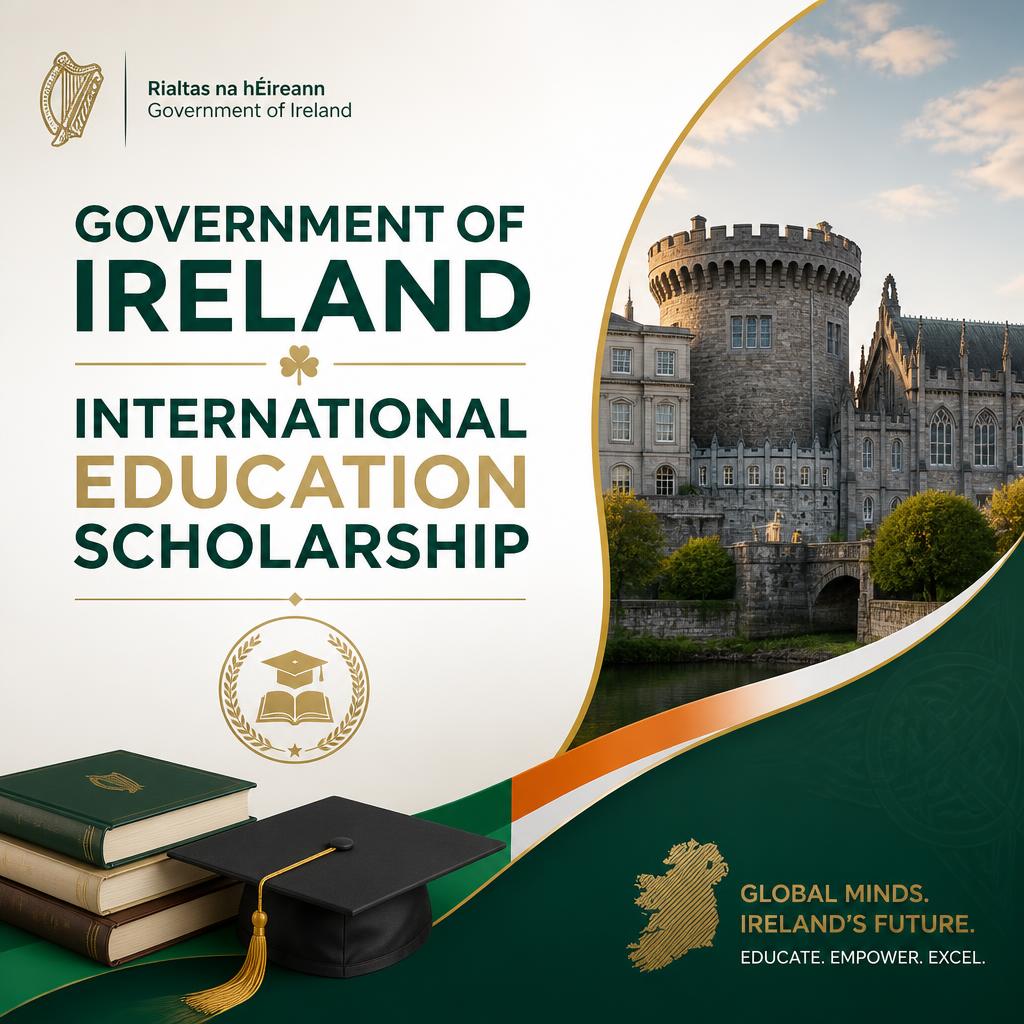
ToggleGovernment of Ireland International Education Scholarship: Funding, Eligibility and Next Cycle
Introduction
If you are an international student from outside the European Union looking for fully funded scholarships in Ireland, the Government of Ireland International Education Scholarship (GOI-IES) is one of the most important opportunities you should know about.
Unlike many scholarships that cover only partial tuition, the GOI-IES provides a full waiver of all tuition fees and registration costs at your host Irish institution, plus a €10,000 stipend for one year of study. That combination of tuition coverage and living support is what makes it one of the most competitive and sought-after fully funded scholarships available for study in Europe.
This article explains exactly what the GOI-IES covers, who qualifies, how the application process works, and what you need to know about the next application cycle. Every factual claim in this guide is based on information published by the Higher Education Authority (HEA) of Ireland and the official Education in Ireland portal. Where specific details for future cycles have not yet been confirmed, this article says so clearly.
Before you invest time in an application, read this guide carefully. Understanding the real eligibility requirements and the level of competition will help you decide whether this scholarship is the right fit for your academic profile and career goals.
What You Need to Know About the GOI-IES
What Is the Government of Ireland International Education Scholarship?
The GOI-IES is a national scholarship scheme funded by the Government of Ireland and administered by the Higher Education Authority (HEA). It was established to attract high-calibre international students from non-EU/EEA countries to study at eligible Irish higher education institutions.
The scholarship is designed to support Ireland’s international education strategy by building relationships with talented students from around the world, particularly from regions that are strategic priorities for Irish higher education, including Africa, Asia, Latin America, and the Middle East.
Who Administers It?
The Higher Education Authority (HEA) manages the GOI-IES on behalf of the Irish government. The HEA is the statutory body responsible for higher education policy and funding in Ireland. Applications are processed through the HEA’s official scholarship management system.
What Does “Fully Funded” Actually Mean Here?
It is important to be precise about what the GOI-IES covers, because the term “fully funded” can mean different things in different scholarship contexts.
The GOI-IES provides:
- Full waiver of all tuition fees at the host Irish higher education institution for one year of study
- Full waiver of all registration costs and other mandatory institutional charges for that year
- A stipend of €10,000 for one year, intended to contribute toward living expenses
The GOI-IES does NOT typically cover:
- International airfare or travel costs to Ireland
- Health insurance (though Irish institutions may have separate arrangements)
- Accommodation costs beyond what the €10,000 stipend can cover
- Visa application fees
- Costs for a second or subsequent year of study (the scholarship is for one year only)
This means the GOI-IES is fully funded for tuition and provides substantial living support, but you should still budget carefully for travel, visa costs, and any living expenses that exceed the stipend. Dublin, in particular, has high rental costs, and the €10,000 stipend may not cover a full year of rent and living expenses in the capital.
Duration of the Scholarship
The GOI-IES is a one-year scholarship. It can be applied to:
- One year of a taught Master’s programme (typically a one-year programme in Ireland)
- The final year of an undergraduate degree
- One year of a PhD programme
It does not fund multi-year programmes in their entirety. If you are enrolling in a two-year Master’s or a multi-year PhD, the GOI-IES would cover only one year.
GOI-IES Funding Breakdown
| Component | Coverage |
|---|---|
| Tuition Fees | 100% waived for one year |
| Registration Costs | 100% waived for one year |
| Stipend | €10,000 for one year |
| Travel/Airfare | Not covered |
| Accommodation | Not directly covered (stipend may contribute) |
| Health Insurance | Not covered |
| Visa Fees | Not covered |
| Duration | One academic year only |
Source: Higher Education Authority (HEA), Ireland. Verify the latest funding details on the official HEA GOI-IES call for applications before applying.
Eligibility Requirements
The GOI-IES has strict eligibility criteria. Meeting the minimum requirements does not guarantee selection — the competition is intense — but failing to meet any single criterion will result in disqualification.
Nationality Requirements
- You must be a non-EU/EEA national. Citizens of European Union member states, European Economic Area countries, and Switzerland are not eligible.
- You must be domiciled in a non-EU/EEA country at the time of application.
- The scholarship is open to students from all non-EU/EEA countries, including African, Asian, Middle Eastern, and Latin American nations.
Academic Requirements
- You must have a conditional or full offer of a place at an eligible Irish higher education institution for the relevant academic year.
- The offer must be for a full-time programme at one of the following levels:
- Taught Master’s degree (NFQ Level 9)
- Final year of an undergraduate degree (NFQ Level 8)
- PhD research programme (NFQ Level 10)
- You must demonstrate a strong academic record. While the HEA does not publish a strict minimum GPA, successful applicants typically have first-class or upper second-class honours equivalents.
English-Language Requirements
- You must meet the English-language proficiency requirements of your host institution.
- Most Irish universities require IELTS, TOEFL, or equivalent test scores. Specific minimum scores vary by institution and programme.
- Some applicants from English-speaking countries or those who completed previous degrees in English may qualify for waivers, depending on the host institution’s policy.
Other Key Eligibility Points
- You must not have previously received a GOI-IES scholarship.
- You must be a new incoming student or a current student entering the final eligible year of their programme.
- You must intend to study full-time in Ireland.
- Dual nationals who hold EU/EEA citizenship are generally not eligible, even if they also hold a non-EU passport.
Eligible Irish Higher Education Institutions
The GOI-IES is available at eligible higher education institutions across Ireland. Historically, this has included all publicly funded universities, technological universities, and several other designated institutions.
Major Irish universities that have participated in the GOI-IES include:
- Trinity College Dublin (TCD) — Ireland’s oldest university, consistently ranked among the top globally
- University College Dublin (UCD) — Ireland’s largest university with a strong international student community
- University of Galway — Located on the west coast, known for research excellence
- University College Cork (UCC) — A comprehensive university with strong programmes in science, business, and humanities
- Dublin City University (DCU) — Known for its industry connections and innovation focus
- Maynooth University — A rapidly growing university near Dublin
- University of Limerick (UL) — Known for its cooperative education model
- Munster Technological University (MTU) — Formed from the merger of IT Tralee and CIT
- Technological University Dublin (TU Dublin) — Ireland’s first technological university
- South East Technological University (SETU) — Serving the southeast region
- Atlantic Technological University (ATU) — Serving the west and northwest
Note: The full list of eligible institutions is published in each year’s official call for applications. Always confirm your institution’s eligibility on the HEA website before applying.
Application Process: Step by Step
The GOI-IES application process is entirely online and managed through the HEA’s scholarship portal. Here is how it typically works:
Step 1 — Secure an Offer from an Irish Institution
You must have a conditional or full offer of admission from an eligible Irish higher education institution before you can apply for the GOI-IES. The scholarship application requires you to provide details of your offer, including the programme name, institution, and start date.
This is the most important prerequisite. Without an offer, your GOI-IES application will not be considered.
Step 2 — Check the Official Call for Applications
The HEA publishes an annual “Call for Applications” document that outlines the specific requirements, deadlines, and evaluation criteria for that year’s cycle. This document is typically released on the Education in Ireland website and the HEA website.
Step 3 — Prepare Your Documents
Based on previous cycles, you will typically need:
- A copy of your offer letter from the Irish institution
- Academic transcripts from all previous higher education qualifications
- A personal statement (usually with a strict word limit, often around 1,000–1,500 words)
- A CV or résumé
- Evidence of English-language proficiency (if required by your institution)
- A copy of your passport
- Any additional documents specified in the call for applications
Step 4 — Write a Strong Personal Statement
The personal statement is one of the most heavily weighted components of the GOI-IES application. Based on previous evaluation criteria, the HEA typically assesses:
- Academic excellence and achievements — Your grades, awards, publications, and research experience
- Rationale for choosing Ireland and the specific programme — Why Ireland? Why this institution? Why this course? Generic answers weaken your application significantly.
- Career ambitions and how the scholarship will help — The HEA wants to see a clear connection between the funded study and your future professional goals.
- Potential as an ambassador for Irish higher education — The GOI-IES is part of Ireland’s international education strategy. Demonstrating how you will promote Irish education in your home country or professional network can strengthen your application.
Step 5 — Submit Through the Official HEA Portal
Applications are submitted through the HEA’s online scholarship management system. The link to the portal is provided in the official call for applications. Do not submit applications through third-party websites or agents.
Step 6 — Institutional Review
After you submit your application, your host Irish institution typically reviews and endorses applications before they are forwarded to the HEA for national-level evaluation. This means your university may contact you for additional information during this stage.
Step 7 — HEA Evaluation and Results
The HEA evaluates all endorsed applications against the published criteria. Results are typically announced several months after the deadline. Successful applicants are notified through the HEA portal and their host institution.
Application Timeline and Next Cycle
Historical Timeline
Based on previous cycles, the GOI-IES typically follows this approximate timeline:
| Stage | Typical Period |
|---|---|
| Call for Applications Published | December – January |
| Application Deadline | Late February – March |
| Institutional Endorsement | March – April |
| HEA Evaluation | April – June |
| Results Announced | June – July |
| Scholarship Commences | September (start of academic year) |
Status of the Next Cycle
As of June 2025, the specific details for the 2026 GOI-IES cycle have not yet been officially announced. The 2025 cycle has already closed.
Based on the historical pattern, the call for applications for the 2026 cycle is expected to be published between December 2025 and January 2026, with a deadline likely in February or March 2026.
However, this is a projection based on previous years, not a confirmed date. The HEA may adjust the timeline. You must monitor the official sources for the confirmed announcement.
Where to check for updates:
- Education in Ireland website: www.educationinireland.com
- HEA website: www.hea.ie
Information could not be independently verified at the time of publication regarding the exact 2026 cycle dates. Always confirm on the official HEA website.
Opportunities for African Students
The GOI-IES is open to students from all non-EU/EEA countries, and African students are explicitly within the target demographic for Ireland’s international education strategy.
Key Points for African Applicants
- No country-specific quotas are publicly stated, but the HEA has historically encouraged applications from African nations as part of Ireland’s development and education partnerships.
- Students from Nigeria, South Africa, Kenya, Ghana, Ethiopia, Tanzania, Uganda, Zimbabwe, Cameroon, and other African countries have successfully received the GOI-IES in previous cycles.
- African applicants must meet the same academic and English-language requirements as all other international applicants.
- If you completed your previous degree in an English-speaking African country (such as Nigeria, Ghana, Kenya, or South Africa), you may be able to satisfy the English-language requirement through your academic record, depending on the host institution’s policy. Confirm this directly with the university.
Specific Considerations for Nigerian Students
Nigerian students represent one of the largest groups of African international students in Ireland. If you are applying from Nigeria:
- Ensure your academic transcripts are properly evaluated and, if necessary, converted to the Irish grading framework (NFQ).
- IELTS or TOEFL scores are commonly required, even for graduates of Nigerian universities where English is the medium of instruction. Some institutions may waive this, but do not assume a waiver — check with the admissions office.
- The Irish student visa process for Nigerian nationals requires careful documentation, including evidence of funding. The GOI-IES award letter can serve as strong evidence of financial support for your visa application.
- Begin your visa application well in advance, as processing times can vary.
Important Things to Know Before Applying
The Competition Is Intense
The GOI-IES receives a large number of applications from highly qualified candidates worldwide. The number of scholarships awarded each year is limited — historically around 60 scholarships across all institutions and levels. This means the acceptance rate is low, and even excellent candidates may not be selected.
The Stipend May Not Cover All Living Costs
While €10,000 is a significant contribution, the cost of living in Ireland — particularly in Dublin — is high. As of recent data:
- Monthly rent in Dublin for a single room in shared accommodation can range from €700 to €1,200 or more.
- Monthly living expenses (food, transport, utilities, personal costs) can add another €500–€800.
- Over 12 months, total living costs can easily reach €15,000–€20,000.
This means the €10,000 stipend may cover roughly half to two-thirds of your annual living expenses. You should have a plan for funding the remainder through personal savings, family support, part-time work (international students in Ireland are permitted to work up to 20 hours per week during term time), or additional scholarships.
You Must Have an Offer First
Many applicants make the mistake of applying for the GOI-IES before securing admission to an Irish institution. This is not possible. The scholarship application requires proof of an offer. You should begin your university application process well in advance — ideally 9–12 months before your intended start date.
The Scholarship Is for One Year Only
If you are enrolling in a multi-year programme, the GOI-IES will fund only one year. You are responsible for securing funding for any remaining years.
No Application Fee
The GOI-IES application itself does not charge a fee. However, you may need to pay application fees to the Irish universities you apply to for admission. These are separate from the scholarship.
Fraud Warning
The GOI-IES does not operate through agents, WhatsApp recruiters, or third-party “guaranteed scholarship” services. All applications must be submitted through the official HEA portal. If anyone asks you to pay a fee to “secure” a GOI-IES scholarship, it is a scam.
Documents You Need
Based on previous application cycles, prepare the following documents well in advance:
- Valid passport (with at least 12 months of validity remaining)
- Offer letter from an eligible Irish higher education institution
- Academic transcripts from all post-secondary qualifications
- Degree certificates (if you have already graduated)
- English-language test results (IELTS, TOEFL, PTE, or equivalent, if required)
- Personal statement tailored to the GOI-IES criteria
- Curriculum Vitae (CV) highlighting academic achievements, research, work experience, and extracurricular activities
- Reference letters (if required by the specific call — check the official guidelines)
- Evidence of any additional achievements (publications, awards, community leadership, etc.)
Common Mistakes to Avoid
- Applying without an offer. This is the most common disqualifying error. Secure your university admission first.
- Writing a generic personal statement. The HEA evaluators read hundreds of applications. A statement that could apply to any country or any scholarship will not stand out. Be specific about Ireland, your chosen institution, and your career trajectory.
- Ignoring the word limit. If the call specifies a 1,000-word limit for the personal statement, do not submit 1,500 words. Following instructions is part of the evaluation.
- Missing the deadline. The GOI-IES deadline is strict. Late applications are not accepted. Submit well before the closing date to avoid technical issues.
- Overlooking institutional endorsement. Your application must be endorsed by your host institution. Communicate with the university’s international office to ensure they are aware of your GOI-IES application and can complete their part of the process.
- Assuming the stipend covers everything. Plan your finances realistically. The €10,000 stipend is generous but not sufficient to cover all living costs in Ireland for a full year.
- Using unverified agents. Apply directly through the official HEA portal. Do not pay anyone to apply on your behalf.
How to Improve Your Chances
- Apply to strong programmes at well-ranked Irish institutions. The HEA considers the academic quality of your chosen programme as part of the evaluation.
- Demonstrate clear academic excellence. High grades, research output, and academic awards strengthen your profile significantly.
- Articulate a compelling connection between your study in Ireland and your future impact. The GOI-IES is an investment in international relationships. Show the evaluators how your education in Ireland will create value in your home country or field.
- Highlight leadership and community engagement. The HEA values candidates who demonstrate potential as ambassadors for Irish higher education.
- Start early. Begin your university applications at least a year in advance so that you have your offer letter ready when the GOI-IES call opens.
- Proofread everything. Spelling errors, grammatical mistakes, and formatting inconsistencies create a poor impression.
Study in Ireland: Key Facts for International Students
Tuition Fees (Without Scholarship)
For context, non-EU tuition fees at Irish universities typically range from:
- Undergraduate programmes: €10,000–€25,000 per year, depending on the field
- Taught Master’s programmes: €12,000–€30,000 per year
- PhD programmes: €6,000–€15,000 per year (though many PhD students receive separate research funding)
The GOI-IES waiver eliminates these costs for one year, which represents significant financial value.
Student Visa Requirements
Non-EU/EEA students need a Stamp 2 student visa (or Stamp 2A for certain categories) to study in Ireland. Key requirements include:
- A letter of acceptance from an Irish institution
- Evidence of sufficient funds to cover tuition and living costs (the GOI-IES award letter helps significantly)
- Medical insurance
- Evidence of English-language proficiency
- A valid passport
- Payment of the visa application fee (currently around €60–€100, depending on the type)
Part-Time Work Rights
International students on a Stamp 2 visa are permitted to work:
- Up to 20 hours per week during term time
- Up to 40 hours per week during designated holiday periods (June–September and mid-December to mid-January)
Post-Study Work Options
Ireland offers a Third Level Graduate Programme (Stamp 1G) that allows non-EU graduates to remain in Ireland to seek employment after completing their studies:
- Master’s graduates: Up to 24 months
- PhD graduates: Up to 36 months
- Honours Bachelor’s graduates: Up to 12 months
This is an important consideration if you plan to build your career in Ireland after your studies.
Best Options at a Glance
| Criterion | GOI-IES Assessment |
|---|---|
| Best for full funding | Excellent for tuition; stipend covers partial living costs. Not comprehensive for multi-year programmes. |
| Best for Master’s students | Strong fit, since most Irish taught Master’s programmes are one year — matching the scholarship duration perfectly. |
| Best for PhD students | Covers one year only. PhD students should also seek research council funding (e.g., Irish Research Council). |
| Best for undergraduate students | Limited to the final year. Useful but not a full-degree solution. |
| Best for African students | Open and accessible. No nationality restrictions within the non-EU/EEA pool. |
| Best for Nigerian students | Same as above. Strong pathway, especially combined with post-study work rights. |
| Best without IELTS | Depends on the host institution. The GOI-IES itself defers to institutional English-language requirements. |
| Best for ease of application | Straightforward online process, but requires prior university admission. |
Conclusion
The Government of Ireland International Education Scholarship is one of the most valuable fully funded scholarships in Ireland available to international students from non-EU/EEA countries. With a full tuition fee waiver and a €10,000 stipend, it significantly reduces the financial burden of studying at a world-class Irish university.
However, the competition is fierce, the scholarship covers only one year, and the stipend may not cover all living expenses — particularly in Dublin. Successful applicants are those who plan early, secure strong university offers, write compelling personal statements, and understand the real financial picture of studying in Ireland.
What you should do now:
- Identify the Irish universities and programmes that match your academic profile and career goals.
- Begin your university application process immediately if you have not already done so.
- Monitor the HEA website and Education in Ireland portal for the official announcement of the next GOI-IES cycle (expected late 2025 or early 2026).
- Prepare your documents, personal statement, and references well in advance.
- Plan your finances realistically, including costs that the scholarship does not cover.
Always verify the latest information on the official HEA and Education in Ireland websites before making any decisions. Deadlines, eligibility criteria, and funding amounts can change from year to year.
Keep checking ScholarCareer.com for verified scholarship, study abroad, job, and career opportunities updated regularly for international students and professionals.
- SCHOLARSHIP COMPARISON TABLE
| Scholarship | Country | Provider | Degree Level | Funding | Eligibility | Deadline | Status | Official Source |
|---|---|---|---|---|---|---|---|---|
| Government of Ireland International Education Scholarship (GOI-IES) | Ireland | Higher Education Authority (HEA) | Master’s, Final Year UG, PhD (1 year) | Full tuition waiver + €10,000 stipend | Non-EU/EEA nationals with offer from Irish institution | Typically Feb–Mar (annual) | 2025 cycle CLOSED; 2026 cycle NOT YET ANNOUNCED | hea.ie / educationinireland.com |
- COUNTRY-BY-COUNTRY OPPORTUNITIES
This article focuses specifically on Ireland. For readers interested in fully funded scholarships in other European countries, the following resources on ScholarCareer are relevant:
- Germany: DAAD Scholarships for international students — see ScholarCareer’s Germany study abroad section
- UK: Chevening Scholarships, Commonwealth Scholarships — see ScholarCareer’s UK study abroad section
- Netherlands: Holland Scholarship, Orange Knowledge Programme — see ScholarCareer’s Europe study abroad section
- Sweden: Swedish Institute Scholarships — see ScholarCareer’s Europe study abroad section
- APPLICATION GUIDE
Step 1 — Research Irish universities and programmes that match your academic background and career goals. Use the official institution websites.
Step 2 — Apply for admission to your chosen programme(s) at least 9–12 months before your intended start date.
Step 3 — Receive a conditional or full offer of admission from an eligible Irish institution.
Step 4 — Monitor the HEA website and Education in Ireland portal for the official GOI-IES call for applications (typically published December–January).
Step 5 — Download and read the official call document carefully. Note the exact deadline, word limits, and required documents.
Step 6 — Gather all required documents: passport, offer letter, transcripts, degree certificates, English test results, CV.
Step 7 — Write your personal statement. Focus on academic excellence, your rationale for choosing Ireland and the specific programme, your career ambitions, and your potential as an ambassador for Irish higher education.
Step 8 — Register on the HEA’s official scholarship portal and complete the online application form.
Step 9 — Upload all required documents in the specified format.
Step 10 — Submit your application before the deadline. Save your confirmation receipt.
Step 11 — Contact your host institution’s international office to ensure they are aware of your GOI-IES application and can complete the institutional endorsement.
Step 12 — Monitor your email and the HEA portal for updates. Results are typically announced between June and July.
Step 13 — If successful, follow the HEA’s instructions for accepting the award and coordinating with your institution regarding tuition waiver and stipend disbursement.
Step 14 — Begin your Irish student visa application process using your GOI-IES award letter as evidence of funding.
- IMPORTANT WARNINGS
- No guaranteed outcomes. The GOI-IES is highly competitive. Meeting all eligibility criteria does not guarantee selection.
- One-year funding only. The scholarship covers one academic year. Plan for additional funding if your programme is longer.
- Living costs are high. The €10,000 stipend is substantial but may not cover all living expenses, especially in Dublin. Budget carefully.
- Offer required first. You cannot apply for the GOI-IES without a university offer. Do not wait until the scholarship deadline to begin your university application.
- No application fee for GOI-IES. The scholarship application itself is free. Be suspicious of anyone charging you to apply.
- Beware of scams. The HEA does not operate through WhatsApp agents, Facebook recruiters, or “guaranteed placement” services. All applications go through the official HEA portal.
- Verify everything. Deadlines, funding amounts, and eligibility rules can change. Always confirm on the official HEA and Education in Ireland websites.
- ScholarCareer does not guarantee selection, admission, or visa approval. We provide information to help you make informed decisions.
- FAQ
Q1: Is the GOI-IES fully funded?
The GOI-IES provides a full waiver of tuition fees and registration costs plus a €10,000 stipend for one year. It does not cover airfare, health insurance, or visa fees. It is fully funded for tuition but provides partial living support.
Q2: Who is eligible for the GOI-IES?
Non-EU/EEA nationals who have a conditional or full offer from an eligible Irish higher education institution for a taught Master’s, final-year undergraduate, or PhD programme.
Q3: Can Nigerian students apply for the GOI-IES?
Yes. Nigerian students are eligible as non-EU/EEA nationals. You must meet all academic, English-language, and institutional offer requirements.
Q4: How much is the GOI-IES stipend?
The stipend is €10,000 for one academic year, paid in instalments through the host institution.
Q5: Does the GOI-IES cover accommodation?
No. Accommodation is not directly covered. The €10,000 stipend is intended to contribute toward living expenses, which includes accommodation, but it may not cover the full cost.
Q6: When does the GOI-IES application open?
Historically, the call for applications is published between December and January, with a deadline in February or March. The exact dates for the next cycle should be confirmed on the HEA website.
Q7: Can I apply for the GOI-IES without a university offer?
No. A conditional or full offer from an eligible Irish institution is a mandatory requirement. Applications without an offer will not be considered.
Q8: Is there an application fee for the GOI-IES?
No. The GOI-IES application is free. However, individual universities may charge their own application fees for admission.
Q9: Can I apply for the GOI-IES more than once?
No. Previous recipients of the GOI-IES are not eligible to apply again.
Q10: Does the GOI-IES cover a full Master’s degree?
Most taught Master’s programmes in Ireland are one year, so the GOI-IES typically covers the full programme. If your Master’s is two years, the scholarship covers only one year.
Q11: What English test scores do I need?
The GOI-IES defers to the English-language requirements of your host institution. Most Irish universities require IELTS 6.5 overall (with no band below 6.0) or equivalent, but this varies by programme. Check your institution’s specific requirements.
Q12: Can I work in Ireland while on the GOI-IES?
Yes. International students on a Stamp 2 visa can work up to 20 hours per week during term time and up to 40 hours per week during designated holidays.