


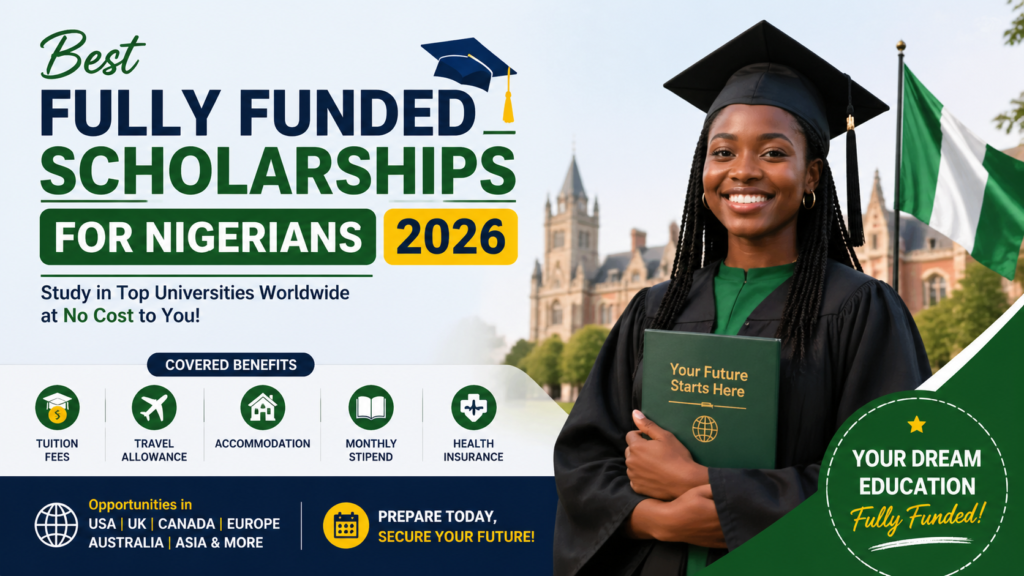
Best Fully Funded Scholarships for Nigerian Students in 2026 (Complete Guide)
Table of Contents
ToggleIntroduction: Your Passport to the World Is Sitting in a Scholarship Portal Right Now
You’re Nigerian. You’re ambitious. You’ve watched colleagues post graduation photos from universities in the UK, Germany, Canada, and the US, and a part of you has wondered—is that actually possible for me?
It is. And in 2026, it’s more possible than it has ever been.
Fully funded scholarships for Nigerian students are not myths, lottery tickets, or privileges reserved for the children of ministers. They are structured, merit-based programs that exist specifically to find people like you—driven, qualified, purpose-led Nigerians who need financial support to access world-class education.
The frustrating reality is that thousands of scholarship spots go unfilled or go to less-qualified candidates every year—simply because the right Nigerian students either didn’t know the opportunity existed, didn’t think they qualified, or didn’t know how to apply strategically.
This guide fixes all three problems.
By the time you finish reading, you’ll know exactly which fully funded scholarships are open to Nigerian students in 2026, what each one actually covers, how to check your eligibility in under five minutes, and how to position your application to compete seriously—even against candidates from better-resourced backgrounds.
This isn’t a list of vague links. This is a tactical roadmap.
📌 Quick Summary
- What this covers: The best fully funded scholarships available to Nigerian students in 2026, including eligibility, application strategy, and insider tips for each major program
- Key benefits: You’ll leave knowing which scholarships match your profile, what documents you need, and how to write an application that gets noticed
- How to use this post: Read it fully for the complete picture, then return to the specific scholarships that match your level and field—bookmark this page and treat it as your scholarship headquarters
Why Nigerian Students Are Winning International Scholarships More Than Ever
Let’s kill a myth before it kills your ambition.
There’s a widespread belief among Nigerian students—especially those who graduated a few years ago, took time to work, or come from non-elite universities—that international scholarships are only for Ivy League-adjacent candidates with a 5.0 GPA and parents who know somebody who knows somebody.
That belief is outdated, and it’s costing you opportunities.
The landscape of international scholarship funding has shifted dramatically in the last decade. According to UNESCO’s Global Education Monitoring Report, non-traditional and mature students now account for a growing proportion of internationally mobile students from sub-Saharan Africa, with programs explicitly redesigning their criteria to recruit applicants with professional experience, community ties, and demonstrated resilience—not just academic perfection.
Here’s what that means practically: fewer Nigerian applicants who meet the criteria actually apply, because they’ve disqualified themselves in their own heads before the committee ever sees their name. That creates a real opportunity gap—and you can step into it.
Consider Ngozi, a 31-year-old public health officer from Enugu who spent five years working with state-level health programs before applying to the Chevening Scholarship. She assumed her state university degree wouldn’t be competitive against candidates from Lagos or Abuja. She was shortlisted in her first attempt and won on her second, with an essay built around her fieldwork experience—the very thing she initially considered a weakness.
Or Emeka, a 28-year-old civil engineer from Kano who applied to the DAAD scholarship three years after graduation, during which he had managed infrastructure projects in three northern states. His committee feedback described his professional experience as “exceptional contextual grounding for graduate-level research.”
Your Nigerian story—the hustle, the context, the stakes—is not a liability. It’s the most compelling scholarship asset you have.
Understanding “Fully Funded”: What You’re Actually Getting
Before you apply anywhere, you need to know exactly what “fully funded” means—because the term gets thrown around loosely, and misunderstanding it can lead to financial shock mid-program.
“Fully funded” does not mean the same thing across all scholarship programs. It’s a spectrum, and knowing where each program sits on that spectrum helps you plan realistically.
Here’s what full funding typically includes:
- Tuition fees — usually covered in full, paid directly to the institution
- Monthly living stipend — to cover rent, food, local transport, and daily expenses
- Return airfare — economy class, usually one round trip per academic year
- Health insurance — basic coverage; the scope varies significantly by program and country
- Visa fees — some programs cover this, many do not; always verify
- Research or study allowances — common in postgraduate and PhD programs for books, fieldwork, conferences
Here’s what “fully funded” frequently does not include:
- Dependent or family relocation costs
- Pre-departure medical examination fees (often required for UK and Canadian visas)
- Excess baggage or international shipping
- Personal discretionary spending beyond the stipend
- Technology equipment (some programs offer this—always check)
Let’s ground this in two real 2026 examples.
The Chevening Scholarship (UK government) covers full tuition at any eligible UK university, a monthly living allowance calibrated to London/city costs, one return economy flight, and an arrival allowance. It does not cover dependants. The net value of a Chevening award typically exceeds £30,000 for a one-year master’s program.
The DAAD Scholarship (Germany) covers tuition exemption at German public universities (which charge minimal semester fees), a monthly stipend of €861–€1,200 depending on your qualification level, health insurance, and a travel subsidy. German public university fees are among the lowest in the developed world, making DAAD one of the most financially comprehensive options for Nigerian students.
When you see “fully funded,” always ask five questions: Does it cover my visa fee? What is the exact monthly stipend? Does it include health insurance or deduct it from the stipend? Is family travel covered? Is there a return-service obligation?
Knowing what you’re getting before you apply is how you make decisions that change your life, not just your CV.
The Top Fully Funded Scholarships for Nigerian Students in 2026
This is the section you came for. Below are the most accessible, most competitive, and most transformative fully funded scholarships open to Nigerian students in 2026—organized for clarity and strategic use.
1. Chevening Scholarship (United Kingdom)
Funded by: UK Foreign, Commonwealth and Development Office (FCDO)
Level: Master’s degree (one year)
Covers: Full tuition + monthly living allowance + return flights + arrival allowance
Work experience required: Minimum 2 years post-undergraduate
Deadline: Typically November each year for the following September intake
Chevening is arguably the most prestigious scholarship a Nigerian student can win. It’s not just a scholarship—it’s admission to a global network of over 50,000 Chevening alumni in 160+ countries, many of whom hold senior government, private sector, and NGO leadership positions.
What makes Nigerian applicants competitive: Chevening explicitly prioritizes leadership potential and professional trajectory over academic grades alone. Your years in industry, your community involvement, your demonstrated ability to influence people and systems—these carry as much weight as your degree classification.
The selection process involves written application, three reference letters, and a structured interview with a Chevening panel. The interview is the stage most Nigerian applicants underestimate. Prepare for it like a professional presentation, not a casual conversation.
Strategic insight: Chevening receives a high volume of Nigerian applications, which means the bar is real. But most rejected applications share a common flaw—they’re generic. The winning applications connect the applicant’s specific Nigerian professional experience directly to what they’ll study and exactly what they’ll do when they return. Specificity is everything.
2. DAAD Scholarship (Germany)
Funded by: German Academic Exchange Service
Level: Undergraduate, Master’s, PhD, and postdoctoral research
Covers: Monthly stipend (€861–€1,200) + tuition exemption + health insurance + travel subsidy
Work experience required: Varies by program; generally 2+ years for development-focused awards
Deadline: Varies by program (August–October for most Nigerian applicants)
DAAD is one of the most generous and accessible scholarship programs for Nigerian students, partly because Germany has made a strategic investment in African academic partnerships—and partly because German universities offer world-class education with some of the lowest tuition fees globally.
What makes Nigerian applicants competitive: DAAD values academic merit combined with a clear development-oriented motivation. If your proposed studies connect to Nigeria’s development challenges—in agriculture, public health, engineering, environmental science, governance, or education—your application carries inherent relevance.
Many DAAD programs also offer in-country language training for German-language programs, meaning language isn’t an automatic barrier.
Strategic insight: DAAD has multiple sub-programs. The “Development-Related Postgraduate Courses” (EPOS) program is specifically designed for professionals from developing countries, including Nigeria. It’s one of the most Nigerian-applicant-friendly programs in the DAAD portfolio.
3. Commonwealth Scholarship (United Kingdom)
Funded by: UK government / Commonwealth Scholarship Commission
Level: Master’s and PhD
Covers: Full tuition + living allowance + return airfare + thesis grant (PhD) + warm clothing allowance
Work experience required: Preferred but not mandatory; academic merit is primary
Deadline: Typically December each year
The Commonwealth Scholarship is Nigeria’s second-most applied-for UK scholarship after Chevening—and for good reason. It’s open to Nigerian citizens who are committed to contributing to development after their studies, and it has a strong track record of funding candidates from non-elite academic backgrounds.
What makes Nigerian applicants competitive: The Commonwealth Scholarship explicitly prioritizes applicants whose studies will contribute to development in their home country. If your research or field of study has a clear Nigerian application—and almost every field does, when framed correctly—this is a structural advantage.
Strategic insight: Unlike Chevening, the Commonwealth Scholarship includes a PhD stream, making it valuable for Nigerian academics and researchers. The PhD funding includes a thesis allowance and is renewable, making it one of the most comprehensive long-term funding options available.
4. Mastercard Foundation Scholars Program
Funded by: Mastercard Foundation
Level: Undergraduate and postgraduate (at partner universities)
Covers: Full tuition + living stipend + accommodation + books + return travel + mentorship
Work experience required: Not required; strong for recent graduates and early-career applicants
Deadline: Varies by partner university (typically January–March)
The Mastercard Foundation Scholars Program is perhaps the most explicitly Africa-focused scholarship program at scale. It operates through a network of partner universities across Africa, North America, and beyond—including the University of Edinburgh, Cornell University, Sciences Po, and several African universities.
What makes Nigerian applicants competitive: This program is designed for academically talented young Africans with demonstrated financial need. It explicitly values leadership potential, community commitment, and the intention to return and contribute to Africa’s development. Nigerian applicants who can demonstrate both need and purpose are strongly positioned.
Strategic insight: The program includes structured leadership development, mentorship, and community engagement requirements beyond academics. This is not just funding—it’s a development ecosystem. Apply with that understanding, and show the committee you’re ready for both the academic and leadership journey.
5. Fulbright Foreign Student Program (United States)
Funded by: U.S. Department of State
Level: Master’s and PhD
Covers: Full tuition + living stipend + health insurance + return airfare + enrichment activities
Work experience required: Strongly preferred; leadership experience is weighted heavily
Deadline: Typically February–May for Nigerian applicants (apply through the U.S. Embassy in Abuja or Lagos)
Fulbright is the United States government’s flagship international educational exchange program—one of the most recognized scholarship names in the world. For Nigerian students, it offers access to virtually any accredited U.S. university, with a stipend calibrated to the cost of living in your specific study city.
What makes Nigerian applicants competitive: Fulbright is not just about academic achievement. It prioritizes cultural exchange, leadership, and the capacity to build U.S.-Nigeria ties in meaningful ways. Nigerian applicants who can articulate a compelling vision of what they’ll bring to American campuses—and what they’ll bring back to Nigeria—have a genuine competitive advantage.
Strategic insight: The Fulbright application requires you to identify specific U.S. universities where you’d like to study. Do this research thoroughly. A Nigerian applicant who can name the specific professor whose research aligns with theirs, at a university with a known Nigeria connection or African studies program, signals exactly the kind of purposeful thinking Fulbright rewards.
6. Gates Cambridge Scholarship (United Kingdom)
Funded by: Bill & Melinda Gates Foundation (administered by University of Cambridge)
Level: Postgraduate (MPhil, PhD, MBA, and one-year postdoctoral)
Covers: Full tuition + maintenance allowance + return flights + inbound visa costs + family allowance (if applicable)
Work experience required: Preferred; intellectual leadership and research potential are primary
Deadline: Typically October–December
Gates Cambridge is among the most selective scholarships in the world, with a ~1% acceptance rate. But that statistic shouldn’t scare you off—it should sharpen your focus. The Gates Cambridge Scholarship explicitly seeks students with extraordinary intellectual ability, leadership potential, and a commitment to improving the lives of others.
What makes Nigerian applicants competitive: Gates Cambridge is particularly receptive to applicants whose research addresses real-world problems in their home countries. A Nigerian applicant researching agricultural technology, public health systems, climate resilience, or governance reform is directly aligned with the Gates Foundation’s broader priorities.
Strategic insight: Don’t apply to Gates Cambridge as your only scholarship. Apply here as your ambitious stretch goal while building a strategic portfolio of 5–8 other programs. The application process—particularly the research proposal and leadership essays—will sharpen every other application you write.
7. Japanese Government MEXT Scholarship (Japan)
Funded by: Japanese Ministry of Education, Culture, Sports, Science and Technology
Level: Undergraduate, Master’s, PhD, and research students
Covers: Full tuition + monthly stipend (¥117,000–¥145,000) + return airfare + Japanese language training
Work experience required: Not required for undergraduate; preferred for graduate programs
Deadline: Typically May–June (Embassy recommendation track) or varies by university
The MEXT Scholarship is one of the most underutilized fully funded opportunities for Nigerian students, primarily because Japan isn’t the first destination that comes to mind. That’s precisely why you should consider it seriously—less competition, extraordinary academic infrastructure, and a stipend that covers living costs comfortably in most Japanese cities.
What makes Nigerian applicants competitive: Nigerian applicants willing to engage with Japanese language and culture—even minimally at the application stage—signal adaptability and genuine interest that sets them apart. STEM-focused Nigerian students in particular will find Japan’s research infrastructure world-class.
Strategic insight: The MEXT Embassy Track (applying through the Japanese Embassy in Abuja) is generally more accessible than the university-nominated track. Begin the Embassy track process in March, as document requirements are extensive.
8. Aga Khan Foundation International Scholarship
Funded by: Aga Khan Foundation
Level: Postgraduate (Master’s only)
Covers: Up to 50% grant + 50% loan (repayable after studies); some recipients receive higher grant proportions based on need
Work experience required: Minimum 2 years
Deadline: Typically March–June
The Aga Khan Foundation scholarship operates on a hybrid grant-loan model, which makes it technically partially funded rather than fully funded in the traditional sense. However, it’s included here because for Nigerian students in specific fields—development, public health, education, architecture, planning—it remains one of the most accessible and credible pathways to international postgraduate education, with repayment terms designed to be manageable on developing-country salaries.
Strategic insight: Apply alongside fully funded scholarships. If you win a fully funded award, you decline this one. If you don’t, this may still make your dream program financially viable.
Building Your Nigerian Scholarship Database: A Systematic Approach
Finding scholarships is one thing. Finding the right scholarships—the ones where your Nigerian profile is genuinely competitive—is the skill that separates applicants who win from applicants who collect rejection emails.
Here’s how to build a curated, strategic scholarship database over four weeks:
Step 1: Start With Verified Platforms, Not Random Google Searches
Your starting points should be platforms with rigorous vetting standards and consistent updates. For Nigerian students specifically, these are your most reliable sources:
- Opportunity Desk (opportunitydesk.org) — consistently the best-curated aggregator for African students; filter by country and degree level
- Scholars4Dev (scholars4dev.com) — focused exclusively on developing-country applicants; Nigeria-specific filters available
- The official Chevening scholarship portal — the definitive source for UK government scholarship information for Nigerian applicants, including eligibility criteria and application timelines
- DAAD Nigeria (daad.de/en/countries/africa/nigeria/) — country-specific DAAD page with Nigeria-tailored program listings
- Nigerian Bulletin (nigerianbulletin.com/threads/) — active community of Nigerian scholarship applicants sharing real-time experiences and opportunities
- Federal Scholarship Board Nigeria (fsb.gov.ng) — government portal for Nigerian government-sponsored international scholarships; often overlooked
- University of Edinburgh, University of Manchester, King’s College London — each has dedicated international student funding pages with Nigeria-specific awards not listed on aggregators
Step 2: Filter by Your Academic Level and Field First
Before you read a single scholarship description in full, filter by: degree level (undergraduate/master’s/PhD) and field of study. Many scholarships are field-restricted. Applying to a scholarship that doesn’t fund your discipline is a guaranteed rejection and a waste of months.
Step 3: Cross-Reference Every Opportunity Against Three Non-Negotiables
Nigerian citizenship eligible? Minimum academic grade met? Field of study included? If any one of these answers is no, move on without hesitation.
Step 4: Search Using Power Terms That Surface Hidden Funding
Standard searches miss specialized funding. Use these search strings in Google: “scholarship for Nigerian students 2026,” “fully funded fellowship Nigeria,” “Nigerian graduate award [your field],” “bursary sub-Saharan Africa [your subject],” and “Commonwealth funding Nigeria [your field].” You’ll find programs that never appear in standard aggregator searches.
Step 5: Verify Every Opportunity Rigorously
A legitimate scholarship charges zero application fees. It has a verifiable institutional email address (not Gmail or Yahoo), an established website with a provable history, and a named contact at a real funding organization. If any of these elements are missing or suspicious, report it and move on. Scholarship scams targeting Nigerian students are real and increasingly sophisticated.
Your curated database—10 scholarships, all verified, all matched to your profile—is the foundation everything else is built on.
Nigerian Applicant Eligibility Checklist
Before investing weeks in any application, run yourself through this checklist. Brutal honesty now saves devastating disappointment later.
Academic Performance
- Do you hold a minimum of a Second Class Upper (2:1) or equivalent? (Most UK scholarships require this; DAAD and Fulbright may accept 2:2 with strong work experience)
- Are your academic transcripts officially certified and sealed by your university registrar?
- If you graduated more than five years ago, do you have graduate-level coursework or professional certifications that demonstrate continued academic engagement?
Language Proficiency
- Do you hold a valid IELTS Academic score of at least 6.5 overall (or TOEFL iBT 90+) for UK/US/Canada/Australia programs?
- Is your language test score within its 2-year validity period?
- For programs in non-English countries (Germany, Japan, France), have you checked whether English-medium programs are available or whether language training is provided?
Nigerian Citizenship and Residency
- Are you a Nigerian citizen with a valid Nigerian passport?
- Are you currently residing in Nigeria? (Several scholarships—including Chevening—require applications from your home country)
- Does the scholarship require a post-study return commitment to Nigeria? (Most government-funded scholarships do; Mastercard Foundation explicitly requires it)
Work Experience
- Do you have verifiable professional work experience if required? (Chevening: 2 years minimum; Fulbright: strongly preferred; DAAD EPOS: 2+ years)
- Can you document that experience with official appointment letters, payslips, or employer reference letters?
- Have you held any leadership role—formal or informal—that you can reference in your application?
Financial Need
- Does the scholarship require demonstrated financial need? (Mastercard Foundation: yes; Chevening: no)
- If yes, do you have documentation—bank statements, family income records—to support a financial need claim?
🔍 Are You Eligible? Quick Self-Assessment
Answer these four questions honestly in 60 seconds:
- Do you hold a Nigerian passport and currently reside in Nigeria? Yes / No
- Does your undergraduate result meet the minimum academic grade requirement for your target scholarship? Yes / No
- Do you hold a valid English language test score, or do you qualify for a recognized waiver? Yes / No
- Do you meet the work experience requirement (where applicable) with official documentation? Yes / No
Four Yes answers: You’re eligible—focus exclusively on strategy, essay quality, and documentation.
One or two No answers: Identify which gaps are fixable (register for IELTS, request official transcripts) versus disqualifying (citizenship), and build your timeline around closing the fixable gaps first.
How Experience Counts—Even When Grades Were Average
Employment gaps, career changes, and below-average undergraduate grades are not automatic disqualifiers for most major scholarships—but they do require deliberate framing.
The Mastercard Foundation Scholars Program, for example, evaluates applicants holistically. A candidate with a 3.2/5.0 GPA who spent three years building a youth education initiative in rural Borno State is more competitive than a 4.9/5.0 candidate with no demonstrated impact outside their classroom. The Foundation explicitly states that academic grades are one input among many—leadership, community commitment, and development motivation carry equal weight.
Similarly, Chevening’s selection criteria don’t specify a minimum GPA. They specify “a strong academic background”—which is evaluated in context, alongside professional achievement and leadership trajectory.
Clarity about where you genuinely qualify is what transforms anxiety into confident, targeted action.
The 5 Scholarship Types Nigerian Students Actually Win
Not all scholarships are created equal—and not all of them suit Nigerian applicants equally. Here are the five categories where Nigerian candidates consistently win funding, with specifics for each.
Type 1: Government-Funded Bilateral Scholarships
Who funds them: Foreign governments investing in diplomatic soft power and bilateral relations—UK, US, Germany, Japan, Canada, Australia, China.
What makes Nigerian applicants competitive: Your Nigerian citizenship is itself a strategic asset. These scholarships are specifically designed for citizens of partner countries, and Nigeria’s size, influence, and development trajectory make it a high-priority partner nation for most donor governments.
Typical award: Full tuition + stipend + travel; total value ranges from £25,000 (UK) to US$50,000+ (US) per academic year.
Acceptance rate: Roughly 1–3% of applicants for the most competitive programs (Chevening, Fulbright, Gates Cambridge); higher for bilateral agreements with less competition.
Real example: The Chevening Scholarship awards approximately 50–60 places to Nigerian students annually—one of the highest country allocations on the African continent.
Nigerian advantage: Government scholarships value return-to-home commitments. Nigerian applicants who can articulate a compelling vision of what they’ll build back home after their studies consistently outperform candidates whose post-study plans are vague.
Type 2: University-Specific International Scholarships
Who funds them: Individual universities drawing on endowments, alumni donations, and government research grants.
What makes Nigerian applicants competitive: Many universities specifically track and target applicants from underrepresented countries and regions. Nigerian students often benefit from geographic diversity quotas and active Nigeria-university partnerships.
Typical award: Ranges from partial (50% tuition) to fully funded; varies widely by institution and program.
Acceptance rate: Variable; some university-specific awards have acceptance rates as high as 15–20% because fewer people know they exist.
Real example: The University of Edinburgh’s Global Development Academy has awarded Nigerian researchers full funding for PhD programs specifically studying African development challenges. Similar programs exist at Manchester, Leeds, and SOAS.
Nigerian advantage: University-specific scholarships often allow more personal, relationship-based applications. A strong email to a potential supervisor, followed by a well-targeted application, can open doors that purely competitive national scholarships cannot.
Type 3: NGO and Foundation Scholarships for Purpose-Driven Applicants
Who funds them: Foundations with explicit Africa or development mandates—Mastercard Foundation, Ford Foundation, Open Society Foundations, African Leadership Academy.
What makes Nigerian applicants competitive: These organizations are specifically looking for Nigerians who can articulate a development vision connected to their studies. Your proximity to Nigeria’s challenges is a unique qualification.
Typical award: Full funding including living stipend, often with mentorship and network benefits beyond financial support.
Acceptance rate: Highly competitive (1–5%) but more transparent criteria than government scholarships; a well-matched applicant has genuinely strong odds.
Real example: The Mastercard Foundation Scholars Program has funded hundreds of Nigerian students since its launch, with alumni now working across government, NGOs, and the private sector in Nigeria and across Africa.
Nigerian advantage: Foundation scholarships tend to value community impact over pedigree. A state university graduate from Plateau State who has spent five years working on rural health access is genuinely more competitive for a Mastercard Foundation award than an elite-university graduate with no demonstrated community engagement.
Type 4: Merit-Based Scholarships Open to All Ages and Backgrounds
Who funds them: A mix of private donors, corporations, and academic institutions offering awards based purely on academic excellence and intellectual potential.
What makes Nigerian applicants competitive: The Nigerian educational system, for all its structural challenges, consistently produces students of exceptional intellectual caliber. Nigerian applicants who can demonstrate academic distinction—even from non-elite institutions—compete strongly on pure merit.
Typical award: Varies; can be partial to full funding; often tied to specific graduate programs or research areas.
Real example: The Rhodes Scholarship, while extremely selective, has a sub-Saharan Africa constituency that includes Nigeria. Nigerian Rhodes Scholars have studied at Oxford in fields ranging from law to medicine to public policy.
Nigerian advantage: Merit-based scholarships are increasingly blind to institutional prestige. What matters is what you’ve done with the resources you had—and Nigerian students who’ve achieved distinction under challenging circumstances make compelling merit cases.
Type 5: Research and Fellowship Grants for Professionals
Who funds them: Research institutes, think tanks, international organizations (World Bank, UN agencies, African Development Bank).
What makes Nigerian applicants competitive: Work experience is a prerequisite, not a nice-to-have. These programs are designed for professionals, which means Nigerian applicants with 3–10 years of career experience are the exact target demographic.
Typical award: Full funding for research, conference attendance, or residential fellowship periods; some include stipends equivalent to or exceeding full scholarships.
Real example: The World Bank Scholarship Program offers fully funded master’s degrees in development-related fields, with Nigeria consistently among the top recipient countries in sub-Saharan Africa.
Nigerian advantage: Professional research fellowships value contextual knowledge—and your lived experience navigating Nigeria’s complex economic, social, and political landscape is precisely the kind of knowledge these programs want to resource and amplify.
Winning is absolutely within reach for Nigerian students across all five of these categories—the question is knowing which type fits your profile best.
Crafting Your Nigerian Application: Step-by-Step
You’ve found your scholarship. You meet the eligibility criteria. Now comes the part that determines everything.
The quality of your application—not the prestige of your university or the connections you have—is what decides whether you win or not.
Here’s how to build yours:
Step 1: Create Your Scholarship Account and Map the Portal (Week 1)
Log in to the scholarship portal immediately after deciding to apply. Don’t just browse—actually create your account, explore every section of the application form, and download the full guidelines document. Most Nigerian applicants open the portal a week before the deadline. You’re opening it six to eight weeks out. That difference alone puts you in the top tier of organized applicants.
Note every required document, every character limit, every upload specification. Some portals require PDFs; others require Word documents. Some have 500-word limits; others allow 1,500. Know the technical requirements before you write a single word.
Step 2: Gather Your Core Documents (Weeks 1–3)
Start here, because this is where applications die—not in the essay, but in the document queue.
You’ll gather: official academic transcripts (sealed, signed, certified); degree certificates or graduation letters; your IELTS or TOEFL certificate (check validity—must be within 2 years); your Nigerian passport (check expiry—many scholarships require 6 months minimum validity beyond program end); proof of work experience (appointment letters, payslips, professional reference letters on company letterhead); and any professional certifications relevant to your field.
If your transcripts require authentication by the West African Examinations Council or notarization, begin that process in Week 1 without exception. These processes take 3–6 weeks at Nigerian institutions—sometimes longer.
Step 3: Draft Your Personal Statement (Weeks 2–4)
Start with a rough dump—write everything you might want to say without editing. Then structure it around your chosen framework (see Section 9). Write multiple drafts. The first draft will be too long, too generic, or too biographical. That’s normal. The fifth draft is what you submit.
Address your Nigerian context explicitly. Don’t write as if your background is a blank canvas. The specific challenges you’ve navigated, the specific problems you’ve witnessed, the specific impact you intend to create in Nigeria—these are your most powerful differentiators.
Step 4: Brief and Collect Your References (Weeks 2–5)
Contact your referees early—at minimum six weeks before the deadline. Give each one: the scholarship description and selection criteria, your CV, your personal statement draft, and three specific examples you’d like them to highlight. Don’t leave referees to guess what to say. The best reference letters are the ones written with clear, candidate-supplied context.
Set a personal deadline for receiving your reference letters two weeks before the scholarship deadline. This gives you time to chase late submissions without panic.
Step 5: Have Your Application Reviewed (Week 7)
Before you submit anything, have at least two people review your complete application—ideally someone with scholarship experience (a mentor, a previous awardee, a faculty advisor) and someone outside your field who can flag where your narrative becomes unclear to a non-specialist reader.
Step 6: Submit—At Least 10 Days Early (Week 8)
Submit 10 days before the deadline. Not two days. Not the morning of. Nigerian internet infrastructure, power outages, and portal traffic spikes are real variables. Submitting early eliminates all of them.
After submission, send a brief, professional email to the scholarship office confirming receipt and thanking them for the opportunity. This is not required—but it demonstrates the kind of professionalism that makes your name memorable at the edges of a competitive process.
⚠️ 5 Mistakes That Cost Nigerian Applicants Fully Funded Scholarships
- Generic personal statements — Writing “I am passionate about development” tells a Chevening committee nothing. Writing “I spent three years designing community water access systems in rural Kogi State, and this scholarship is the technical training that turns those field lessons into national policy” tells them everything.
- Submitting unofficial documents — A photocopy of your degree certificate is not an official transcript. A signed letter from your Vice Chancellor’s office is. Know the difference before you submit.
- Choosing referees for convenience, not strategy — Your best friend who works in your office cannot write you a strategic reference. Your department head who watched you lead a project under impossible conditions can.
- Ignoring the return commitment requirement — Many Nigerian students gloss over the post-study return clause. Committees take it seriously. Address it specifically and convincingly in your application.
- Starting too late — Nigerian university registrar offices can take 4–8 weeks to produce official transcripts. Starting your application two weeks before the deadline is not starting—it’s hoping.
Give yourself a minimum of 8–10 weeks from decision to submission; preparation is the only thing that reliably removes uncertainty.
Positioning Your Nigerian Story: Why You’re Exactly Who They’re Looking For
Here is something most scholarship guides won’t tell you, because most scholarship guides aren’t written for Nigerians specifically:
Your Nigerian story—the complexity of navigating life, education, and career in Nigeria’s specific context—is one of the most compelling application narratives available to any scholarship committee in the world.
The committees reviewing your application include people who study international development, who follow African politics, who understand what it means to build a professional career in an economy with 33% unemployment and infrastructural challenges that would humble most Western cities. They don’t read your background as a deficit. They read it as context—and context is what makes a person fundable.
The “Why Nigeria, Why Now” Frame
Your most important essay task is answering the unspoken question: Why are you the right person, at this exact moment, to receive this investment?
For Nigerian applicants, this question almost always has a powerful answer rooted in proximity to problems worth solving. The key is articulating it specifically, not abstractly.
Weak: “Nigeria faces many development challenges that I hope to address with this education.”
Strong: “After four years working as a procurement officer in Abuja’s Federal Ministry of Health, I watched ₦2.3 billion in medical supply contracts fail quality assurance—not because of corruption alone, but because procurement officers lacked the technical training to specify and verify pharmaceutical standards. This MSc in Pharmaceutical Policy is the training that closes that specific gap. I’m applying now because I have enough institutional knowledge to implement change, and enough career years ahead to see it through.”
That second version is specific. It’s connected to real experience. It makes the committee feel the stakes. And it’s fundable.
The Three Frameworks That Work for Nigerian Applicants
Framework 1: The Problem I Lived Inside
Open with a specific Nigerian challenge you’ve observed or experienced professionally. Show your proximity to it—why you’re not theorizing from a distance but speaking from inside the problem. Position the scholarship as the tool that enables your solution. Close with the concrete impact you’ll create.
Framework 2: From the Field to the Policy Room
This works brilliantly for Nigerian professionals moving from implementation roles to policy, research, or leadership. “I’ve spent five years on the ground. I know what works and what fails. This program gives me the academic credential and global network to make the case at the level where decisions are actually made.”
Framework 3: The Turning Point
Identify one specific moment—a project failure, a community crisis, a professional realization—that crystallized your need for this specific education. Build your essay from that moment outward: what it revealed, what you’ve done since, and why this scholarship is the next necessary step.
“I used to try to hide the fact that my university wasn’t in the top tier, or that my GPA wasn’t perfect. When I finally wrote honestly about what I’d actually done with my five years of work—the projects, the failures, the lessons—my Chevening application went from forgettable to shortlisted. They funded my experience, not my transcript.”
— Adaeze N., Chevening Scholar, 2024, age 33, Public Health
Authenticity is not a consolation prize for applicants who can’t compete on grades—it’s the strategy that wins when grades alone aren’t enough.
The 2026 Nigerian Scholarship Application Timeline
Map your year against this calendar and you’ll never miss a deadline that matters.
| Date Range | Milestone / Action |
|---|---|
| January – February 2026 | Research and shortlist 6–10 scholarships; build tracking spreadsheet with deadlines and document requirements |
| February – March 2026 | Contact Nigerian university registrar for official transcripts; register for IELTS/TOEFL if score not current |
| March – April 2026 | Identify and brief referees; begin personal statement drafts for primary targets |
| April – May 2026 | Authenticate documents; collect reference letters; apply for MEXT Embassy Track (deadline: May) |
| May – June 2026 | Submit DAAD applications (August–October deadlines; begin June); Mastercard Foundation applications (some deadlines: June) |
| July – August 2026 | Commonwealth Scholarship and DAAD submissions; finalize Fulbright application (some Nigerian deadlines: August) |
| September – October 2026 | Chevening applications open (deadline: November); Gates Cambridge opens (deadline: October–December) |
| November 2026 | Chevening submission deadline; Gates Cambridge deadline; begin interview preparation for shortlisted programs |
| December 2026 – January 2027 | Interview rounds for shortlisted candidates (Chevening, Fulbright, Mastercard Foundation) |
| February – April 2027 | Final scholarship decisions announced; visa applications and pre-departure preparation begin |
| September 2027 | Most programs commence (some January 2027 for DAAD and MEXT) |
Rolling applications: DAAD, some university-specific awards, and several NGO scholarships operate on rolling review cycles. These are particularly valuable if your work schedule makes fixed deadlines difficult. Prioritize submitting to rolling programs as early as possible—early submissions receive more careful attention.
Set phone calendar reminders 6 weeks before every deadline in your tracker. Documentation delays are the number one reason Nigerian applicants miss deadlines they were otherwise qualified to meet. Six weeks is your minimum safe window.
Proactive planning converts scholarship ambition into scholarship results.
Frequently Asked Questions
Can I get a fully funded scholarship as a Nigerian student if I attended a state university?
Yes—absolutely. The majority of scholarship programs, including Chevening, DAAD, and the Mastercard Foundation, do not restrict applicants to graduates of elite Nigerian universities. What matters is your academic grade, your professional experience, and the strength of your application. Many recent Nigerian scholarship winners attended Ambrose Alli, Usmanu Danfodiyo, Federal University Oye-Ekiti, and similar institutions.
What IELTS score do I need for UK scholarships as a Nigerian applicant?
Most UK scholarships, including Chevening and the Commonwealth Scholarship, require a minimum IELTS Academic score of 6.5 overall with no individual band below 5.5 or 6.0 (check each program’s specific requirement). Some programs accept the British Council’s own English test. Your score must be within 2 years of your application date to be valid.
Do I have to go back to Nigeria after my scholarship ends?
For most government-funded and foundation scholarships—yes. Chevening requires you to return to Nigeria for a minimum of two years after your program. The Mastercard Foundation explicitly requires a return-to-Africa commitment. This return obligation is evaluated in your application, so address it sincerely and specifically. Committees can tell the difference between genuine intention and a box being ticked.
Can I apply for multiple scholarships at the same time?
Yes—and you should. Applying to 6–8 well-matched scholarships simultaneously is standard strategy for serious scholarship applicants. Most scholarship programs don’t require exclusivity until you accept an award. The key is building a portfolio of customized applications, not submitting the same generic application to multiple programs.
How long does the Chevening application process take from start to finish?
The full Chevening cycle runs approximately 8–9 months. Applications typically open in August–September and close in November. Shortlist notifications are sent around March. Interviews take place April–May. Final decisions are announced in June, with programs beginning the following September. Plan your professional life around this timeline well in advance.
What if I was rejected from a scholarship last year? Can I reapply?
Yes—and many successful Nigerian scholarship recipients applied two or three times before winning. The official Chevening scholarship guidance explicitly encourages reapplication and notes that persistence is a quality they respect. Treat your rejection as diagnostic: request feedback where available, audit your previous application against the strategies in this guide, and resubmit a meaningfully stronger version.
Is it harder for Nigerian applicants to win scholarships because of Nigeria’s reputation?
Not in the way you might fear. Reputable scholarship committees evaluate individuals, not country stereotypes. What you may find is that some committees require additional documentation to verify claims—which means your document quality needs to be impeccable. Strong, authentic, well-documented applications from Nigerian candidates succeed at the highest levels of every program listed in this guide, year after year.
Your application is your argument—make it airtight and the committee will make the right call.
Your Action Plan: Start Today, Not When You Feel Ready
You’ve just read one of the most comprehensive guides to fully funded scholarships for Nigerian students available anywhere. That’s not nothing—that’s investment in yourself, and it matters.
But you already know that reading about scholarships isn’t the same as winning them. The Nigerian students who win these programs are not smarter or better-connected than you. They’re more organized, more deliberate, and—critically—they started earlier.
Maybe you’re feeling a flicker of excitement right now, mixed with the familiar Nigerian pragmatism that whispers: “But will it really work for me? Is this one of those things that sounds good but never actually happens?”
It happens. It happens to people who look exactly like you, who started exactly where you are, who asked exactly that question—and then decided to act anyway.
Here’s your next three moves:
1. Build your scholarship tracker right now.
Open Google Sheets, create six columns (Scholarship Name | Deadline | Eligibility | Documents Required | Status | Notes), and populate it with five programs from this guide that match your academic level and field. Do this before you close this tab. Not tomorrow—now.
2. Email your university registrar today.
Send a formal request for your official academic transcripts. Reference the specific format required (sealed, signed, notarized if needed). State that you need them within four weeks. This one email, sent today, is the single most time-sensitive action in your entire scholarship journey.
3. Map your top three deadlines to your phone calendar.
Identify the three scholarships in your tracker with the nearest deadlines. Set calendar reminders for six weeks before each one. Label them “SCHOLARSHIP DOCUMENT CHECK — [Name].” When those reminders fire, you’ll thank yourself.
And when you’re ready to write the essay that ties your entire application together, read our complete guide to writing scholarship personal statements for Nigerian applicants—because a powerful story, told with precision and authenticity, is what transforms a qualified application into a funded one.
The scholarship that takes you where you’ve always wanted to go is waiting for an application that proves you’ve earned the journey. You have everything you need. Start today.
Last updated: January 2026. Scholarship details, deadlines, and award amounts are subject to change. Verify all information directly with each scholarship program before applying.