


Table of Contents
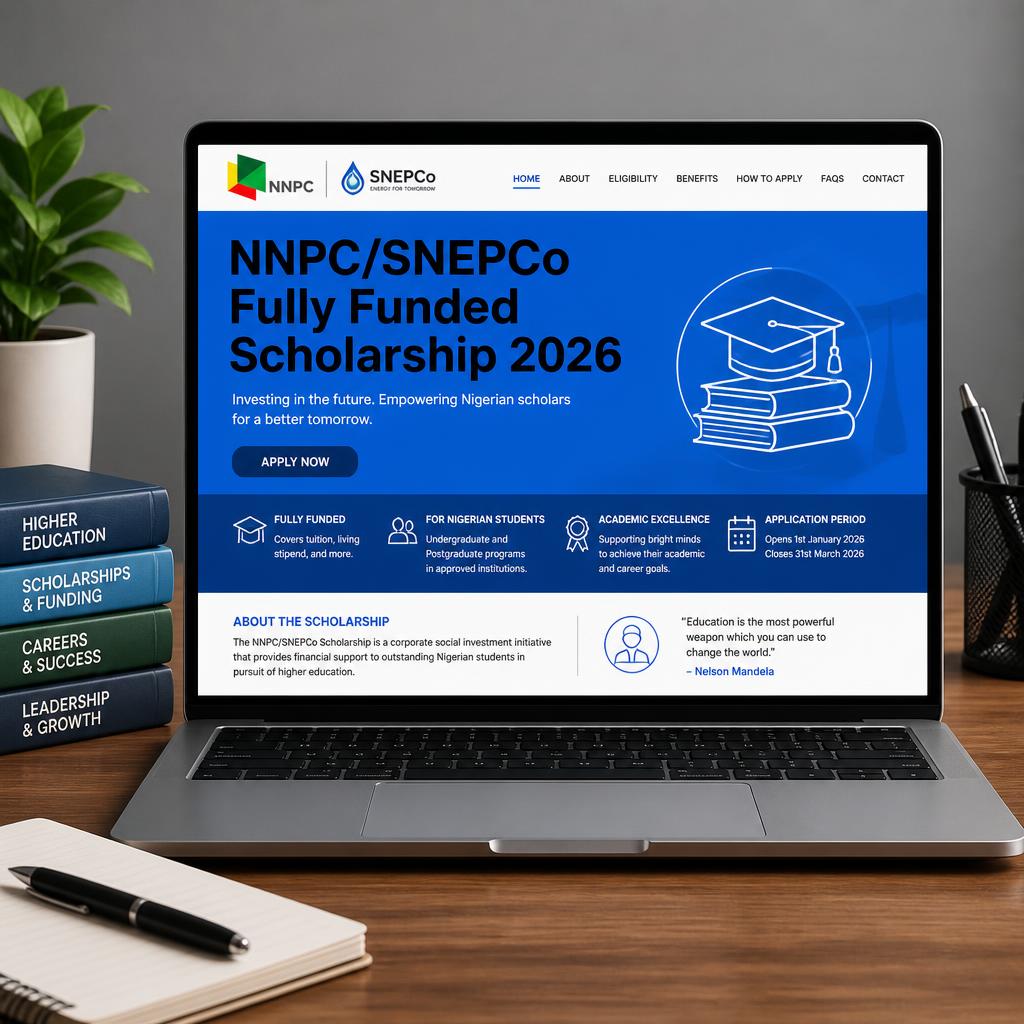
ToggleNNPC/SNEPCo Fully Funded Scholarship 2026: Nigerian Students’ Complete Guide to Winning Nigeria’s Most Competitive Oil Sector Award
Introduction: The Scholarship That Can Change Everything — If You Know How to Win It
You’ve heard the name before. Maybe a senior student mentioned it in passing, or you stumbled across it during a late-night Google search. Either way, something about the NNPC/SNEPCo fully funded scholarship made you stop scrolling.
And it should.
This isn’t a token award or a partial bursary that covers half your textbooks. The Nigerian National Petroleum Company (NNPC) and Shell Nigeria Exploration and Production Company (SNEPCo) jointly fund one of the most prestigious, most comprehensive, and — let’s be honest — most competitive scholarship programs available to Nigerian undergraduates today. Every year, thousands of brilliant students apply. Only a select few walk away with it.
So what separates the winners from the rest? It isn’t always the highest GPA or the fanciest secondary school. It’s knowing exactly what this scholarship demands, preparing accordingly, and presenting yourself with the kind of clarity and confidence that selection panels cannot ignore.
This guide gives you everything you need to do exactly that.
By the time you finish reading, you’ll understand the scholarship’s full structure, know precisely whether you qualify, understand how to build a compelling application, and have a realistic week-by-week action plan for the 2026 cycle. You’ll also learn the mistakes that sink otherwise promising applications — and how to avoid every single one.
Quick Summary Box
- What this guide covers: The complete NNPC/SNEPCo scholarship 2026 — structure, eligibility, application process, essay strategy, and timelines
- Key benefits you’ll gain: Insider knowledge of what selection panels prioritize, plus practical tools to build a winning application from scratch
- How to use this post: Read it end-to-end once, then return section by section as you build your application
Section 1: What Is the NNPC/SNEPCo Scholarship and Why Does It Matter?
Before you invest energy in any application, you deserve to understand exactly what you’re applying for — and why this particular award carries so much weight.
The NNPC/SNEPCo scholarship is a fully funded undergraduate scholarship established through the partnership between Nigeria’s national oil company and Shell Nigeria’s deep-water exploration arm. It’s part of Nigeria’s broader commitment to developing indigenous talent in science, technology, engineering, and mathematics — fields that directly power the nation’s energy sector and broader economic future.
SNEPCo, for context, operates Nigeria’s Bonga deep-water oil field — one of the country’s most strategically significant assets. When a company running operations at that scale funds your education, they aren’t doing it out of charity alone. They’re making a calculated investment in Nigeria’s future workforce and intellectual infrastructure. You become part of that national story the moment you win this award.
What makes this scholarship genuinely special — beyond the full funding — is the reputational weight it carries. In Nigerian professional and academic circles, NNPC/SNEPCo on your CV functions like a quality seal. It tells employers, postgraduate institutions, and professional networks that you’ve already been vetted by one of Africa’s most rigorous scholarship selection processes.
The scholarship also reflects something bigger: Nigeria’s long-term vision for local content development in the oil and gas sector. Under the Nigerian Oil and Gas Industry Content Development Act (the “Local Content Act”), international energy companies operating in Nigeria are mandated to invest in Nigerian talent. This scholarship is one of the most visible and meaningful expressions of that mandate.
Here’s the part that surprises most people: despite this scholarship’s prestige and life-changing value, many eligible Nigerian students never apply. Some assume the process is rigged. Others don’t think they’re competitive enough. Still others simply don’t know it exists until the deadline has passed.
You’re reading this now. That already puts you ahead.
Section 2: Understanding “Fully Funded” — What the NNPC/SNEPCo Award Actually Covers
The phrase “fully funded” gets thrown around casually in scholarship discussions. Before you build an application strategy around this award, you need to know exactly what those two words mean in this specific context.
A fully funded scholarship, at its most complete, covers tuition, living expenses, books, and sometimes travel. But scholarship programs define “full funding” differently, and the NNPC/SNEPCo award has its own specific structure worth understanding clearly.
Here’s what the NNPC/SNEPCo scholarship typically covers:
- Full tuition fees at the approved Nigerian university
- Monthly stipend to cover living and feeding expenses
- Textbook and academic materials allowance
- Accommodation support (either direct provision or inclusion in the stipend)
Here’s what it generally does not cover:
- Personal travel unrelated to academics
- Elective medical expenses beyond basic health coverage
- Business or entrepreneurial ventures
- Expenses at universities not approved under the scheme
This distinction matters enormously for your planning. If you’re admitted to the University of Lagos, University of Ibadan, Obafemi Awolowo University, or another top-tier Nigerian university, the scholarship essentially eliminates your financial burden for the duration of your undergraduate study.
Compare this with a partial scholarship — which might cover only tuition — or a grant, which provides a lump sum payment with no ongoing support. The NNPC/SNEPCo scholarship sits at the premium end of the funding spectrum because it commits to sustaining your entire academic journey, not just the entry point.
You should also understand the difference between this and a loan (which must be repaid, often with interest) or a work-study programme (where you earn funding by working part-time on campus). The NNPC/SNEPCo award requires nothing financial in return. What it does require is academic performance, commitment to your field of study, and often a willingness to consider opportunities within Nigeria’s energy sector after graduation.
Read every scholarship document carefully — especially the fine print around continuation criteria. Most fully funded awards, including this one, include performance benchmarks. Fall below a specified CGPA threshold during your studies, and the funding can be suspended.
Section 3: Who Actually Qualifies? The NNPC/SNEPCo Eligibility Requirements Explained
This is where a lot of students make their first — and most costly — mistake. They invest weeks building an application only to discover midway through that they don’t meet a fundamental requirement.
Read this section carefully before you write a single word of your personal statement.
Citizenship and Nationality
The NNPC/SNEPCo scholarship is exclusively for Nigerian citizens. You must hold a valid Nigerian identity document — National ID card, NIN slip, international passport, or voter’s card. Dual citizens with Nigerian nationality are typically eligible, but verify this against the current year’s specific guidelines.
Course of Study
This is arguably the most critical eligibility filter. The scholarship is heavily weighted toward science, technology, engineering, and mathematics (STEM) disciplines. Specifically, courses like:
- Petroleum Engineering
- Mechanical Engineering
- Chemical Engineering
- Electrical/Electronics Engineering
- Geology and Geophysics
- Physics
- Mathematics
- Computer Science
- Environmental Science
Some cycles have also included select social science and humanities courses, particularly those relevant to the oil and gas sector like Economics or Accounting. But if you’re studying Theatre Arts or Philosophy, this particular scholarship isn’t designed for you.
Always confirm the approved list of eligible courses in the official 2026 cycle guidelines — the list can shift slightly between years.
University Status
You must be admitted to and currently enrolled in a Nigerian university accredited by the National Universities Commission (NUC). The scholarship does not fund studies at polytechnics or colleges of education. You should also be studying at one of the universities listed as eligible in the specific cycle’s documentation.
Year of Study
The scholarship targets students in their first year (100 level) of undergraduate study. This is a fresh-start scholarship, not a mid-programme award. In most cycles, you need to have recently gained admission and be at the beginning of your academic programme. Some special provisions exist for students who deferred admission, but these are handled case-by-case.
Academic Performance
You’ll need a strong O-Level result — specifically, minimum of five credits at one sitting, including Mathematics and English Language, plus credits in science subjects relevant to your field. Admissions through UTME (JAMB) are required, and your UTME score matters. A higher score signals stronger academic foundations.
Age Requirement
Most NNPC/SNEPCo scholarship cycles specify a maximum age of 22 years at the time of application. This makes it a scholarship optimized for students entering university shortly after completing secondary education.
Are You Eligible? Quick Self-Assessment
Answer Yes or No:
- Are you a Nigerian citizen with valid documentation? ☐ Yes ☐ No
- Are you enrolled in or recently admitted to an eligible STEM course at an NUC-accredited Nigerian university? ☐ Yes ☐ No
- Do you have at least five O-Level credits including English and Mathematics, obtained at one sitting? ☐ Yes ☐ No
- Are you 22 years old or younger (confirm against the official 2026 age cut-off)? ☐ Yes ☐ No
If you answered Yes to all four: You likely meet the baseline eligibility criteria. Keep reading to optimize your application.
If you answered No to any: Identify which criterion you don’t meet and explore whether alternative scholarship routes are better suited to your profile.
Knowing your eligibility with certainty is the foundation that everything else builds on.
Section 4: Building Your Application File — Documents You’ll Need Before You Start
One of the most underrated aspects of a winning application is documentation readiness. The students who submit the strongest applications aren’t necessarily the most brilliant — they’re the most organized.
Start assembling these documents well before the portal opens:
Academic Documents
- O-Level result(s) — WAEC, NECO, or GCE certificates showing your credits. If you sat at more than one sitting, have both ready but know which result to lead with.
- JAMB UTME result slip — Your 2025 or 2026 UTME result with your score clearly visible.
- University admission letter — Official letter from your institution confirming your admission and course of study.
- Student ID or matriculation letter — Proof of current enrollment.
Personal Identification
- Birth certificate or age declaration — Required to verify your age for the scholarship’s cut-off criteria.
- National Identification Number (NIN) slip or valid Nigerian passport.
- Local Government Area (LGA) identification — Some cycles require documentation of your state of origin.
Photographs
- Recent passport photographs — Typically white background, formal attire. Many portals require digital uploads of specific dimensions. Don’t use an old phone selfie edited to white.
Additional Supporting Documents
- Testimonial or principal’s reference from your secondary school, signed and stamped.
- Letter of recommendation from a relevant academic or community figure (check whether this is required for the specific 2026 cycle).
Pro tip: Create a dedicated folder — both physical and digital — labelled “NNPC Scholarship 2026.” Scan every physical document at high resolution (300 DPI minimum). Scholarship portals often reject low-quality uploads, and discovering this at 11:58pm on a deadline night is a uniquely Nigerian academic nightmare.
Give yourself a full month just for document gathering. Bureaucratic delays at WAEC verification desks, NUC confirmation systems, or university administrative offices are entirely normal — and they won’t accept “the registry was closed” as an excuse for a late or incomplete submission.
Section 5: The NNPC/SNEPCo Application Process — A Step-by-Step Walkthrough
Now that you understand what you’re applying for and whether you qualify, let’s walk through the actual application process. This is where many capable students stumble — not because they’re unqualified, but because they underestimate how much precision the process demands.
Step 1: Monitor Official Channels for the Application Opening
Never rely on third-party blogs (including this one) as your primary information source for the official opening date. The authoritative sources are:
- The official NNPC website: nnpcgroup.com
- The SNEPCo official communications page
- Verified NNPC/SNEPCo social media accounts (Twitter/X, LinkedIn)
- Your university’s scholarship office noticeboard
Set a Google Alert for “NNPC SNEPCo scholarship 2026” so you’re notified the moment any official announcement goes live. Also, speak directly with your university’s Dean of Student Affairs office — they receive formal notifications and sometimes know before the public announcement.
Step 2: Create Your Portal Account
When the application portal opens, register immediately — don’t wait until you’ve finished gathering every document. Early registration gives you time to navigate any technical issues with the system before the deadline pressure intensifies.
Use your permanent, professional email address. Not a nickname. Not a joke address you created in 2016. Something clean and straightforward — your first name, last name, maybe a number. You’ll use this address for all scholarship correspondence.
Complete your profile section accurately. Errors in your name, date of birth, or state of origin — especially mismatches with your submitted documents — can trigger automatic disqualification during document verification.
Step 3: Complete the Personal Information Section
Fill every field. Leave nothing blank — even optional fields are an opportunity to demonstrate thoroughness. Selection panels notice applications that feel complete versus ones that feel rushed.
Your LGA of origin matters here. Some scholarship cycles allocate spots by geopolitical zone to ensure national spread. Being accurately and verifiably from an underrepresented zone can work in your favour.
Step 4: Upload Your Academic Records
Upload every document in the formats specified by the portal (typically PDF or JPEG). Confirm that:
- Every page of multi-page documents is included
- Text is legible and not cut off at the edges
- File sizes are within the portal’s specified limits
If you’re submitting WAEC results, make sure the result is the original certificate or an online verification print, not a photocopy. Scholarship portals are increasingly sophisticated at flagging altered documents — and being caught submitting a tampered document is an immediate and permanent ban from reapplying.
Step 5: Write and Upload Your Personal Statement / Essay
This is the section that separates the finalists from the rest of the field. It deserves its own dedicated section — and you’ll find a full strategy breakdown in Section 7 of this guide.
For now: don’t write your essay directly in the portal text box. Draft it in Google Docs or Microsoft Word, review it multiple times, get at least two trusted people to read it, and only then paste the final version into the system.
Step 6: Provide Referee Information
Most cycles request at least one academic referee — typically your secondary school principal or a subject teacher who can speak to your academic character. Some also request a community or character reference.
Contact your referee before you submit their details. Inform them of what you’re applying for, what the scholarship involves, and what qualities you’d like them to highlight. An unsolicited referee request is a semi-professional discourtesy — and a referee caught off-guard writes a weaker letter.
Step 7: Review, Preview, and Submit
Before you hit submit:
- Read every section of your completed application from start to finish
- Cross-check every uploaded document against your physical originals
- Confirm your email address is typed correctly
- Look for any fields marked “incomplete” or flagged by the system
Submit at least 48 hours before the deadline. Portal systems under heavy load slow down, crash, and time out. Every year, qualified students lose their shot because they submitted 90 seconds after the portal closed.
5 Mistakes That Cost Nigerian Students the NNPC/SNEPCo Scholarship (Avoid These)
- Submitting at the last minute: Portal crashes on deadline day are legendary. Submit 48 hours early — no exceptions.
- Generic personal statements: Writing “I have always loved science” tells the panel nothing. Show them a specific moment, a real decision, a concrete aspiration.
- Document mismatches: Your name on your birth certificate must match your O-Level certificate must match your application form. Any discrepancy triggers verification red flags.
- Neglecting your referee: A referee who doesn’t know what to emphasize writes a forgettable letter. Brief them thoroughly and give them adequate time.
- Applying to the wrong course category: Double-check that your specific course is listed as eligible for the current year’s cycle before investing hours in the application.
Section 6: Writing Your Personal Statement — The Section That Wins or Loses the Scholarship
Here’s something the most competitive applicants understand that many others miss: your personal statement is not a summary of your CV. The panel can already see your grades, your school, and your course. What they can’t see — until you tell them — is why you, specifically, deserve this specific award.
The NNPC/SNEPCo scholarship is built around Nigeria’s energy future. So your personal statement needs to connect your individual journey to that national story in a way that feels genuine, specific, and forward-looking.
Framework 1: “The Turning Point” Story
Begin with a single vivid moment — a field trip to an industrial site, a blackout in your community that made you curious about power systems, a conversation with a relative who worked in the oil industry — that crystallized your interest in your chosen field. Then connect that moment to your course of study, and then to your long-term vision for contributing to Nigeria’s energy landscape.
This framework works because it grounds abstract ambition in lived experience. The panel reads hundreds of statements that begin with “I have always been passionate about engineering.” They almost never read one that begins with a specific, sensory memory that draws them in.
Framework 2: “The Problem I Intend to Solve”
Identify a specific, verifiable challenge within Nigeria’s energy or scientific landscape — low local refining capacity, over-dependence on crude exports, underinvestment in renewable integration, environmental remediation gaps in the Niger Delta — and explain how your intended course of study equips you to contribute to solving it.
This approach signals maturity, awareness, and intellectual depth. It tells the panel you’re not just coming to collect a degree — you’re coming to develop expertise with a national purpose.
Framework 3: “From My Community to the Nation”
Connect your state of origin, community background, or family context to your motivation. If you grew up in an oil-producing community in Rivers State, Bayelsa, or Delta and saw both the industry’s potential and its challenges up close, say that. If you’re from a non-oil-belt state and you specifically want to bring energy expertise back to your community, explain that too.
Scholarship panels at organizations like SNEPCo — which operate under local content mandates — respond strongly to candidates who articulate a clear line from personal history to community impact to national contribution.
The Difference Between Generic and Compelling
Generic: “I am passionate about petroleum engineering and I believe this scholarship will help me achieve my dreams.”
Compelling: “When NEPA — what we still call it in my neighbourhood — took light for eleven straight days last harmattan, I watched my mother run the provisions shop by kerosene lantern light. That moment never left me. Now, studying chemical engineering at the University of Port Harcourt, I want to understand Nigeria’s downstream deficit from the inside out — because the answer to our energy poverty isn’t abstract. It lives in the gap between what our refineries produce and what our communities need.”
One is forgettable. The other earns a second read.
A Word on Authenticity
Resist the temptation to write what you think the panel wants to hear. Scholarship panels at this level review thousands of applications annually — they have finely tuned instincts for performative ambition versus genuine conviction. Honesty about your journey, even its imperfect parts, is more compelling than polished pretence.
If you struggled academically in one subject before mastering it, explain what that experience taught you about persistence. If your career direction shifted, show the intellectual growth behind that shift. Your realness is your differentiator.
“The essay that got me shortlisted wasn’t the most sophisticated one I wrote — it was the most honest. I stopped trying to sound like a press release and started writing like I was explaining my life to someone who actually cared to understand it.”
— Adaeze O., NNPC Scholarship Finalist, University of Ibadan, Chemical Engineering, 2023
Section 7: The Five Scholarship Types Nigeria’s Best Students Win — And Where NNPC/SNEPCo Fits
Understanding the broader scholarship landscape sharpens your strategy — and reveals backup opportunities if the primary competition is fierce.
1. Government-Funded National Scholarships
Who funds it: Federal and state governments through bodies like the Federal Scholarship Board (FSB) and state scholarship boards.
Why you’re competitive: Citizenship plus strong academics and community grounding.
Award range: ₦150,000–₦500,000 annually at federal level, varying significantly at state level.
Acceptance rate: Moderate — heavily influenced by geopolitical quota allocations.
Real example: The Federal Government Scholarship Award (BMAS) — Bilateral and Multilateral Scholarships offered through the FSB for international study.
Adult/context advantage: State scholarships often prioritize local students from the state — your community ties are assets, not afterthoughts.
2. University-Specific Merit Scholarships
Who funds it: Nigerian universities, sometimes with alumni or foundation support.
Why you’re competitive: Exceptional CGPA within the specific institution’s student population.
Award range: Partial to full tuition; rarely covers living expenses comprehensively.
Acceptance rate: Competitive but institutionally bounded — you’re competing only with students at your own university.
Real example: The University of Lagos Vice-Chancellor’s Scholarship for Top-Performing Students.
Context advantage: These awards have smaller applicant pools — fewer people know they exist or bother to apply.
3. Oil and Gas Sector Industry Scholarships
Who funds it: Energy companies operating in Nigeria under local content obligations — NNPC, Shell, Total Energies, Chevron, ExxonMobil, Schlumberger.
Why you’re competitive: STEM enrollment, academic strength, demonstrated interest in the energy sector.
Award range: Fully funded to near-fully funded, including stipends — among the most generous in Nigeria’s scholarship ecosystem.
Acceptance rate: Highly competitive — Chevron and Shell scholarships routinely receive tens of thousands of applications for hundreds of spots.
Real example: NNPC/SNEPCo scholarship (this guide’s focus) — Fully funded undergraduate support targeting STEM students at Nigerian universities.
Context advantage: Students who demonstrate sector awareness, community grounding, and national vision stand out powerfully in a field of otherwise equally qualified applicants.
4. NGO and Foundation Scholarships
Who funds it: Local and international foundations — TY Danjuma Foundation, Tony Elumelu Foundation, Mastercard Foundation, Dangote Foundation, Ford Foundation.
Why you’re competitive: Community impact, leadership potential, demonstrated resilience.
Award range: Highly variable — from small grants to full international postgraduate funding.
Acceptance rate: Varies widely — some foundation scholarships are undersubscribed because they’re poorly publicized.
Real example: The Mastercard Foundation Scholars Program, which supports academically talented but financially marginalized African students at partner universities across the continent.
Context advantage: These scholarships explicitly value life story and community connection alongside academics — making them responsive to a broader range of human experience.
5. International Scholarships for Nigerian Students
Who funds it: Foreign governments and bilateral programmes — UK Chevening, DAAD (Germany), Commonwealth Scholarships, US Fulbright.
Why you’re competitive: Academic excellence, leadership profile, English language proficiency, clear study purpose.
Award range: Fully funded postgraduate study in the UK, Germany, USA, Canada, or other partner countries.
Acceptance rate: Extremely competitive globally — but competition from Nigeria is particularly intense at the postgraduate level.
Real example: The Chevening Scholarship programme, funded by the UK Foreign, Commonwealth & Development Office, which offers fully funded one-year master’s degrees in the UK.
Context advantage: At the undergraduate level, international opportunities are rarer — making domestic industry scholarships like NNPC/SNEPCo even more strategically important for first-degree students.
Section 8: The Competitive Landscape — What You’re Actually Up Against
Knowing your competition is not discouraging. It’s strategic intelligence.
The NNPC/SNEPCo scholarship receives tens of thousands of applications annually across Nigeria. The available awards number in the hundreds — meaning acceptance rates are well below 5% in most cycles. That sounds brutal, and it is.
But here’s what the raw numbers don’t tell you: the distribution of quality is wildly uneven.
A significant percentage of applications are eliminated in the first round of review — not because the students lack potential, but because of avoidable errors. Wrong document formats. Courses not on the eligible list. Age cut-off violations. Essays that are entirely generic. Referees who submit letters late or not at all.
When you remove those applications from the competitive pool, the effective competition for a serious, well-prepared candidate looks considerably less intimidating.
The students who actually compete at the final stages are those who:
- Submitted complete, error-free applications on time
- Chose courses squarely within the scholarship’s STEM focus
- Wrote personal statements that were specific, honest, and nationally oriented
- Had referees who submitted meaningful, targeted endorsements
- Demonstrated academic performance genuinely consistent with their claimed ambition
You don’t need to be flawless. You need to be prepared, precise, and genuine. That combination, consistently applied, puts you in the top tier of this competition.
Section 9: What Happens After You Apply — The Selection Process Demystified
Most scholarship guides end at submission. This one doesn’t. Understanding what happens after you hit “submit” reduces anxiety and helps you prepare for the stages ahead.
Stage 1: Initial Screening
Your application goes through an automated and manual review process. This stage checks:
- Completeness — are all required fields filled and documents uploaded?
- Eligibility — do your course, age, institution, and citizenship meet the criteria?
- Document authenticity — this includes WAEC result verification against the official WAEC database
Applicants who fail this stage are typically notified by email. If you receive a query about a document, respond within the stated timeframe or risk automatic disqualification. Monitor your email daily after submission, including your spam folder.
Stage 2: Academic and Application Review
Applications that pass initial screening enter academic scoring. Your O-Level results, UTME score, and application quality are weighted here. Some cycles include the personal statement in this scoring round; others weight it more heavily in subsequent stages.
This is where your essay begins to matter. A student with slightly lower grades but a sharply compelling essay can outperform a student with perfect scores and a generic statement — because the scholarship isn’t just looking for students who can learn, it’s looking for students who understand why they’re learning.
Stage 3: Written Aptitude or Assessment Test (if applicable)
Some NNPC/SNEPCo scholarship cycles include a formal aptitude test — covering numerical reasoning, verbal ability, and sometimes subject-specific knowledge. If this is part of the 2026 cycle, practice papers are available for quantitative reasoning tests from resources like Testbook, Past Questions Africa, and the Scholarhip Guide Nigeria community.
Don’t skip this preparation. Brilliant students who underestimate aptitude tests have been knocked out at this stage before.
Stage 4: Interview
Finalists are invited for interviews — typically conducted in Abuja or Lagos, though some cycles include regional centres. The interview assesses:
- Your understanding of your chosen field and why it excites you
- Your knowledge of the Nigerian energy sector at a basic level (you don’t need to be an expert — you need to be curious and informed)
- Your articulation of how the scholarship fits into your specific academic and career goals
- Your maturity, composure, and communication clarity
Prepare for your interview the same way you’d prepare for a job interview at a major energy firm. Research NNPC and SNEPCo — their current projects, stated priorities, and role in Nigeria’s energy ecosystem. Know your chosen course and be able to explain it to a non-specialist. Practice speaking clearly and confidently under pressure.
Stage 5: Final Award and Notification
Successful candidates receive official offer letters by email and, usually, posted correspondence. Once you receive an offer, respond promptly and precisely according to the instructions provided. Failure to accept within the stated timeframe can result in the award being passed to the next candidate on the reserve list.
Section 10: The NNPC/SNEPCo Scholarship 2026 — Realistic Timeline
Use this table to map your preparation. Dates reflect typical historical cycles — always verify against the official 2026 announcement, as timelines shift between years.
| Date Range | Milestone |
|---|---|
| January–February 2026 | Begin monitoring official NNPC and SNEPCo channels for the application opening announcement |
| February–March 2026 | Application portal expected to open; register immediately upon launch |
| February–April 2026 | Active application window; gather documents, draft personal statement, confirm referee availability |
| April 2026 (Estimated) | Application portal closes; submission deadline |
| May–June 2026 | Initial screening and academic review by the selection committee |
| June–July 2026 | Aptitude test (if included in the 2026 cycle) |
| July–August 2026 | Shortlist announcement; interview invitations issued |
| August–September 2026 | Finalist interviews conducted |
| September–October 2026 | Final award notifications issued to successful candidates |
| October–November 2026 | Scholarship acceptance, onboarding, and commencement of funding |
Set phone reminders six weeks before each major milestone. The biggest documentation delays — WAEC verification, university enrollment confirmation, NIN-related issues — always take longer than expected. Early movers win.
Note: The NNPC/SNEPCo scholarship operates on a fixed annual cycle, not a rolling basis. There is one application window per year. Missing it means waiting another full year. This is not an application you want to rush at the last minute.
Section 11: Frequently Asked Questions
Can I apply for the NNPC/SNEPCo scholarship if I’m studying a social science course?
Most NNPC/SNEPCo scholarship cycles prioritize STEM disciplines — engineering, sciences, geosciences, and related fields. Some cycles include select social science courses like Economics or Accounting where they’re relevant to the energy sector. Always check the current year’s approved course list before applying, as the eligible disciplines can shift between cycles.
What happens if my WAEC result has a credit missing — can I still apply?
No. The standard requirement is a minimum of five credits at one sitting, including English Language and Mathematics. A missing credit in a required subject is a disqualifying factor, not a technicality that can be explained away. If you’re one credit short, use the time before the 2026 cycle to write a WAEC resit and address the gap.
Can I apply even though I’m already in my second year of university?
The NNPC/SNEPCo scholarship primarily targets students at 100 level — the first year of undergraduate study. If you’re already in your second year or above, this specific award isn’t open to you. Explore alternative scholarships from the University of Lagos, University of Ibadan, or sector-specific funding for continuing students instead.
Is the NNPC/SNEPCo scholarship renewable, or is it a one-time award?
The scholarship is designed to support you through your full undergraduate programme — it’s not a one-time grant. However, renewal is conditional on maintaining a satisfactory academic performance (typically a minimum CGPA of around 3.0 on a 5.0 scale). Failing to meet the performance benchmark in any academic year puts your continued funding at risk.
What if I applied last year and wasn’t selected — can I reapply in 2026?
Yes, absolutely. Previous unsuccessful applications do not disqualify you from reapplying in subsequent cycles, provided you still meet the eligibility criteria (particularly the age and year-of-study requirements). Use the feedback from your previous attempt — reflect on what you submitted, sharpen your personal statement, and return stronger.
Are students from non-oil-producing states at a disadvantage?
No — the scholarship is not restricted to students from oil-producing states like Rivers, Bayelsa, or Delta. It’s open to eligible Nigerian students across all 36 states and the FCT. Some historical cycles have included geopolitical zone distribution to ensure national spread, which can actually create more opportunity for students from zones that are underrepresented in STEM scholarship applications.
Can I hold the NNPC/SNEPCo scholarship alongside another award?
This depends on the specific terms of the 2026 cycle. Many scholarship programmes prohibit award-stacking — holding multiple fully funded scholarships simultaneously — on the grounds that funding should benefit as many students as possible. Check the scholarship’s terms of award carefully, and if you receive multiple offers, declare them honestly and seek clarification before accepting.
Clarity about the rules is not a limitation — it’s the foundation of an application you can submit with complete confidence.
Section 12: Your Action Plan — What to Do Right Now
You’ve read the guide. You understand what the NNPC/SNEPCo fully funded scholarship is, what it covers, who it’s for, what the application demands, and what the selection process looks like from start to finish.
Now comes the part that separates the students who win from the ones who finish guides like this one and then do nothing: you act.
Maybe you’re feeling a mix of excitement and uncertainty right now. Maybe you’re wondering whether your grades are truly good enough, whether your story is interesting enough, whether the whole thing is worth the emotional investment of trying. Those feelings are completely normal — and they’re not a signal to stop. They’re a signal that you care about something that matters.
That’s exactly the kind of care that compelling scholarship applications are built from.
Here are your three immediate, specific action steps:
Action 1: Build Your Scholarship Monitoring System Today
Go to the official NNPC website (nnpcgroup.com) and the SNEPCo communications page right now. Set up a Google Alert using the phrase “NNPC SNEPCo scholarship 2026.” Follow both organizations’ verified LinkedIn and Twitter/X accounts. Speak with your university’s scholarship office this week and ask them to notify you the moment the official announcement is made. Don’t rely on one source — build a system.
Action 2: Gather and Organize Your Documents This Week
Create a folder labelled “NNPC Scholarship 2026” on your phone, laptop, and Google Drive. Place physical copies of your WAEC certificate, JAMB result slip, admission letter, birth certificate, and NIN slip in a physical folder. Scan every document at high resolution. Address any gaps — if your WAEC certificate is damaged, request a replacement now, not in March.
Action 3: Draft the First Version of Your Personal Statement This Month
Don’t wait for the portal to open. Write a 500-word draft of your personal statement using one of the three frameworks from Section 6. Describe the moment your interest in your field began. Connect it to a specific national challenge. Explain what you intend to do with the expertise the scholarship helps you develop. Get one person — a teacher, mentor, or brilliant friend — to read it and give you honest feedback.
The NNPC/SNEPCo scholarship isn’t looking for perfect students. It’s looking for purposeful ones — students who know what they want, why they want it, and what they intend to do with it once they have it.
You already know more about this scholarship than 80% of people who will apply for it. Now use that knowledge. Start today. Your 2026 application begins this moment.
Sources and further reading: For the most current and authoritative information on NNPC scholarship programmes, visit the official NNPC Group scholarships page. For guidance on Mastercard Foundation Scholars Program opportunities for African students, visit the official Mastercard Foundation Scholars Program.