


How to Apply for Scholarships Without IELTS in Lesser-Known Countries (2026)
The IELTS Requirement Is Blocking You From Scholarships You Already Qualify For
You’ve done the research. You’ve found the scholarship. You meet the GPA requirement, your field aligns perfectly, your goals match the program’s mission — and then you hit the wall.
“English proficiency required: IELTS 6.5 or equivalent.”
For millions of African students who studied entirely in English, this requirement feels like a bureaucratic insult. You’ve written essays in English, defended research in English, worked professionally in English — and now you’re being asked to pay $250 and wait six weeks to prove it to an algorithm.
But here’s what the scholarship guides don’t tell you: scholarships without IELTS in 2026 are not rare exceptions. They are a substantial, growing category of international funding — particularly in lesser-known study destinations across Eastern Europe, Central Asia, Latin America, the Middle East, and Southeast Asia — and the competition for them is dramatically lower than for equivalent programs in Western countries.
This guide exists to change how you see your options.
You’ll discover exactly which countries and universities offer fully funded scholarships with no IELTS requirement, why these destinations are academically credible and professionally valuable, what you need instead of IELTS, and how to build a winning application step by step.
By the time you finish reading, you’ll have a shortlist of real programs, a clear understanding of alternative language evidence requirements, and a documented plan for submitting your strongest possible application in 2026.
The IELTS score you don’t have is not the end of your story. It might be the beginning of a smarter one.
📋 Quick Summary Box
- ✅ What this guide covers: Fully funded and partially funded scholarships in lesser-known countries that don’t require IELTS, plus what documentation replaces it
- ✅ Key benefits you’ll gain: A country-by-country breakdown, eligibility criteria, application steps, and insider tips for African students applying without English test scores
- ✅ How to use this post: Read straight through for complete preparation, or navigate directly to your region of interest, the document alternatives section, or the FAQ using the headings below
Why IELTS Isn’t the Only Proof of English Proficiency — And Why Many Countries Know It
The IELTS examination was developed in 1989 as a standardized tool for measuring English language readiness. It was designed for a world where international student mobility was limited, communication about academic ability was difficult across borders, and institutions needed a single comparable metric.
That world has changed substantially.
Today, more than 1.3 billion people speak English as a first, second, or official language — and a significant proportion of them live in African countries where English is the primary medium of education, government, and professional life. Nigeria, Ghana, Kenya, Uganda, Tanzania, Zambia, Zimbabwe, South Africa, Sierra Leone, Liberia, and more than a dozen other African nations conduct their entire formal education systems in English.
For students from these countries, IELTS is not a language assessment. It’s a $250 administrative fee that delays their applications by six to eight weeks while producing a number that tells admissions offices nothing they couldn’t determine from a transcript written entirely in English.
An increasing number of universities and scholarship programs outside the traditional Anglo-American academic sphere have recognized this reality. They’ve developed alternative English proficiency evidence pathways that are faster, cheaper, and often more genuinely informative:
- Medium of instruction letters from your previous institution confirming that English was the language of teaching and assessment
- Previous degree certificates from English-medium institutions as standalone evidence
- English-medium secondary school certificates (WAEC, WASSCE, NECO, ZIMSEC, KCSE) as proficiency evidence
- Skype or video interviews conducted in English as real-time proficiency assessment
- Writing sample submissions reviewed by admissions panels
This shift isn’t charity. It’s practicality. Institutions recruiting globally need efficient pathways to assess genuine academic talent without imposing financial and logistical barriers that disproportionately exclude students from the Global South.
Understanding which programs have made this shift — and how to document your English proficiency without IELTS — is the core competency this guide builds.
Lesser-Known Countries With Fully Funded Scholarships and No IELTS Requirement
These destinations don’t make headlines in the same way that the UK, US, and Australia do. But academically, financially, and professionally, they represent some of the most genuinely valuable scholarship opportunities available to African students in 2026 — precisely because the competition hasn’t caught up with the opportunity yet.
1. Turkey — Türkiye Scholarships (No IELTS for Turkish-Taught Programs; English Programs Flexible)
Why Turkey belongs at the top of this list: The Turkish government’s Türkiye Scholarships program is one of the world’s most comprehensive government-funded scholarship systems — fully funded, generously stipended, and explicitly welcoming to African students. And IELTS is frequently not required.
The IELTS situation: For programs taught in Turkish, no English test is required — and Turkish language training is provided as part of the scholarship. For English-medium programs, many universities within the Türkiye Scholarships network accept a medium of instruction letter or conduct their own English proficiency assessment rather than requiring external test scores.
What Türkiye Scholarships cover:
- Full tuition at Turkish state universities
- Monthly stipend of TRY 700–1,600 (~$25–$55 USD) — modest but supplemented by free accommodation
- Free university accommodation
- Health insurance
- Round-trip airfare
- One year of Turkish language training (paid)
Fields available: Medicine, engineering, social sciences, humanities, Islamic studies, agriculture, environmental sciences, architecture — a genuinely broad portfolio.
African applicant notes: Turkey has maintained active scholarship diplomacy with African nations for over a decade. Multiple African countries have dedicated quota slots within the Türkiye Scholarships system, which improves acceptance odds significantly for applicants from those nations.
Application window 2026: January–February 2026 through the official Türkiye Scholarships portal.
Eligibility snapshot: Undergraduate applicants must be under 21; postgraduate under 30; doctoral under 35. Minimum academic average of 70% (undergraduate) or 75% (postgraduate/doctoral).
Practical consideration: The stipend amount in Turkish Lira has been affected by currency fluctuation. While accommodation and tuition are fully covered, the monthly cash stipend provides limited purchasing power in USD terms. Factor this into your financial planning and confirm current exchange rates before applying.
2. China — Chinese Government Scholarship (CSC) — No IELTS for Chinese-Taught Programs
The scale of this opportunity: China’s government scholarship program is one of the largest in the world, funding tens of thousands of international students annually at Chinese universities ranging from regional institutions to globally ranked powerhouses like Peking University, Tsinghua, and Fudan.
The IELTS situation: For programs taught in Chinese (Mandarin), no English test is required — Chinese language training is provided. For English-taught programs, many Chinese universities within the CSC system accept medium of instruction letters or conduct their own English assessments rather than requiring IELTS. This varies by institution, so confirm with your specific target university.
What the Chinese Government Scholarship covers:
- Full tuition
- University accommodation or monthly accommodation allowance
- Monthly stipend: CNY 2,500 for undergraduates, CNY 3,000 for master’s students, CNY 3,500 for doctoral students (approximately $345–$485 USD)
- Comprehensive medical insurance
- One-time settlement allowance
For African students specifically: China has formal bilateral educational agreements with most African nations, and many African countries have dedicated CSC quota allocations. The Chinese Embassy track (applying through your country’s Chinese Embassy rather than directly to universities) often has less competition than the university-direct track.
Application window 2026: February–April 2026 for most African country tracks through Chinese Embassies.
Important: Chinese universities increasingly teach master’s and doctoral programs in English, especially in STEM and business fields. Identifying English-medium programs at CSC partner universities that accept alternative language evidence is the key research task — and it’s worth the investigation time.
3. Hungary — Stipendium Hungaricum Scholarship — No IELTS Required
Why Hungary surprises people: Hungary’s Stipendium Hungaricum scholarship is a fully funded program that has been quietly offering exceptional value to international students — including many Africans — for nearly a decade. And it doesn’t require IELTS.
The IELTS situation: Stipendium Hungaricum explicitly states that IELTS and TOEFL are not required for English-medium programs. Instead, universities assess English proficiency through their own admission processes — which typically involve reviewing your previous English-medium academic records and sometimes conducting a short admission interview.
What Stipendium Hungaricum covers:
- Full tuition waiver
- Monthly stipend of HUF 43,700 (~$120 USD) for non-dormitory students, with free dormitory accommodation for eligible students
- Health insurance contribution of HUF 65,000/semester
Fields available: Engineering, IT, medicine, agriculture, natural sciences, social sciences, humanities — with particularly strong programs in medical sciences and engineering at institutions like Budapest University of Technology and University of Debrecen.
Participating African countries: Stipendium Hungaricum has bilateral agreements with a growing list of African nations. Eligible applicants apply through their country’s Ministry of Education, which nominates candidates for the scholarship. Check your specific country’s eligibility status through your Ministry of Education.
Application window 2026: January–February 2026 through your country’s Ministry of Education nomination process.
Living costs in Hungary: Budapest and other Hungarian cities remain significantly more affordable than Western European capitals. Monthly living costs for students typically range from $400–$700 USD, which the stipend partially offsets alongside free accommodation.
4. Czech Republic — Czech Government Scholarships and University Programs — IELTS Often Not Required
The Czech opportunity: The Czech Republic hosts a number of scholarship programs and direct university admissions processes for international students where English test scores are either not required or where alternatives are readily accepted.
The IELTS situation: Czech universities offering English-medium programs frequently accept a medium of instruction letter from your previous institution in place of IELTS. Some universities conduct their own English language entrance exams or interviews. Charles University in Prague, one of Europe’s oldest universities, has programs accessible through this pathway.
Government scholarship programs: The Czech Ministry of Education offers scholarships specifically for students from developing countries under the Czech Government Development Cooperation framework. These are administered through Czech Embassies and do not uniformly require IELTS.
Coverage: Varies by program — university scholarship programs typically cover tuition and provide a monthly stipend of approximately CZK 5,000–15,000 (~$220–$660 USD). Government development cooperation scholarships may offer additional support.
Fields: Medicine, engineering, natural sciences, social sciences, and humanities — with Charles University, Czech Technical University, and Masaryk University being the primary destinations.
Application window 2026: Varies by institution and program; most begin accepting applications October 2025 through March 2026.
5. Russia — Russian Government Scholarships — No IELTS for Russian-Taught Programs
The scale and scope: The Russian government funds approximately 18,000 international scholarships annually through Rossotrudnichestvo and direct government allocation. African students represent a growing portion of recipients, particularly in medicine, engineering, and natural sciences.
The IELTS situation: For Russian-medium programs (the majority), no English test is required. Russian language training is provided as part of the scholarship. For the smaller number of English-medium programs, alternative evidence is typically accepted.
What Russian government scholarships cover:
- Full tuition
- Free dormitory accommodation
- Monthly stipend of approximately RUB 1,500–4,500 (~$16–$50 USD) — modest; currency fluctuation affects this significantly
- Free Russian language preparation course (one year)
Practical reality check: The monthly stipend in current exchange rate terms is low. Russian government scholarship recipients typically rely on family support or part-time tutoring for discretionary spending. However, accommodation and tuition being fully covered means the financial exposure is limited.
Fields: Russia has particular strength in medicine, aerospace engineering, nuclear physics, oil and gas engineering, and military sciences. Medical programs at Russian universities have long attracted African students.
Application window 2026: October 2025–February 2026 through the Russian Embassy in your country or Rossotrudnichestvo representative offices.
6. Malaysia — Malaysian Technical Cooperation Programme (MTCP) and University Scholarships — English Assessment Flexible
Why Malaysia is underrated: Malaysia is an English-proficient country with a mature, internationally accredited university system — and it’s one of the most affordable study destinations in Asia. Several scholarship programs, including the Malaysian Technical Cooperation Programme funded by the government, offer pathways where IELTS is not mandatory.
The IELTS situation: Many Malaysian public universities accept English-medium degree certificates or conduct their own English assessments for scholarship recipients, particularly through government-to-government scholarship channels. Universiti Malaya (UM), Universiti Teknologi Malaysia (UTM), and Universiti Putra Malaysia (UPM) all have international scholarship pathways with flexible language evidence requirements.
MTCP scholarships cover: Full tuition, accommodation, monthly living allowance, return airfare, and health insurance — for postgraduate programs specifically targeting students from developing countries, including African nations.
Application window 2026: MTCP applications typically open March–May 2026 through Malaysian Embassies or your country’s Ministry of Foreign Affairs.
Cost of living: Malaysia is genuinely affordable. Monthly living costs outside of scholarship-covered accommodation run approximately $300–$500 USD, making it one of the more financially comfortable study environments on this list.
7. Kazakhstan — Bolashak International Scholarship and University Programs — IELTS Alternatives Available
The emerging opportunity: Kazakhstan has positioned itself as a Central Asian education hub, and its Bolashak International Scholarship — while primarily for Kazakh nationals studying abroad — exists alongside a growing number of university-level international programs that actively recruit African students.
Beyond Bolashak: Nazarbayev University, Kazakhstan’s flagship international-standard institution, offers scholarships for international students and assesses English proficiency through its own placement process rather than exclusively requiring IELTS.
Why it matters for African students: Kazakhstan’s government has been actively developing Africa-Kazakhstan academic partnerships. Tuition at Kazakh universities is significantly lower than European equivalents, and several programs offer partial to full scholarships with English language assessment through alternative pathways.
Application window 2026: February–April 2026 for most international programs.
8. Morocco — Mohammed VI Polytechnic University and Government Scholarships — French or Arabic Medium, No IELTS
The African continental angle: Morocco offers a scholarship opportunity that’s genuinely pan-African in character. The Moroccan government allocates thousands of scholarship slots annually to students from sub-Saharan Africa, primarily for programs taught in French or Arabic.
The language situation: These programs don’t require IELTS because they’re not English-medium. For Francophone African students from countries like Senegal, Côte d’Ivoire, Cameroon, DRC, Madagascar, and others, this is a fully funded opportunity with no language barrier whatsoever. For Anglophone African students interested in French-medium programs, French proficiency (DELF B2 or equivalent) replaces IELTS as the language requirement.
Mohammed VI Polytechnic University (UM6P): A world-class institution in Ben Guerir, Morocco, offering English and French-medium programs in engineering, agriculture, business, and environmental sciences — with international scholarships that include stipend, accommodation, and tuition coverage.
Moroccan Government Scholarships: Cover tuition, accommodation, and a monthly allowance for selected African students. Apply through your country’s Ministry of Education or the Moroccan Embassy.
Application window 2026: November 2025–March 2026 for most programs.
9. Argentina — Argentine Government Scholarships — Spanish Medium, No IELTS
The Latin American angle: Argentina offers fully government-funded scholarships for international students through the AUGM network and direct government programs. Programs are taught in Spanish — so the language requirement is Spanish proficiency, not IELTS.
Why it’s worth considering: For African students who speak Spanish or French (which is structurally accessible to Spanish learning), Argentina’s universities — particularly the University of Buenos Aires, one of Latin America’s leading institutions — offer world-class education in medicine, engineering, law, social sciences, and humanities at no cost.
The Argentine Government scholarship program covers tuition, accommodation, and a monthly stipend for qualifying international students from eligible developing countries.
Application window 2026: March–June 2026 through the Argentine Embassy or your country’s Ministry of Education.
10. Belarus — Belarusian State University and Government Programs — Russian Medium, IELTS Not Required
The affordable European option: Belarus offers some of the lowest tuition rates in Europe for international students, with government scholarships that eliminate even those costs for qualifying African applicants.
Programs at Belarusian State University and Belarusian National Technical University are primarily Russian-medium, with Russian language training provided. Some English-medium programs exist in specific faculties.
Application window 2026: January–April 2026 through the Belarusian Embassy or directly through university portals.
📸 Content Image Suggestion 2:
A world map graphic highlighting the ten countries covered in this section — Turkey, China, Hungary, Czech Republic, Russia, Malaysia, Kazakhstan, Morocco, Argentina, and Belarus — with color-coded markers indicating: no IELTS required (green), alternative evidence accepted (yellow), language-medium switch available (blue). Title the graphic: “Where African Students Can Study Without IELTS in 2026.” This works as a shareable Pinterest image and an email newsletter visual. Include the ScholarCareer.com URL watermark.
What Replaces IELTS: Alternative English Proficiency Evidence That Works
Knowing that IELTS isn’t required is only useful if you know exactly what to submit instead. Different programs and countries have different alternative evidence pathways — here’s a comprehensive breakdown of what actually works and how to obtain each document.
Option 1: Medium of Instruction (MOI) Letter
What it is: An official letter from your previous university confirming that English was the language used for teaching, examinations, and academic communication during your degree program.
Who accepts it: The majority of no-IELTS scholarship programs listed in this guide, plus many universities in Eastern Europe, Central Asia, and Southeast Asia.
How to obtain it: Contact your university’s international office or registrar with a written request specifying exactly what the letter needs to confirm. Most universities have a standard template for this document.
What it should include:
- Your full name and student ID
- Your program of study and dates of enrollment
- An explicit statement that English was the medium of instruction
- The registrar’s signature and official university stamp
- The date of issue (keep it recent — within six months of application)
Processing time: One to four weeks at most African universities. Request it early.
Cost: Often free or minimally charged; confirm with your registrar.
Option 2: English-Medium Secondary School Certificate
What it is: Your secondary school leaving certificate from an institution where English was the language of instruction — WAEC, WASSCE, NECO, KCSE, ZIMSEC, BGCSE, and equivalent certificates from Anglophone African nations.
Who accepts it: Some programs, particularly at Turkish, Chinese, and Hungarian institutions, accept strong secondary school English results as standalone proficiency evidence.
What makes it more persuasive: If your certificate shows strong performance in English Language as a subject (a credit or distinction in English Language on WAEC, for example), include that specifically when submitting your secondary school evidence.
Option 3: University-Specific English Assessment
What it is: Some universities conduct their own English proficiency assessment — either a written test administered during admission, a reading and writing task submitted online, or a short video or telephone interview.
Who uses this: Increasingly common at Hungarian universities within the Stipendium Hungaricum framework, and at several Turkish universities.
How to prepare: Practice formal academic writing in English. Read academic articles in your field. Be prepared to discuss your research interests or career goals in a structured conversation. If you’re given advance notice of an interview format, practice exactly that format.
Option 4: Writing Sample Submission
What it is: Some programs accept a substantial writing sample — typically a research paper, thesis chapter, or extended essay — written in English as evidence of language proficiency.
Who accepts it: Primarily doctoral and research programs where written academic English is the most relevant form of the language. Some humanities and social science master’s programs also accept this.
What makes a strong writing sample: Your undergraduate dissertation or a chapter from your thesis, if written in English, is ideal. A published academic article is even stronger. The sample should demonstrate complex idea expression, accurate grammar, and academic register — not just grammatical correctness.
Option 5: TOEFL or Duolingo English Test (Cheaper IELTS Alternatives)
When this matters: Some programs that waive IELTS specifically still accept alternative English tests. TOEFL iBT and the Duolingo English Test are often accepted where IELTS is not required.
The Duolingo advantage: The Duolingo English Test costs approximately $59 (compared to IELTS at ~$250), can be taken from home, and produces results within 48 hours. It’s accepted by over 5,000 institutions worldwide and has been adopted by several scholarship programs as an IELTS alternative.
When to use it: If your target scholarship requires some form of standardized English evidence but explicitly accepts alternatives to IELTS, the Duolingo English Test is the fastest and most affordable route.
Step-by-Step Application Guide for No-IELTS Scholarships in 2026
Knowing which scholarships exist is only the beginning. Here’s exactly how to build and submit a competitive application — from initial research through confirmation of receipt.
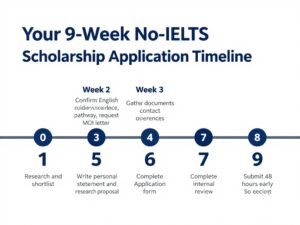
Step 1: Build Your No-IELTS Scholarship Shortlist (Weeks 1–2)
Start by creating a spreadsheet with these columns: Scholarship Name | Country | Program Level | Application Deadline | IELTS Alternative Accepted | Monthly Stipend | Fields Covered | Eligibility Requirements | Status.
Populate it with five to seven programs from this guide that match your field and academic level. Prioritize programs where your nationality is explicitly listed as eligible and where the alternative evidence pathway aligns with what you can provide.
Research action: For each program on your shortlist, visit the official scholarship portal and locate the English proficiency section of the eligibility requirements. Read it carefully. Identify exactly which alternative evidence is accepted, and confirm it through the official FAQ or a direct email inquiry to the program office if necessary.
Step 2: Confirm Your English Proficiency Evidence Pathway (Week 2)
Based on your shortlist research, identify which alternative evidence type applies to each program you’re targeting. For most Anglophone African students, a medium of instruction letter will be the primary document.
Action: Send your MOI letter request to your university’s registrar this week. Don’t wait — processing takes time, and you may need to follow up. If you’re targeting programs that accept secondary school certificates, locate your original certificate and arrange a certified copy.
Step 3: Gather All Required Documentation (Weeks 2–6)
Priority document list for no-IELTS scholarship applications:
- Official academic transcripts (all institutions, officially certified)
- Academic certificates and diplomas (bachelor’s degree certificate minimum)
- Medium of instruction letter (from your university registrar)
- Curriculum Vitae / Resume (academic and professional)
- Statement of purpose / personal statement (program-specific)
- Research proposal (postgraduate and doctoral applicants)
- Two to three reference letters (on official letterhead)
- Valid passport (minimum 18 months validity from program start)
- Passport-sized photographs (format varies by program)
- Medical fitness certificate (where required)
- No objection certificate from your Ministry of Education (for bilateral scholarships)
- Police clearance certificate / certificate of good conduct
- Financial documents (where required for partial scholarship or self-funded components)
The most time-sensitive documents: NOC from Ministry of Education (4–6 weeks), official transcripts (2–6 weeks), police clearance (2–4 weeks). Request all three immediately.
Step 4: Write a No-IELTS Statement of Purpose That Addresses Language Directly (Weeks 3–7)
Here’s something most applicants miss: when you’re applying to a program that doesn’t require IELTS, briefly acknowledging your English proficiency within your statement of purpose reinforces the alternative evidence you’re submitting.
You don’t need to make it a focal point. A single sentence works: “My undergraduate degree was completed entirely in English at [University Name], and I have submitted a medium of instruction letter confirming this.”
This proactively addresses what might otherwise be an unspoken question in a reviewer’s mind and demonstrates that you understand the application process — a small signal of organizational competence that compounds with other quality indicators in your application.
Your statement’s core focus should still be:
- Why this specific program and this specific country
- What your academic and professional background brings to the program
- What you’ll do with the qualification after graduation
- Why now is the right time in your career trajectory
Length: Follow the program’s specified word or character limit exactly. If no limit is given, 600–900 words is the standard range.
Step 5: Approach and Brief Your References (Weeks 3–5)
Contact your referees at least five to six weeks before your first application deadline. Provide each one with:
- A clear description of the scholarship and program
- Your CV and transcript summary
- A note on which aspects of your ability or character you’d like them to address
- The deadline and exact submission method (email, online form, sealed letter)
Reference selection strategy for no-IELTS applications: If English is a relevant dimension of your application, a referee who can naturally attest to your English academic performance — “I supervised [your name]’s thesis, which was written in English to a high academic standard” — adds a useful reinforcing layer to your language evidence.
Step 6: Complete the Application Form With Meticulous Care (Weeks 6–9)
Every no-IELTS scholarship program has its own application portal and form structure. Complete each field methodically:
- Read every instruction before completing any field
- Stay strictly within character and word limits
- Upload documents in the specified file format and within size limits
- Use the exact naming convention required for uploaded files (many portals reject files with incorrect names)
- Double-check that every required field is completed before final submission
Common technical elimination errors:
- Uploading scanned documents that are too dark or low-resolution to read
- Submitting transcripts without the registrar’s official stamp
- Missing the No Objection Certificate when it’s listed as required
- Uploading a personal photograph that doesn’t meet dimension specifications
Step 7: Submit Early and Confirm Receipt (Deadline Week)
Submit your application a minimum of 48 hours before the official deadline. If the program has an online portal, download or screenshot your confirmation page immediately after submission.
If you don’t receive an automated confirmation email within 24 hours, send a brief, professional email to the program’s contact address confirming your application reference number and requesting confirmation of receipt.
Keep copies of every document you submitted, organized by scholarship program, in a clearly labeled digital folder.

Eligibility Requirements You Need to Meet — No-IELTS Doesn’t Mean No Standards
Removing the IELTS requirement doesn’t mean these programs are easy to win. The academic, professional, and motivational standards for no-IELTS scholarships are as rigorous as any other fully funded program. Here’s what you’ll actually be assessed on:
Academic Performance
Most programs require a minimum grade equivalent to 60–75% across your previous studies — with competitive applicants typically holding records well above that threshold. Grade requirements by program level:
- Undergraduate: Strong secondary school results, particularly in subjects related to your intended field
- Master’s programs: Bachelor’s degree with minimum second-class lower (2:2); competitive applicants hold second-class upper (2:1) or first class
- Doctoral programs: Master’s degree with strong research output or clear research potential; a well-developed research proposal is often more important than GPA alone
Work and Research Experience
For postgraduate applicants, relevant professional or research experience significantly strengthens your application. Many programs in the countries listed here value practical experience — particularly in development-related fields — alongside academic credentials.
Clarity of Purpose
Scholarship committees can identify genuine purpose in a personal statement almost immediately. Your “why” — why this country, why this institution, why this program, why now, and what you’ll do after graduation — must be specific, consistent, and evidently informed by real research about the program. Vague statements about “broadening horizons” or “contributing to development” without concrete specifics are the most common reason otherwise qualified applications are declined.
Financial Need or Development-Oriented Goals
Many of the programs in lesser-known countries are specifically funded to support students from developing nations who demonstrate both academic merit and a commitment to applying their education for development purposes. Articulating your connection to your home country’s needs — how your graduate education will enable specific professional contributions — is a competitive differentiator in this scholarship category.
Common Mistakes African Students Make on No-IELTS Scholarship Applications
These aren’t hypothetical errors. They’re the consistent patterns that separate shortlisted candidates from rejected ones across the programs in this guide.
Mistake 1: Assuming “No IELTS” Means No Language Evidence Needed
The most common mistake. No IELTS means no IELTS specifically — it doesn’t mean no English evidence at all. Almost every program in this guide requires some form of language evidence. Submitting an application with no language documentation is almost always a disqualifying error.
Fix: Identify the exact alternative evidence required by each program and obtain it before you begin completing the application form.
Mistake 2: Applying to Programs in Your Field of Interest Without Confirming Field Availability
Turkish, Chinese, and Russian scholarship programs cover a wide range of fields — but not every field is available at every participating institution, and some fields are restricted for international students. Applying to a program where your intended field isn’t offered, or isn’t open to international applicants, wastes your application cycle.
Fix: Confirm your specific intended program and field of study is available and open to international students at your target institution before investing time in preparation.
Mistake 3: Submitting a Generic Statement of Purpose Across Multiple Programs
Sending the same personal statement to a Turkish scholarship, a Malaysian scholarship, and a Hungarian scholarship — with only the country name changed — is immediately recognizable to experienced reviewers. Each statement needs to demonstrate specific knowledge of that country’s academic environment, the institution’s strengths, and why that specific location serves your goals.
Fix: Spend two hours per program researching the specific institution, its faculty research areas, and its country context. Let that research visibly inform each statement.
Mistake 4: Missing the Ministry of Education Nomination Step for Government-to-Government Scholarships
Several programs in this guide — including Stipendium Hungaricum, Moroccan Government Scholarships, and Malaysian MTCP — require your home country’s Ministry of Education to nominate you before you can apply. Students who go directly to the scholarship portal without first securing nomination are ineligible.
Fix: For every scholarship on your shortlist, identify whether the application goes directly to the scholarship body or through your Ministry of Education. If the latter, contact your Ministry’s scholarship or international education department immediately — nomination processes often have their own internal deadlines that precede the official scholarship deadline.
Mistake 5: Underestimating Living Cost Differences Between Scholarship and Non-Scholarship Expenses
A scholarship that covers tuition and accommodation leaves your food, transport, personal items, books, and social costs uncovered. In countries like Russia and Turkey where the monthly stipend is modest in USD terms, this gap can be significant.
Fix: Research the realistic monthly cost of living in your specific host city — not just the country average. Calculate whether the scholarship’s stipend covers your non-tuition costs or whether you’ll need family support or savings. Build this into your decision before applying.
The No-IELTS Scholarship Quick-Match Quiz
Take two minutes to identify which program category best matches your profile:
Question 1: What is your intended level of study?
- A) Undergraduate → Consider Turkey (Türkiye Scholarships), China (CSC), Morocco
- B) Master’s degree → Consider Hungary (Stipendium Hungaricum), Malaysia (MTCP), Czech Republic, Turkey
- C) Doctoral/PhD → Consider China (CSC), Russia, Czech Republic, Kazakhstan
Question 2: Which language medium are you comfortable with?
- A) English only → Hungary, Malaysia, Czech Republic (English-medium programs), China (English-medium programs)
- B) Willing to learn a new language → Turkey (Turkish training provided), Russia (Russian training provided), China (Chinese training provided), Morocco (French/Arabic), Argentina (Spanish)
- C) French proficient → Morocco, Argentina (partial), some Belgian and Swiss programs
Question 3: What is your primary field of study?
- A) Engineering, STEM, Technology → Turkey, China, Russia, Czech Republic, Kazakhstan
- B) Medicine and Health Sciences → Russia, China, Belarus, Czech Republic
- C) Agriculture, Environment, Natural Resources → Malaysia, Morocco, Turkey, China
- D) Social Sciences, Humanities, Business → Hungary, Czech Republic, Malaysia, Argentina
Question 4: How important is geographic proximity to Africa?
- A) Very important → Morocco (North Africa), Turkey (bridge between Africa and Europe)
- B) Somewhat important → Malaysia (major African student community)
- C) Not a priority → Any program on the list
Your result: Map your A/B/C/D answers across the four questions to identify two to three programs where multiple answers align. Those are your strongest scholarship matches. Build your shortlist around them.
💬 We’d love to hear from you: Which country surprised you most on this list? Are you currently applying to any of these programs? Drop a comment below — your question might help a fellow African student who’s navigating the same decision.
2026 Application Timeline: No-IELTS Scholarships at a Glance
| Application Window | Scholarship Program | Country | Level |
|---|---|---|---|
| January–February 2026 | Türkiye Scholarships | Turkey | UG / PG / PhD |
| January–April 2026 | Czech Government Scholarships | Czech Republic | PG / PhD |
| January–April 2026 | Belarusian University Programs | Belarus | UG / PG |
| January–February 2026 | Stipendium Hungaricum | Hungary | UG / PG / PhD |
| February–April 2026 | Chinese Government Scholarship (CSC) | China | UG / PG / PhD |
| February–April 2026 | Kazakh University Programs | Kazakhstan | PG / PhD |
| November 2025–March 2026 | Moroccan Government Scholarships | Morocco | UG / PG |
| October 2025–February 2026 | Russian Government Scholarships | Russia | UG / PG / PhD |
| March–May 2026 | Malaysian MTCP Scholarships | Malaysia | PG |
| March–June 2026 | Argentine Government Scholarships | Argentina | PG |
Key planning notes:
- Stipendium Hungaricum and Moroccan scholarships require Ministry of Education nomination — begin this process by October 2025
- CSC applications through the Chinese Embassy track often have country-specific deadlines that differ from the dates above — confirm with your nearest Chinese Embassy
- Russian Embassy application windows vary by African country — contact your Russian Embassy by September 2025 for country-specific dates
Set calendar reminders eight weeks before every deadline you’re targeting. The Ministry of Education nomination step and the official transcript request are the two bottlenecks that most commonly cause African applicants to miss otherwise accessible scholarship opportunities.
Frequently Asked Questions: Scholarships Without IELTS 2026
Can I apply for fully funded scholarships without IELTS if I studied in English my whole life?
Yes — and this is the most common situation for Anglophone African students. If your secondary school and university education were conducted in English, you typically qualify for a medium of instruction letter from your university as your English evidence. Many fully funded programs in Turkey, Hungary, Malaysia, and China accept this in place of IELTS. Confirm the specific requirement with each program you apply to.
Is the Duolingo English Test accepted instead of IELTS for these scholarships?
For some programs, yes. The Duolingo English Test is accepted by over 5,000 institutions globally and is increasingly recognized by scholarship programs that accept IELTS alternatives. It costs approximately $59 and produces results in 48 hours. Check each program’s specific accepted alternatives — some explicitly list Duolingo; others don’t mention it either way, requiring direct inquiry.
Do no-IELTS scholarships offer the same funding as programs that require IELTS?
Many do. Türkiye Scholarships, the Chinese Government Scholarship, and Stipendium Hungaricum are all government-funded programs covering tuition, accommodation, and monthly stipends — the same comprehensive coverage as Chevening or DAAD. The IELTS requirement (or absence of it) is an admissions criterion, not a proxy for funding generosity.
What if I’m not sure whether my country qualifies for a specific bilateral scholarship?
Contact your home country’s Ministry of Education international scholarships department and ask directly whether your country has an active bilateral agreement with the country you’re targeting. Also contact the relevant Embassy in your country. This two-channel inquiry usually produces an answer within one to two weeks.
Can I apply to multiple no-IELTS scholarships simultaneously?
Absolutely — and you should. Most scholarship programs don’t require exclusivity during the application phase, though you’ll typically withdraw other applications once you accept an award. Applying to four to six well-matched programs simultaneously is the strategy most scholarship recipients retrospectively describe as essential. Apply broadly but tailor each application specifically.
How competitive are no-IELTS scholarships compared to programs that require IELTS?
Competition varies significantly. Türkiye Scholarships receives hundreds of thousands of applications annually — it’s highly competitive despite the lower barrier. Stipendium Hungaricum is moderately competitive. Programs in Kazakhstan, Belarus, and some Moroccan tracks have smaller applicant pools and may offer better odds for well-prepared candidates. Removing the IELTS requirement doesn’t eliminate competition — it removes one specific barrier and changes the pool composition.
What happens to my scholarship if I fail to demonstrate English proficiency to my host university’s standard after arrival?
Most programs that accept MOI letters as English evidence assess actual language ability during orientation or the first semester. Students who struggle linguistically may be required to complete a language support program or, in serious cases, may face academic probation. The honest preparation approach: if English is genuinely your strong medium, your MOI letter is accurate evidence. If you’re uncertain about your academic English level, invest in preparation through practice writing and reading in English before arrival.
Every question you have about this process is one a successful scholarship winner has already navigated — keep going.
Your Action Plan: Start Your No-IELTS Scholarship Journey This Week
You came to this guide carrying a specific barrier: the IELTS requirement you didn’t have. You’re leaving it with something more useful — a clear picture of ten countries, multiple alternative evidence pathways, a step-by-step application process, and the knowledge that the competition pool for these opportunities is smaller than you thought.
What you do in the next seven days determines whether 2026 becomes your year of enrollment or another year of watching others go.
Three specific actions to take before the week ends:
1. Build your personal no-IELTS scholarship shortlist today.
Open a spreadsheet. Add five programs from this guide that match your field, level, and language situation. Include the deadline, the alternative English evidence they accept, and the one eligibility requirement you need to verify. You don’t need a perfect list — you need a starting list you can act on.
2. Request your medium of instruction letter within 72 hours.
Email your university’s registrar or international office today with a formal request for an official letter confirming English as your medium of instruction. Specify that it needs to be on official letterhead with the registrar’s signature and institutional stamp. Follow up in five business days if you haven’t received a response.
3. Contact your Ministry of Education this week about bilateral scholarship nominations.
If you’re targeting Stipendium Hungaricum, Moroccan Government Scholarships, or Malaysian MTCP, your Ministry of Education is the first step — not the scholarship portal. Send a formal inquiry this week asking about active bilateral scholarship agreements with your target countries for 2026, and requesting information about the nomination process and internal deadlines.
For deeper guidance on writing the personal statement that wins scholarships in Eastern European and Asian programs, read our guide to [scholarship essays for non-Western study destinations →] (ScholarCareer.com internal link).
And if you’re building a parallel application strategy that includes IELTS-required programs alongside these options, our post on [fully funded scholarships with monthly stipends in 2026 →] (ScholarCareer.com internal link) gives you the complete picture.
📌 Bookmark this page now — you’ll need it when deadlines open.
If this guide helped you see options you hadn’t considered, share it with one person in your network who’s been held back by the IELTS requirement. Your share could be the information that changes their trajectory.
Have a specific question about applying to any of the programs in this guide? Leave it in the comments. We update this post regularly and respond to every question that helps our readers move forward.
All scholarship details, deadlines, and funding amounts in this guide reflect publicly available program documentation as of 2024–2025. Program terms are subject to annual updates. Always verify current requirements directly with the official scholarship portal or embassy before submitting your application. External program links verified at time of publication.