


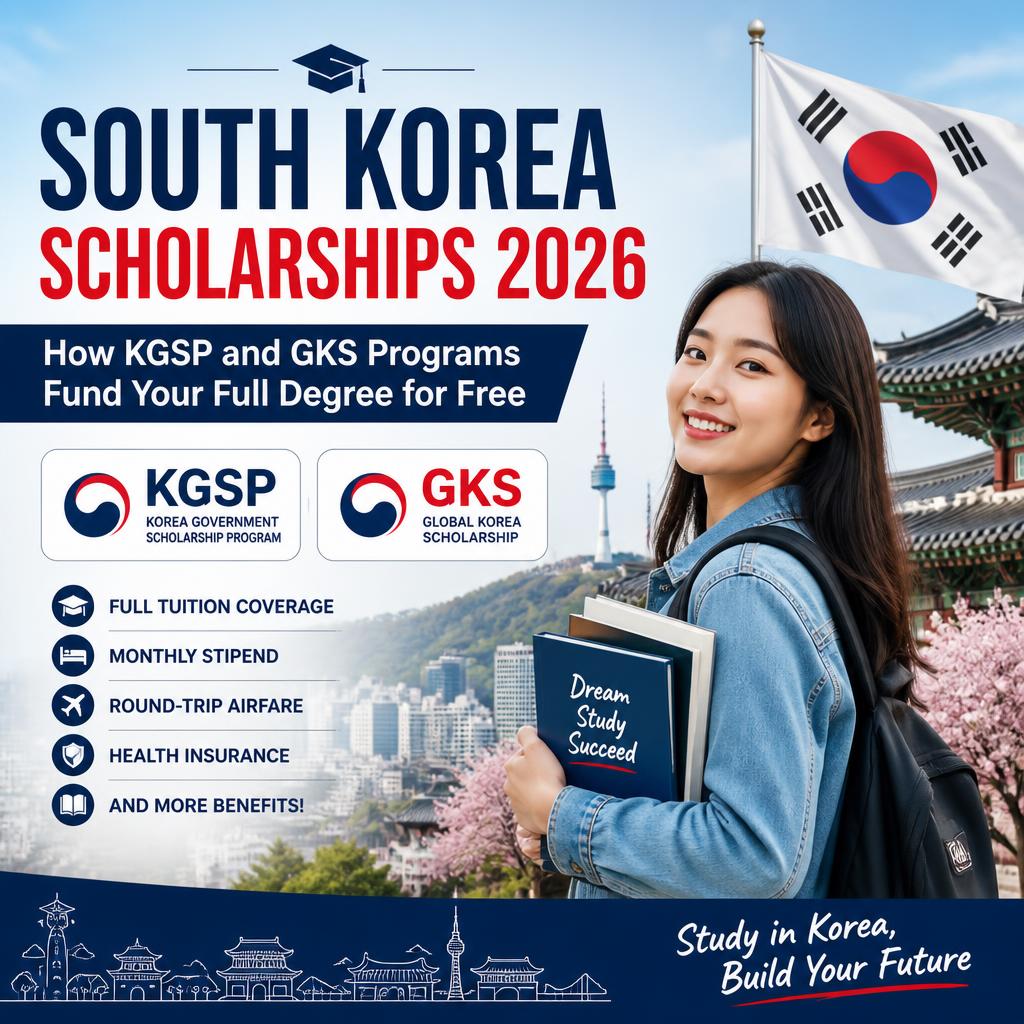
South Korea Scholarships 2026: How KGSP and GKS Programs Fund Your Full Degree for Free
Quick Summary Box 📋
- Scholarship Name: Korean Government Scholarship Program (KGSP) / Global Korea Scholarship (GKS)
- Host Country: South Korea 🇰🇷
- Funding Type: Fully Funded (100% — tuition, stipend, airfare, housing, insurance)
- Degree Levels: Undergraduate, Master’s, PhD, Research
- Application Window: February – March 2026 (estimated)
- IELTS Required? No — Korean language training provided
- Application Fee: Free
- Monthly Stipend: ₩900,000 – ₩1,000,000 (approx. $650–$750 USD)
- Official Website: www.studyinkorea.go.kr
SECTION 1: INTRODUCTION 🎓
Imagine receiving a letter that tells you every single cost of your university education — tuition, rent, food, flights, health insurance — will be paid in full by a national government. Not a loan. Not a partial grant with hidden conditions. A complete, unconditional investment in your future, funded by one of Asia’s most dynamic economies.
For thousands of students from Africa, Asia, Latin America, and beyond, that letter is real. It arrives every year from the Republic of South Korea — and in 2026, it could arrive for you.
South Korea scholarships 2026 represent one of the most generous and accessible government-funded education programs available to international students anywhere in the world. The Korean Government Scholarship Program — widely known as KGSP or GKS (Global Korea Scholarship) — has been transforming lives since 1967. It has funded over 70,000 international students from more than 140 countries, according to the National Institute for International Education (NIIED), the South Korean government agency that administers the program.
Yet despite its extraordinary scope and value, the majority of eligible students from developing countries have never heard of it. Students in Nigeria, Bangladesh, Ethiopia, Pakistan, Ghana, Kenya, Indonesia, and dozens of other eligible nations remain unaware that a fully funded pathway to a world-class South Korean university exists — and is actively looking for candidates exactly like them.
This comprehensive guide changes that.
Whether you are a recent high school graduate exploring undergraduate scholarships abroad, a working professional seeking master’s scholarships for Africans or Asians, a researcher pursuing PhD scholarships with stipend, or simply someone who has always dreamed of studying abroad but believed the financial gap was uncrossable — this article covers everything you need to know about the KGSP and GKS programs for 2026.
You will learn what the scholarship covers, who is eligible, how to apply step by step, how to write a winning personal statement, how to avoid the mistakes that eliminate strong candidates, and how to maximize your chances of joining South Korea’s growing community of international scholarship scholars.
The thesis is simple: South Korea’s KGSP and GKS scholarships are among the most complete, generous, and accessible fully funded scholarships for international students available in 2026 — and with the right preparation, you can win one.
Let us begin.
SECTION 2: SCHOLARSHIP OVERVIEW AND BACKGROUND 🌍
Who Funds the KGSP/GKS Scholarship?
The Korean Government Scholarship Program is funded directly by the Ministry of Education of the Republic of South Korea and administered by the National Institute for International Education (NIIED) — a specialized government agency established in 1992 whose sole mandate is to promote international educational exchange.
This is not a private foundation with variable funding. This is a sovereign government making a consistent, multi-decade commitment to global education. That distinction matters enormously. It means the program is stable, well-resourced, and expanding rather than contracting.
The South Korean government allocated approximately KRW 65 billion (approximately $50 million USD) to international student scholarships in 2023–2024, with budget projections for 2025–2026 indicating further increases, according to NIIED’s annual program reports.
The History and Evolution of the KGSP
The scholarship program began in 1967 — decades before South Korea became the technological and cultural powerhouse it is today. At the time, South Korea was still rebuilding from the devastation of the Korean War. The government made a deliberate and visionary choice: invest in global educational exchange as a pathway to building international relationships and advancing national development.
That vision paid off. South Korea is now one of the world’s largest economies, ranked consistently in the top 15 globally by GDP. It is home to world-class universities including Seoul National University (SNU), KAIST, Yonsei University, Korea University, POSTECH, and Sungkyunkwan University — all of which participate in the GKS program and rank among Asia’s best institutions.
Over its history, the KGSP has evolved significantly. What began as a small exchange program for a handful of neighboring countries now encompasses over 140 eligible countries, multiple degree levels, and a comprehensive suite of benefits that makes it one of the most complete scholarship packages in the world.
In recent years, the program rebranded elements of its international marketing under the Global Korea Scholarship (GKS) name, though KGSP and GKS refer to the same core program administered by NIIED. Understanding this dual naming convention is important when searching for information online or corresponding with university admissions offices.
How Many Students Does the Program Support?
NIIED awards approximately 1,000–1,500 new scholarships annually through the GKS program, depending on the year and degree level. Recipients are selected through two parallel tracks:
- Embassy Track: Applications submitted through South Korean embassies or consulates in the applicant’s home country
- University Track: Applications submitted directly to participating Korean universities
Both tracks are equally competitive and lead to identical scholarship benefits. Choosing the right track for your situation is one of the most important strategic decisions in your application — and we cover this fully in Section 5.
Why 2026 Is a Critical Year
South Korea’s Study Korea 300K Project — a government initiative to attract 300,000 international students to Korean universities by 2027 — is directly driving scholarship expansion. The Korean government increased GKS spots significantly between 2022 and 2024 as part of this initiative, and 2026 allocations are expected to remain at or above recent peak levels.
Additionally, South Korea’s aging population and labor market dynamics are creating a policy environment where international student attraction and retention are national priorities — not just educational niceties. Students who study in Korea on GKS scholarships are increasingly positioned to access post-graduation work opportunities through Korea’s expanding international graduate employment pathways.
This convergence of scholarship generosity and post-graduation opportunity makes international scholarships 2026 from South Korea uniquely valuable.
SECTION 3: COMPLETE SCHOLARSHIP DETAILS 💰
The KGSP/GKS scholarship is legendary among international scholarship hunters for one reason: it is genuinely, completely, comprehensively fully funded. Let us break down every component.
Financial Benefits
Tuition Coverage
The GKS scholarship covers 100% of tuition fees at the host Korean university for the full duration of your program. There are no partial coverages, no annual renewal requirements tied to additional fundraising, and no hidden fees passed on to scholars.
For context, annual tuition at major Korean universities ranges from KRW 4,000,000 to KRW 8,000,000 (approximately $3,000–$6,000 USD per year) — costs that the scholarship covers entirely, regardless of which participating university you attend.
Monthly Living Stipend
GKS scholars receive a monthly stipend designed to cover daily living expenses. The current stipend rates are:
- Undergraduate scholars: KRW 900,000 per month (approximately $670 USD)
- Master’s and PhD scholars: KRW 1,000,000 per month (approximately $745 USD)
- Research scholars: KRW 1,500,000 per month (approximately $1,115 USD)
South Korea’s cost of living, while higher than many developing countries, is significantly lower than comparable scholarship destinations like the UK, USA, or Australia. Many GKS scholars report saving money from their monthly stipend after covering accommodation and food — a rare luxury among international scholarship recipients.
Travel Allowance
The scholarship provides round-trip international airfare — one economy class ticket from your home country to South Korea at the start of your program, and one return ticket upon graduation.
For students from Africa, Latin America, or South Asia where international airfare can cost $800–$2,000 or more, this benefit alone represents a significant financial relief.
Accommodation Support
GKS scholars are provided free or heavily subsidized on-campus dormitory accommodation for the duration of their studies. Most Korean university dormitories are clean, modern, and safe — equipped with study rooms, laundry facilities, internet access, and on-site dining.
Students who choose to live off-campus receive a housing allowance instead. This flexibility makes the program practical for scholars with family members accompanying them.
Health Insurance
Comprehensive medical insurance is provided throughout the scholarship period, covering hospitalization, outpatient treatment, prescription medications, and emergency care. South Korea has an excellent national healthcare system, and GKS scholars benefit from full coverage within this system.
Korean Language Training Allowance
One of the most unique and valuable features of the GKS program is the one-year Korean language training stipend. Students who are not fluent in Korean — which is most international applicants — receive a full year of funded Korean language instruction before their degree program begins.
During this language year, scholars receive the same monthly stipend and accommodation benefits as during their degree. They are essentially paid to learn Korean before their formal studies begin.
This feature makes the GKS one of the most accessible scholarships without IELTS available anywhere — because the program teaches you the language you need rather than requiring you to have mastered it before applying.
Settlement and Relocation Allowance
Upon arrival in Korea, new GKS scholars receive a one-time settlement allowance of KRW 200,000 (approximately $150 USD) to cover initial expenses — transportation from the airport, essential supplies, and first-week costs before their first stipend payment arrives.
Research and Dissertation Support
PhD and research scholars receive additional funding for thesis research, laboratory materials, and academic publications. The exact amount varies by university and department, but most Korean universities provide supplementary research budgets specifically for international scholarship students.
Benefits Summary Table
| Benefit | Coverage Details |
|---|---|
| Tuition Fees | 100% covered for full program duration |
| Monthly Stipend | KRW 900,000–1,500,000 ($670–$1,115 USD/month) |
| Travel Allowance | Round-trip economy class airfare |
| Accommodation | Free university dormitory or housing allowance |
| Health Insurance | Comprehensive medical coverage |
| Visa Support | D-2 student visa facilitation through NIIED |
| Korean Language Training | 1-year funded language course + stipend |
| Settlement Allowance | KRW 200,000 one-time upon arrival |
| Research Funding | Additional support for PhD/research scholars |
| Other Benefits | Academic mentorship, alumni network access |
Academic Benefits
Access to World-Class Korean Universities
GKS scholars are placed at some of Asia’s most prestigious institutions. The program’s participating universities include:
- Seoul National University (SNU) — Ranked #1 in South Korea and consistently in the global top 50
- KAIST (Korea Advanced Institute of Science and Technology) — World-renowned for STEM research
- Yonsei University — One of Korea’s elite “SKY” universities
- Korea University — Among the most internationally connected Korean institutions
- POSTECH — A leading science and engineering research university
- Sungkyunkwan University, Hanyang University, Ewha Womans University — And over 60 additional participating institutions
For students pursuing graduate programs in engineering, science, business, social sciences, humanities, and arts, this range of institutions covers virtually every academic discipline at an internationally competitive level.
Academic Mentorship
Every GKS scholar is assigned a faculty advisor who provides academic guidance throughout the program. This relationship goes beyond administrative supervision — Korean professors typically maintain close mentoring relationships with their international students, facilitating research collaboration, publication support, and career guidance.
Networking and International Community
South Korea’s GKS program hosts scholars from over 140 countries simultaneously. This creates an extraordinary international community on Korean campuses — a permanent peer network that spans continents, cultures, and disciplines.
NIIED organizes regular cultural exchange events, alumni gatherings, and networking forums specifically for GKS scholars and alumni. The GKS alumni network, spanning over 70,000 individuals in more than 140 countries, is a genuine career and professional resource.
Research Opportunities
Korean universities are significant contributors to global academic research. In 2023, South Korea ranked 5th globally in scientific output per capita according to the SCImago Journal Rankings. GKS scholars, particularly at the PhD and research levels, participate actively in this research ecosystem — co-authoring papers, presenting at international conferences, and contributing to laboratory discoveries with real-world impact.
Career Benefits
Employability Advantages
A degree from a top Korean university carries significant weight in Asian job markets and is increasingly recognized globally. Korean industry giants — Samsung, LG, Hyundai, SK Group, Lotte, and dozens of major corporations — actively recruit from GKS-participating universities.
For students from developing countries, a Korean university credential combined with a Korean language certificate represents a significant competitive advantage in their home country job markets, in regional Asian job markets, and in international organizations operating across Asia.
Post-Graduation Work Opportunities
South Korea has expanded its post-graduation work visa options for international graduates in recent years. GKS alumni who wish to remain in Korea after graduation can apply for work visas (D-10 job-seeking visa, E-7 professional employment visa) with strong government support.
This post-graduation pathway makes the GKS scholarship not just an educational investment but potentially a complete international education and immigration pathway — one of the few scholarship programs in the world that can realistically lead to long-term residence in the host country.
Global Alumni Network
The GKS alumni community is active, organized, and globally distributed. Alumni chapters exist in major cities across Africa, Asia, Europe, and the Americas. These networks facilitate job referrals, business partnerships, research collaborations, and ongoing mentorship between generations of Korean education alumni.
SECTION 4: ELIGIBILITY REQUIREMENTS 🏆
Understanding exactly who qualifies for the KGSP/GKS scholarship — and who does not — is the essential first step in your application strategy.
Academic Requirements
| Requirement | Details |
|---|---|
| Degree Level | High school diploma (undergraduate track); Bachelor’s degree (Master’s track); Master’s degree (PhD track) |
| GPA/Grades | Minimum GPA of 2.64 on a 4.0 scale (80% average or higher) for undergraduate; similar minimums for graduate programs |
| Academic Standing | Must be in good academic standing with no academic sanctions |
| Field of Study | All fields accepted; STEM, arts, humanities, business, social sciences all eligible |
| Language | Korean or English proficiency demonstrated (see Language Requirements below) |
| Nationality | Citizen of one of 140+ eligible countries (see Nationality Requirements) |
| Age | Under 25 (undergraduate); Under 40 (master’s); Under 40 (PhD) |
| Experience | Not required for most tracks; research experience preferred for PhD |
Nationality Requirements
The GKS scholarship is open to citizens of over 140 eligible countries designated by NIIED. The full list is updated annually on the official Study in Korea website.
Countries that are consistently included in GKS eligibility and produce large numbers of scholars include:
Africa: Nigeria, Ghana, Kenya, Ethiopia, Tanzania, Uganda, Rwanda, South Africa, Egypt, Morocco, Cameroon, Senegal, Ivory Coast, Zimbabwe, Zambia, and 30+ additional African nations
Asia: Bangladesh, Pakistan, India, Sri Lanka, Nepal, Indonesia, Vietnam, Philippines, Myanmar, Cambodia, Laos, Thailand, and many more
Latin America: Brazil, Colombia, Mexico, Peru, Ecuador, Bolivia, Guatemala, Honduras, and others
Eastern Europe and Central Asia: Ukraine, Kazakhstan, Uzbekistan, Kyrgyzstan, Georgia, Azerbaijan, and others
Pacific Islands: Fiji, Papua New Guinea, Samoa, and others
⚠️ Critical Note: Citizens of countries that are OECD members are generally not eligible for the GKS scholarship as it targets developing and emerging economy students. This includes citizens of the USA, UK, Australia, Canada, and most Western European nations. Verify your country’s specific eligibility status on www.studyinkorea.go.kr before beginning your application.
Additionally, applicants and their parents must not be citizens of the Republic of Korea. Applicants of Korean heritage may face additional restrictions — consult the NIIED guidelines carefully.
Age Requirements
| Degree Level | Maximum Age at Application |
|---|---|
| Undergraduate | Under 25 years old |
| Master’s | Under 40 years old |
| PhD | Under 40 years old |
| Research | Under 45 years old (varies) |
Age is calculated as of the program start date (typically September of the award year). Applicants who will turn 25, 40, or 45 after the application deadline but before the program starts should verify their eligibility carefully with their host Korean embassy.
Language Requirements
The GKS has one of the most flexible language policies of any major international scholarship:
- Korean Language: TOPIK (Test of Proficiency in Korean) score is helpful but not mandatory for most applicants. The program includes a one-year Korean language training year precisely to address this.
- English Language: TOEFL, IELTS, or equivalent scores are accepted but not required for most embassy track applications. Some university track applications may require English proficiency evidence depending on the specific university and program.
- No Test Required: Many successful GKS applicants are accepted with no IELTS or TOEFL score at all, particularly through the embassy track.
This language policy makes GKS one of the most prominent scholarships without IELTS in the world — a genuine lifeline for excellent students from communities where expensive language testing is a barrier to scholarship access.
Work Experience Requirements
Work experience is generally not required for the GKS scholarship, making it highly accessible to recent graduates and high school students.
For PhD applicants, relevant research experience is strongly preferred and should be highlighted in the research proposal and personal statement. For master’s applicants, professional experience can strengthen an application but is not a formal requirement.
Who Cannot Apply?
⚠️ Citizens of OECD member nations are generally ineligible.
⚠️ Applicants who are currently enrolled in a Korean university degree program cannot apply through the standard GKS tracks.
⚠️ Previous GKS scholarship recipients cannot apply for the same level of study (e.g., a previous GKS master’s recipient cannot apply for another GKS master’s scholarship, but may apply for a GKS PhD scholarship).
⚠️ Applicants with a history of Korean immigration violations or academic misconduct at Korean institutions are ineligible.
⚠️ Applicants who hold dual Korean citizenship or Korean permanent residence are not eligible.
Required Documents Overview
| Document | Details |
|---|---|
| Passport | Valid for minimum 2 years beyond program end |
| Academic Transcripts | Official, sealed, certified translations if not in English or Korean |
| Degree/Diploma Certificates | Original and certified copies |
| Personal Statement | Program-specific, maximum 2 pages typically |
| Study Plan | Detailed academic and career goals plan |
| Research Proposal | Required for PhD applicants |
| Recommendation Letters | Two letters from academic or professional referees |
| Medical Certificate | Physical health examination from certified physician |
| Language Test Results | TOPIK or English test scores (if available, strengthens application) |
| Proof of Nationality | Birth certificate or national ID in addition to passport |
SECTION 5: STEP-BY-STEP APPLICATION GUIDE 📋
The GKS application process involves multiple stages and two distinct application tracks. Follow this guide precisely to maximize your chances.
Step 1: Verify Your Eligibility
Actions Required:
Visit the official NIIED Study in Korea website at www.studyinkorea.go.kr and navigate to the GKS scholarship page. Download the most current GKS Application Guidelines document — this is the authoritative source for all current requirements and supersedes any older information online.
Confirm your country appears on the current eligible countries list. Confirm your age eligibility for your target degree level. Review GPA requirements and compare honestly against your academic record.
If your GPA falls slightly below the stated minimum, do not immediately disqualify yourself — consult with your local Korean embassy or consulate, as some flexibility exists in borderline cases.
Choose your application track: Embassy Track or University Track.
Embassy Track is best if:
- You want NIIED to help match you to a suitable university
- You do not have a specific Korean university preference
- Your local Korean embassy has strong relationships with NIIED
- You are applying from a country with an active Korean embassy
University Track is best if:
- You have already identified a specific Korean professor willing to supervise your research
- You have a strong preference for a specific university program
- You have made direct contact with a Korean university’s admissions or international office
⚠️ Important: You can only choose ONE track per application cycle. Applying through both tracks simultaneously is not permitted.
Step 2: Gather All Required Documents (Begin 6–9 Months Before Deadline)
Document preparation is the phase where most applicants lose unnecessary time. Begin immediately.
Complete Required Documents Checklist:
✅ Valid international passport (check expiry date carefully)
✅ Official academic transcripts from every institution attended (sealed with official stamps)
✅ Degree and diploma certificates (original plus certified copies)
✅ Certified translations of all documents not in English or Korean
✅ Comprehensive CV/Resume (academic format)
✅ Personal Statement (motivation letter — see Step 3)
✅ Study Plan (detailed outline of your academic plans in Korea)
✅ Research Proposal (PhD applicants — see specific guidance below)
✅ Two Recommendation Letters (academic referees strongly preferred)
✅ Medical Certificate of Health (must be completed by a licensed physician)
✅ Family Relations Certificate or Birth Certificate (proving you and your parents are not Korean citizens)
✅ GKS Application Form (downloaded from official website, completed carefully)
✅ Self-Introduction (separate from personal statement in some tracks)
✅ Language Test Certificates (TOPIK, IELTS, or TOEFL if available)
✅ Portfolio or creative work samples (for arts, design, or music applicants)
Step 3: Write a Powerful Personal Statement and Study Plan
The personal statement and study plan are the two documents that determine whether your application advances from the initial screening to the interview or selection stage.
Personal Statement Guidance:
Your personal statement should answer four core questions with specific, evidence-based responses:
1. Who are you and what shaped you?
Write two to three sentences about your background and the specific experiences that made you the scholar you are today. Avoid generic phrases. Name specific events, people, challenges, and turning points.
2. What have you achieved academically and professionally?
Cite specific grades, research projects, awards, publications, or professional accomplishments. Use numbers and names wherever possible. Vague claims like “I performed well” are worthless. Specific claims like “I graduated ranked second in my department of 340 students” are powerful.
3. Why Korea — specifically?
This is where most applicants fail. Scholarship committees know when an essay has simply replaced “UK” with “Korea” from a previous application. You must demonstrate genuine engagement with Korean academic culture, Korean research, or Korean society. Reference specific Korean universities, professors, research centers, or programs that align with your goals. Mention what you have already done to prepare — Korean language study, Korean cultural engagement, contact with Korean scholars.
4. What will you do with your Korean education?
Connect your future goals explicitly to both your home community’s development and to the mutual relationship between your country and South Korea. GKS is a diplomatic as well as educational program — committees respond to candidates who understand and embrace this dimension.
Study Plan Guidance:
The study plan is separate from your personal statement in most GKS tracks and should cover:
- Specific courses you plan to take and why
- Research questions you want to explore
- Korean professors or research groups you want to work with
- Your intended thesis or dissertation topic (for graduate applicants)
- Your timeline for completing your degree
- What you will do after graduation — in your home country
Research Proposal Guidance (PhD Applicants):
Your research proposal should be 2,000–3,000 words covering:
- Research background and literature review
- Clear research question or hypothesis
- Methodology
- Expected outcomes and contributions
- Timeline
- Relevance to Korean research priorities and global development goals
Wherever possible, identify a specific Korean professor whose published research aligns with your proposal. Reaching out to that professor before you apply — to introduce yourself and your research interests — is one of the most effective strategies available to PhD applicants.
Step 4: Obtain Two Strong Recommendation Letters
Best Practices:
Request recommendation letters from referees at least three months before the application deadline. GKS deadlines are typically in February or March — meaning you should approach referees no later than November of the preceding year.
For each referee, provide:
- A completed GKS recommendation form (downloaded from official website — some tracks require this specific form)
- Your CV and academic transcripts
- Your personal statement draft
- The specific qualities you want them to highlight
- The submission deadline and instructions
Academic referees who have directly supervised your coursework, thesis, or research are strongest. If professional referees are needed, choose supervisors who can speak specifically about your intellectual capabilities and professional character — not just your job performance.
Follow up politely one month, two weeks, and one week before the submission deadline to ensure letters are submitted on time.
Step 5: Complete the Official GKS Application Form
Download the current GKS application form from www.studyinkorea.go.kr. Do not use forms from previous years — NIIED updates them annually and will reject applications submitted on outdated forms.
Complete every section of the form. Leave nothing blank — write “N/A” for sections that genuinely do not apply rather than leaving fields empty.
List your university preferences in the designated section. Most tracks allow you to list up to three preferred universities in order of preference. Research each university carefully before listing. Visit each university’s international admissions page and confirm that your intended program is available and actively enrolling international students.
Have your completed form reviewed by at least one other person before submission. A trusted teacher, academic advisor, or scholarship mentor should review for errors, omissions, and formatting issues.
Step 6: Submit Your Application Package
Embassy Track: Deliver your complete application package to the Korean embassy or consulate in your home country. Most embassies require physical document submission — visit the embassy’s website to confirm exact submission instructions for your country.
University Track: Submit directly to the international admissions office of your chosen Korean university, following that university’s specific submission instructions.
In both cases:
- Submit at least one week before the official deadline
- Use a tracked courier service for mailed documents
- Keep photocopies and digital scans of every document submitted
- Request written confirmation of receipt wherever possible
Step 7: Prepare for the Scholarship Interview
Many GKS tracks include an interview round, conducted either in person at the Korean embassy or via video conference.
Interview Preparation Strategy:
Research South Korea’s educational landscape, major universities, and national development priorities. Read current news about Korean government education policies.
Prepare detailed, specific answers to these core interview questions:
- Why do you want to study in South Korea specifically?
- What will you study and what specific Korean university or professor has inspired you?
- How will your Korean education benefit your home country after graduation?
- Tell us about your academic background and your most significant achievement.
- Where do you see yourself in ten years?
Practice your answers in English (or Korean if you have studied it) with a mock interviewer. Record yourself. Review the footage. Practice until your answers flow naturally without sounding rehearsed.
Dress formally for all interviews — even video interviews conducted from home. Your background should be neutral and professional.
Step 8: Await Results and Prepare for Arrival
GKS results are typically announced two to four months after the application deadline. Successful applicants receive notification through their application track (embassy or university).
While waiting for results:
- Continue studying Korean through free resources like TTMIK (Talk to Me in Korean) at talktomeinkorean.com or the King Sejong Institute online platform
- Research your target city in South Korea — accommodation, climate, cost of living, cultural practices
- Prepare your financial plan for the first month in Korea before your first stipend arrives
- Continue building your academic profile — writing, researching, attending seminars
If selected, you will receive official documents to begin the D-2 student visa application process through your nearest Korean embassy or consulate. Begin this process immediately upon receiving your award letter — visa processing can take 4–8 weeks.
SECTION 6: APPLICATION TIMELINE AND DEADLINES ✈️
Timing is the single most controllable factor in your GKS application success. Here is a complete timeline for 2026 intake.
GKS 2026 Application Timeline
| Period | Action Required |
|---|---|
| September – October 2025 | Research GKS program; confirm eligibility; identify target universities and professors |
| October – November 2025 | Begin document collection; request official transcripts and certificates |
| October 2025 | Contact potential referees; provide briefing materials |
| November 2025 | Begin drafting personal statement and study plan |
| December 2025 | Complete first draft of all written materials; seek feedback |
| January 2026 | Finalize all documents; confirm referee submissions; obtain medical certificate |
| February 2026 | Submit application to Korean embassy or target university (estimated — verify exact date) |
| February – March 2026 | Typical GKS application deadline window (verify on official portal) |
| March – April 2026 | Embassy/university first-round screening results |
| April – May 2026 | NIIED final selection process |
| May – June 2026 | Final results announcement |
| June – July 2026 | D-2 student visa application and processing |
| July – August 2026 | Korean language training year begins (September 2026 for most scholars) |
| September 2027 | Degree program officially begins |
Key Deadline Guidance
⚠️ The GKS 2026 application deadline has not been officially announced as of this writing. Historically, embassy track deadlines fall in February–March of the application year, with university track deadlines in the same window. Check www.studyinkorea.go.kr from December 2025 onward for confirmed 2026 deadlines.
The single most important recommendation: Begin your preparation no later than September 2025. Students who begin preparing 12 months before the deadline consistently produce stronger applications than those who begin 3–4 months before.
Korean embassies in many African, Asian, and Latin American countries open application submission windows for only two to four weeks. If you are not prepared and document-ready when the window opens, you will miss the entire 2026 cycle.
Do not let a one-month window in February cost you an entire year of your life. Prepare now.
SECTION 7: HOW TO MAXIMIZE YOUR CHANCES OF WINNING THE GKS SCHOLARSHIP 🏆
Thousands of eligible candidates apply for GKS every year. The difference between those who succeed and those who miss out almost always comes down to preparation quality and strategic thinking — not raw talent.
Here are the most powerful strategies employed by successful GKS recipients.
1. Academic Excellence — Maintain and Document Every Achievement
GKS committees review academic records carefully. A strong GPA is the minimum baseline — but a GPA alone does not make a compelling application.
Document every academic honor you have received. Academic prizes, departmental rankings, faculty commendations, research awards, and student competitions all belong in your CV and personal statement. If your transcript does not explain your class ranking, attach a separate document from your university confirming your rank among your peers.
If your GPA from earlier years was weaker but improved significantly in later years, frame this narrative explicitly in your personal statement. Upward academic trajectories demonstrate resilience and growth — qualities that scholarship committees value.
2. The Korea Connection — Demonstrate Genuine Engagement
This is the strategy that separates good GKS applications from great ones. Committees read hundreds of essays where applicants claim to love Korean culture, food, and K-pop. This kind of generic enthusiasm is easy to spot and easy to dismiss.
Genuine Korea connection means:
- Contacting a Korean professor directly before applying, expressing interest in their specific published research, and requesting guidance on your research proposal
- Studying Korean language through a formal course or structured self-study program before you apply — even a TOPIK Level 1 or 2 score demonstrates commitment
- Citing specific Korean research publications in your study plan and research proposal
- Referencing specific programs, courses, or research centers at your target Korean universities by name
- Demonstrating awareness of South Korea’s national development priorities and how your academic goals intersect with them
One email to a Korean professor that results in a warm response — “Yes, your research interests align with our lab’s current project” — is worth more than a hundred generic enthusiasm statements.
3. Leadership and Community Impact — Make It Specific and Quantifiable
GKS committees prioritize applicants who will become ambassadors of goodwill between their home country and South Korea. They want scholars who will return home and make a difference — not just scholars who want a prestigious degree.
Every leadership or community service experience you include must be specific and quantifiable. Not “I volunteered in my community.” Instead: “I founded an after-school science mentoring program that reached 180 secondary students in three rural schools over two academic years.”
Numbers transform generic claims into compelling evidence. Before you finalize your application, review every leadership and service claim and ask yourself: Can I add a number here? Can I add a name? Can I add a specific outcome?
4. The Two-Track Research Strategy for PhD Applicants
For PhD scholarship applicants, the most powerful preparation strategy involves two parallel tracks:
Track A — Identify Your Research Niche: Define your research question with as much specificity as possible. Read recent publications in your field from Korean universities. Identify two to three Korean professors whose work directly intersects with yours.
Track B — Make Direct Contact: Email those professors — professionally, concisely, and specifically — to introduce yourself, describe your research interests, mention your GKS application plan, and ask whether your proposed research would fit their laboratory or research group.
Many Korean professors respond positively to well-crafted outreach emails from international students. A professor who responds positively to your email before you apply becomes an informal internal advocate when your application arrives at the university. This advantage is significant and completely available to any applicant willing to put in the research and effort.
5. Korean Language Preparation — Even Minimal Investment Pays Off
While the GKS program does not require Korean language ability at the time of application, demonstrating even basic Korean language preparation makes your application significantly more compelling.
Take a TOPIK Level 1 or 2 preparation course online through platforms like Coursera, the King Sejong Institute’s free online platform (sejonghakdang.org), or TTMIK. Even if you cannot take the formal test before your application deadline, you can mention your language preparation commitment in your personal statement.
Applicants who demonstrate Korean language effort signal three things simultaneously: they are serious about Korea specifically (not just any scholarship), they are self-directed learners who do not wait to be taught, and they will integrate into Korean academic and social life more successfully than applicants with no preparation.
6. Professional Presentation of All Documents
Every document in your GKS application should be formatted with the same care you would give a professional job application to a major international organization.
Your CV should use a clean, professional academic format. No colors, no photos (unless specifically requested), no graphics. Use consistent fonts, clear section headings, and chronological organization.
Your personal statement should be error-free. Have native English speakers review it if English is your second language. Consider using professional editing services for this single most important document.
Certified translations of academic documents should be done by a certified translation agency — not by a friend or family member, regardless of their English or Korean proficiency.
7. Strategic University Selection
List your three preferred universities thoughtfully. Do not simply list the most famous Korean universities in rank order — this is exactly what thousands of less-prepared applicants do.
Instead, select universities based on:
- The specific department or research center that aligns with your academic goals
- The availability of English-taught programs in your field (if your Korean is not advanced)
- The professor you have contacted and their home institution
- The geographic location and lifestyle fit for your personal circumstances
A well-reasoned university selection list signals academic seriousness and demonstrates genuine research into the Korean higher education landscape.
Insider Tips from Successful GKS Recipients
💡 Tip 1: Visit the Korean embassy in your country not just to submit documents, but also to attend any GKS information sessions or cultural events the embassy hosts. Embassy staff who recognize your face from prior engagement may advocate for your application during the initial screening process.
💡 Tip 2: Connect with current GKS scholars from your country through Facebook groups (search “GKS Scholars [Your Country]” or “KGSP Alumni [Your Country]”). Ask for honest advice about what worked in their successful applications.
💡 Tip 3: The GKS medical certificate requirement is one of the most commonly delayed documents. Book your medical examination appointment as soon as you decide to apply — do not leave this until the final weeks before the deadline.
💡 Tip 4: If you are applying through the University Track, check whether your target university has its own separate scholarship or research funding for GKS scholars beyond the standard NIIED package. Some Korean universities add departmental grants, research budgets, or additional housing support to the baseline GKS award.
💡 Tip 5: Write your personal statement, set it aside for one full week, then re-read it with fresh eyes. What feels powerful in the moment of writing often reveals its weaknesses a week later. This one-week review process has improved applications more than any other single strategy reported by successful scholars.
SECTION 8: COMMON APPLICATION MISTAKES TO AVOID ⚠️
These are the seven most common mistakes that eliminate otherwise competitive GKS applications — and exactly how to avoid each one.
1. Using Outdated Application Forms
Why it hurts: NIIED updates GKS application forms annually. Submitting an application on a 2024 or 2023 form in 2026 results in automatic disqualification regardless of application quality. Embassies do not return submissions with this error — they simply reject them.
How to avoid it: Download your application form from www.studyinkorea.go.kr in the same month you begin completing it. Never use forms saved from previous years.
2. Generic Personal Statements With No Korea-Specific Content
Why it hurts: A personal statement that could be submitted to any scholarship program in any country signals lack of genuine interest in Korea. Committees are experienced readers who identify generic essays in the first paragraph.
How to avoid it: Your personal statement must include specific references to Korean universities, Korean professors, Korean research programs, or Korean cultural engagement that are unique to your GKS application. If you removed the word “Korea” from your essay and it still made complete sense as a general scholarship application — rewrite it entirely.
3. Submitting Uncertified or Unofficial Documents
Why it hurts: GKS requires official, certified documents throughout. Unofficial transcripts printed from student portals, uncertified copies of degree certificates, or translations completed without official certification are grounds for immediate disqualification.
How to avoid it: Contact your university’s registrar office early and request official sealed transcripts explicitly. Budget time and money for official certified translations of all non-English and non-Korean documents.
4. Choosing Universities Without Researching Programs
Why it hurts: Applicants who list their university preferences based on name recognition alone — without researching available programs, professors, or research centers — produce study plans that do not align with what those universities actually offer. Committees notice this disconnect immediately.
How to avoid it: Spend at least two hours researching each university you plan to list. Visit the department pages. Read faculty research profiles. Identify specific professors and courses. Your study plan should demonstrate this research clearly.
5. Requesting Recommendation Letters Too Late
Why it hurts: Professors and supervisors need time to write meaningful letters. A request made three weeks before the deadline produces a rushed, generic letter that does more harm than good. The best recommendation letters take the most time to write.
How to avoid it: Request letters at least three months before the deadline. Provide your referees with everything they need — the application form, your CV, your draft personal statement, and clear deadline instructions — in one complete package.
6. Ignoring the Medical Certificate Requirement
Why it hurts: The medical certificate requires a formal physician examination and typically takes one to two weeks to complete and deliver. Many applicants remember this requirement only in the final week before the deadline and discover that their physician is unavailable or the required form requires a specialist examination.
How to avoid it: Read the GKS application guidelines the moment you decide to apply, identify the medical certificate requirements immediately, and book your examination appointment at least six weeks before the deadline.
7. Applying to Both Tracks Simultaneously
Why it hurts: NIIED explicitly prohibits applicants from submitting to both the Embassy Track and the University Track in the same application cycle. Applicants discovered to have submitted to both tracks are disqualified from both applications.
How to avoid it: Make a clear, deliberate decision about which track best suits your situation before you begin any application preparation. Commit to that track and execute it fully.
SECTION 9: USEFUL RESOURCES AND OFFICIAL LINKS 🔗
Official GKS / KGSP Scholarship Resources
- Study in Korea (Official GKS Portal): www.studyinkorea.go.kr
- NIIED (National Institute for International Education): www.niied.go.kr
- GKS Application Guidelines: Available on Study in Korea portal annually (download current year only)
Korean University International Admissions Portals
- Seoul National University (SNU) International: en.snu.ac.kr
- KAIST International: international.kaist.ac.kr
- Yonsei University International: www.yonsei.ac.kr/en_sc/international (Verify before publishing)
- Korea University International: international.korea.ac.kr (Verify before publishing)
- POSTECH International: admission.postech.ac.kr (Verify before publishing)
Korean Student Visa Information
- Korea Immigration Service: www.immigration.go.kr
- D-2 Student Visa Guide: Available through Korea Immigration Service portal
- Korean Embassy Locator (find your nearest embassy): www.mofa.go.kr
Korean Language Learning Resources
- King Sejong Institute Online (Free): www.sejonghakdang.org
- TOPIK Official Website: www.topik.go.kr
- Talk to Me in Korean (TTMIK): www.talktomeinkorean.com
- Duolingo Korean Course: www.duolingo.com
Credential Evaluation Services
- World Education Services (WES): www.wes.org
- NACES (National Association of Credential Evaluation Services): www.naces.org (Verify before publishing)
Education Data and Authority Sources
- UNESCO Global Education Monitoring: www.unesco.org/gem-report
- OECD Education Data: www.oecd.org/education
- SCImago Journal Rankings (Korean research output): www.scimagojr.com
GKS Alumni and Community Networks
- Search Facebook for: “GKS Scholars [Your Country Name]” and “KGSP Alumni Network”
- Global Korea Scholarship Official Alumni: Through Study in Korea portal
SECTION 10: FREQUENTLY ASKED QUESTIONS 📚
FAQ 1: Is the GKS scholarship really fully funded with no hidden costs?
Yes — the GKS scholarship is genuinely fully funded. It covers tuition, monthly stipend, round-trip airfare, dormitory accommodation or housing allowance, health insurance, Korean language training costs, and a settlement allowance upon arrival. There are no hidden fees that scholars must pay from their own funds. However, scholars should budget for personal expenses beyond the scholarship coverage — entertainment, personal travel, and discretionary spending — which are not covered. Most scholars report that the monthly stipend is sufficient to cover all essential living costs in South Korea with careful budgeting.
FAQ 2: Can I apply for the GKS scholarship without IELTS or TOEFL?
Yes. The GKS scholarship does not require IELTS or TOEFL scores for most applicants through the Embassy Track. The program includes a mandatory one-year Korean language training period that prepares scholars for academic study. Applicants who have English or Korean language test results may include them to strengthen their application, but the absence of such scores does not make an application ineligible. This makes GKS one of the most accessible scholarships without IELTS available globally. Check the specific requirements for your country’s embassy and your target university track, as some university-specific programs may have additional language requirements.
FAQ 3: How competitive is the GKS scholarship and what are my realistic chances?
The GKS scholarship is competitive, but not impossible. NIIED awards approximately 1,000–1,500 new scholarships annually. Competition levels vary significantly by country — smaller nations with fewer applicants may have higher per-capita acceptance rates, while large countries like Nigeria, India, or Indonesia face more competition from a larger domestic applicant pool. The most important competitive factors are academic record quality, the quality and specificity of your personal statement and study plan, genuine evidence of Korea-specific interest, and strong recommendation letters. Well-prepared applicants who begin early and invest seriously in their application materials compete far more effectively than the raw numbers suggest.
FAQ 4: Can married applicants apply and will their families be supported?
Married applicants can apply for and receive the GKS scholarship. However, the scholarship does not officially cover the living costs of accompanying spouses or children. Some Korean universities provide family accommodation options, and the housing allowance may be used toward family housing in some cases. Married scholars with families need to independently plan for family living costs in South Korea, which can be significant. The monthly stipend alone may not be sufficient for a family. Married applicants should research cost of living for their specific city, explore whether their spouse can obtain a dependent visa with work authorization in South Korea, and plan their financial situation carefully before applying.
FAQ 5: What happens after I graduate — can I stay in South Korea?
Yes, staying in South Korea after graduation is possible and increasingly accessible for GKS alumni. Upon graduation, GKS scholars can apply for a D-10 Job-Seeking Visa, which allows a stay of up to one year while searching for employment. If employed, they can then transition to an E-7 Specially Designated Activities visa or other appropriate work visa category. South Korea’s government has been actively expanding post-graduation pathways for international graduates as part of its talent attraction strategy under the Study Korea initiative. GKS alumni with Korean language proficiency and relevant skills are well-positioned for employment in Korean industries and international organizations operating in Korea.
FAQ 6: Can I choose any university in South Korea?
Not any university — but a wide range. The GKS program has a designated list of participating universities, which currently includes over 60 major Korean universities covering virtually every academic discipline. The list includes all of South Korea’s top-ranked institutions. Through the Embassy Track, you can list up to three preferred universities. NIIED makes final university placement decisions based on your preferences, your academic profile, and available spots. Through the University Track, you apply directly to a specific university. The current list of participating universities is available on the Study in Korea official portal.
FAQ 7: Can final-year undergraduate students apply for the GKS master’s scholarship?
Yes. Final-year undergraduate students are eligible to apply for the GKS master’s scholarship. You must hold your bachelor’s degree by the program start date (typically September of the award year). At the time of application, you may submit an enrollment verification letter confirming your expected graduation date. Final-year students should apply promptly and ensure that their final transcripts and degree certificates will be available within the NIIED timeline for submission of final documents upon acceptance.
FAQ 8: Is there an age limit and are there any exceptions?
Yes, age limits apply. The standard limits are under 25 for undergraduate applicants and under 40 for master’s and PhD applicants at the program start date. These limits are generally firm, but specific research scholarship tracks may have slightly different age parameters — always check the current NIIED guidelines for your specific degree level. There are no general exceptions to the age limits for standard GKS tracks. If you are close to the age limit, confirm your eligibility precisely with your local Korean embassy before investing significant time in application preparation.
FAQ 9: What fields of study are eligible for the GKS scholarship?
The GKS scholarship is open to virtually all academic fields offered at participating Korean universities. This includes engineering, computer science, natural sciences, medicine, public health, social sciences, international relations, business, education, arts, humanities, Korean studies, and more. There are no restricted fields. Some specific NIIED annual guidelines may note particular fields as priority areas in certain years — check current guidelines for any prioritization notes. Korean Studies and Korean language programs are consistently popular and often well-supported by GKS funding.
FAQ 10: Can I apply for other scholarships while holding the GKS scholarship?
The GKS scholarship’s combination policy must be reviewed carefully in the current NIIED guidelines. Many supplementary grants and university-specific bursaries are compatible with GKS — particularly those covering research expenses, conference attendance, or personal development. However, holding another fully funded government scholarship simultaneously typically requires disclosure and may not be permitted depending on the source of the other funding. Always disclose any concurrent scholarship awards or applications to NIIED immediately upon receiving another award. Honest disclosure protects your GKS scholarship and your academic integrity. Refer to the official GKS guidelines for the current combination policy.
SECTION 11: CONCLUSION AND CALL TO ACTION 🌍
The Korean Government Scholarship Program — the Global Korea Scholarship — is not merely a financial award. It is a complete transformation package. It covers everything. It asks only that you bring your best self, your genuine purpose, and your commitment to making the most of an extraordinary opportunity.
In 2026, South Korea will once again invest tens of millions of dollars to bring talented international students to its universities, fund their complete education, and send them home as ambassadors of knowledge, cross-cultural connection, and global progress.
One of those funded students could be you.
The path is clear. Start in September 2025. Verify your eligibility. Gather your documents. Contact Korean professors in your field. Study Korean — even informally. Write personal statements that are specific, honest, and compelling. Ask your best referees for letters with confidence and with enough lead time to produce something outstanding. Submit everything early.
The students who win GKS scholarships are not always the most brilliant in their class. They are the most prepared. They are the ones who started earlier, researched deeper, wrote more drafts, and refused to treat this application as anything less than the life-changing opportunity it genuinely is.
Here is what to do right now:
✅ Bookmark this article and revisit it weekly during your preparation
✅ Visit www.studyinkorea.go.kr today and download the current GKS guidelines
✅ Share this article with every talented friend, classmate, or colleague who deserves this opportunity
✅ Subscribe to ScholaCareer.com for weekly scholarship alerts, application guides, and deadline reminders
✅ Begin your scholarship journey today — not tomorrow, not after the holidays — today
The world needs what you will become. South Korea is ready to help you get there. The only question is whether you are ready to apply.
The fully funded scholarships for international students you have dreamed about are real. They are waiting. And the 2026 deadline is coming faster than you think.
Go apply. Your future is on the other side of that application.
⚠️ Disclaimer: Scholarship requirements, deadlines, benefit amounts, and eligibility criteria may change without notice. All information in this article is based on historical GKS program data and is subject to change for the 2026 cycle. Always verify current information through the official NIIED Study in Korea portal at www.studyinkorea.go.kr and your nearest Korean embassy or consulate before beginning your application. ScholaCareer.com provides educational guidance only and does not guarantee scholarship success or outcomes.