


Table of Contents
ToggleTuition-Free Countries 2026: Fully Funded Scholarships
Introduction
The idea of earning a world-class degree without paying tuition is not a fantasy. Several countries around the world operate public university systems that charge zero tuition fees — even to international students. But there is a critical distinction that most articles gloss over: tuition-free does not mean cost-free.
Even when a university charges no tuition, you still need to cover rent, food, health insurance, transportation, semester administration fees, and visa costs. In cities like Munich, Reykjavik, or Oslo, living expenses can exceed €1,000 per month. That is where fully funded scholarships become essential. They bridge the gap between “no tuition” and “actually affordable.”
This guide covers the top countries with tuition-free or near-free university education heading into 2026, based on current government policies and official university information. It also profiles verified fully funded scholarships that can cover your living costs, travel, and insurance on top of tuition waivers.
What you will find in this article:
- Countries where public universities charge no tuition to international students
- Countries where tuition is free only for EU/EEA students (with honest notes for non-EU applicants)
- Recent policy changes that many outdated articles miss (including Norway’s 2023 fee introduction and Bavaria’s new tuition rules)
- Eight verified fully funded scholarship programs with real eligibility details
- A dedicated section for African and Nigerian students
- A step-by-step application guide
- Scam warnings and hidden costs you need to know about
Important note: Scholarship deadlines, tuition policies, and visa rules can change. The information below reflects the most current official data available at the time of publication. Always confirm details on the official source before applying.
Understanding “Tuition-Free” vs “Fully Funded Scholarships”
Before diving into country lists, it is important to understand two terms that are often confused:
Tuition-free means the university does not charge tuition fees for instruction. However, students may still pay:
- Semester administration contributions (€150–€350 per semester in Germany, for example)
- Student union fees
- Registration fees
- Living expenses (rent, food, transport, insurance)
- Visa and residence permit fees
Fully funded scholarships go much further. A genuinely fully funded scholarship typically covers:
- Full tuition fees
- Monthly living stipend
- Health insurance
- Round-trip airfare
- Visa costs (in some cases)
- Accommodation or housing allowance
- Research or book allowances
The most valuable opportunities combine both: studying in a tuition-free country and securing a fully funded scholarship to cover your living expenses. This combination can make a European degree genuinely cost-free.
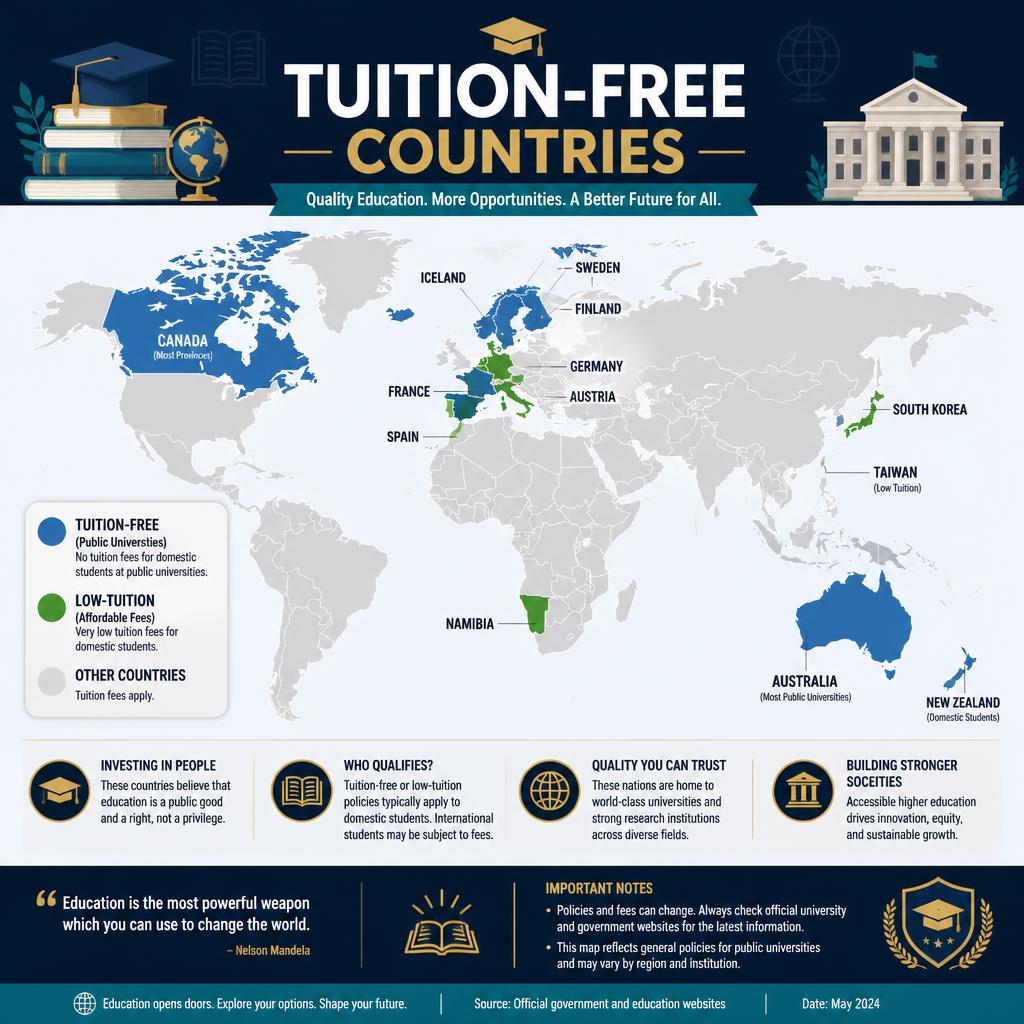
Top Countries With Tuition-Free Universities in 2026
Germany
Tuition-free for: All students at public universities in 14 of 16 federal states, regardless of nationality.
Germany remains the most popular destination for tuition-free higher education. Public universities in the majority of German states charge no tuition fees to any student — domestic or international, undergraduate or postgraduate.
Important exceptions:
- Baden-Württemberg has charged non-EU students €1,500 per semester since 2017.
- Bavaria passed legislation in 2024 allowing public universities to introduce tuition fees for non-EU students. The Technical University of Munich (TUM) began charging non-EU students €2,000–€6,000 per semester starting winter semester 2024/25. Other Bavarian universities may follow.
What you still pay: A mandatory semester contribution (Semesterbeitrag) of approximately €150–€350 per semester at most universities. This typically includes a public transportation ticket for the region.
Living costs: Approximately €850–€1,200 per month, depending on the city. Munich and Frankfurt are at the higher end; Leipzig and Dresden are more affordable.
Language: Many Master’s programs are taught in English. Bachelor’s programs are predominantly in German, requiring C1-level proficiency.
Official source: daad.de and individual university websites.
Iceland
Tuition-free for: All students at public universities, regardless of nationality.
Iceland’s public universities — the University of Iceland, University of Akureyri, Hólar University, and the Agricultural University of Iceland — charge no tuition fees to any student.
What you still pay: An annual registration fee of approximately ISK 75,000 (roughly €500 at current exchange rates).
Living costs: Iceland is one of the most expensive countries in Europe. Expect to budget €1,200–€1,800 per month for living expenses in Reykjavik.
Language: Many graduate programs at the University of Iceland are offered in English. Undergraduate programs are primarily in Icelandic.
Key consideration: The high cost of living makes fully funded scholarships particularly important for Iceland. Without one, the absence of tuition fees may be offset by steep housing and food costs.
Official source: hi.is (University of Iceland)
Austria
Tuition-free for: EU/EEA and Swiss students at public universities.
Non-EU students: Pay approximately €726.72 per semester at most public universities. This is still significantly lower than tuition in the UK, US, or Australia.
What you still pay: A student union fee (ÖH-Beitrag) of approximately €22 per semester.
Living costs: Approximately €900–€1,300 per month in Vienna; lower in Graz, Linz, or Innsbruck.
Language: Most Bachelor’s programs are in German. A growing number of Master’s programs are available in English.
Official source: oead.at (Austrian Agency for Education and Internationalisation)
France
Tuition-free for: EU/EEA students at public universities (nominal fees of approximately €170/year for Bachelor’s, €243/year for Master’s).
Non-EU students: The French government’s “Bienvenue en France” strategy set higher fees for non-EU students at €2,770/year for Bachelor’s and €3,770/year for Master’s. However, many French public universities have chosen to partially or fully exempt international students from these increased fees. The situation varies by institution, so you must check directly with the university.
Living costs: Approximately €800–€1,200 per month in Paris; €600–€900 in cities like Lyon, Toulouse, or Montpellier.
Language: Many Master’s programs and some Bachelor’s programs are taught in English, particularly at grandes écoles and research universities.
Official source: campusfrance.org
Czech Republic
Tuition-free for: All students (regardless of nationality) enrolled in programs taught in the Czech language at public universities.
English-taught programs: Typically charge tuition fees ranging from €0 to €5,000 per year, depending on the university and program.
Living costs: Approximately €500–€900 per month in Prague; lower in Brno or Olomouc. The Czech Republic is one of the most affordable study destinations in Western/Central Europe.
Key consideration: If you are willing to learn Czech, you can access genuinely free education at prestigious institutions like Charles University and Masaryk University. The Czech government offers a one-year Czech language preparatory course for scholarship recipients.
Official source: studyin.cz
Norway (Important Policy Change)
Tuition-free for: EU/EEA and Swiss students only.
Critical update: As of autumn 2023, Norway introduced tuition fees for students from outside the EU/EEA/Switzerland. This was a major policy reversal. Non-EU students now pay tuition fees that vary by institution and program, often ranging from NOK 130,000 to NOK 260,000 per year (approximately €11,000–€22,000).
Many older articles still list Norway as tuition-free for all international students. This is no longer accurate.
For EU/EEA students: Public universities remain tuition-free. Students pay a small semester fee of approximately NOK 500–800 (€45–€70).
Living costs: Norway is extremely expensive. Budget €1,000–€1,500 per month.
Official source: studyinnorway.no
Brazil
Tuition-free for: All students, including international students, at federal and state public universities.
Brazil’s public university system — including prestigious institutions like the University of São Paulo (USP), Federal University of Rio de Janeiro (UFRJ), and University of Campinas (UNICAMP) — charges no tuition fees to any student.
Key considerations:
- Programs are almost exclusively taught in Portuguese.
- Admission is highly competitive, typically through the ENEM national exam and SISU selection system.
- Living costs are relatively low (approximately €400–€700 per month).
- The PEC-G program facilitates admission for students from developing countries, particularly Portuguese-speaking African nations.
Official source: Individual university websites and mec.gov.br
Argentina
Tuition-free for: All students, including international students, at public universities.
Argentina’s public universities, including the University of Buenos Aires (UBA) — consistently ranked among the top universities in Latin America — charge no tuition fees.
Key considerations:
- Programs are taught in Spanish.
- Living costs are very low by international standards (approximately €300–€600 per month), though economic volatility can affect this.
- Admission processes vary by university; some require entrance exams.
Official source: Individual university websites and argentina.gob.ar
Luxembourg
Tuition-free for: Technically not free, but extremely low-cost. The University of Luxembourg charges approximately €200–€400 per semester for most programs, regardless of nationality.
Living costs: Luxembourg is one of the most expensive countries in Europe. Budget €1,200–€1,600 per month.
Language: Many programs are multilingual (French, German, English), and several Master’s programs are fully in English.
Official source: uni.lu
Fully Funded Scholarships to Cover Living Costs
Tuition-free universities eliminate the biggest expense, but living costs remain a significant barrier. The following fully funded scholarships can cover your stipend, insurance, travel, and accommodation — making your entire study experience genuinely affordable.
DAAD Scholarships (Germany)
Provider: German Academic Exchange Service (DAAD)
Degree levels: Master’s and PhD (some programs for Bachelor’s)
What it covers:
- Monthly stipend: approximately €934 for Master’s students, €1,300 for PhD students (amounts subject to periodic adjustment)
- Health, accident, and personal liability insurance
- Travel allowance
- Tuition is already free at most German public universities
- In some cases: rent subsidy and family allowances
Key program: The EPOS (Development-Related Postgraduate Courses) program is the most popular DAAD scholarship for students from developing countries, including many African nations. It funds specific Master’s and PhD programs at German universities in fields like engineering, public health, economics, and environmental sciences.
Eligibility: Varies by program. EPOS typically requires:
- A Bachelor’s degree (no older than six years)
- At least two years of professional experience
- Nationality from an eligible developing country
- English or German language proficiency (depending on the program)
Typical application period: August–October for the following academic year (deadlines vary by individual program).
Status: Annual cycle. Specific 2026 deadlines should be checked on the official DAAD database.
Official source: daad.de/en/study-and-research-in-germany/scholarships/
Erasmus Mundus Joint Master Degrees (EU-Wide)
Provider: European Union (European Education and Culture Executive Agency)
Degree level: Master’s (joint degrees from 2–4 European universities)
What it covers:
- Full participation costs (tuition, library, laboratory fees)
- Monthly living allowance of €1,400 for up to 24 months
- Travel costs based on distance
- Installation costs
Eligibility: Open to students of all nationalities. You must hold a Bachelor’s degree (or be in your final year) and not have resided in the program’s host countries for more than 12 months in the last five years.
Key advantage: You study in at least two different European countries, earning a joint or double degree. Programs span every field from data science to human rights to marine biology.
Typical application period: October–January for the following academic year.
Status: Annual cycle. The 2026 intake catalogue is typically published in October 2025.
Official source: eacea.ec.europa.eu/scholarships/erasmus-mundus-catalogue_en
Swedish Institute Scholarships for Global Professionals (Sweden)
Provider: Swedish Institute (SI), funded by the Swedish government
Degree level: Master’s
What it covers:
- Full tuition fees
- Monthly living allowance of SEK 12,000 (approximately €1,050)
- Health insurance
- Travel grant of SEK 15,000
Eligibility: Citizens of specific eligible countries (many African countries are included, such as Nigeria, Kenya, Ghana, Ethiopia, Rwanda, South Africa, Tanzania, Uganda, and others). Applicants must demonstrate leadership experience and work experience.
Note: Sweden charges tuition to non-EU students (typically SEK 80,000–140,000 per year), which makes this fully funded scholarship particularly valuable.
Typical application period: February (after you have applied to a Swedish university through universityadmissions.se).
Official source: si.se/en/apply/scholarships/swedish-institute-scholarships-for-global-professionals/
Stipendium Hungaricum (Hungary)
Provider: Hungarian government (Tempus Public Foundation)
Degree levels: Bachelor’s, Master’s, PhD, and non-degree programs
What it covers:
- Tuition-free education
- Monthly stipend: HUF 43,700 for Bachelor’s/Master’s (approximately €110), HUF 180,000 for PhD (approximately €450)
- Accommodation contribution or free dormitory place
- Medical insurance
Eligibility: Citizens of partner countries (over 90 countries, including Nigeria, Ghana, Kenya, Ethiopia, South Africa, Egypt, Morocco, and many others). Age limits and academic requirements vary by degree level.
Key advantage: One of the most accessible fully funded scholarships for African students, with a straightforward application process and a wide range of English-taught programs.
Typical application period: November–January for the following academic year.
Official source: stipendiumhungaricum.hu
Türkiye Bursları (Turkey)
Provider: Government of the Republic of Türkiye (Presidency for Turks Abroad and Related Communities)
Degree levels: Bachelor’s, Master’s, PhD, and research programs
What it covers:
- Full tuition
- Monthly stipend (varies by level; approximately TRY 3,500 for Bachelor’s, TRY 5,000 for Master’s, TRY 6,500 for PhD — amounts subject to adjustment)
- Free accommodation in university dormitories
- Health insurance
- One-year Turkish language course (even if your program is in English)
- Round-trip flight ticket
Eligibility: Open to citizens of all countries. Applicants must not be Turkish citizens. Academic merit and extracurricular achievements are considered.
Typical application period: January–February.
Official source: turkiyeburslari.gov.tr
Eiffel Excellence Scholarship (France)
Provider: French Ministry for Europe and Foreign Affairs
Degree levels: Master’s and PhD
What it covers:
- Monthly allowance: €1,181 for Master’s, €1,700 for PhD
- International airfare
- Health insurance
- Cultural activities
- Note: Does not directly cover tuition, but French public university fees are low (and many universities exempt Eiffel recipients)
Eligibility: Non-French nationals. Maximum age: 25 for Master’s, 30 for PhD. Applications must be submitted by the French university on your behalf — you cannot apply directly.
Fields: Engineering, science, economics, management, law, and political science.
Typical application period: Applications open around September; deadline typically in January.
Official source: campusfrance.org/en/eiffel-scholarship-program-excellence
Swiss Government Excellence Scholarships (Switzerland)
Provider: Swiss State Secretariat for Education, Research and Innovation (SERI)
Degree levels: PhD, postdoctoral research, and arts Master’s
What it covers:
- Monthly stipend: CHF 1,920 for PhD students (approximately €2,000)
- Tuition fee waiver
- Health insurance
- Airfare allowance
- Housing allowance (in some cases)
Eligibility: Citizens of over 180 eligible countries. Applicants must have a Master’s degree (for PhD track) and a research proposal supported by a Swiss professor.
Note: Switzerland is not tuition-free (fees at ETH Zurich and EPFL are relatively low at approximately CHF 730 per semester, but living costs are very high at CHF 1,500–2,500 per month). This scholarship makes it feasible.
Typical application period: Varies by country; typically August–November through the Swiss embassy in your home country.
Official source: sbf.admin.ch/scholarships
Italian Government Scholarships (MAECI)
Provider: Italian Ministry of Foreign Affairs and International Cooperation
Degree levels: Master’s, PhD, and research programs
What it covers:
- Tuition fee exemption
- Monthly stipend of €900
- Health and accident insurance
Eligibility: Citizens of eligible countries (many African nations included). Age limit: 28 for Master’s, 30 for PhD (with some exceptions). Italian language proficiency may be required for some programs, but many English-taught options exist.
Typical application period: May–June for the following academic year.
Official source: studyinitaly.esteri.it
Opportunities for African and Nigerian Students
African students have access to several of the fully funded scholarships listed above. Here is a focused overview:
Best fully funded scholarships for African students:
- DAAD EPOS (Germany): Specifically designed for developing countries. Most sub-Saharan African countries are eligible. Requires two years of work experience.
- Erasmus Mundus (EU-wide): Open to all African nationalities. Highly competitive but extremely generous funding.
- Swedish Institute Scholarships: Eligible African countries include Nigeria, Kenya, Ghana, Ethiopia, Rwanda, South Africa, Tanzania, Uganda, Zambia, Zimbabwe, and others. Check the current eligible country list on si.se each cycle.
- Stipendium Hungaricum (Hungary): Partner African countries include Nigeria, Ghana, Kenya, Ethiopia, South Africa, Egypt, Morocco, Tunisia, Angola, Mozambique, and others. One of the most accessible options.
- Türkiye Bursları (Turkey): Open to all African nationalities. Very comprehensive funding package.
- MAECI (Italy): Many African countries are eligible. Good option for students interested in Italian-taught or English-taught programs.
Specific considerations for Nigerian students:
- Nigerian applicants are eligible for all six programs listed above.
- For DAAD EPOS, ensure your Bachelor’s degree is from a recognized Nigerian university and that you have at least two years of post-graduation work experience.
- For the Swedish Institute, Nigeria is consistently on the eligible country list, but verify each cycle.
- English proficiency: Most programs accept WAEC/NECO results or IELTS/TOEFL. Check specific requirements.
- Passport: Ensure your Nigerian passport is valid for at least 18 months beyond your intended start date.
- Visa processing times at European embassies in Abuja or Lagos can be lengthy. Apply for your student visa well in advance once you receive your admission letter.
Important Things to Know Before Applying
Competition is intense. Fully funded scholarships receive thousands of applications for a limited number of spots. Erasmus Mundus programs, for example, may accept fewer than 5% of applicants. Apply to multiple programs and have backup plans.
“Tuition-free” does not mean “free.” Even in Germany, you need approximately €11,200 per year in a blocked account (Sperrkonto) to obtain a student visa. This is a legal requirement to prove you can cover your living expenses.
Hidden costs add up. Budget for:
- Visa application fees (€75–€160 depending on the country)
- Health insurance (€80–€120 per month in Germany)
- Semester contributions (€150–€350 per semester)
- Flight tickets
- Initial accommodation deposits
- Language course fees (if required)
Beware of scholarship scams. No legitimate scholarship will ask you to:
- Pay an “application processing fee” via wire transfer or cryptocurrency
- Send money to a personal bank account
- Provide your bank login details
- Pay a “guaranteed placement fee”
Always apply through the official scholarship website or the official university portal. If a website URL looks suspicious (e.g., “daad-scholarship-application.com” instead of “daad.de”), it is likely fraudulent.
Deadlines are strict. Most fully funded scholarships have hard deadlines. Late applications are not accepted. Start preparing your documents at least 6–12 months before the deadline.
Language requirements are real. Even in countries with English-taught programs, you may need to demonstrate proficiency through IELTS (typically 6.5+), TOEFL (typically 90+), or equivalent. Some programs accept alternative proof, but check the specific requirements.
Policies can change. Norway’s 2023 tuition fee introduction and Bavaria’s 2024 policy shift demonstrate that “tuition-free” is not a permanent guarantee. Always verify the current policy on the official university or government website before making plans.
Step-by-Step Application Guide
Step 1 — Confirm your eligibility. Check nationality, age, academic, and language requirements for each scholarship before investing time in an application.
Step 2 — Research your target country and university. Visit the official university website. Read the program curriculum, admission requirements, and language of instruction.
Step 3 — Gather your documents early. Typical requirements include:
- Certified academic transcripts and degree certificates
- Passport copy
- CV/resume (Europass format for European applications)
- Motivation letter or statement of purpose
- Two or three academic/professional reference letters
- Language proficiency test results (IELTS, TOEFL, TestDaF, DELF, etc.)
- Research proposal (for PhD applications)
Step 4 — Prepare a strong motivation letter. Explain why you chose the specific program, how it connects to your career goals, and what you will contribute. Avoid generic templates.
Step 5 — Apply to the university first (if required). Many scholarships (like the Eiffel or Swedish Institute) require you to have a university admission offer before the scholarship application.
Step 6 — Complete the scholarship application. Follow the instructions exactly. Submit through the official portal only.
Step 7 — Review everything. Check for typos, missing documents, and formatting errors. Ask someone to proofread your essays.
Step 8 — Submit before the deadline. Do not wait until the last day. Technical issues can occur.
Step 9 — Save your confirmation. Screenshot or download your submission confirmation and application reference number.
Step 10 — Monitor your email. Scholarship committees may request additional documents or schedule interviews.
Step 11 — Prepare for the visa process. Once accepted, begin your student visa application immediately. Gather financial proof, admission letters, and insurance documents.
Step 12 — Plan your arrival. Arrange accommodation, register with local authorities, and open a local bank account upon arrival.
11. SCHOLARSHIP COMPARISON TABLE
| Scholarship | Country | Degree | Funding Coverage | Eligibility | Typical Deadline | Status | Official Source |
|---|---|---|---|---|---|---|---|
| DAAD EPOS | Germany | Master’s/PhD | Stipend, insurance, travel | Developing countries | Aug–Oct | Annual cycle | daad.de |
| Erasmus Mundus | EU-wide | Master’s | Tuition, €1,400/month, travel | All nationalities | Oct–Jan | Annual cycle | eacea.ec.europa.eu |
| SI Global Professionals | Sweden | Master’s | Tuition, SEK 12,000/month, travel, insurance | Select countries | Feb | Annual cycle | si.se |
| Stipendium Hungaricum | Hungary | All levels | Tuition, stipend, housing, insurance | Partner countries (90+) | Nov–Jan | Annual cycle | stipendiumhungaricum.hu |
| Türkiye Bursları | Turkey | All levels | Tuition, stipend, housing, flights, insurance, language course | All nationalities | Jan–Feb | Annual cycle | turkiyeburslari.gov.tr |
| Eiffel Excellence | France | Master’s/PhD | Allowance, travel, insurance | Non-French nationals | Jan | Annual cycle | campusfrance.org |
| Swiss Govt Excellence | Switzerland | PhD/Postdoc | Stipend, tuition, insurance, airfare | 180+ countries | Aug–Nov | Annual cycle | sbf.admin.ch |
| MAECI | Italy | Master’s/PhD | Tuition, €900/month, insurance | Select countries | May–Jun | Annual cycle | studyinitaly.esteri.it |
12. COUNTRY-BY-COUNTRY OPPORTUNITIES SUMMARY
| Country | Tuition-Free For | Admin Fees | Est. Monthly Living Cost | Key Language | Best For |
|---|---|---|---|---|---|
| Germany | All (14 of 16 states) | €150–€350/sem | €850–€1,200 | German/English | Master’s and PhD students |
| Iceland | All students | ~€500/year | €1,200–€1,800 | Icelandic/English | Graduate researchers |
| Austria | EU/EEA only | ~€22/sem | €900–€1,300 | German/English | EU students |
| France | EU (non-EU varies) | €170–€3,770/yr | €800–€1,200 | French/English | Master’s and PhD |
| Czech Republic | All (Czech-taught) | Varies | €500–€900 | Czech/English | Budget-conscious students |
| Norway | EU/EEA only (since 2023) | ~€50–€80/sem | €1,000–€1,500 | Norwegian/English | EU/EEA students |
| Brazil | All students | None | €400–€700 | Portuguese | Portuguese speakers |
| Argentina | All students | None | €300–€600 | Spanish | Spanish speakers |
| Luxembourg | All (very low fees) | €200–€400/sem | €1,200–€1,600 | French/German/English | Multilingual students |
| Hungary | Via Stipendium Hungaricum | Covered by scholarship | €500–€800 | Hungarian/English | African and Asian students |
| Turkey | Via Türkiye Bursları | Covered by scholarship | €400–€700 | Turkish/English | All international students |
13. APPLICATION GUIDE
(See the step-by-step section above for the full 12-step guide.)
14. IMPORTANT WARNINGS
- No scholarship is guaranteed. Be skeptical of any website, agent, or consultant that promises “guaranteed admission” or “guaranteed scholarship.”
- Never pay for a scholarship application through unofficial channels. Legitimate government scholarships do not charge processing fees through third-party agents.
- Verify every URL. Official scholarship websites use government or institutional domains (e.g., .de, .gov, .edu, .hu, .gov.tr). Fake sites often use .com or .org domains with official-sounding names.
- Beware of WhatsApp and Telegram recruiters. No legitimate scholarship program recruits students through unsolicited social media messages.
- ScholarCareer.com does not guarantee admission, scholarship selection, visa approval, or employment. We provide verified information to help you make informed decisions.
15. FAQ
1. Which country is completely tuition-free for international students in 2026?
Germany (in 14 of 16 states), Iceland, Brazil, and Argentina offer tuition-free education at public universities to all international students regardless of nationality. However, students must still cover living expenses and administrative fees.
2. Is Norway still tuition-free for international students?
No. As of autumn 2023, Norway charges tuition fees for students from outside the EU/EEA/Switzerland. EU/EEA students still study for free at Norwegian public universities.
3. What is the difference between tuition-free and fully funded?
Tuition-free means no tuition fees, but you pay for living costs, insurance, and administrative fees yourself. Fully funded scholarships cover tuition, living stipend, insurance, and often travel and accommodation.
4. Can African students get fully funded scholarships in Europe?
Yes. Programs like DAAD EPOS (Germany), Erasmus Mundus (EU), Swedish Institute Scholarships, Stipendium Hungaricum (Hungary), and Türkiye Bursları (Turkey) are all open to students from many African countries.
5. Do I need IELTS to study in Germany for free?
For English-taught programs, most German universities require IELTS (typically 6.5 or higher) or TOEFL. For German-taught programs, you need German proficiency (TestDaF or DSH) instead of IELTS. Some programs accept alternative proof of English proficiency.
6. How much money do I need in a German blocked account?
As of 2024, the required amount is €11,208 per year (€934 per month). This figure is adjusted periodically by the German government. Check the latest requirement on the German Federal Foreign Office website.
7. Are there fully funded scholarships for undergraduate students?
Yes, but they are less common than Master’s and PhD scholarships. Stipendium Hungaricum (Hungary) and Türkiye Bursları (Turkey) both fund Bachelor’s degrees. Most DAAD and Erasmus Mundus programs are for postgraduate study.
8. Can I work while studying in a tuition-free country?
Most European countries allow international students to work part-time (typically 20 hours per week during term and full-time during holidays). Germany allows 140 full days or 280 half days per year for non-EU students. Check the specific work regulations for your host country.
9. When should I start applying for 2026 scholarships?
Begin researching and preparing documents 12–18 months before your intended start date. Most scholarship applications for the 2026/27 academic year will open between August 2025 and February 2026.
10. Are tuition-free universities lower quality?
No. Many tuition-free public universities rank among the world’s best. The University of Munich (LMU), Technical University of Munich (TUM), University of Zurich, University of Buenos Aires, and Charles University in Prague are all highly ranked globally. Tuition-free models are funded by government taxation, not by lower quality.
Conclusion
Studying at a tuition-free university in 2026 is a realistic goal — but only if you understand the full financial picture. Countries like Germany, Iceland, Brazil, and Argentina offer genuinely tuition-free public education to international students. Countries like Austria, France, and the Czech Republic offer free or very low-cost options under specific conditions. And recent policy changes in Norway and Bavaria remind us that these benefits are not permanent guarantees.
The smartest strategy is to combine a tuition-free destination with a fully funded scholarship that covers your living costs. Programs like DAAD EPOS, Erasmus Mundus, Stipendium Hungaricum, and Türkiye Bursları can transform a “low-cost” degree into a genuinely cost-free experience.
What you should do now:
- Identify 2–3 countries that match your academic goals and language skills.
- Research the specific fully funded scholarships you are eligible for.
- Start gathering your documents — transcripts, references, language test results.
- Mark the application deadlines on your calendar and set reminders 3 months in advance.
- Apply through official portals only.
Keep checking ScholarCareer.com for verified scholarship, study abroad, job, and career opportunities updated regularly.
Last Verified: June 2025
Scholarship deadlines, eligibility requirements, tuition policies, and visa rules can change at any time. Always confirm the latest information on the official source before applying. The information in this article reflects the most current data available at the time of publication.
17. OFFICIAL SOURCES
- DAAD: daad.de
- Erasmus Mundus: eacea.ec.europa.eu
- Swedish Institute: si.se
- Stipendium Hungaricum: stipendiumhungaricum.hu
- Türkiye Bursları: turkiyeburslari.gov.tr
- Campus France (Eiffel): campusfrance.org
- Swiss Government Scholarships: sbf.admin.ch
- Study in Italy (MAECI): studyinitaly.esteri.it
- Study in Norway: studyinnorway.no
- Study in Czech Republic: studyin.cz
- Austrian Agency (OeAD): oead.at
- University of Iceland: hi.is
- University of Luxembourg: uni.lu