Table of Contents
ToggleScrum Master Certification (PSM I) 2026: How to Become a Certified Scrum Master and What It Pays
Editor’s Note: This article focuses on the Professional Scrum Master I (PSM I) credential from Scrum.org and the Certified ScrumMaster (CSM) credential from Scrum Alliance. All exam details, costs, and structural information referenced below are drawn from the official Scrum.org and Scrum Alliance websites. Salary figures are approximate ranges sourced from publicly available compensation platforms and should be treated as estimates, not guarantees. Always verify current pricing and exam details on the official provider websites before registering.
Introduction
If you are exploring a career in Agile project management, you have almost certainly encountered the title “Scrum Master.” Organizations across technology, finance, healthcare, government, and consulting continue to adopt Scrum as their preferred framework for delivering complex products — and they need qualified Scrum Masters to guide their teams.
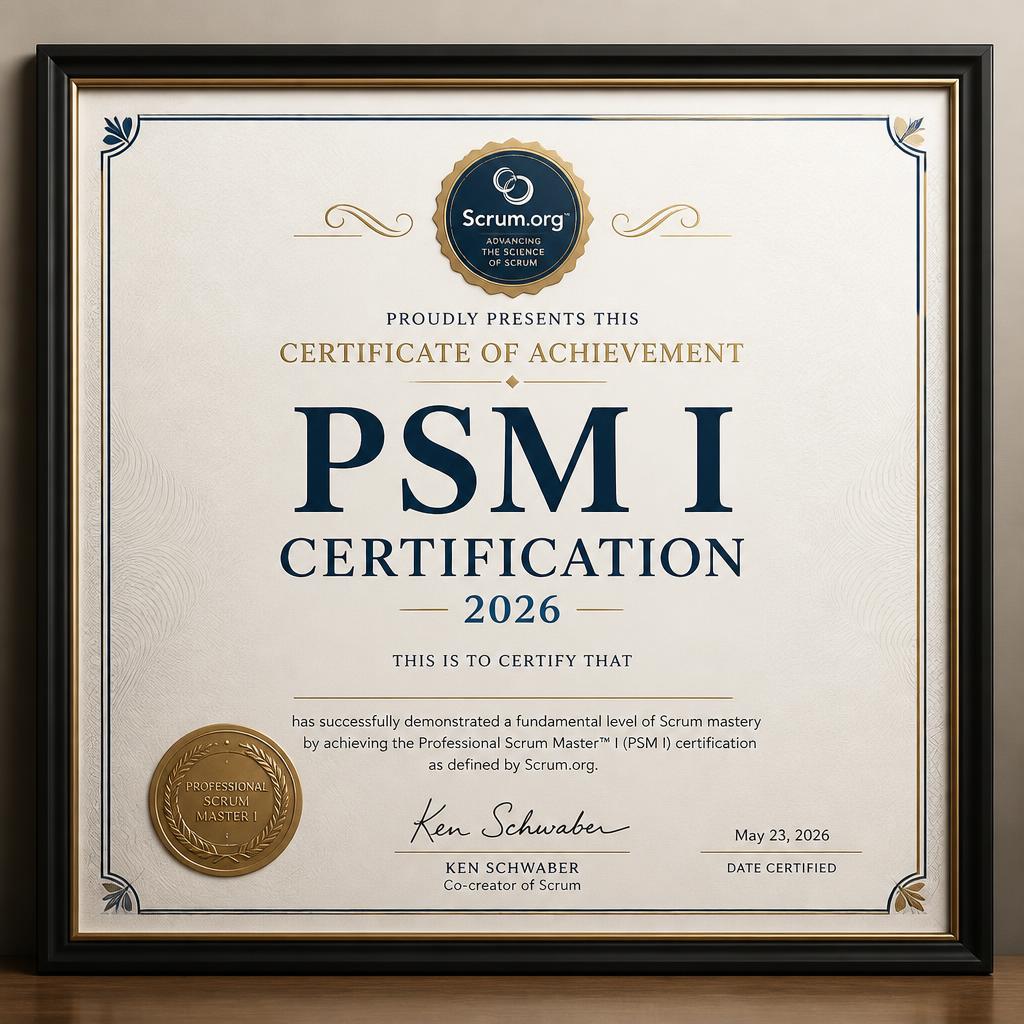
The PSM I (Professional Scrum Master I) certification from Scrum.org is one of the most recognized entry-level credentials in this field. Unlike some competing certifications, it does not require you to attend an expensive multi-day training course before sitting the exam. This makes it an attractive option for self-directed learners, career changers, and professionals in regions where in-person Agile training is difficult to access.
This guide will walk you through everything you need to know about earning your PSM I certification in 2026: what the exam covers, how much it costs, how to prepare effectively, how PSM I compares to the CSM credential, and what kind of salary you can realistically expect once certified.
We will be direct about what this certification can and cannot do for your career. A certification alone does not guarantee employment. But it does signal to employers that you understand the Scrum framework at a professional level — and that matters.
What You Need to Know About Scrum Master Certification
What Is a Scrum Master?
A Scrum Master is a servant-leader who helps a team (and the wider organization) understand and apply the Scrum framework effectively. This is not a traditional project manager role. The Scrum Master does not assign tasks, set deadlines, or manage budgets. Instead, they:
- Coach the team in self-management and cross-functionality
- Facilitate Scrum events (Sprint Planning, Daily Scrum, Sprint Review, Sprint Retrospective)
- Remove impediments that block the team’s progress
- Help the Product Owner with effective backlog management
- Guide the organization in adopting Agile practices
The role is defined in The Scrum Guide, authored by Ken Schwaber and Jeff Sutherland. The current version (2020) is freely available at scrumguides.org.
Why Get Certified?
- Employer recognition: Many job listings for Scrum Master roles list PSM I or CSM as a preferred or required qualification.
- Structured knowledge: Preparing for the exam forces you to study the Scrum Guide deeply, which builds a stronger foundation than casual reading.
- Career transition: For professionals moving from traditional project management, software development, or business analysis into Agile roles, certification provides a credible entry point.
- Global portability: Scrum.org certifications are recognized internationally and do not expire.
PSM I Certification: Complete Details
Provider
Scrum.org — Founded in 2009 by Ken Schwaber, one of the co-creators of Scrum. Scrum.org is a separate organization from the Scrum Alliance.
Official website: scrum.org
Credential Name
Professional Scrum Master I (PSM I)
Prerequisites
None. Scrum.org does not require you to complete any training course before attempting the PSM I assessment. You can self-study and register directly. This is one of the biggest differentiators from the CSM credential.
Exam Format
| Detail | Specification |
|---|---|
| Number of questions | 80 |
| Question types | Multiple choice, multiple answer, true/false |
| Time limit | 60 minutes |
| Passing score | 85% (68 out of 80 correct) |
| Delivery | Online, proctored via password-protected assessment on Scrum.org |
| Language | English |
| Attempts | Each purchase gives you one attempt; additional attempts require repurchasing |
Source: Scrum.org PSM I assessment page. Verify current details at scrum.org/professional-scrum-master-i-certification.
Cost
USD $200 per assessment attempt.
This fee includes one attempt at the online assessment. If you do not pass, you must purchase another attempt at the same price. There are no hidden renewal fees because the certification does not expire.
Note: Pricing is set by Scrum.org and may change. Confirm the current fee on the official website before purchasing.
Certification Validity
Lifetime. Once you pass the PSM I assessment, your certification never expires. There are no continuing education units (CEUs) or renewal fees. This is a significant long-term cost advantage over the CSM credential.
What the Exam Covers
The PSM I assessment tests your understanding of the Scrum framework as defined in the Scrum Guide. Key topic areas include:
- Scrum Theory and Principles — Empiricism, the three pillars (transparency, inspection, adaptation), and the Scrum values (commitment, focus, openness, respect, courage).
- Scrum Roles and Accountabilities — The Scrum Master, Product Owner, and Developers. Their specific responsibilities and how they interact.
- Scrum Events — The Sprint, Sprint Planning, Daily Scrum, Sprint Review, and Sprint Retrospective. Purpose, timeboxes, and participants for each.
- Scrum Artifacts — Product Backlog, Sprint Backlog, and Increment. Including the associated commitments (Product Goal, Sprint Goal, Definition of Done).
- Cross-cutting concerns — Definition of Done, self-managing teams, scaling considerations, and common anti-patterns.
The exam is known for being tricky. Many questions test subtle distinctions in the Scrum Guide that casual readers miss. Words like “must,” “may,” “accountable,” and “responsible” carry specific meanings in the Scrum context.
CSM vs PSM I: Which Should You Choose?
This is the most common question from aspiring Scrum Masters. Both credentials are widely recognized, but they differ in important ways.
| Feature | PSM I (Scrum.org) | CSM (Scrum Alliance) |
|---|---|---|
| Training required | No | Yes — 2-day course from a Certified Scrum Trainer (CST) |
| Typical course cost | N/A (self-study) | $400–$1,500+ USD (varies by trainer and location) |
| Exam cost | $200 USD (included in attempt) | Included in course fee |
| Exam format | 80 questions, 60 min, 85% pass | 50 questions, 60 min, 74% pass |
| Exam difficulty | Generally considered harder | Generally considered easier |
| Validity | Lifetime | 2 years |
| Renewal fee | None | $100 USD every 2 years |
| Global recognition | High | High |
| Best for | Self-learners, budget-conscious candidates, those who want a harder credential | Those who prefer classroom learning, networking, and guided instruction |
Key takeaway: If you are disciplined enough to self-study and want to minimize cost, PSM I is the clear choice. If you learn better in a classroom setting and value the networking aspect of a live course, CSM may be worth the investment. Both are respected by employers.
How to Prepare for the PSM I Exam
Step 1 — Read the Scrum Guide (Multiple Times)
The Scrum Guide is only about 13 pages long, but it is dense. Read it at least three to five times. On each pass, focus on different elements: roles, events, artifacts, and principles. Pay close attention to exact wording.
Official source: scrumguides.org — Available in over 30 languages.
Step 2 — Take the Free Scrum.org Open Assessment
Scrum.org offers a free Scrum Open practice assessment on their website. It contains 30 questions and is a good starting point to gauge your baseline knowledge. Do not rely on this alone — it is shorter and less nuanced than the real exam — but use it to identify weak areas.
Step 3 — Study the Scrum Master Learning Path
Scrum.org provides a recommended learning path on the PSM I certification page, including suggested readings, blog posts, and videos. These resources are free and directly aligned with the assessment.
Step 4 — Practice with Realistic Mock Exams
Several reputable platforms offer PSM I practice exams. Be cautious with third-party question banks — some contain outdated or incorrect answers that contradict the 2020 Scrum Guide. Prioritize resources that explicitly reference the current Scrum Guide version.
Step 5 — Understand the “Why” Behind Each Rule
The PSM I exam does not just test memorization. Many questions present a scenario and ask what the Scrum Master should do. You need to understand the reasoning behind Scrum’s rules, not just the rules themselves.
Step 6 — Manage Your Time During the Exam
You have 60 minutes for 80 questions — that is 45 seconds per question. Flag difficult questions and return to them later. Do not get stuck on a single question for more than a minute on your first pass.
Scrum Master Salary: What Can You Realistically Expect?
Important disclaimer: Salary data varies enormously based on location, industry, years of experience, company size, and whether the role is purely a Scrum Master position or a hybrid (e.g., Scrum Master/Agile Coach or Scrum Master/Project Manager). The figures below are approximate ranges drawn from publicly available compensation data on platforms such as Glassdoor, Payscale, and LinkedIn Salary. They are not guarantees.
United States
- Entry-level Scrum Master (0–2 years): Approximately $75,000–$95,000 per year
- Mid-level (3–5 years): Approximately $95,000–$120,000 per year
- Senior/Agile Coach level (5+ years): Approximately $120,000–$160,000+ per year
Major tech hubs (San Francisco, New York, Seattle) skew significantly higher. Government and nonprofit roles tend to be lower.
United Kingdom
- Entry-level: Approximately £40,000–£55,000 per year
- Mid-level: Approximately £55,000–£75,000 per year
- Senior/Contract: £75,000–£100,000+ per year (contractors may earn £400–£600+ per day)
London salaries are typically 15–25% higher than the UK average.
Canada
- Range: Approximately CAD $75,000–$110,000 per year
- Toronto, Vancouver, and Montreal are the primary markets.
Australia
- Range: Approximately AUD $100,000–$140,000 per year
- Sydney and Melbourne dominate the Agile job market.
Germany
- Range: Approximately €55,000–€85,000 per year
- Berlin, Munich, and Frankfurt are key cities.
India
- Range: Approximately ₹10,00,000–₹25,00,000 per year (varies widely by city and company)
- Bangalore, Hyderabad, Pune, and Gurgaon are major hubs.
Nigeria
- Range: Varies significantly. Multinational tech companies and consulting firms in Lagos may offer ₦8,000,000–₦18,000,000+ per year for experienced Scrum Masters. Local startups and smaller firms may pay considerably less.
- The Agile job market in Nigeria is growing, particularly in fintech and banking.
Reality check: A PSM I certification alone will not automatically place you at the top of these salary ranges. Experience, demonstrated results, and complementary skills (e.g., SAFe, Kanban, coaching, technical background) all influence compensation. The certification opens doors; your performance keeps them open.
Scrum Master Job Market in 2026: Key Trends
While specific job openings change daily, several macro trends are relevant for anyone entering the Scrum Master profession:
- Continued Agile adoption beyond tech. Financial services, healthcare, government, and manufacturing organizations are increasingly adopting Scrum and other Agile frameworks. This expands the job market beyond software companies.
- Hybrid roles are common. Many organizations combine the Scrum Master role with Agile coaching, project management, or delivery management responsibilities. Pure Scrum Master roles exist but are more common in larger organizations.
- Remote and distributed teams. The rise of remote work has increased demand for Scrum Masters who can facilitate effectively in virtual environments. Familiarity with tools like Jira, Miro, Confluence, and Slack is increasingly expected.
- Competition at the entry level. The barrier to entry for PSM I is relatively low (no course required, $200 exam fee), which means many candidates hold the certification. Differentiating yourself through experience, volunteering, community involvement, or additional certifications (PSM II, SAFe, ICAgile) becomes important.
- AI and automation awareness. Organizations expect Scrum Masters to understand how AI tools are affecting team workflows and product development cycles. This is not a technical requirement but a contextual awareness that adds value.
Important Things to Know Before Applying
The Certification Is Not a Job Guarantee
Earning your PSM I demonstrates knowledge of the Scrum framework. It does not guarantee employment, a specific salary, or visa sponsorship. Be skeptical of any training provider or website that promises guaranteed job placement after certification.
The Exam Is Harder Than Most People Expect
The 85% passing threshold is high, and the questions are deliberately designed to test deep understanding rather than surface-level familiarity. Many candidates fail on their first attempt. This is normal. Do not be discouraged.
Beware of Fake Training Providers
The Agile certification industry attracts some unscrupulous actors. Watch out for:
- Websites offering “guaranteed pass” vouchers
- Third-party sellers offering discounted PSM I assessments (purchase only from Scrum.org)
- Fake Scrum Master certificates from unrecognized organizations
- Recruiters on WhatsApp or Telegram offering “Scrum Master jobs” that require upfront payment
Always purchase your assessment directly from scrum.org.
The Scrum Guide Is the Single Source of Truth
If a practice question or study resource contradicts the Scrum Guide, the Scrum Guide is correct. The exam is based exclusively on the Scrum Guide, not on any textbook, blog, or training course.
Experience Matters More Than Certification in the Long Run
After your first or second job, employers will care far more about your track record of helping teams improve than about the letters after your name. Use the certification as a starting point, not a destination.
Step-by-Step Application Guide: How to Earn Your PSM I
Step 1 — Create a Scrum.org account.
Visit scrum.org and register for a free account.
Step 2 — Study the Scrum Guide.
Download or read the Scrum Guide at scrumguides.org. Read it multiple times.
Step 3 — Use free Scrum.org resources.
Complete the Scrum Open practice assessment and review the PSM I suggested reading list on the certification page.
Step 4 — Supplement with additional study.
Use reputable books (e.g., Scrum: The Art of Doing Twice the Work in Half the Time by Jeff Sutherland), video courses, and community forums to deepen your understanding.
Step 5 — Purchase the PSM I assessment.
Log in to your Scrum.org account, navigate to the PSM I certification page, and purchase the assessment for $200 USD.
Step 6 — Schedule and take the exam.
The assessment is available on demand — you do not need to schedule a specific date. When you feel ready, start the 60-minute timer and complete all 80 questions.
Step 7 — Receive your results.
You will receive your score immediately after completing the assessment. If you score 85% or higher, you are certified.
Step 8 — Access your certificate.
Your PSM I certification will appear on your Scrum.org profile. You can share your credential on LinkedIn and include it on your CV.
Step 9 — Consider next steps.
If you want to deepen your expertise, consider PSM II, PSM III, or complementary certifications such as Professional Scrum Product Owner (PSPO I) or SAFe Agilist.
Best Options at a Glance
| Category | Recommendation |
|---|---|
| Best value certification | PSM I — $200 one-time fee, lifetime validity, no course required |
| Best for classroom learners | CSM (Scrum Alliance) — 2-day guided training with a Certified Scrum Trainer |
| Best for career changers on a budget | PSM I — Self-study using the free Scrum Guide and Scrum.org open assessments |
| Best for experienced Agile practitioners | PSM II or PSM III — Advanced credentials that demonstrate deeper mastery |
| Best complementary certification | PSPO I (Professional Scrum Product Owner) — Broadens your Agile skill set |
Conclusion
The PSM I certification remains one of the most accessible, affordable, and respected entry points into the Scrum Master profession. At $200 with no prerequisite course and lifetime validity, it offers a strong return on investment compared to many competing credentials.
However, certification is a beginning, not an end. The real value comes from applying Scrum principles in real team environments, continuously improving your facilitation and coaching skills, and building a track record of helping teams deliver better outcomes.
If you are preparing for the PSM I exam in 2026, start with the Scrum Guide, use the free resources on Scrum.org, and resist the urge to rush. The 85% passing threshold demands genuine understanding, not memorization.
Always verify current exam details, pricing, and certification policies on the official Scrum.org website before registering.
Keep checking ScholarCareer.com for verified career development resources, professional certifications, and job opportunities worldwide.
11. CERTIFICATION COMPARISON TABLE
| Certification | Provider | Cost | Training Required | Exam Format | Pass Score | Validity | Renewal | Official Source |
|---|---|---|---|---|---|---|---|---|
| PSM I | Scrum.org | $200 USD | No | 80 questions, 60 min | 85% | Lifetime | None | scrum.org |
| PSM II | Scrum.org | $250 USD | No | 30 questions, 90 min | 85% | Lifetime | None | scrum.org |
| CSM | Scrum Alliance | $400–$1,500+ (course) | Yes (2-day) | 50 questions, 60 min | 74% | 2 years | $100/2 years | scrumalliance.org |
| SAFe Agilist | Scaled Agile | $295–$895+ (course + exam) | Yes (2-day) | 45 questions, 90 min | ~77% | 1 year | $295/year | scaledagile.com |
| PMI-ACP | PMI | $435–$495 USD | No (but 21 hrs Agile training) | 120 questions, 180 min | Not disclosed | 3 years | 30 PDUs | pmi.org |
12. COUNTRY-BY-COUNTRY OPPORTUNITIES
Note: The PSM I certification is globally available and administered online. There are no country-specific restrictions on who can take the exam. The information below focuses on job market relevance and salary context.
United States
- Largest Agile job market globally
- Strong demand in tech, finance, defense, and healthcare
- Salaries among the highest worldwide
- Many employers list PSM I or CSM as preferred qualifications
United Kingdom
- Mature Agile market, especially in London, Manchester, and Edinburgh
- Strong contracting opportunities (IR35 rules apply)
- Financial services and government are major employers
Canada
- Growing demand in Toronto, Vancouver, and Montreal
- Government of Canada and major banks actively hire Scrum Masters
- Bilingual (English/French) candidates have an advantage in Quebec
Australia
- Strong Agile adoption in banking, insurance, and government
- Sydney and Melbourne are primary markets
- Contract rates can be very competitive
Germany
- Growing demand, particularly in automotive, finance, and tech
- Berlin, Munich, Frankfurt, and Hamburg are key cities
- German language skills are often required for local companies
India
- Rapidly expanding Agile job market
- Major employers include TCS, Infosys, Wipro, Accenture, and global tech firms
- Salary varies widely by city and employer type
Nigeria
- Emerging Agile market, concentrated in Lagos fintech and banking sectors
- Multinational companies and well-funded startups are the primary employers
- PSM I is increasingly recognized by Nigerian tech employers
South Africa
- Agile adoption growing in banking, insurance, and telecom
- Johannesburg and Cape Town are the main markets
- PSM I and CSM are both recognized
13. APPLICATION GUIDE
(See the Step-by-Step Application Guide section above in the main article body for the full 9-step process.)
Quick summary:
- Create a free Scrum.org account
- Study the Scrum Guide thoroughly
- Complete free practice assessments
- Purchase the PSM I assessment ($200 USD)
- Take the 80-question online exam
- Score 85% or higher to pass
- Access your lifetime certification on your Scrum.org profile
14. IMPORTANT WARNINGS
- Purchase only from Scrum.org. Third-party “discount” vouchers may be fraudulent.
- No guaranteed jobs. Certification improves your profile but does not guarantee employment or a specific salary.
- Beware of fake recruiters. Legitimate employers will not ask you to pay fees to secure a Scrum Master position.
- Scam indicators: Requests for cryptocurrency payments, WhatsApp-only recruitment, “guaranteed visa sponsorship” tied to certification, or offers that seem too good to be true.
- The Scrum Guide is free. Do not pay for a “premium” version of the Scrum Guide. It is freely available at scrumguides.org.
- ScholarCareer.com does not guarantee certification success, employment, admission, or visa approval. We provide information to help you make informed decisions.
15. FAQ
1. Is the PSM I certification worth it in 2026?
Yes, for most aspiring Scrum Masters. At $200 with lifetime validity, it offers strong value. However, its worth depends on your career goals, location, and whether employers in your target industry recognize it.
2. How hard is the PSM I exam?
Moderately difficult. The 85% passing threshold is high, and questions often test nuanced understanding of the Scrum Guide. Many candidates require two or more attempts. Thorough preparation is essential.
3. Do I need to take a course before the PSM I exam?
No. Scrum.org does not require any prerequisite training. You can self-study using the Scrum Guide and free resources.
4. How long does it take to prepare for PSM I?
Most candidates report 2–6 weeks of focused study, depending on their existing Agile knowledge. If you are completely new to Scrum, allow more time.
5. Does the PSM I certification expire?
No. PSM I is a lifetime certification with no renewal requirements or fees.
6. What is the difference between PSM I and CSM?
PSM I (Scrum.org) requires no course, costs $200, and never expires. CSM (Scrum Alliance) requires a 2-day training course ($400–$1,500+), has an easier exam, and must be renewed every two years for $100. Both are widely recognized.
7. Can I get a Scrum Master job with no experience?
It is possible but challenging. Entry-level Scrum Master roles exist, particularly in large organizations and consulting firms. Combining your PSM I with relevant work experience (even in non-Agile roles), volunteering as a Scrum Master for community projects, or transitioning internally within your current organization can improve your chances.
8. What is the average Scrum Master salary?
Salaries vary widely by country and experience. In the US, mid-level Scrum Masters typically earn $95,000–$120,000 per year. In the UK, £55,000–£75,000. In India, ₹10–25 lakhs. These are approximate ranges, not guarantees.
9. Can I take the PSM I exam from any country?
Yes. The assessment is delivered entirely online through the Scrum.org platform. You can take it from any location with a reliable internet connection.
10. What should I do after earning PSM I?
Consider gaining practical experience, pursuing PSM II for advanced knowledge, exploring complementary certifications (PSPO I, SAFe, Kanban), and engaging with the Agile community through meetups, conferences, and online forums.
11. Is Scrum Master a good career for someone in Africa?
Yes, the Agile job market is growing across Africa, particularly in Nigeria, South Africa, Kenya, and Ghana. The PSM I certification is globally recognized and can be earned entirely online, making it accessible regardless of location.
12. Are there free resources to prepare for PSM I?
Yes. The Scrum Guide is free. Scrum.org offers a free Scrum Open practice assessment. Numerous free blog posts, YouTube videos, and community forums provide high-quality study material. You do not need to spend money beyond the $200 exam fee.
17. OFFICIAL SOURCES
- Scrum.org (PSM I Certification): scrum.org/professional-scrum-master-i-certification
- The Scrum Guide (2020): scrumguides.org
- Scrum Alliance (CSM Certification): scrumalliance.org/get-certified/scrum-master-track/certified-scrummaster
- Scaled Agile (SAFe): scaledagile.com
- Project Management Institute (PMI-ACP): pmi.org/certifications/agile-acp
- Glassdoor (Salary Data): glassdoor.com
- Payscale (Salary Data): payscale.com
- LinkedIn Salary: linkedin.com/salary
18. FINAL FACT-CHECK NOTES
| Claim | Status | Source |
|---|---|---|
| PSM I costs $200 USD | Verified (subject to change) | Scrum.org |
| 80 questions, 60 minutes, 85% pass | Verified | Scrum.org |
| No prerequisite course required | Verified | Scrum.org |
| Lifetime validity, no renewal | Verified | Scrum.org |
| CSM requires 2-day course | Verified | Scrum Alliance |
| CSM renewal $100 every 2 years | Verified | Scrum Alliance |
| Scrum Guide is free | Verified | scrumguides.org |
| Salary ranges (US, UK, etc.) | Approximate — varies by source and date | Glassdoor, Payscale, LinkedIn |
| PSM I available globally online | Verified | Scrum.org |
| Scrum Guide 2020 is current version | Verified as of last check | scrumguides.org |
Note: Salary figures are approximate ranges compiled from publicly available compensation platforms. They are not official figures from any single employer and should be treated as estimates. Actual compensation depends on numerous individual and market factors. Always verify current exam pricing and format on the official Scrum.org website before registering.
Last Verified: July 2025
Certification details, exam formats, pricing, and job market conditions can change. Always confirm the latest information on the official source before making any financial or career decisions.
