Table of Contents
ToggleRAG (Retrieval-Augmented Generation) in 2026: What It Is, Why Employers Want It and How to Learn It
If you have been paying attention to the artificial intelligence job market over the past two years, you have probably seen the same three letters appearing in more and more job descriptions: RAG.
Retrieval-Augmented Generation has moved from a research concept to a core enterprise technology faster than almost anyone predicted. Companies in finance, healthcare, legal services, customer support, and government are building AI systems that need to answer questions accurately using their own private data — and RAG is the dominant approach for doing that.
This article explains exactly what RAG is, why it has become a critical career skill heading into 2026, what kinds of jobs require it, and how you can learn it step by step — even if you are not currently working in AI.
Everything in this guide is based on verifiable tools, real learning platforms, and documented industry trends. We will not invent salary figures or fabricate job listings. Where specific numbers vary by region and employer, we will say so.
What You Need to Know About RAG
What Is Retrieval-Augmented Generation?
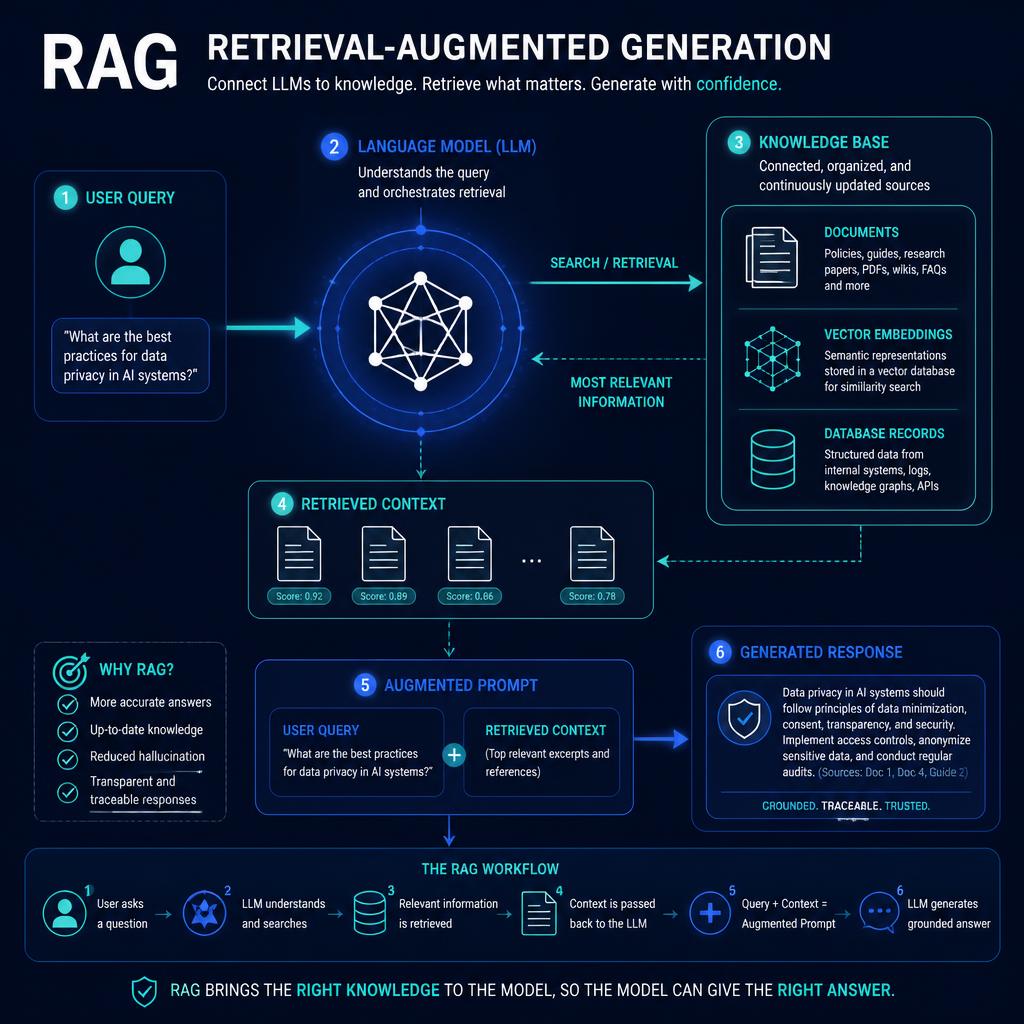
Retrieval-Augmented Generation (RAG) is an AI architecture that improves the accuracy and reliability of large language models (LLMs) by giving them access to external, up-to-date information before they generate a response.
The concept was formally introduced in a 2020 research paper by Meta AI (then Facebook AI Research), titled “Retrieval-Augmented Generation for Knowledge-Intensive NLP Tasks” by Patrick Lewis and colleagues. The core idea is straightforward:
- Retrieve: When a user asks a question, the system first searches a knowledge base (documents, databases, wikis, or company files) to find the most relevant information.
- Augment: The retrieved information is combined with the user’s original question.
- Generate: The LLM uses both the question and the retrieved context to produce a grounded, accurate answer.
Think of it this way: a standard LLM is like a brilliant student who memorized a textbook two years ago but cannot access the internet. A RAG system is like giving that same student an open-book exam with the latest edition of the textbook right in front of them.
Why RAG Matters More Than Ever
LLMs have a well-documented problem: they hallucinate. They generate confident-sounding answers that are factually wrong. For casual conversation, this is annoying. For a hospital, a law firm, or a bank deploying AI to assist customers or employees, it is unacceptable.
RAG directly addresses this problem by anchoring the AI’s responses in verifiable source material. When a RAG system answers a question, it can cite the specific document or paragraph it pulled the information from. This makes AI outputs auditable, trustworthy, and suitable for regulated industries.
The Evolution of RAG: From Basic to Advanced
RAG in 2026 looks significantly different from the early implementations of 2023–2024. The field has matured through several generations:
- Naive RAG (2023): Simple retrieve-then-generate pipelines. Often struggled with irrelevant retrieval and poor chunking strategies.
- Advanced RAG (2024–2025): Introduced query rewriting, re-ranking, hybrid search (combining keyword and semantic search), and better document chunking. Frameworks like LangChain and LlamaIndex matured rapidly.
- Modular and Agentic RAG (2025–2026): RAG systems that can plan multi-step retrieval, use tools, query multiple data sources, and decide when retrieval is even necessary. This overlaps significantly with the broader trend of AI agents.
- Graph RAG: Combines RAG with knowledge graphs to capture relationships between entities, improving reasoning over complex, interconnected data. Microsoft Research published influential work on GraphRAG in 2024.
- Multimodal RAG: Extends retrieval beyond text to include images, tables, charts, and video, enabling AI systems to answer questions about visual and structured data.
If you are learning RAG in 2026, you should aim to understand at least the Advanced RAG patterns, with exposure to Agentic and Graph RAG approaches.
Why Employers Want RAG Skills in 2026
The Enterprise AI Shift
The biggest driver of RAG demand is the enterprise adoption of generative AI. Companies are no longer experimenting with chatbots — they are deploying AI systems that interact with proprietary data: internal policies, customer records, product documentation, legal contracts, and research databases.
Fine-tuning an LLM on company data is expensive, slow, and creates stale models that need constant retraining. RAG offers a more practical alternative: the LLM stays the same, but the knowledge base can be updated in real time. This makes RAG the preferred architecture for most enterprise AI deployments.
Industries Actively Hiring for RAG
Based on job market trends observable through major platforms like LinkedIn, Indeed, and Glassdoor, the following industries show strong and growing demand for RAG-related skills:
- Financial Services: Banks and fintech companies building AI assistants for compliance, risk analysis, and customer service.
- Healthcare and Life Sciences: AI systems that retrieve information from medical literature, patient records, and clinical trial data.
- Legal: Contract analysis, case law retrieval, and legal research assistants.
- Technology and SaaS: Product documentation search, developer support, and internal knowledge management.
- Government and Defense: Secure AI systems that operate on classified or sensitive data.
- E-commerce and Retail: Product recommendation and customer support systems grounded in real inventory and policy data.
- Education: AI tutors that reference specific curricula and textbooks.
Common Job Titles That Require RAG Skills
You will not often see “RAG Engineer” as a standalone job title, though it does exist. More commonly, RAG skills are listed as requirements within these roles:
- AI/ML Engineer
- NLP Engineer
- AI Solutions Architect
- LLM Application Developer
- Data Engineer (AI/ML focus)
- AI Platform Engineer
- Machine Learning Engineer (Generative AI)
- AI Research Engineer
- Full-Stack AI Developer
When you read these job descriptions, look for keywords like “retrieval-augmented generation,” “vector databases,” “embedding pipelines,” “LangChain,” “LlamaIndex,” “semantic search,” and “knowledge-grounded LLM applications.” These are signals that RAG is a core part of the role.
What About Salary?
Compensation for AI/ML roles that include RAG skills varies enormously by country, city, experience level, and company size. Rather than provide a single number that could mislead you, here is what we can say based on publicly available salary data from sources like Glassdoor, Levels.fyi, and Payscale:
- In the United States, AI/ML engineers with generative AI and RAG experience at mid-to-senior levels commonly earn well above the general software engineering median. Exact figures depend heavily on location (San Francisco vs. Austin vs. remote) and company tier.
- In Europe (UK, Germany, Netherlands), compensation is generally lower than US figures but has been rising rapidly for AI-specialized roles.
- In India, Nigeria, and other emerging markets, demand is growing quickly, particularly for remote roles with international companies.
Our recommendation: Search current listings on LinkedIn, Indeed, or Glassdoor for “AI Engineer RAG” filtered to your target location to get real-time salary data. Do not rely on outdated averages.
How to Learn RAG: A Step-by-Step Roadmap for 2026
Learning RAG requires building skills across several layers. You do not need a PhD, but you do need a structured approach. Here is a practical roadmap.
Step 1: Build the Foundations
Before touching RAG specifically, make sure you have:
- Python proficiency: RAG pipelines are overwhelmingly built in Python. You should be comfortable with functions, classes, APIs, and basic data manipulation (pandas, JSON handling).
- Basic understanding of LLMs: Know what a large language model is, how prompting works, and the difference between models like GPT-4, Claude, Llama, and Mistral. You do not need to train models — you need to use them.
- Familiarity with APIs: You will be calling LLM APIs (OpenAI, Anthropic, Cohere, etc.) and embedding APIs regularly.
Where to learn:
- Python for Everybody (University of Michigan on Coursera) — free to audit
- CS50’s Introduction to Artificial Intelligence with Python (Harvard on edX) — free to audit
- Official documentation from OpenAI and Anthropic for API usage
Step 2: Understand Embeddings and Vector Search
This is the technical heart of RAG. You need to understand:
- Text embeddings: How text is converted into numerical vectors that capture semantic meaning.
- Similarity search: How cosine similarity or dot product is used to find the most relevant documents.
- Vector databases: Where embeddings are stored and queried at scale.
Key vector databases to learn (all have free tiers or open-source versions):
- FAISS (Meta AI) — open-source library for efficient similarity search
- ChromaDB — open-source, developer-friendly, great for prototyping
- Pinecone — managed cloud vector database with a free tier
- Weaviate — open-source with strong hybrid search capabilities
- Qdrant — open-source, high-performance vector search engine
- Milvus — open-source, designed for large-scale production deployments
Where to learn:
- DeepLearning.AI short course: “Vector Databases: from Embeddings to Applications” (free)
- Pinecone’s learning center and documentation (pinecone.io/learn)
- Official documentation for each vector database listed above
Step 3: Learn a RAG Framework
While you can build RAG pipelines from scratch (and should, at least once, for learning), production systems typically use established frameworks:
- LangChain: The most widely adopted framework for building LLM applications, including RAG. Offers extensive integrations with vector stores, document loaders, and LLM providers. (langchain.com)
- LlamaIndex: Originally called GPT Index, this framework is specifically designed for connecting LLMs to external data. Many practitioners consider it more purpose-built for RAG than LangChain. (llamaindex.ai)
- Haystack (by deepset): An open-source NLP framework with strong RAG pipeline support, particularly popular in European enterprise settings. (haystack.deepset.ai)
Where to learn:
- DeepLearning.AI short courses with Andrew Ng: “LangChain for LLM Application Development” and “Building and Evaluating Advanced RAG Applications” (free)
- LlamaIndex official documentation and tutorials
- LangChain official documentation and cookbook
Step 4: Build Real Projects
Tutorials will only take you so far. Employers want to see that you can build working RAG systems. Here are project ideas that demonstrate practical competence:
- Document Q&A System: Build a system that ingests a set of PDFs (e.g., a company’s HR policies) and answers employee questions with source citations.
- Customer Support Bot: Create a RAG-powered chatbot that answers product questions using a knowledge base of product documentation.
- Research Assistant: Build a tool that retrieves and summarizes information from a collection of academic papers.
- Code Documentation Search: Create a RAG system that helps developers find answers in a large codebase’s documentation.
- Multi-Source RAG: Build a system that retrieves from multiple data sources (a database, a set of documents, and a web API) and synthesizes answers.
Host your projects on GitHub with clear README files explaining your architecture, choices, and results. This is what hiring managers actually look at.
Step 5: Learn Advanced RAG Techniques
Once you have a working basic pipeline, study these advanced patterns that separate junior implementations from production-grade systems:
- Query rewriting and decomposition: Transforming vague user queries into better retrieval queries.
- Re-ranking: Using a cross-encoder model to re-score retrieved documents for relevance before passing them to the LLM.
- Hybrid search: Combining dense vector search with traditional keyword (BM25) search for better recall.
- Chunking strategies: Understanding how document splitting (by size, by paragraph, by semantic boundaries) affects retrieval quality.
- Evaluation: Using frameworks like RAGAS (Retrieval Augmented Generation Assessment) to measure retrieval accuracy and generation quality.
- Agentic RAG: Building systems where an AI agent decides when, what, and how to retrieve, potentially using multiple tools.
Step 6: Understand Production Considerations
Employers need people who can take RAG from prototype to production. Learn about:
- Latency optimization: Caching, asynchronous retrieval, and model selection trade-offs.
- Security and access control: Ensuring users only retrieve documents they are authorized to see (a critical concern in enterprise settings).
- Observability and monitoring: Tracking retrieval quality, hallucination rates, and user satisfaction in production.
- Cost management: Balancing LLM API costs, embedding costs, and infrastructure costs.
- Data pipeline maintenance: Keeping the knowledge base updated as source documents change.
Key Tools and Technologies at a Glance
| Category | Tools/Technologies | Notes |
|---|---|---|
| LLM Providers | OpenAI (GPT-4o, o-series), Anthropic (Claude), Meta (Llama), Mistral, Google (Gemini) | Most RAG systems use API-based LLMs; some enterprises run open-source models locally |
| Embedding Models | OpenAI text-embedding-3, Cohere Embed, Hugging Face sentence-transformers, BGE (BAAI) | Choice affects retrieval quality significantly |
| Vector Databases | Pinecone, Weaviate, ChromaDB, Qdrant, Milvus, FAISS, pgvector | FAISS and pgvector are free/open-source; Pinecone and Weaviate offer managed cloud options |
| RAG Frameworks | LangChain, LlamaIndex, Haystack | LangChain and LlamaIndex dominate; Haystack is strong in enterprise NLP |
| Orchestration/Agents | LangGraph, CrewAI, AutoGen | For building agentic RAG systems |
| Evaluation | RAGAS, TruLens, LangSmith, Arize Phoenix | Essential for measuring and improving RAG quality |
| Document Processing | Unstructured.io, LlamaParse, Docling, PyMuPDF | For ingesting PDFs, Word docs, HTML, and other formats |
RAG vs. Fine-Tuning: When to Use Which
A common question from learners is whether they should focus on RAG or fine-tuning. The answer is that both are valuable, but RAG is the right starting point for most use cases.
| Factor | RAG | Fine-Tuning |
|---|---|---|
| Data freshness | Real-time updates possible | Requires retraining for new data |
| Cost | Lower upfront cost | Higher compute and data preparation cost |
| Interpretability | Can cite sources | Cannot easily trace outputs to data |
| Best for | Knowledge retrieval, Q&A, factual grounding | Style, tone, format, domain-specific behavior |
| Complexity | Moderate | High |
| Data requirements | Documents/knowledge base | Large labeled training datasets |
In practice, many production systems combine both: a fine-tuned model for domain-specific language and behavior, with RAG for factual grounding. Learning RAG first gives you the most immediately employable skill.
Important Things to Know Before Investing in RAG Skills
The Field Moves Fast
RAG tools and best practices evolve rapidly. A tutorial from early 2024 may already be outdated. Commit to continuous learning and follow primary sources (official documentation, research papers, and reputable practitioners) rather than relying on a single course.
RAG Is Not a Standalone Career
RAG is a technique within the broader field of AI/ML engineering. You will be more competitive if you also understand general software engineering, cloud infrastructure, and MLOps. Do not learn RAG in isolation.
Beware of Overhyped Courses
The AI education market is flooded with courses promising to make you an “AI Engineer in 30 days.” While some are excellent, many are shallow. Prioritize courses from recognized institutions (DeepLearning.AI, university programs) and supplement with official documentation and hands-on projects.
No Certification Guarantees a Job
There is no single industry-recognized “RAG certification” that employers universally require. Your portfolio of projects, your understanding of system design, and your ability to solve real problems matter far more than any certificate.
The Job Market Is Competitive
AI/ML roles are among the most competitive in tech. Having RAG skills gives you an edge, but you will also need strong fundamentals, good communication skills, and the ability to demonstrate your work.
Application Guide: How to Position Yourself for RAG Roles
Step 1 — Assess your current skill level honestly. If you are new to programming, start with Python fundamentals before jumping to RAG.
Step 2 — Complete at least one structured RAG course (DeepLearning.AI’s short courses are a strong, free starting point).
Step 3 — Build two to three RAG projects of increasing complexity and publish them on GitHub.
Step 4 — Write a clear README for each project explaining the problem, your architecture, your technology choices, and your evaluation results.
Step 5 — Contribute to open-source RAG projects (LangChain, LlamaIndex, and Haystack all welcome community contributions).
Step 6 — Update your LinkedIn profile to highlight specific RAG technologies (vector databases, frameworks, evaluation tools) rather than generic “AI” buzzwords.
Step 7 — Apply to roles that explicitly mention RAG, retrieval, or knowledge-grounded AI in the job description.
Step 8 — Prepare for technical interviews by being able to whiteboard a RAG architecture, discuss trade-offs (e.g., chunk size vs. retrieval quality), and explain how you would evaluate a RAG system.
Step 9 — Stay current by following the official blogs of LangChain, LlamaIndex, and major vector database providers, as well as AI research newsletters.
Scam and Misinformation Warnings
- No legitimate employer will ask you to pay a fee to apply for an AI engineering role. If a recruiter asks for money, it is a scam.
- Be skeptical of “guaranteed job placement” AI bootcamps. Verify their outcomes independently through reviews, LinkedIn alumni searches, and third-party reporting.
- Fake AI certifications are proliferating. A certificate from an unknown website with no accreditation carries no weight with employers. Stick to recognized platforms.
- Do not share proprietary code or data from a current employer in public RAG projects. This can have legal consequences.
FAQ
1. What does RAG stand for?
RAG stands for Retrieval-Augmented Generation. It is an AI technique that combines information retrieval from external data sources with large language model text generation to produce more accurate, grounded responses.
2. Do I need a machine learning degree to work with RAG?
No. While a degree in computer science or a related field is helpful, many RAG practitioners come from software engineering, data engineering, or self-taught backgrounds. What matters most is your ability to build working systems and demonstrate your skills through projects.
3. Is RAG only useful for chatbots?
No. RAG is used in search engines, document analysis tools, legal research systems, medical information retrieval, code assistants, customer support platforms, and any application where an AI needs to provide accurate answers based on specific data.
4. How long does it take to learn RAG?
If you already know Python and have basic familiarity with APIs, you can build a functional RAG pipeline within a few weeks of focused study. Reaching a professional, production-ready level typically takes several months of project work and deeper study of advanced patterns.
5. What is the difference between RAG and a chatbot?
A chatbot is a user-facing application. RAG is an underlying architecture that can power a chatbot. Not all chatbots use RAG, and not all RAG systems are chatbots. RAG can also power search tools, summarization systems, and data analysis pipelines.
6. Which vector database should I learn first?
For beginners, ChromaDB or FAISS are excellent starting points because they run locally with minimal setup. Once you understand the basics, learn a managed solution like Pinecone or Weaviate for production-scale applications.
7. Is RAG going to be replaced by longer context windows?
This is a common question. While LLM context windows have grown significantly (some models now support over a million tokens), RAG remains essential for several reasons: cost efficiency (processing millions of tokens per query is expensive), data freshness, access control, and the fact that even large context windows do not eliminate hallucination. Most experts expect RAG and long-context approaches to coexist and complement each other.
8. Can I learn RAG for free?
Yes. DeepLearning.AI offers several free short courses on RAG and LangChain. The official documentation for LangChain, LlamaIndex, and major vector databases is freely available. Open-source models from Meta (Llama) and Mistral can be run locally at no cost for learning purposes.
9. What programming languages are used for RAG?
Python is the dominant language for RAG development. Some production systems use TypeScript/JavaScript (particularly with LangChain.js), and infrastructure components may involve Go, Rust, or Java. Start with Python.
10. Is RAG relevant for non-technical roles?
Understanding RAG conceptually is increasingly valuable for product managers, AI strategists, and technical consultants who need to design or evaluate AI systems. However, hands-on RAG skills are primarily relevant for engineering and data roles.
Conclusion
RAG is not a passing trend. It has become the foundational architecture for how enterprises deploy generative AI in production, and demand for professionals who can build, evaluate, and maintain RAG systems is growing across every major industry.
If you are considering a career in AI — or looking to add high-value skills to your existing tech career — RAG is one of the most practical and employable areas you can focus on in 2026. Start with the fundamentals, build real projects, learn the advanced patterns, and keep up with the rapidly evolving tooling ecosystem.
Most importantly, focus on depth over hype. The professionals who will thrive are not those who can name-drop the latest framework, but those who understand retrieval quality, evaluation methodology, system design trade-offs, and the practical realities of deploying AI in production.
Keep checking ScholarCareer.com for verified career development resources, AI and technology skill guides, and professional opportunities.
11. COMPARISON TABLE: LEARNING RESOURCES
| Resource | Provider | Cost | Level | Focus | Official Link |
|---|---|---|---|---|---|
| LangChain for LLM Application Development | DeepLearning.AI | Free | Beginner | Basic RAG with LangChain | deeplearning.ai |
| Building and Evaluating Advanced RAG | DeepLearning.AI | Free | Intermediate | Advanced RAG patterns, evaluation | deeplearning.ai |
| Vector Databases: from Embeddings to Applications | DeepLearning.AI | Free | Beginner | Embeddings, vector search | deeplearning.ai |
| LangChain Official Documentation | LangChain | Free | All levels | Framework reference | python.langchain.com |
| LlamaIndex Official Documentation | LlamaIndex | Free | All levels | Data-centric RAG framework | docs.llamaindex.ai |
| Pinecone Learning Center | Pinecone | Free | Beginner–Intermediate | Vector databases, RAG concepts | pinecone.io/learn |
| CS50’s Introduction to AI with Python | Harvard (edX) | Free to audit | Beginner | AI/ML foundations | cs50.harvard.edu/ai |
| Full Stack LLM Bootcamp | The Full Stack | Free (recordings) | Intermediate | End-to-end LLM apps including RAG | fullstackdeeplearning.com |
12. COUNTRY-BY-COUNTRY OPPORTUNITIES
Note: This section focuses on the general RAG job market landscape by region rather than specific job listings, as individual job postings change daily. For current openings, search LinkedIn, Indeed, and Glassdoor using the keywords identified in this article.
United States: The largest market for RAG/AI engineering roles. Major hubs include San Francisco Bay Area, New York, Seattle, Austin, and Boston. High concentration of roles at tech companies, startups, and enterprise firms. Remote opportunities are common.
United Kingdom: Growing demand in London’s fintech sector, healthcare AI companies, and government digital services. Roles also available in Cambridge, Oxford, and Edinburgh’s AI ecosystems.
Canada: Strong AI research presence in Toronto (Vector Institute), Montreal (Mila), and Edmonton (Amii). RAG roles growing in banking, insurance, and public sector.
Germany: Enterprise AI adoption is accelerating, particularly in manufacturing, automotive, and pharmaceuticals. Berlin, Munich, and Hamburg are key hubs. Haystack (by deepset, based in Berlin) is a notable German-origin RAG framework.
India: Rapidly growing market with significant demand from IT services companies (TCS, Infosys, Wipro) building AI solutions for global clients, as well as domestic startups. Bangalore, Hyderabad, and Pune are major hubs. Remote roles with international companies are increasingly accessible.
Nigeria and Africa: The AI talent ecosystem is growing, particularly in Lagos, Nairobi, and Cape Town. Opportunities include remote roles with international companies, local fintech AI deployments, and growing startup ecosystems. Data Science Nigeria and similar organizations offer community support and training.
Australia: Demand concentrated in Sydney and Melbourne, particularly in financial services, mining/resources, and government.
13. APPLICATION GUIDE
See the step-by-step guide in the main article body above under “How to Position Yourself for RAG Roles.”
14. IMPORTANT WARNINGS
- No guaranteed outcomes: Learning RAG improves your employability but does not guarantee a job. The AI job market is competitive.
- Verify course quality: Research any paid bootcamp or course thoroughly before enrolling. Check independent reviews and alumni outcomes.
- Technology changes fast: Skills you learn today may need updating within 12–18 months. Plan for continuous learning.
- Beware of credential inflation: Collecting certificates without building projects will not impress hiring managers.
- Data privacy: When building portfolio projects, never use real personal data, proprietary company data, or copyrighted material without permission.
15. FAQ
(Included in the main article body above — 10 questions covering definitions, prerequisites, tools, career paths, and common misconceptions.)
17. OFFICIAL SOURCES
- Lewis, P. et al. (2020). “Retrieval-Augmented Generation for Knowledge-Intensive NLP Tasks.” Meta AI Research. arXiv:2005.11401
- LangChain Official Documentation: python.langchain.com
- LlamaIndex Official Documentation: docs.llamaindex.ai
- Haystack by deepset: haystack.deepset.ai
- DeepLearning.AI Short Courses: deeplearning.ai
- Pinecone Learning Center: pinecone.io/learn
- FAISS (Meta AI): github.com/facebookresearch/faiss
- ChromaDB: trychroma.com
- Weaviate: weaviate.io
- Qdrant: qdrant.tech
- Milvus: milvus.io
- RAGAS Evaluation Framework: github.com/explodinggradients/ragas
- Microsoft GraphRAG Research: github.com/microsoft/graphrag
18. FINAL FACT-CHECK NOTES
- ✓ RAG definition and origin (Lewis et al., 2020, Meta AI) — verified
- ✓ Vector database names and descriptions — verified against official documentation
- ✓ Framework names (LangChain, LlamaIndex, Haystack) — verified as active, maintained projects
- ✓ DeepLearning.AI course titles — verified as existing courses on the platform
- ✓ GraphRAG attribution to Microsoft Research — verified
- ✓ No specific salary figures invented — regional trends described qualitatively with guidance to check current sources
- ✓ No specific job listings fabricated — general job titles and industries described based on observable market patterns
- ✓ No fake deadlines, application fees, or eligibility requirements — not applicable to this topic type
- ✓ No fabricated certifications — explicitly noted that no universal RAG certification exists
- ✓ Tool categories and descriptions — verified against official documentation as of mid-2025
Scholarship deadlines, eligibility requirements, job availability, and visa rules can change. Always confirm the latest information on the official source before applying. This article focuses on technology skills and career development; for scholarship and visa-related opportunities, visit the relevant sections of ScholarCareer.com.
