Table of Contents
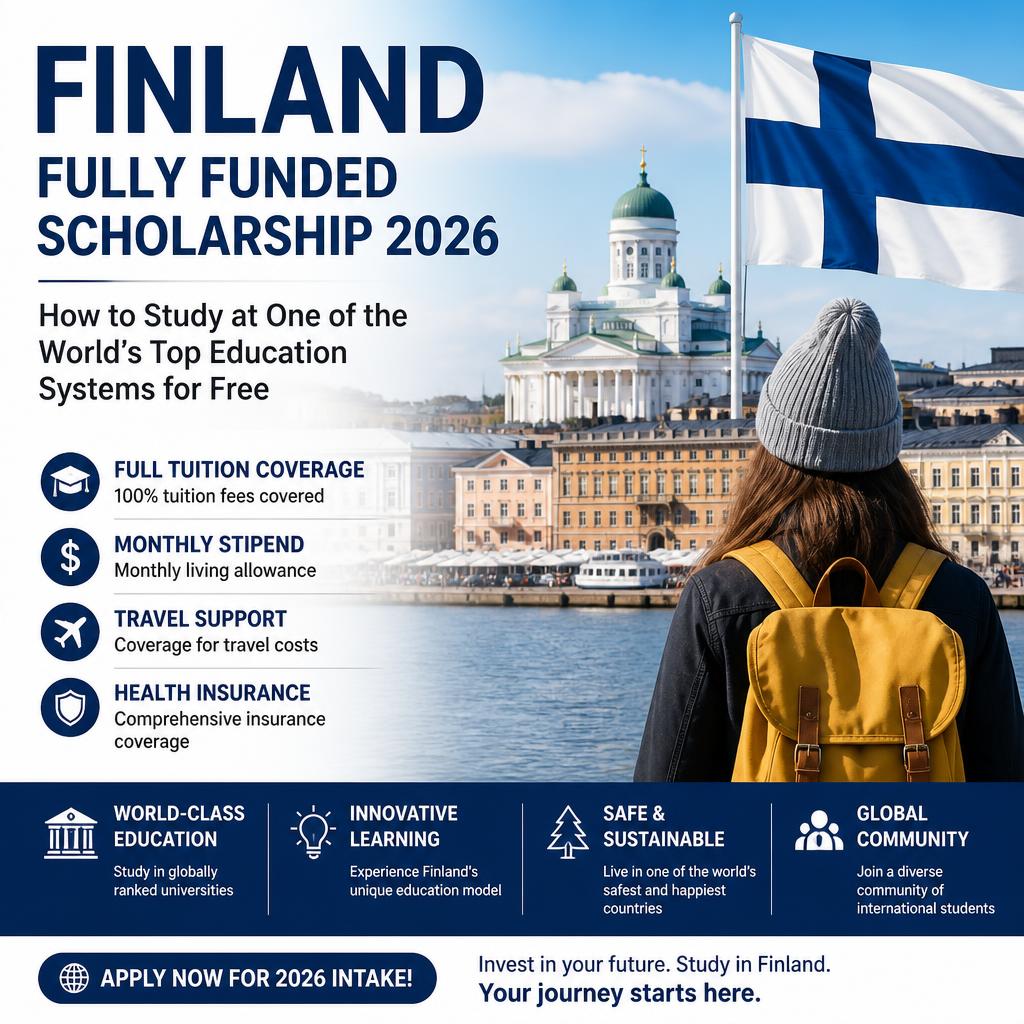
ToggleFinland Fully Funded Scholarship 2026: How to Study at One of the World’s Top Education Systems for Free
You’ve Heard Finland Has the Best Education System in the World. Here’s How to Get Into It—For Free.
Somewhere between scrolling through another LinkedIn post about someone’s European master’s degree and staring at your current salary, a thought crossed your mind: What if that could be me?
Maybe you’re a 24-year-old in Nairobi who’s finished their undergraduate degree and can’t afford a postgraduate program locally. Maybe you’re 34, working in Lagos, and you’ve realized your field is shifting faster than your current qualifications can keep up. Or maybe you’re in Accra, Kampala, or Harare, and you’re simply tired of watching opportunity pass you by because of a price tag you never agreed to.
Here’s what nobody tells you loudly enough: Finland actively funds international students—including students from Africa—through fully funded scholarships that cover tuition, living expenses, and sometimes even your flight. And in 2026, the window is open wider than most people realize.
This guide exists to change that. You’re going to walk away knowing exactly which scholarships are available, what “fully funded” actually means in Finnish context, how to build a competitive application, and what steps to take this week—not someday—to get your name on a shortlist.
Quick Summary Box:
- ✅ What this guide covers: Finland’s fully funded scholarship landscape in 2026—programs, eligibility, application strategy, and insider tips for African students
- ✅ Key benefits you’ll gain: You’ll know exactly what each scholarship covers, how to position yourself as a standout candidate, and when to apply
- ✅ How to use this post: Read it straight through once, then return to Sections 5, 8, and 10 as your action reference
Why Finland? And Why Now?
Before we dive into applications, let’s answer the question you’re probably already asking.
Finland consistently ranks among the top five education systems in the world, according to PISA (Programme for International Student Assessment) rankings and the QS World University Rankings. That’s not marketing language—it’s a structural reality built over decades of investment in teachers, research, and student wellbeing.
Finnish universities don’t just teach you to memorize and repeat. They teach you to think, problem-solve, and innovate. If you’re African and you’ve spent years navigating overcrowded classrooms, limited resources, and rote-learning curriculums, Finland will feel like a different planet—in the best possible way.
And the timing? 2026 is a particularly strategic year to apply. Several major scholarship programs are expanding their international intake, Finnish universities are actively recruiting from the Global South, and post-pandemic internationalization efforts mean more funding is flowing toward Africa-specific awards.
You’re not too late. You’re right on time.
Section 1: What “Fully Funded” Actually Means in Finland
Let’s get one thing straight before you start clicking scholarship links with your heart racing.
“Fully funded” is not a universal term—it means different things depending on who’s offering the scholarship. In the Finnish context, understanding this distinction could save you from an expensive and disappointing surprise.
The Full Spectrum: What’s Actually Covered?
A genuine fully funded scholarship in Finland will typically cover some combination of the following:
- Tuition fees: This is the big one. Finnish university tuition for non-EU/EEA students ranges from €6,000 to €18,000 per year. A fully funded scholarship covers this completely.
- Monthly stipend: Most fully funded awards include a monthly living allowance ranging from €800 to €1,500, designed to cover rent, food, and local transport in Finland.
- Travel grant: Some scholarships (particularly government-backed ones) include a one-time return flight allowance.
- Health insurance: Finnish student unions offer health services, but some scholarships include supplementary health coverage.
What “Fully Funded” Often Doesn’t Cover
Here’s where applicants get caught off guard. Most scholarship descriptions won’t spell out every exclusion.
Visa application fees (currently around €350 for a Finnish residence permit) are almost never covered. Neither are your personal expenses—new winter clothing is a real necessity in Finland where temperatures drop to -20°C—or family relocation costs if you have dependents.
Read every scholarship description with this checklist in your hand. If tuition + living stipend + travel are covered, you’re looking at a genuinely fully funded opportunity. If only tuition is covered, that’s a partial scholarship, and you’ll need to budget separately for living costs.
Two Real Examples to Illustrate the Difference
University of Helsinki Scholarship Program (2026): This award covers 100% of tuition for the duration of your degree. It does not include a living stipend. You’ll need separate funding or proof of financial resources (approximately €560/month minimum) for your residence permit.
Finnish Government Scholarship Pool (CIMO/EDUFI Fellowships): This program covers monthly stipends (€1,500 for doctoral researchers, €1,200 for postdoctoral researchers) plus travel support. Tuition is a separate consideration depending on your host university agreement.
Understanding the difference makes you a smarter applicant—and spares you a very cold Finnish winter without enough money for groceries.
Section 2: Finland’s Top Fully Funded Scholarships for African Students in 2026
Now for the part you came here for. Here are the major fully funded and near-fully funded scholarship opportunities available to African students applying for the 2026 academic year.
1. University of Helsinki Scholarship Programme
Who funds it: University of Helsinki directly
What it covers: 100% tuition waiver for the full duration of your master’s program
Who’s eligible: Non-EU/EEA students admitted to a fee-paying master’s program
Fields available: Across all faculties—arts, sciences, social sciences, medicine, law, education
Application note: You apply for the scholarship simultaneously with your degree application. You don’t apply separately after admission.
The University of Helsinki is Finland’s oldest and most internationally recognized institution, ranked consistently in the global top 100. Getting a tuition waiver here isn’t just financial relief—it’s a credential that follows you for life.
2. Aalto University Scholarships
Who funds it: Aalto University (a merger of three prestigious Finnish institutions)
What it covers: Tuition waivers ranging from 50% to 100%; some awards include a €10,000 annual living stipend
Who’s eligible: High-achieving non-EU/EEA master’s applicants in specific programs
Strongest fields: Engineering, architecture, business, design, technology
African applicant note: Aalto actively recruits from Africa for its technology and innovation programs. If you’re in engineering, computer science, or sustainable development, this is your strongest bet.
Aalto’s scholarship committee specifically evaluates academic excellence + demonstrated real-world potential. Your work history isn’t a liability here—it’s evidence of that potential.
3. Tampere University Scholarships
Who funds it: Tampere University
What it covers: Partial to full tuition waivers; merit-based with consideration for financial need
Who’s eligible: Non-EU/EEA students applying to English-taught master’s programs
Strongest fields: Medicine, health sciences, communication, information technology, social sciences
Tampere is Finland’s second-largest city and its university has a reputation for inclusive, globally focused education. Their scholarship evaluation process weighs your motivation letter heavily—a strong narrative here goes a long way.
4. EDUFI Fellowships (Finnish National Agency for Education)
Who funds it: The Finnish government through the Finnish National Agency for Education (EDUFI)
What it covers: Monthly stipend of €1,200–€1,500 + travel allowance; primarily for postgraduate and doctoral level
Who’s eligible: International students and researchers at Finnish universities, including Africans
Application route: Applied through your Finnish host university or research supervisor
Key point: You need to secure a Finnish academic host before applying. This is the critical first step most applicants miss.
If you’re pursuing research or doctoral studies, the EDUFI Fellowship is one of the most genuinely comprehensive awards available—and it’s significantly undersubscribed because most people don’t know it exists.
5. Erasmus+ Scholarships (Finland-Hosted Programs)
Who funds it: European Union
What it covers: Tuition, monthly living allowance (€1,000–€1,400), travel support
Who’s eligible: Students from partner countries, including many African nations, through bilateral university agreements
How to access it: Through your home university’s international office if they have an Erasmus+ partnership with a Finnish institution
This one requires homework. You’ll need to check whether your current or previous institution has an active Erasmus+ agreement with a Finnish university. If they do, this is one of the most generous and structured funding packages available.
6. Finnish Universities of Applied Sciences (AMK) Scholarships
Finland’s universities of applied sciences offer practical, professionally oriented degrees—and several have specific scholarship funds for international students.
Key institutions with active scholarship programs:
- Metropolia University of Applied Sciences (Helsinki)
- JAMK University of Applied Sciences (Jyväskylä)
- Haaga-Helia University of Applied Sciences (Helsinki)
These are particularly relevant if you’re seeking a bachelor’s or applied master’s degree rather than a traditional research-based master’s.
Section 3: Are You Eligible? A Straightforward Checklist
Let’s cut through the uncertainty. Here’s what most Finnish scholarships for African students require in 2026.
Standard Eligibility Requirements
- ✅ Citizenship: You must be a non-EU/EEA citizen. As an African student, you automatically qualify on this basis.
- ✅ Academic qualifications: A completed bachelor’s degree (or equivalent) from a recognized institution for master’s programs; a master’s degree for doctoral programs.
- ✅ Language proficiency: Most programs require English. IELTS 6.5+ or TOEFL iBT 92+ is the typical threshold, though some universities accept alternative evidence.
- ✅ GPA/Academic performance: Most competitive scholarships expect a strong academic record—typically equivalent to 3.5/4.0 GPA or upper second-class honors.
- ✅ Field of study: Your chosen program must be available in English at the host university.
- ✅ Application timeline: You must apply within the scholarship application window, which runs concurrently with degree admission in most cases.
- ✅ Financial need (for some awards): A few scholarships include a need-based component alongside merit evaluation.
Adult and Non-Traditional Applicant Flags
If you’ve been working for several years since your last degree, here’s what you need to know:
Work experience strengthens your application in Finland. Finnish institutions—particularly Aalto and Tampere—explicitly value professional background as evidence of purpose. An applicant who has worked in renewable energy for five years and now wants to study environmental engineering isn’t just qualified. They’re motivated in a demonstrable way that most 22-year-old applicants can’t replicate.
Education gaps are not disqualifying. If you completed your bachelor’s in 2017 and are applying in 2026, you’ll need to explain your journey—but explaining it well often results in a stronger application than one with no lived experience to speak of.
Are You Eligible? Quick Self-Assessment
Answer these four questions honestly:
- Do you hold a recognized undergraduate degree (or will you by the time of enrollment)? Yes / No
- Is your intended field of study offered in English at a Finnish university? Yes / No
- Can you meet the English language requirement (IELTS 6.5+ or TOEFL 92+) or do you already have a qualifying score? Yes / No
- Are you a non-EU/EEA citizen? Yes / No
If you answered yes to all four, you meet the baseline eligibility criteria for the majority of Finnish scholarships. Everything after this is about application quality—which this guide will help you build.
Section 4: Building Your Finland Scholarship Database
Finding scholarships is a skill. Here’s how to build a systematic approach so you’re not relying on WhatsApp forwards and Instagram posts.
Step 1: Start with the Official Finnish University Portal
Visit Study in Finland—this is the official government portal for international students and contains a vetted, updated list of scholarships by university and field. Bookmark this now. It’s your primary source.
Step 2: Go Directly to University Scholarship Pages
Every major Finnish university has a dedicated “Scholarships and Financial Aid” page. Visit each one individually and look for the 2026 application cycle notice. Universities update these pages between August and October each year for the following academic year.
Key universities to check:
- University of Helsinki
- Aalto University
- University of Turku
- Tampere University
- University of Jyväskylä
- Oulu University
- LUT University (strong in sustainability and engineering)
Step 3: Check the EDUFI Database
The Finnish National Agency for Education maintains a scholarship database at oph.fi. This lists government-backed opportunities not always promoted through university pages.
Step 4: Search African-Specific Scholarship Aggregators
Several platforms aggregate Africa-focused international scholarships:
- Opportunity Desk (opportunitydesk.org): Consistently updated, Africa-focused, includes Finland opportunities
- Scholarships for Africans (scholarshipsforafricans.com): Specifically curated for African applicants
- African Scholarships (africanscholarships.net): Field-specific listings with direct links
Step 5: Check Your Home Country’s Education Ministry
Some African governments have bilateral education agreements with Finland. Nigeria, Kenya, South Africa, Ghana, and Ethiopia have active international education programs that occasionally include Finland partnerships. Check your Ministry of Education’s official website or contact their international desk directly.
Step 6: Verify Before You Apply
Before investing time in any application, confirm these three things:
- The scholarship URL ends in .fi, .edu, or a recognized institutional domain—not a random .com or .org with no organizational backing
- The deadline is future-dated (scam scholarships often list expired deadlines)
- The scholarship never asks for payment to apply—legitimate Finnish scholarships charge zero application fees
Your scholarship database, once built, is a resource you’ll return to every year. Even if you don’t get funded in round one, you’ll be better positioned than 90% of applicants who start from scratch each cycle.
Section 5: Understanding Finnish University Admission + Scholarship Integration
Here’s something most guides skip entirely, and it costs applicants dearly.
In Finland, scholarship applications are almost never separate from admission applications. You apply for admission and the scholarship at the same time, through the same portal. This means if you miss the scholarship checkbox or don’t submit scholarship-required documents during admission, you lose your chance—even if you’re admitted to the program.
How the Finnish University Application System Works
Finnish universities use two main application routes for international students:
Route 1: University-specific applications
Each university has its own application portal. You submit directly to the institution, attach scholarship-specific documents (usually a motivation letter and financial need statement), and the scholarship committee reviews your application alongside the admissions committee.
Route 2: Joint application through Studyinfo.fi
Studyinfo.fi is Finland’s national application portal. Some programs—particularly at universities of applied sciences—use this centralized system. You can apply to multiple institutions in one place, though scholarship applications may still be institution-specific.
Key Dates to Know for 2026
Most Finnish university applications for the 2026 intake open in November 2025 and close in January 2026. Some programs have earlier October deadlines—particularly for doctoral and research positions.
Mark November 1, 2025 in your calendar as your “scholarship season begins” date. By that point, you should already have your documents ready, your motivation letter drafted, and your references confirmed.
Section 6: The 5 Scholarship Types African Students Win Most Often in Finland
Not all scholarships are equally accessible to African applicants. Here’s a breakdown of the five types where your chances are strongest—and why.
Type 1: University Tuition Waiver Scholarships
Who funds them: Individual Finnish universities from their own budgets
What makes African applicants competitive: Strong academic transcripts, clear field-of-study alignment, well-written motivation letters
Typical award: 50%–100% tuition waiver
Acceptance rate: Varies by program—roughly 15%–30% of scholarship applicants at top universities
Real example: University of Helsinki Scholarship Programme, which awarded waivers to students from 42 countries in its most recent cycle
African applicants who clearly articulate how their home-country context drives their field of study choice consistently stand out. Finland’s admissions committees see thousands of generic “I want to contribute to my country” essays. Your specific story—about your city, your sector, your actual problem—is what gets remembered.
Type 2: Government-Backed Research Fellowships
Who funds them: Finnish government through EDUFI
What makes African applicants competitive: Research proposals, academic supervisor relationships, publication history (even minimal)
Typical award: €1,200–€1,500/month + travel
Acceptance rate: Competitive but less known—many eligible applicants simply don’t apply
Real example: EDUFI Fellowships for doctoral and postdoctoral researchers
The biggest barrier here isn’t eligibility—it’s the requirement to have a Finnish academic host. If you reach out to Finnish professors directly with a clear research proposal, you’re already ahead of most applicants.
Type 3: Erasmus+ Bilateral Scholarships
Who funds them: European Union
What makes African applicants competitive: Home university partnership with Finnish institution; academic merit
Typical award: Full tuition + €1,000–€1,400/month living allowance
Acceptance rate: Varies by partnership; often 1–4 spots per university per year
Real example: Erasmus+ exchange programs between University of Nairobi and Aalto University
These are high-value but highly specific. The work is in finding and confirming your home institution’s partnerships. Your international office should have a list—go ask them this week.
Type 4: Field-Specific Awards (STEM, Education, Sustainability)
Who funds them: Finnish government departments, research institutes, and private foundations
What makes African applicants competitive: Relevant field experience, alignment with Finnish research priorities (clean energy, education technology, forestry, health)
Typical award: €500–€15,000 depending on program
Acceptance rate: Low awareness = less competition
Real example: Business Finland innovation scholarships for STEM applicants; Finnish Forest Research Institute (Luke) researcher grants
Finland’s national priorities—carbon neutrality, digital education, health innovation—align well with development challenges across Africa. If your research or career focus touches any of these areas, you have a built-in narrative.
Type 5: University of Applied Sciences Institutional Grants
Who funds them: AMK institutions directly
What makes African applicants competitive: Practical experience, professional motivation, English proficiency
Typical award: 50%–100% tuition waiver; living stipend rare
Acceptance rate: 20%–40% for shortlisted applicants
Real example: Metropolia University of Applied Sciences international student scholarship
These institutions are often overlooked by applicants chasing prestigious research universities—which means your competition pool is smaller and your chances are proportionally higher.
Section 7: Crafting a Winning Application—Step by Step
You’ve found your scholarship. You meet the eligibility criteria. Now comes the part that actually determines whether you get funded.
Application quality is where most African applicants lose scholarships they were academically qualified to win. Here’s how to make sure that doesn’t happen to you.
Step 1: Create Your Application Account Early
Open your application portal account at least 8 weeks before the deadline. Don’t wait until January if the deadline is January 31st. Systems crash, documents take time to upload, and you’ll want breathing room for revisions.
For Studyinfo.fi: Create your account at studyinfo.fi and familiarize yourself with the portal before your documents are ready.
Step 2: Gather and Prepare Your Documents
You’ll need a standard set of documents. Start collecting these now—not next month.
Core documents for almost every Finnish scholarship application:
- Official transcripts: Must be certified/attested; if your university issues digital transcripts, confirm Finland accepts them
- Degree certificates: Certified copies, not scans of originals
- English language test results: IELTS or TOEFL score report (valid within 2 years)
- Passport copy: Clear scan, valid for at least 18 months beyond your intended study start
- CV/Resume: Maximum 2 pages; include education, work experience, and relevant extracurriculars
- Motivation letter/Personal statement: This is the heart of your application—we’ll cover this in depth in Section 9
- Reference letters: Two academic or professional references; more on reference selection below
Scholarship-specific additions:
- Financial need statement (for need-based components)
- Research proposal (for doctoral/research programs)
- Portfolio (for design, architecture, or arts programs)
Step 3: Write Your Motivation Letter (Draft 1)
Don’t write your final motivation letter in one sitting. Write a first draft—messy, honest, and complete—then step away for 48 hours before revising.
Your motivation letter should answer four questions:
- Why Finland? (Specific—name the university, the program, a professor’s research, a Finnish approach that aligns with your goals)
- Why this program? (Connect your background directly to the program’s focus areas)
- Why now? (What has changed, crystallized, or become urgent in your life that makes this the right moment?)
- What will you do with this education? (Concrete, grounded in your specific context—not “I will contribute to Africa” but “I will bring precision agriculture techniques to smallholder farming cooperatives in northern Ghana”)
Step 4: Secure Your References
A weak reference letter can sink an otherwise strong application. Choose people who:
- Know your academic or professional work specifically (not just “I know this person”)
- Can speak to your capacity for graduate-level study or research
- Are willing to write the letter themselves—not edit a draft you wrote
Give your referees at least 4 weeks’ notice. Send them a clear briefing document with the scholarship details, your CV, your motivation letter draft, and three specific achievements you’d like them to mention.
Step 5: Review and Submit
Read your entire application as if you’re the scholarship committee—someone who has read 400 applications this week.
Check for:
- Consistent dates across all documents
- Spelling and grammar (use Grammarly + read aloud)
- All required documents attached
- Motivation letter word count within limit
- Correct scholarship/program name throughout (never leave a previous application’s program name by accident)
Submit at least 48 hours before the deadline. Portals are not forgiving of last-minute crashes.
⚠️ 5 Mistakes That Cost African Applicants Finnish Scholarships (Avoid These)
Mistake 1: Generic motivation letters.
“I have always been passionate about engineering and want to contribute to my country’s development” gets deleted. Specific, personal, contextual stories get shortlisted.Mistake 2: Applying without confirming program availability.
Not all Finnish programs are taught in English. Confirm the program language before submitting.Mistake 3: Sending unofficial transcripts.
Finnish universities require officially certified transcripts. A scanned copy from your email is not sufficient.Mistake 4: Weak or rushed reference letters.
A one-paragraph reference that says “I recommend this student” does more harm than good. Brief your referees properly.Mistake 5: Missing the scholarship checkbox.
Because scholarships are bundled with admission, failing to check the scholarship consideration box during application means you’re automatically excluded—even if admitted to the program.
Section 8: Positioning Your Story—Why You’re the Right Candidate
This is where your application either becomes memorable or forgettable.
Finnish scholarship committees are sophisticated. They read thousands of applications from academically qualified students. What separates winners from runners-up is almost never grades—it’s story clarity and personal authenticity.
Your Experience Is Your Edge
If you’ve been working for three, five, or ten years since your last degree, you know things that a recent graduate doesn’t. You understand how industries actually function. You’ve encountered real problems that textbooks describe in theory. You’ve made decisions under pressure and lived with consequences.
That context is exactly what Finland’s research-oriented universities value. They’re not just training students—they’re training future contributors to global knowledge. An applicant who has seen a problem firsthand is a far more compelling research partner than one who has only read about it.
Don’t minimize your work history in your essays. Leverage it.
How to Frame Your “Why Now” Story
The most common weakness in applications from working professionals is an unclear explanation of timing. Committees notice when someone says “I want to study” without explaining why they’re returning now rather than three years ago or three years from now.
Your “why now” should be honest and specific. Some real frameworks:
Framework 1: “The Tipping Point”
“After five years in public health administration, I’ve hit a ceiling I can’t grow past without deeper statistical and epidemiological training. This program is the specific bridge I need.”
Framework 2: “The Problem I Can’t Solve Without This”
“I’m working on water sanitation infrastructure in rural Uganda, and I keep running into the same technical limitation. Finland’s environmental engineering program at LUT directly addresses this gap through its Nordic water systems curriculum.”
Framework 3: “The Pivot with Purpose”
“I spent eight years in commercial banking, and I’ve come to understand that the communities I grew up in don’t need more banking products—they need better financial systems. This development economics program is how I bridge those two worlds.”
Notice what all three frameworks have in common: specificity, honesty, and a clear line between past and future. None of them apologize for experience. All of them use it as evidence of readiness.
The Comparison That Makes the Point
Generic version:
“I am a motivated student with a strong academic background. I am passionate about environmental sustainability and believe that studying in Finland will help me achieve my goals and contribute to my country.”
Specific version:
“I’ve spent four years monitoring deforestation rates in the Congo Basin for a regional NGO, and the data I collect consistently outpaces our analytical capacity. Aalto’s Environmental Engineering program, specifically Professor Virtanen’s work on remote sensing and forest monitoring, is not a career detour—it’s the missing piece that transforms the data I already have into policy I can actually influence.”
Same candidate. Completely different impact.
As Amara K., a 2024 Aalto University scholarship recipient from Sierra Leone, put it: “I kept writing essays that sounded like everyone else’s until I stopped trying to sound impressive and started trying to sound like myself. That’s when it clicked.” — Amara K., Aalto University Scholar, 2024
Section 9: The 2026 Finland Scholarship Application Timeline
Use this table as your master planning document. Set calendar reminders for every milestone.
| Date Range | Milestone |
|---|---|
| June–August 2025 | Research programs and confirm English-taught options; shortlist 3–5 target universities |
| August–September 2025 | Contact Finnish professors for doctoral/research positions; begin EDUFI Fellowship inquiries |
| September 2025 | Request official transcripts and degree certificates from your institution |
| September–October 2025 | Take or retake IELTS/TOEFL if current scores are expired or below threshold |
| October 2025 | Brief references and give them at least 4 weeks to write letters |
| November 2025 | University application portals open; create accounts on Studyinfo.fi and university-specific portals |
| November–December 2025 | Draft motivation letters; get feedback from a trusted reader; finalize CV |
| December 2025 | Submit early-deadline applications (some programs close in December) |
| January 2026 | Main application deadline window for most Finnish universities and scholarship programs |
| February–March 2026 | Admissions processing; some universities send scholarship shortlist notifications |
| March–April 2026 | Interviews (for some programs and scholarships) |
| April–May 2026 | Final admission and scholarship decision letters |
| May–June 2026 | Accept offer; begin Finnish residence permit application |
| August–September 2026 | Program start; orientation for international students |
Adult applicants specifically: If you’re employed, the documentation phase (October–November) is where you’ll feel the time pressure most. Request transcripts and certifications well in advance—registrar offices at African universities can take 4–8 weeks to process official requests.
Set your phone reminders now. Not later. Now.
Section 10: Frequently Asked Questions
Can I get a fully funded Finland scholarship if I’ve already been working for several years?
Yes, absolutely. Most Finnish university scholarships have no upper age limit and actively value professional experience. Programs at Aalto, Tampere, and LUT explicitly welcome applicants who bring industry experience alongside academic qualifications. Your work history strengthens your application—it demonstrates purpose and readiness.
What if there’s a gap between my bachelor’s degree and now?
A gap isn’t disqualifying—but it needs explanation. Use your motivation letter to briefly address what you were doing and how it connects to your current academic goals. A gap filled with work, community involvement, or professional development is a narrative asset, not a liability.
Do I need to speak Finnish to study in Finland?
No. All the programs relevant to international scholarship applicants are taught entirely in English. You’ll need English proficiency (IELTS 6.5+ or TOEFL 92+ for most programs), not Finnish. That said, learning basic Finnish phrases will enrich your experience and your local relationships.
Can I work part-time while on a Finnish scholarship?
Yes, with conditions. As a non-EU student on a Finnish residence permit for studying, you’re allowed to work up to 25 hours per week during term time and full-time during holidays. Many scholarship terms don’t restrict part-time work. However, your primary focus must remain academic, and some research scholarships have restrictions—read your scholarship agreement carefully.
Do I need to be living in Africa to apply for Finnish scholarships?
No. Most Finnish scholarships require that you be a citizen or national of a non-EU/EEA country—where you’re currently residing is not typically a requirement. Whether you’re in Nairobi, London, or Dubai, you can apply as a Nigerian, Kenyan, or Ghanaian citizen.
How long does the process take from application to enrollment?
The full timeline from application submission to program start is approximately 8–10 months for the standard January application, September enrollment cycle. If you include scholarship preparation time, you’re realistically looking at 12 months of total process from when you seriously begin researching.
Can I reapply if I’m rejected?
Yes—and you should. Most Finnish scholarships explicitly encourage reapplication. Applicants who reapply with stronger motivation letters, improved language scores, or better-targeted program choices regularly succeed on their second or third attempt. Rejection is data. Use it.
You have more options than you know—and more time to use them than you think.
Your Action Plan: What to Do This Week
You’ve read the full picture. Now let’s make sure it translates into action rather than a saved browser tab you’ll revisit someday.
You might be feeling a mix of things right now—excitement about the possibility, anxiety about the complexity, uncertainty about whether you’re really the type of person who ends up studying in Finland. You are. The only difference between you and someone who already has their scholarship is that they started earlier.
Start today.
Three specific actions to take before this week is over:
- Build your target list: Go to studyinfinland.fi/scholarships right now and identify three programs in your field of study. Write down the university name, program name, and 2026 scholarship deadline. That’s your database started.
- Request your official transcripts: Email or visit your undergraduate institution’s registrar office this week and formally request official certified transcripts. This process takes weeks in most African universities—starting now means you won’t be scrambling in December.
- Map your 2026 timeline: Open your calendar and block three dates: October 15, 2025 (references briefed), November 15, 2025 (motivation letter final draft complete), January 10, 2026 (all applications submitted). Working backward from those dates tells you exactly what to do each month.
Also, if you’re working on your personal statement, read our guide to writing scholarship essays that committees actually remember—it covers the exact structure and language moves that turn decent essays into winning ones.
Finland isn’t a dream reserved for someone else. It’s a real, fundable, achievable destination—and the 2026 application cycle is open to you specifically. The best time to start was last year. The second-best time is right now.
References & Further Reading
This guide references the following official resources for scholarship information and verification:
- Study in Finland – Official Scholarship Portal: studyinfinland.fi — The Finnish government’s official resource for international scholarship listings, updated annually for each intake cycle.
- Finnish National Agency for Education (EDUFI): oph.fi/en/scholarships-and-grants — Official source for government-funded fellowships, researcher grants, and bilateral scholarship programs available to African and international students.
Last updated for the 2026 application cycle. Scholarship details, award amounts, and deadlines are subject to annual updates by host institutions. Always verify directly with the awarding university before submitting your application.
