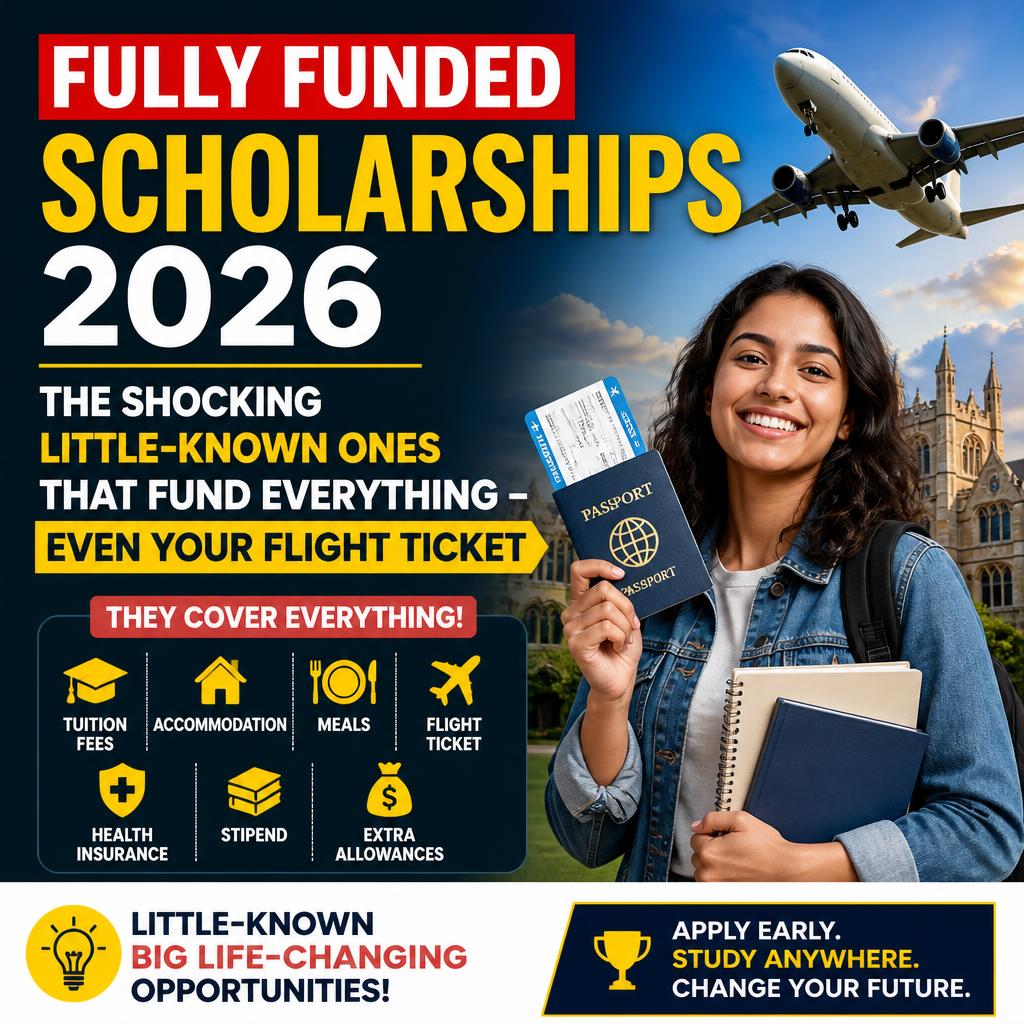
Fully Funded Scholarships 2026: The Shocking Little-Known Ones That Fund Everything — Even Your Flight Ticket
Introduction: These Scholarships Exist. Most People Just Don’t Know About Them.
You’ve probably applied for — or at least Googled — the Chevening Scholarship. Maybe the MasterCard Foundation, too. You know about Rhodes. You’ve bookmarked DAAD.
But here’s something that might shock you: some of the most generous fully funded scholarships in the world have almost no African applicants — not because Africans aren’t eligible, but because nobody talks about them.
We’re talking about scholarships that cover your full tuition, monthly living stipend, return flights from Lagos or Nairobi or Accra, visa fees, and in some cases, your laptop and health insurance. Scholarships that fund everything — and yet quietly receive a fraction of the applications that Chevening does.
This post exists to change that.
By the time you finish reading, you’ll know:
- Exactly what “fully funded” means and what it actually covers
- How to build a personal database of lesser-known scholarships you actually qualify for
- The step-by-step application process, from portal to submission
- How to position your story to win — even if your grades weren’t perfect
- Specific dates and a 2026 action timeline you can follow today
📋 Quick Summary Box
What this guide covers: Lesser-known fully funded scholarships for 2026 that cover tuition, flights, living costs, and more — with a focus on African students
Key benefits you’ll gain: A curated list of opportunities, a step-by-step application system, and the confidence to submit a competitive application
How to use this post: Read end-to-end for full context, or jump to the section most relevant to where you are in your journey
Why “I’m Too Old, Too Late, Too Unknown” Is the Lie Keeping You Broke and Stuck
Let’s be honest about something.
A lot of African students — especially those who are 25, 30, 35, or older — have quietly convinced themselves that fully funded scholarships are for recent graduates with 4.0 GPAs from federal universities. That the doors are already closing. That it’s “too late.”
That belief is costing you tens of thousands of dollars in free education.
Here’s the reality: non-traditional applicants — people with work experience, career pivots, family responsibilities, and unconventional educational paths — are increasingly preferred by many scholarship committees. Why? Because funders want to invest in people who will use what they learn. And someone who has worked in healthcare for six years and now wants to study public policy? That person has a story. That person has urgency. That person gets funded.
A 2023 report by the Institute of International Education found that the number of non-traditional and adult students participating in international scholarship programs grew by 18% between 2019 and 2023.
Across Africa, the story is even more powerful. Many adult learners in Nigeria, Ghana, Kenya, and South Africa have navigated economic disruptions, family obligations, and under-resourced educational systems — and emerged with clarity, resilience, and a very specific idea of what they want to study and why. Scholarship panels value that clarity enormously.
Think of it this way: two candidates apply. One is 22, fresh out of university, unsure why they want to study abroad except that it “sounds good.” The other is 31, has worked in renewable energy for five years, and knows exactly how a master’s in environmental policy will help them lead climate adaptation in West Africa. Who would you fund?
Age is not your obstacle. Obscurity is — and this guide fixes that.
Understanding “Fully Funded” vs. Everything Else (This Distinction Will Save You From Nasty Surprises)
Before we get into the scholarships themselves, let’s talk about what “fully funded” actually means — because it’s not always what it sounds like.
A truly fully funded scholarship covers, at minimum: full tuition, a monthly living stipend, and return airfare. The best ones also cover health insurance, visa application fees, conference attendance, and sometimes even a pre-departure allowance.
Here’s how the funding spectrum actually breaks down:
| Type | What It Covers |
|---|---|
| Fully Funded | Tuition + Stipend + Airfare + Health Insurance |
| Full Tuition Only | Covers tuition, but you fund your own living costs |
| Partial Scholarship | Covers a percentage of tuition — you cover the rest |
| Grant | A lump sum, not tied to a specific institution |
| Loan | Must be repaid — not a scholarship |
| Work-Study | You earn funding by working on campus |
When you read a scholarship description, look for these three words: “stipend,” “travel allowance,” and “health coverage.” If those three appear, you’re looking at a genuinely full package.
Here are two real-world examples of what “fully funded” looks like in practice:
The DAAD (German Academic Exchange Service) Scholarship covers full tuition at German universities, a monthly stipend of approximately €934 for graduates, health insurance, and a one-time travel allowance. If you’re coming from Nigeria, that travel allowance alone covers your Lagos-Frankfurt return ticket.
The Aga Khan Foundation International Scholarship provides 50% grant + 50% loan for top-tier universities — meaning it’s not fully funded, even though it’s often described casually as such. This distinction matters enormously when you’re budgeting.
The lesson: read every word of the award description, not just the headline. A scholarship that “covers all costs” means nothing until you see a line item for airfare and accommodation.
Building Your Scholarship Database: A Systematic Approach That Takes One Weekend
Most people search for scholarships the same way: type “scholarship for Nigerian students 2026” into Google, click the first three links, feel overwhelmed, and close the tab.
That approach almost guarantees you’ll find only the most competitive, most oversubscribed scholarships — the ones with 60,000 applicants for 150 spots.
Here’s a better system:
Step 1: Anchor your search to your field of study Instead of searching broadly, start with “[your field] fully funded scholarship 2026 Africa.” A nursing student, a data scientist, and a journalist need very different databases.
Step 2: Go where the crowd isn’t The most underutilized scholarship databases include:
- Scholars4Dev — one of the most comprehensive databases for scholarships targeting developing-country students, updated regularly, with strong African coverage
- DAAD Scholarship Portal (daad.de) — Germany funds thousands of African students annually, many with no German language requirement
- Korean Government Scholarship Program (KGSP) — vastly undersubscribed by African students; covers everything including Korean language training
- Japanese Government (MEXT) Scholarship — one of the most generous packages in the world; fewer than 200 African students apply per country annually
- Hubert H. Humphrey Fellowship Program — for mid-career professionals from Africa with no age cap
- African Union Scholarships — often unknown even to African students, and specifically reserved for citizens of AU member states
- Government-specific portals: Nigeria’s Federal Scholarship Board (fsb.gov.ng), Ghana’s GETFund, and South Africa’s NSFAS each list country-specific opportunities
Step 3: Search with adult-learner language When using any database, add these filters or keywords: “open to all ages,” “professional experience required,” “mid-career,” “working professionals.” Many scholarships that favor adults never use the word “adult” — they simply don’t have an age cap.
Step 4: Verify legitimacy before investing time A legitimate scholarship will: have a verifiable sponsoring organization, never ask you to pay an application fee, list a physical address or official government/university affiliation, and have a traceable alumni network. If any of these are missing, walk away.
Step 5: Build a spreadsheet, not a bookmark folder For every scholarship you find, log: name, funder, deadline, coverage, eligibility, link, and your personal fit score (1–10). Review your spreadsheet weekly. Treat this like a job search — because it is.
A curated database is the difference between reactive panic and strategic action.
Adult Applicant Eligibility Checklist: Before You Apply Anything, Check This
Here’s every eligibility category you need to assess before investing time in an application:
Standard Eligibility Criteria:
- ✅ Citizenship/nationality (many scholarships target specific African countries or regions)
- ✅ Age range — note that many scholarships have no upper age limit; others cap at 35 or 45
- ✅ Academic qualification — bachelor’s degree required for most postgraduate scholarships; GPA minimums vary (2.5–3.5 on a 4.0 scale is common)
- ✅ English proficiency — IELTS 6.0–7.0 or TOEFL 80–100 for most anglophone programs; waivers sometimes available for applicants from English-medium universities
- ✅ Field of study — some scholarships fund only STEM, others only humanities or development-related fields
- ✅ Work experience — increasingly required or preferred; typically 2–5 years for mid-career programs
- ✅ Financial need — some scholarships require proof; others are purely merit-based
- ✅ Country of residence — a few scholarships require you to be living in your home country at the time of application
Adult-Specific Flags to Watch:
- Employment gaps: Most scholarship panels view these as context, not disqualification — especially if you can explain them (caregiving, health, entrepreneurship)
- Non-linear education paths: Attending multiple institutions, transferring, or taking time off is common and rarely disqualifying
- Professional certifications: Many programs accept industry certifications alongside or in lieu of traditional transcripts
How experience counts: The Hubert H. Humphrey Fellowship, for example, explicitly requires a minimum of five years of professional experience and weights your career trajectory heavily in the selection process. Your work history isn’t background noise — it’s a primary criterion.
🔍 Are You Eligible? Quick Self-Assessment
Answer these four questions honestly:
- Are you a citizen of an eligible country for at least one scholarship on your list? (Most target Sub-Saharan Africa)
- Do you hold at least a bachelor’s degree, or will you by the application deadline?
- Can you demonstrate English proficiency — either through a test or by having studied entirely in English?
- Can you articulate, in one sentence, why this scholarship, why this program, why now?
If you answered yes to all four: you are eligible somewhere. Start applying.
Clarity about where you stand is the first step to moving forward with confidence.
The 7 Little-Known Fully Funded Scholarships You Should Apply to in 2026
This is the section most scholarship websites won’t write — because it requires actual research. Here are seven undersubscribed, legitimate, fully funded scholarships with strong coverage for African students:
1. Korean Government Scholarship Program (KGSP) — Global Korea Scholarship
Who funds it: The Korean government through the National Institute for International Education (NIIED) What makes adults competitive: Korea actively recruits mid-career professionals to strengthen bilateral relationships Award: Full tuition + ₩900,000/month stipend (~$680) + round-trip airfare + health insurance + Korean language training (1 year, free, before your program begins) Acceptance rate: Approximately 5–8% globally, but African applicants face far lower internal competition Eligibility: Under 40 years old; bachelor’s degree; Nigerian and most African countries are eligible Why it’s undersubscribed: Most African students don’t consider South Korea as a study destination — which is exactly why you should
2. Japanese Government (MEXT) Scholarship
Who funds it: Japan’s Ministry of Education What makes adults competitive: Japan values demonstrated professional purpose and community impact Award: Full tuition + ¥117,000–¥145,000/month stipend (~$780–$970) + round-trip airfare + no tuition fees whatsoever Acceptance rate: Highly competitive globally, but fewer than 150–200 African students per country apply annually Eligibility: Under 35 for most categories; strong academic record required Why it’s undersubscribed: The application involves contacting professors directly, which intimidates most applicants — but gives you a huge advantage if you do it
3. Hubert H. Humphrey Fellowship Program (USA)
Who funds it: U.S. Department of State / Bureau of Educational and Cultural Affairs What makes adults competitive: Explicitly designed for mid-career professionals — you cannot apply without at least 5 years of work experience Award: Full tuition + stipend + airfare + health insurance + professional development funds ($1,000+ for conferences and study tours) Acceptance rate: Approximately 10–15%; African countries have dedicated allocations Eligibility: Nigerian, Kenyan, Ghanaian, and most African citizens; 5+ years professional experience; no age cap Why it’s undersubscribed: Many people don’t realize it’s a non-degree fellowship — it’s a 10-month intensive leadership program at a U.S. university, which is often more valuable than a degree for career acceleration
4. Abe Initiative Scholarship (Japan — African Focus)
Who funds it: Japan International Cooperation Agency (JICA) and the African Development Bank What makes adults competitive: Targets African professionals working in public or private sector roles related to development Award: Full tuition + living allowance + health insurance + return airfare Eligibility: African nationals; minimum 2 years professional experience; under 45 years old Why it’s undersubscribed: Almost no coverage in Nigerian or West African media despite being specifically designed for Africans
5. Erasmus Mundus Joint Master’s Scholarships
Who funds it: European Union What makes adults competitive: Erasmus values diverse cohorts; your professional background differentiates you from fresh graduates Award: €1,400/month living allowance + full tuition waiver + €3,000 travel allowance + visa fees Acceptance rate: 10–20% depending on the program consortium Eligibility: Any nationality; no age limit; must apply to specific Erasmus+ program consortiums (each has different focus areas and partner universities) Why it’s undersubscribed among Africans: Most Africans don’t realize that many Erasmus programs actively prioritize applicants from “Partner Countries” — which includes nearly every African nation
6. Commonwealth Scholarship (UK — Developing Country Track)
Who funds it: UK government via the Commonwealth Scholarship Commission What makes adults competitive: Commonwealth scholarships explicitly favor applicants who demonstrate how their study will benefit their home country — a story adults tell far better than fresh graduates Award: Full tuition + living allowance (~£1,347/month in London) + return airfare + arrival allowance + thesis grant Eligibility: Citizens of Commonwealth countries (includes Nigeria, Ghana, Kenya, Uganda, Tanzania, Zambia, and more); must be applying for a master’s or PhD at a UK university Why it’s undersubscribed: Many African students conflate this with Chevening and assume similar competition levels — in fact, developing-country tracks have dedicated spots that go unfilled
7. Swedish Institute Scholarship for Global Professionals (SISGP)
Who funds it: Swedish Institute (Swedish government) What makes adults competitive: Explicitly designed for professionals with leadership experience; minimum 3 years’ work experience required Award: SEK 11,000/month (~$1,050) living grant + full tuition coverage + travel grant + insurance Eligibility: Citizens of select countries including Nigeria, Kenya, Ghana, Ethiopia, Tanzania; under 40 years old; minimum 3 years professional experience Why it’s undersubscribed: Sweden is rarely on the radar for African students seeking study abroad, but Stockholm is one of Europe’s most liveable cities — and this scholarship is extraordinarily generous
Winning is absolutely within reach — especially when you apply to opportunities that the crowd hasn’t found yet.
How to Apply: Step-by-Step, From First Click to Final Submission
Every scholarship has a different portal, but the application journey follows the same general arc. Here’s how to navigate it efficiently:
Step 1: Create your official account (Week 1) Go to the scholarship’s official website — never a third-party aggregator. Create your applicant account with a professional email address (not sexychocolate94@gmail.com — yes, this happens). Screenshot your login credentials and store them securely.
Step 2: Gather your documents (Weeks 1–3) You’ll typically need:
- Official academic transcripts (order early — Nigerian universities and NYSC certificate offices can take 4–6 weeks)
- Degree certificates (certified copies, not photocopies)
- Valid international passport (at least 18 months validity at time of application)
- Updated CV/resume (2 pages max; tailor to the scholarship’s stated values)
- Proof of English proficiency (IELTS or TOEFL score report, or waiver documentation from your previous institution)
- Professional references — typically 2–3 letters from supervisors, professors, or community leaders
- Personal statement / motivation letter (this is your most powerful document — more on this below)
Step 3: Draft your personal statement first (Weeks 2–4) Don’t leave this for last. Your personal statement will take longer than you expect and will go through at least three drafts. Start with your “why now” story — why this scholarship, this program, this moment in your life.
Step 4: Request references early (Week 1–2) Give your referees at least 4–6 weeks’ notice. Provide them with: a brief of the scholarship, your CV, and 2–3 specific accomplishments you’d like them to highlight. Never leave a referee guessing.
Step 5: Complete the online application form (Weeks 4–6) Fill every field carefully. Upload documents in the required format (usually PDF). Double-check file sizes. Many portals reject uploads silently — confirm each document shows as “received.”
Step 6: Internal review (Week 7) Read your entire application as if you’ve never seen it before. Check for consistency — does your CV say you graduated in 2018? Make sure your personal statement doesn’t say 2019. Inconsistencies are instant red flags.
Step 7: Submit before the deadline — not on the deadline (Week 8) Aim to submit at least 72 hours before the official closing time. Portals crash on deadline day. This is not a theory — it happens every year.
⚠️ 5 Mistakes That Cost Adult Applicants (Avoid These)
- Generic motivation statements — “I want to study abroad to broaden my horizons” tells a scholarship panel nothing. Be specific about your field, your goals, and why this program specifically.
- Weak or mismatched references — A reference from your pastor who has never seen your professional work is not useful. Choose people who can speak to your intellectual ability and professional impact.
- Missing work documentation — Many adult applicants forget to include employer letters, payslips, or professional certifications that verify their experience claims.
- Applying to programs that don’t match your background — A scholarship for environmental science is not a good fit for a hospitality professional who “loves nature.” Panels can tell.
- Underestimating document processing time — Nigerian universities, NYSC, and government offices have long processing queues. Start at least 8 weeks before your deadline.
Preparation is what separates the wishful from the winners.
Positioning Your Story: How to Make Panels Choose You Over a 22-Year-Old With a 4.0
Here’s something scholarship applicants almost never hear: your age and experience are your competitive edge, not your handicap. The problem is that most adult applicants don’t know how to use them.
A 22-year-old applicant can write a competent personal statement. But they can’t write your statement — the one that explains how seven years working in public health across three Nigerian states shaped your understanding of policy failure, and why you now need a master’s in global health governance to create the change you’ve watched being needed.
That story wins.
Here’s how to structure it:
Framework 1: “The Turning Point” Identify one specific moment — a project, a failure, a patient, a community, a conversation — that crystallized exactly why you need this education right now. Open with that moment. Build outward from it.
Framework 2: “The Gap I Keep Seeing” Articulate a specific problem in your field or community that you are uniquely positioned to address — and show exactly how this scholarship and program will give you the tools to address it. This frame works especially well for development, policy, and social sector applicants.
Framework 3: “From Stability to Ambition” If you’re leaving a comfortable job to pursue further education, own that decision boldly. Explain what you’re giving up and why. Scholarship panels respect applicants who have something to lose — because it signals genuine commitment.
The trap to avoid: Don’t minimize your background. Some adult applicants try to “sound younger” by downplaying their work history or omitting years of experience to fit what they imagine panels want. This backfires almost every time. Your trajectory is your differentiator.
Here’s how the difference looks in practice:
Generic version: “I have always been passionate about environmental sustainability and wish to gain international exposure to further my career.”
Adult applicant version: “In 2021, I led a waste management audit across four Lagos local governments — and discovered that 73% of recyclable materials were being landfilled due to infrastructure gaps we had the budget to fix, but not the technical knowledge. That audit changed my career trajectory. This master’s program is the specific training I need to return and close that gap.”
Same person. Completely different application.
As DAAD alumna Chiamaka Obi (Nigeria, 2023) shared in an interview with African Scholarship Forum: “When I stopped trying to sound like a fresh graduate and started writing like the seven-year professional I actually was, I got funded. The panels don’t want another polished 22-year-old. They want someone who will actually do something with the degree.”
Authenticity is your differentiator — because no one else has lived your exact story.
The 2026 Adult Scholarship Timeline
Use this table to map your year and set phone reminders now:
| Date Range | Milestone |
|---|---|
| January – February 2026 | MEXT (Japan), Commonwealth Scholarship, KGSP applications open |
| February – March 2026 | Swedish Institute (SISGP) application window opens |
| March 2026 | Humphrey Fellowship application deadline (check country-specific dates) |
| March – April 2026 | Erasmus Mundus program deadlines (varies by consortium) |
| April 2026 | DAAD applications close for most programs |
| April – May 2026 | Abe Initiative scholarship deadline |
| May – June 2026 | Shortlist notifications begin (KGSP, Erasmus) |
| June – August 2026 | Interview periods for most major scholarships |
| September – October 2026 | Final decisions announced across programs |
| January / September 2027 | Most programs begin (depending on academic calendar) |
Important: Set a phone reminder 6 weeks before every deadline you’re targeting — adult applicants consistently underestimate documentation processing time. Nigerian university transcript offices and NYSC verification services routinely take 3–5 weeks. Start earlier than you think you need to.
Proactive planning is the quiet advantage that most applicants never give themselves.
Frequently Asked Questions
Can I get a fully funded scholarship if I have work experience instead of a high GPA?
Yes — and in many cases, you’re more competitive. Scholarships like the Hubert H. Humphrey Fellowship and the Swedish Institute Scholarship explicitly require professional experience and evaluate applicants primarily on their career trajectory and community impact. A 3.0 GPA with a compelling professional record often outperforms a 4.0 with no real-world experience.
What if there’s a gap in my education or work history?
Most scholarship panels expect to see gaps — especially from African applicants who may have navigated economic hardship, caregiving responsibilities, or system failures. Address the gap directly and briefly in your personal statement. Explain what you learned or did during that time. Transparency is far better than hoping reviewers won’t notice.
Can I work part-time while on a full scholarship?
It depends on your host country’s visa terms and the scholarship’s own rules. In Germany and South Korea, student visa holders can typically work limited hours (typically 20 hours/week). In the UK, scholarship conditions often restrict employment. Always read your award letter carefully — working in violation of visa conditions can result in deportation and scholarship cancellation.
Do I need to be living in my home country to apply?
Many scholarships require you to be a citizen of an eligible country but do not require you to be currently residing there. However, some — including certain Commonwealth tracks — specifically state that applicants must be resident in their home country at the time of application. Check each scholarship’s country-specific guidelines.
Can I reapply if I’m rejected?
Absolutely — and you should. Most fully funded scholarships explicitly welcome reapplication, and a significant proportion of successful awardees applied more than once. Use rejection feedback (when available), strengthen your personal statement, and build your professional profile between cycles. Rejection is data, not a verdict.
Can I apply for multiple scholarships at the same time?
Yes, and you should. Applying to multiple scholarships simultaneously is standard practice and not considered unethical. If you receive multiple offers, you’ll simply decline the ones you don’t accept. Applying to only one scholarship per cycle is one of the most common — and costly — mistakes African applicants make.
Are African applicants at a disadvantage compared to applicants from other regions?
On the contrary. Many fully funded programs — especially government-to-government exchange scholarships like MEXT, KGSP, and Erasmus Mundus — actively prioritize applicants from developing regions, including Sub-Saharan Africa. Some programs have dedicated allocation slots for specific African countries. Your African identity and context can be a significant advantage when framed strategically in your application.
The door is open wider than you’ve been told — step through it.
Your Action Plan: What You Do in the Next 7 Days
Here’s what I want you to know before you close this page:
The scholarships in this guide are real. The funding is real. The African students winning them are real. The only variable is whether you decide to be one of them.
You don’t need a perfect GPA. You don’t need to be 22. You don’t need to know someone at the embassy. You need a strategy, a story, and enough discipline to do the work.
So here’s your action plan — not vague suggestions, but specific things you’ll do this week:
Action 1: Build your scholarship shortlist today. Open a Google Sheet. Add six columns: Scholarship Name, Deadline, Coverage, Eligibility, My Fit (1–10), and Link. Visit Scholars4Dev and the DAAD portal. Add at least five scholarships to your sheet before you sleep tonight. Five. Not a bookmark folder — a spreadsheet with deadlines.
Action 2: Gather your documents this week. Email your university’s records office today requesting official transcripts. If you need NYSC verification, start that process immediately — it takes longer than any applicant expects. Pull out your passport and check its expiry date. If it expires within 18 months, renew it now. Every document you delay gathering is a submission deadline you risk missing.
Action 3: Draft your one-sentence “why now” statement. Open a blank document and write one sentence that answers: “I am applying for this scholarship because [specific professional context] has shown me that [specific gap or problem], and [specific program] will give me [specific capability] to [specific impact].” This sentence becomes the spine of every personal statement you write. It takes 20 minutes. Do it today.
And one more thing: subscribe to the Scholacareer newsletter. We send deadline alerts, scholarship announcements, and application tips directly to African students before the crowd finds out. The scholarships in this guide aren’t secret — they’re just underreported. We fix that, every week, in your inbox.
You have lived a life that most 22-year-old applicants haven’t — and somewhere on a scholarship panel, someone is waiting to fund exactly that life. Go find them.
