Table of Contents
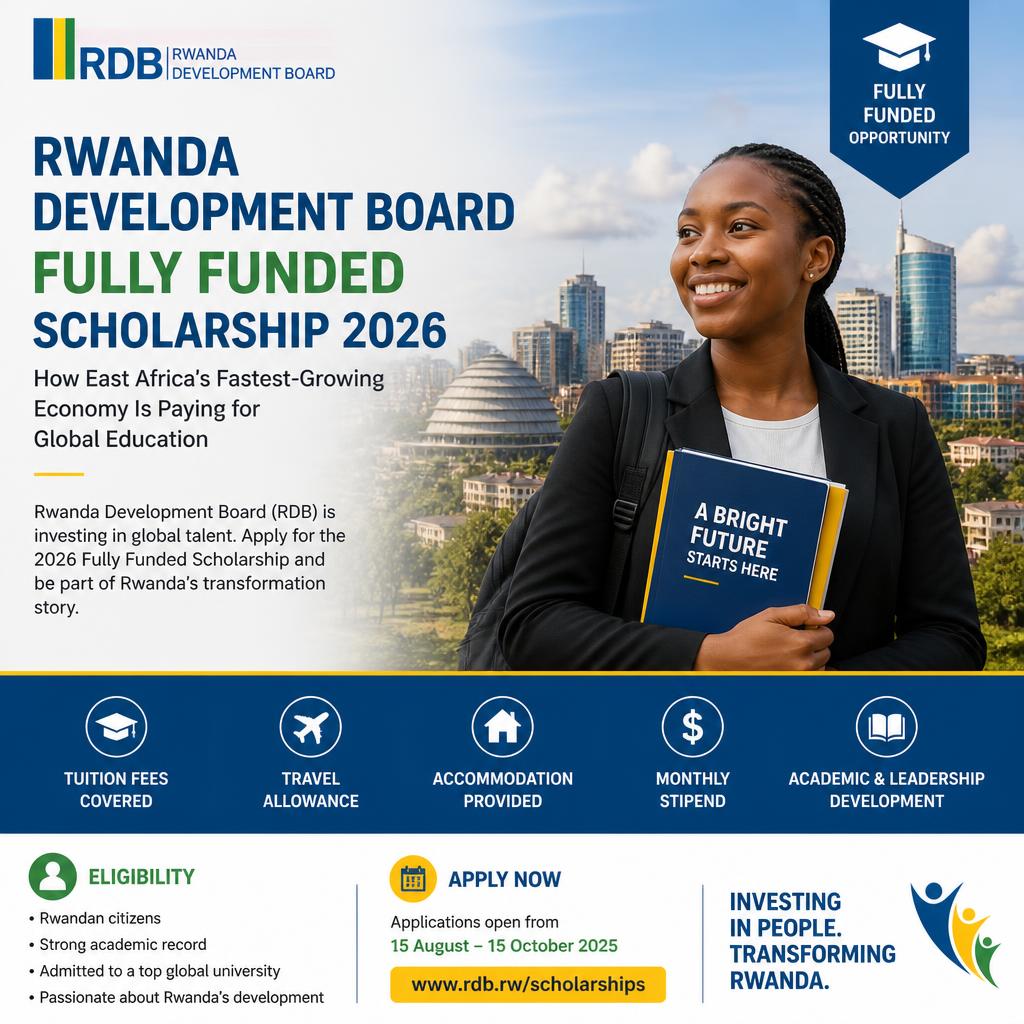
ToggleRwanda Development Board Fully Funded Scholarship 2026: How East Africa’s Fastest-Growing Economy Is Paying for Global Education
Introduction: Rwanda Is Writing Tuition Checks—Is Your Name on One?
Picture this: You’re a Rwandan professional, a recent graduate, or an East African student with enormous ambition and a passport that feels like it’s just waiting for a reason to be stamped. You’ve been watching Rwanda transform—gleaming skyscrapers rising in Kigali, a tech ecosystem competing with cities twice its size, a government that genuinely talks about human capital like it means it. And somewhere in the back of your mind, you’ve been thinking: Is there a way for me to be part of this? Can I actually study abroad without selling everything I own?
The answer is yes—and Rwanda’s government is literally paying for it.
The Rwanda Development Board fully funded scholarship is one of the most strategically targeted, comprehensively covered scholarship programs in sub-Saharan Africa right now. It doesn’t just cover tuition. It covers your living expenses, your flight, and your academic future—because Rwanda understands that investing in you is the same as investing in the country’s GDP.
In this guide, you’ll learn exactly what the RDB scholarship covers, who qualifies, how to build an application that stands out, and what your 2026 timeline looks like from first click to final acceptance. You’ll walk away with a clear, step-by-step action plan—not a vague checklist, but a real roadmap you can start tonight.
Quick Summary Box:
- 📌 What this guide covers: The complete RDB scholarship structure, eligibility, application strategy, and 2026 deadlines
- 💡 Key benefits you’ll gain: Clarity on what “fully funded” actually means, insider positioning tips, and a done-for-you application timeline
- 🗺️ How to use this post: Read straight through once, then return section by section as you begin your actual application
Why Rwanda Is One of the Most Exciting Scholarship Bets in Africa Right Now
Before you dive into applications, you need to understand why this scholarship exists—because understanding the “why” will make your application dramatically stronger.
Rwanda is running one of the most ambitious human capital experiments on the continent. Since the mid-2000s, Rwanda has averaged GDP growth rates that consistently outpace the African average, and the government has publicly committed to transforming the country into a knowledge-based economy by 2035 under the Rwanda Vision 2050 framework. That transformation requires people—specifically, Rwandan and regionally connected professionals trained at world-class institutions in fields that Rwanda’s economy is actively building out.
That’s where you come in.
The Rwanda Development Board was established as the central agency responsible for facilitating investment, tourism, and economic growth. But unlike many development agencies across the continent that focus purely on attracting foreign capital, the RDB has made a parallel commitment: investing in Rwandan talent to lead those sectors from the inside. The fully funded scholarship program is that investment made tangible.
What makes this more compelling than most government scholarship programs is the alignment between what Rwanda needs and what it funds. You’re not applying for a generic academic grant. You’re applying to be developed as a strategic asset in sectors Rwanda has identified as priority growth areas—think ICT, finance, tourism, infrastructure, agriculture technology, and public health.
For you as an applicant, this creates a rare advantage. When a government ties scholarship funding to national development priorities, it funds more scholarships, funds them more generously, and builds longer pipelines of alumni who return with skills the country genuinely needs. You’re not competing for a symbolic prize. You’re competing to join a strategic cohort.
Rwanda’s story also carries psychological weight in your application. Any scholarship committee evaluating candidates from across the continent will immediately recognize Rwanda as a country of serious institutional ambition—and they’ll interpret your association with it positively.
Understanding this context isn’t background reading. It’s application strategy.
What the RDB Scholarship Actually Covers: Understanding “Fully Funded” in Real Terms
Let’s be honest: the phrase “fully funded” gets thrown around so loosely in scholarship marketing that it’s almost become meaningless. Some programs call themselves fully funded and then quietly exclude housing. Others cover tuition only. A few genuinely cover everything.
The Rwanda Development Board scholarship sits at the comprehensive end of the spectrum—but you need to know exactly what that means before you start planning your life around it.
Here’s what a fully funded RDB scholarship typically covers:
- Full tuition fees at the approved international institution, paid directly to the university
- Monthly living stipend calibrated to the cost of living in the host country
- Round-trip international airfare (economy class, one return ticket per academic year in most cases)
- Health insurance for the duration of the program—this alone saves you thousands of dollars annually
- Study materials allowance for textbooks, software, and academic resources
- Visa processing fees covered or reimbursed (verify this during your application cycle as it varies by year)
What it typically does not cover—and this matters for your budgeting:
- Personal discretionary spending (travel within the host country, entertainment, personal shopping)
- Family relocation costs if you have dependents you wish to bring along
- Laptop replacement if yours fails (bring a reliable one)
- Additional certification or short-course fees outside your registered program
The distinction between “full tuition coverage” and “fully funded” is where many applicants get caught off guard. If a scholarship only mentions tuition, that is not fully funded—full stop. An RDB scholarship that is genuinely fully funded will explicitly list living allowance, travel, and insurance in the award documentation. If you’re reviewing an offer and those components are missing, ask directly before accepting.
For comparison, consider two of the other flagship programs operating in this space. The Mastercard Foundation Scholars Program explicitly lists tuition, stipend, travel, and insurance as standard components. The DAAD (German Academic Exchange Service) scholarship similarly breaks down its award into tuition waiver, monthly stipend of approximately €934, and health coverage. The RDB scholarship aligns with this tier.
The bottom line: knowing exactly what’s covered lets you negotiate what isn’t—and stops you from being blindsided six months into your program. Informed applicants make better scholars.
Who Qualifies: Your Complete RDB Scholarship Eligibility Breakdown
This is where most applicants either relax or panic—sometimes for the wrong reasons. Let’s walk through the eligibility criteria clearly, address the parts that concern most people, and help you make an honest assessment of where you stand.
Citizenship and Residency
The RDB scholarship program is primarily designed for Rwandan nationals. This is a government investment in Rwandan human capital, so citizenship verification is a hard requirement. If you’re a Rwandan citizen living abroad, you’re still eligible to apply—diaspora applicants are explicitly welcomed in many cycles. If you’re a non-Rwandan East African national, stay alert: some cycles have opened RDB-affiliated funding to regional applicants under bilateral agreements, particularly in sectors where Rwanda is building regional expertise. Check the current 2026 call carefully for any regional eligibility windows.
Academic Qualifications
For postgraduate scholarships, you’ll typically need:
- A bachelor’s degree from a recognized institution with a strong academic record (usually upper second class or GPA equivalent)
- Transcripts from all institutions attended, officially stamped and translated if not in English or French
For undergraduate scholarships (where available):
- Strong secondary school performance, particularly in subjects relevant to your intended field
- Proof of secondary school completion (PLE/A-Level certificates or equivalents)
The important nuance for applicants with non-traditional academic histories: Work experience and professional certifications can strengthen your application in lieu of a perfect GPA—but they rarely substitute for the minimum academic entry requirement. If your undergraduate record is below the stated threshold, lead with a compelling explanation in your personal statement and let your professional accomplishments carry significant weight.
Priority Fields of Study
The RDB scholarship is sector-specific, not open-ended. You’re not free to study medieval poetry on this funding. The priority areas consistently include:
- Information and Communication Technology (ICT) and data science
- Finance, economics, and investment
- Tourism and hospitality management
- Agricultural technology and agribusiness
- Public health and health systems
- Infrastructure, engineering, and urban planning
- Public policy and governance
If your intended field falls outside these areas, don’t force it—find a framing that genuinely connects your discipline to one of these sectors. A social scientist studying economic behavior in tech adoption fits. A historian studying colonial land systems that informs current agricultural policy fits. Be honest and creative in your alignment.
Language Requirements
Most partner universities for RDB scholarships are English-medium institutions, so you’ll need:
- IELTS (minimum 6.5 overall, with no band below 6.0) or
- TOEFL iBT (minimum 90) or
- Proof of previous English-medium education as a waiver (many Rwandan applicants qualify here)
Return Commitment
This is the element that surprises most applicants. The RDB scholarship typically includes a mandatory return-to-Rwanda clause. After completing your studies, you’re expected to return and contribute to Rwanda’s development for a specified period—usually equivalent to the length of your scholarship. Violating this clause may require repayment of scholarship funds.
This isn’t a bureaucratic footnote. It’s central to the program’s philosophy. If you’re genuinely committed to contributing to Rwanda’s growth, this should feel natural, not restrictive.
Are You Eligible? Quick Self-Assessment
Answer yes or no to these four questions—be honest with yourself:
- Are you a Rwandan national (or a regional national in an applicable bilateral cycle)? ☐ Yes ☐ No
- Do you have a bachelor’s degree (or strong secondary record for undergraduate tracks) with solid academic performance? ☐ Yes ☐ No
- Does your intended field of study connect directly to Rwanda’s priority development sectors? ☐ Yes ☐ No
- Are you prepared to return to Rwanda after your studies for the required commitment period? ☐ Yes ☐ No
If you answered yes to all four, you’re a competitive candidate. Two or three yeses means you have work to do, but don’t count yourself out—read the positioning section carefully. One or fewer yeses means this specific program may not be your best fit this cycle, but keep reading: the database-building section will point you toward alternatives.
The 5 Types of RDB-Affiliated Scholarships You Need to Know About
The RDB scholarship ecosystem is not a single monolithic program. It operates through multiple channels, and understanding which one applies to your situation dramatically improves your targeting accuracy.
1. Presidential Scholars Program (Rwanda Government Flagship)
Who funds it and why: Directly funded by the Government of Rwanda through the Office of the President and administered via RDB. This is the flagship, highest-prestige tier.
What makes adult applicants competitive: Demonstrated leadership, government or institutional work experience, and a clear plan for post-degree service to Rwanda.
Typical award: Full coverage—tuition, stipend, travel, insurance, and study materials. Award values range from $30,000–$80,000+ depending on destination country and program length.
Acceptance rate: Highly competitive. Estimate 5–10% acceptance at the top-tier universities this channel places scholars.
Real example: Rwandan scholars through this program have studied at Harvard Kennedy School, Oxford’s Blavatnik School of Government, and MIT’s Sloan School of Management.
2. RDB Sector-Specific Scholarships (Ministry Partnerships)
Who funds it and why: Co-funded by the RDB and specific Rwandan ministries (Ministry of ICT, Ministry of Agriculture, etc.) targeting workforce gaps in particular sectors.
What makes adult applicants competitive: Existing professional experience within the relevant ministry or sector. If you already work in Rwanda’s ICT sector and you’re applying for a data science master’s, this channel was practically built for you.
Typical award: Tuition and stipend covered; some programs offer only partial living allowances compared to the Presidential tier.
Real example: Rwanda’s National Bank has historically co-sponsored RDB-linked finance scholars studying at London Business School and Sciences Po Paris.
3. African Union-Rwanda Bilateral Scholarships
Who funds it and why: Funded jointly by the African Union and Rwanda under regional integration agreements. Occasionally opens to non-Rwandan East African nationals.
What makes you competitive: Regional perspective, multilingual capacity, and a track record of cross-border collaboration.
Typical award: Varies by cycle; generally covers tuition and a regional-standard stipend. Destination institutions tend to be within Africa or Europe.
Real example: The AU Scholarships Programme, which you can explore through the African Union Commission’s official scholarships portal, has funded placements relevant to RDB priority sectors.
4. University-Partnership Direct Scholarships (RDB-Endorsed)
Who funds it and why: Several international universities have formal MOUs with Rwanda that include reserved scholarship slots for Rwandan students, often co-branded with RDB endorsement.
What makes you competitive: Strong academic record and a proposal that explicitly ties your research to Rwanda’s development goals.
Typical award: Varies significantly by institution—some cover full tuition only; others are genuinely comprehensive.
Real example: Carnegie Mellon University Africa, located in Kigali, offers RDB-endorsed pathways for Rwandans pursuing technology graduate programs with costs dramatically lower than the CMU Pittsburgh campus.
5. Development Partner Scholarships (World Bank, USAID, EU-Rwanda)
Who funds it and why: International development organizations funding human capital in Rwanda through structured partnerships with the RDB.
What makes you competitive: A convincing public benefit argument—your studies must demonstrably serve a population, not just your career.
Typical award: Often the most comprehensive in terms of living support; World Bank-affiliated programs in particular are known for generous stipends.
Real example: The World Bank’s Joint Japan/World Bank Graduate Scholarship Program, one of the most comprehensive in the world, accepts applicants from Rwanda and aligns directly with RDB priority fields.
For adult applicants specifically: every one of these five channels rewards professional experience, sector clarity, and demonstrated commitment to return—qualities that older applicants possess in abundance.
Building Your RDB Application: A Step-by-Step Walkthrough
Now you’re ready to actually apply. Here’s exactly how this moves, step by step, so nothing catches you off guard.
Step 1: Register on the Official Portal (Weeks 1–2)
You’ll start at the RDB official website or the designated scholarship portal for the 2026 cycle. Create your account using a permanent, professional email address—not a university email that expires. Write down your login credentials immediately and store them securely. More applicants than you’d believe lose access to live applications because of forgotten passwords.
Complete your profile fully before uploading a single document. Incomplete profiles are often filtered out before a human reviewer ever sees them.
Step 2: Gather Your Documents (Weeks 2–5)
This is where adult applicants consistently underestimate the timeline. You’ll need:
- Official transcripts from every institution you’ve attended, stamped and signed by the registrar. If your university is overseas, request these immediately—international transcript processing can take 4–6 weeks.
- Degree certificate(s) or provisional letter if you haven’t received the physical certificate yet
- National ID or passport (ensure your passport has at least 18 months of validity before the scholarship start date)
- IELTS/TOEFL score report (no more than two years old for most cycles)
- CV/résumé in a clean, professional format—maximum two pages; lead with relevant professional experience before academic history
- Two or three reference letters (more on selecting referees in the next section)
- Personal statement (drafted in Step 4)
- Research proposal or study plan (for postgraduate applicants)—typically 500–1,500 words outlining your intended program, why you chose it, and how it connects to Rwanda’s development goals
Step 3: Select Your Referees Strategically (Weeks 2–3, concurrent)
Don’t leave this until Week 7. Referees who feel rushed write generic letters. Your strongest referee is not necessarily your most senior one—it’s whoever can speak most specifically about your intellectual capacity, work ethic, and community commitment.
For RDB scholarships, an ideal referee combination is:
- One academic referee who assessed your work directly (a professor, not just a department head who knows your name)
- One professional supervisor who can speak to your sector contribution and leadership
- One community or civic referee if you have meaningful volunteer or NGO involvement
Give each referee a copy of your personal statement, your CV, and a brief note explaining which scholarship you’re applying for and what themes matter most. Make it easy for them to write something powerful.
Step 4: Draft Your Personal Statement (Weeks 3–6)
More on this in the positioning section—but start early. Your first draft will be terrible. That’s normal and necessary. Give yourself time for a second and third revision.
Step 5: Complete the Online Application Form (Week 6–7)
Fill in every field, even optional ones. Scholarship committees notice when optional sections are left blank—it signals low effort or low confidence. If a question doesn’t apply to you, write a brief, honest explanation rather than leaving it empty.
Step 6: Internal Review Before Submission (Week 7–8)
Read your entire application aloud. Yes, aloud. You’ll catch grammatical errors, awkward phrasing, and gaps in your narrative that silent reading misses.
Ask one trusted person—ideally someone who has successfully navigated a competitive application process—to review it. Not a friend who’ll say it’s great regardless, but someone who will identify weaknesses honestly.
Step 7: Submit Early and Confirm Receipt (Week 8–10)
Submit at least five to seven days before the deadline. Portals crash on deadline day. Confirmation emails get delayed. Files fail to upload at 11:58 PM. Early submission gives you a buffer to fix technical problems without losing your spot.
Save your confirmation number and screenshot the submission page.
⚠️ 5 Mistakes That Cost RDB Applicants (Avoid These)
1. Generic motivation statements. “I want to help Rwanda develop” is not a strategy—it’s a slogan. Every applicant says some version of this. You need to say specifically how, in which sector, with what skills, and through what mechanisms.
2. Misaligning your field with RDB priorities. Applying for a creative writing program on a development-focused scholarship is a fast track to rejection. Even if your field genuinely connects, you must make that connection explicit.
3. Weak reference selection. A letter from a very senior official who barely knows your work beats a warm personal endorsement from a colleague—but just barely. The best letter is from someone senior who also knows your work deeply.
4. Ignoring the return commitment. Some applicants treat this as a checkbox. Committees can tell. If you don’t genuinely intend to return, reconsider your application—and your strategy.
5. Submitting on deadline day. Technical failures are not considered valid extensions. Submit early, always.
Positioning Your Story: Why You Are Exactly Who Rwanda Is Looking For
Here’s the part of the application process most guides skip because it requires you to be honest with yourself in ways that are genuinely uncomfortable.
Your story is your strongest differentiator—if you tell it with clarity and courage.
Many applicants write personal statements that read like résumé summaries dressed up in paragraphs. They list achievements, mention ambitions in vague terms, and close with something about making Africa proud. These applications are forgettable. Not because the applicants aren’t qualified, but because they never gave the committee a reason to remember them specifically.
The RDB scholarship is looking for more than academic performance. It’s looking for clarity of purpose, alignment with national priorities, and evidence that you will actually come back and do something with what you’ve learned. Those three things are best conveyed through story, not through a list of credentials.
Two Essay Frameworks That Work for RDB Applications
Framework 1: The Turning Point
Start with a specific moment—a project, a conversation, a failure, a discovery—that crystallized your understanding of a gap in Rwanda’s development landscape. Show how that moment redirected your thinking and led you to pursue this specific field at this specific time. Then connect your proposed studies directly to solving that gap.
Weak version: “I have always been interested in ICT and believe technology can transform Africa.”
Strong version: “In 2022, I watched a smallholder farmer in Musanze lose 40% of his crop yield because he had no access to real-time weather data that a $12 sensor could have provided. That moment made abstract arguments about agricultural technology feel urgent and personal. My proposed research in precision agriculture data systems is a direct response to what I saw that afternoon.”
Framework 2: From Stability to Ambition
If you’re a working professional leaving a stable position to pursue further study, say so directly—and explain why stability wasn’t enough. Committees deeply respect applicants who had something to lose and chose growth anyway. This narrative signals seriousness, maturity, and commitment.
Framework 3: The Unfinished Project
If your professional work has surfaced a problem you cannot solve without deeper academic training, frame your application as the natural continuation of work already in progress. This is particularly powerful for RDB sector-specific scholarships where your professional track record is directly relevant.
“I stopped writing a personal statement and started writing a report on a problem I actually cared about solving. The scholarship committee didn’t admit a student—they funded a solution.”
— Amina K., RDB Scholar, 2023, studying urban infrastructure at Delft University of Technology, age 31
One more thing: don’t minimize your background to sound more traditionally “student-like.” If you managed a team of fifteen people before applying for a master’s program, say so and explain what you learned about leadership under pressure. If you took time away from school to care for family, acknowledge it honestly—resilience is a qualification, not an apology.
Authenticity isn’t just ethically right. It’s strategically smart. Committees read hundreds of applications. The ones that feel real stand out from the ones that feel performed.
The 2026 RDB Scholarship Timeline: Know Every Key Date
Use this table as your operational calendar. Customize it for your specific program track, but these windows reflect the typical RDB scholarship cycle.
| Date Range | Milestone |
|---|---|
| January–February 2026 | Applications portal opens; create your account and begin profile |
| February–March 2026 | Document gathering phase; request transcripts, language scores, and reference letters |
| March–April 2026 | Personal statement drafting and internal review |
| April 2026 | Priority deadline window (rolling programs—submit here for best consideration) |
| May 2026 | Hard application deadline for most fixed-deadline tracks |
| June–July 2026 | Shortlist announcements; interview invitations sent to selected candidates |
| July–August 2026 | Interviews conducted (often virtual; prepare for panel format) |
| September 2026 | Final decisions announced; conditional offers issued |
| October–November 2026 | Visa applications, institutional enrollment confirmation, travel arrangements |
| January or September 2027 | Program commencement at host institution |
Adult-specific note: If you’re balancing work and application preparation simultaneously, the February–April phase is where most professionals fall behind. Block calendar time now—treat your application like a second job during this window.
Practical reminder: Set phone reminders six weeks before every deadline listed above. Adult applicants consistently underestimate how long document collection takes, especially for transcripts from institutions that are slow to respond.
Proactive planning is the single difference between a completed application and a missed opportunity.
Frequently Asked Questions About the RDB Scholarship 2026
Can I apply for the RDB scholarship if I’m already working full-time?
Yes, and your professional experience is an asset, not a distraction. The RDB scholarship explicitly values applicants with sector-relevant work history. You’ll need to resign or take leave from your position before program commencement if selected, but nothing prevents you from applying while employed. Many successful scholars were working professionals at the time of application.
What if there’s a gap between my undergraduate degree and now?
An education gap doesn’t disqualify you. What matters is how you account for it. Use your personal statement to explain what you did during that period—professionally, personally, or in community service—and connect that experience to your current application. Employment gaps are often evidence of maturity and real-world depth, not red flags.
Do I have to leave Rwanda to apply, or can I apply from outside the country?
You can apply from anywhere in the world as long as you meet the citizenship and eligibility requirements. The application process is managed online, and the RDB actively welcomes diaspora applicants who intend to return after their studies. Being outside Rwanda does not disadvantage your application.
How long does the full process take from application to program start?
Expect a minimum eight to twelve months from initial application to program commencement. The timeline typically runs: application submission (Month 1) → shortlisting (Month 3–4) → interviews (Month 4–5) → offers (Month 6) → visa and enrollment (Month 7–9) → program start (Month 9–12). Plan your personal and professional life accordingly.
Can I reapply if I’m rejected in 2026?
Absolutely, and you should. Many RDB scholars were not selected on their first attempt. A rejection is feedback, not a verdict. Request any available feedback from the committee, strengthen the weak areas of your application, and reapply in the next cycle with a demonstrably improved submission. Persistence is a qualification too.
Is there a work-back requirement, and what happens if I can’t fulfill it?
Yes. Most RDB scholarship tracks require you to return to Rwanda for a period equivalent to your scholarship duration after graduation. If you’re unable to fulfill this requirement, you may be asked to repay some or all of the scholarship funds. This is a legally enforceable clause in most award agreements—review it carefully before accepting an offer.
Are applicants with professional degrees (MBAs, MPHs, LLMs) competitive?
Yes—professional degree applicants are often more competitive for RDB sector-specific scholarships because the program prioritizes applicants whose studies translate directly into Rwanda’s workforce needs. An MBA applicant working in Rwanda’s finance sector with a clear post-degree plan for a specific institutional role is an ideal candidate profile for multiple RDB scholarship tracks.
The path is clearer than you thought. All it takes is the decision to walk it.
Your Action Plan: Start Tonight, Not Next Month
You’ve just read everything you need to know to pursue the Rwanda Development Board fully funded scholarship for 2026 with genuine confidence. Now comes the part that separates people who dream about studying abroad from people who actually do it.
You might be feeling a mix of things right now. Excitement because the opportunity is real and the path is clearer than you expected. Anxiety because the timeline is tighter than you’d like. Maybe a quiet doubt whispering that other candidates are more qualified, more polished, more ready. Ignore that voice. The most competitive candidates are not the ones with the most impressive résumés—they’re the ones who actually submit.
Here are your three immediate action items:
- Tonight: Visit the official RDB scholarship page and bookmark it. Note the 2026 application opening date and set a recurring calendar reminder for every major deadline milestone listed in this guide. If the portal is live, create your account right now—it takes ten minutes and signals to yourself that you’re serious.
- This week: Pull together your existing documents—degree certificate, transcripts, passport, and your most recent CV. Place them in a dedicated folder (physical and digital). Identify which documents are missing and contact the relevant institutions immediately to request official copies. Transcript processing is the longest lead-time item; every week you delay costs you exactly one week you don’t have.
- This month: Write the first rough draft of your personal statement using one of the three frameworks in the positioning section above. Don’t edit it yet. Just write it—all of it, including the parts that feel clunky. The revision process is where your authentic story emerges. Also, identify your two or three potential referees and send them a preliminary message asking whether they’d be willing to support your application.
The Rwanda Development Board scholarship is not a lottery. It’s a selection—and selection rewards preparation, clarity, and commitment. You have all of those things. You just needed a roadmap.
Now you have one. Use it.
Sources and further reading: Explore the full list of open African Union scholarship programs at the African Union Commission’s official scholarships portal. For understanding how development-aligned scholarship programs evaluate candidates globally, the World Bank Institute’s human capital development framework provides comprehensive context.
Last updated: 2025 | For the 2026 application cycle | Always verify current deadlines and requirements directly at the official RDB portal before submitting
