Table of Contents
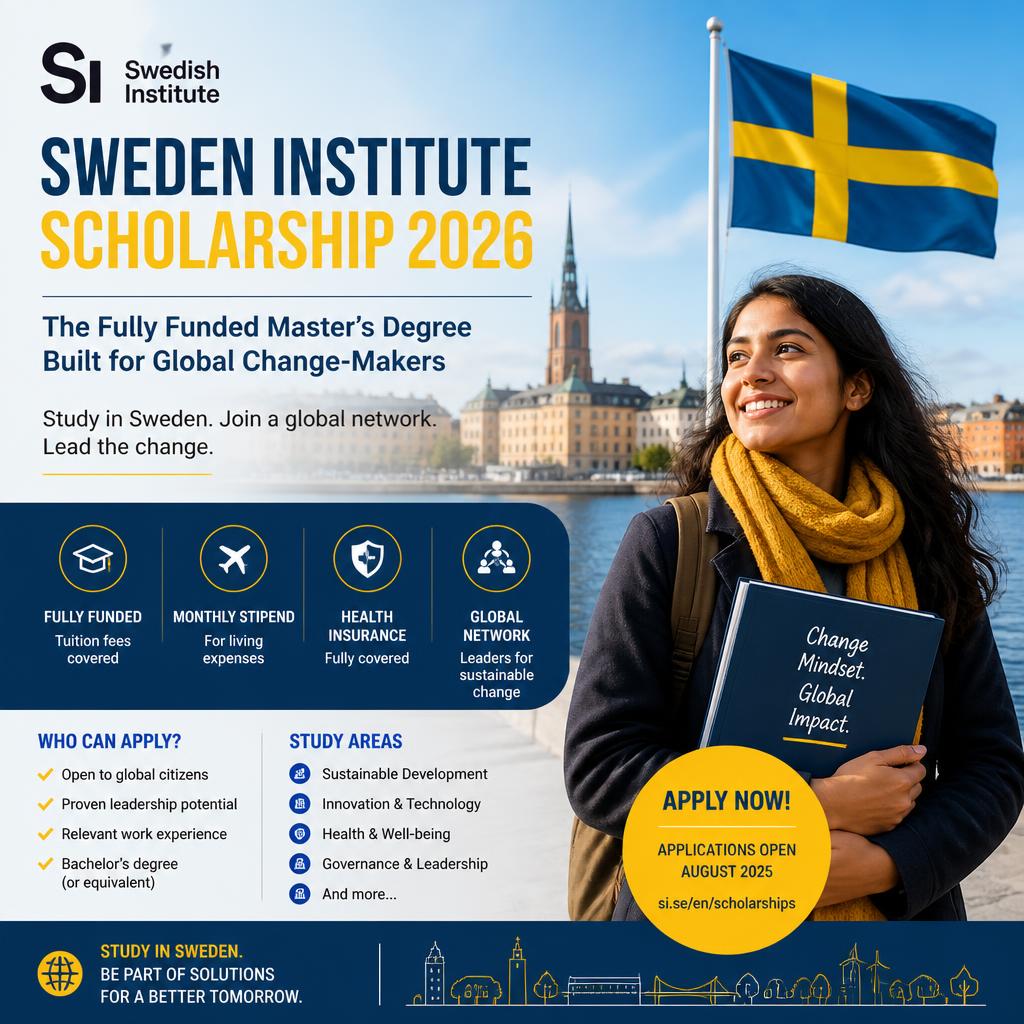
ToggleSweden Institute Scholarship 2026: The Fully Funded Master’s Degree Built for Global Change-Makers
You Already Have What Sweden Is Looking For—You Just Don’t Know It Yet
Picture this: you’re sitting at your desk, doing meaningful work in your community, your organization, or your sector—and somewhere in the back of your mind, a quiet voice whispers that you could do more if only you had the right education, the right network, the right platform.
Now picture studying for your master’s degree in Sweden—fully funded, expenses covered, surrounded by the brightest minds from across the globe—and returning home equipped to drive real, measurable change.
That’s not a fantasy. That’s exactly what the Sweden Institute Scholarship 2026 is designed to make possible.
The Swedish Institute (SI) runs one of the world’s most prestigious and genuinely transformational scholarship programs, specifically targeting professionals and young leaders from select countries who are already making a difference and want to scale their impact. If you’re from an eligible country in Africa, Asia, Latin America, or beyond, this scholarship could be your single most important career move.
In this guide, you’ll learn exactly what the SI Scholarship covers, who qualifies, how the selection process actually works, what makes a winning application, and how to position your story so the selection committee can’t ignore you.
Quick Summary Box:
- ✅ What this guide covers: Full breakdown of the Sweden Institute Scholarship 2026—eligibility, funding details, application steps, and insider positioning tips
- ✅ Key benefits you’ll gain: You’ll know whether you qualify, what to prepare, and how to stand out as a candidate from a competitive pool
- ✅ How to use this post: Read end-to-end for full context, or jump to the section most relevant to your current stage—awareness, eligibility, or active application
What Is the Sweden Institute Scholarship, and Why Does It Exist?
The Swedish Institute Scholarship for Global Professionals (SISGP)—commonly called the SI Scholarship—is not your average academic award. It’s a fully funded scholarship for master’s degree programs at Swedish universities, designed specifically for professionals who are already embedded in development work and leadership.
Sweden has a long-standing commitment to global development, sustainability, and democratic values. The SI Scholarship is one of the country’s most direct investments in that mission—funding the next generation of leaders who will go back to their home countries and drive systemic change.
This isn’t a scholarship looking for the highest GPA or the most polished CV. It’s looking for you—the person who is already doing the work, already showing leadership, and needs a master’s degree to unlock the next level of impact.
The scholarship is funded by the Swedish government through the Swedish Institute, a public agency that promotes Sweden’s engagement with the world. Every year, SI selects hundreds of scholars from a competitive global pool and sends them to study at some of Sweden’s finest universities—Uppsala, Lund, Stockholm, Chalmers, and more.
For African students specifically, the SI Scholarship represents one of the most accessible, most generous, and most strategically aligned fully funded opportunities available right now. And the 2026 cycle is open.
What “Fully Funded” Actually Means Here (No Surprises)
Let’s be completely honest about what you’re getting, because “fully funded” can mean different things across different scholarship programs. Here’s what the SI Scholarship 2026 actually covers:
Tuition fees: The scholarship covers 100% of tuition for your chosen master’s program at a participating Swedish university. You pay nothing.
Monthly living stipend: You’ll receive SEK 11,000 per month (approximately $1,050 USD)—enough to live comfortably in most Swedish cities. This covers rent, food, transportation, and day-to-day expenses.
Travel grant: SI provides a one-time travel grant to help cover your flight to Sweden and back home at the end of your studies. The exact amount varies depending on your country of origin, but it is provided.
Insurance: You’ll receive health and accident insurance coverage throughout your studies in Sweden.
Leadership and networking: This is the part most scholarship descriptions skip. SI scholars gain access to the SI Network for Future Global Leaders—a curated community of SI alumni and current scholars that opens doors long after graduation.
Now, what doesn’t it cover? A few things to keep in mind:
- Visa application fees are typically your own responsibility, though the scholarship support letter significantly strengthens your application.
- Dependent family costs (bringing a spouse or children) are not covered by SI—you’d need to arrange that independently.
- Personal extras like travel within Europe, leisure activities, and personal shopping fall outside the stipend’s intended scope—though plenty of scholars manage to explore Europe on a student budget.
The bottom line: For your core academic and living needs, this scholarship has you covered. It’s as close to a true zero-cost master’s degree as you’ll find anywhere in the world.
Who Is This Scholarship For? (And Who It Absolutely Is Not)
Understanding the SI Scholarship’s target profile is the most important thing you can do before investing time in an application. The selection committee is looking for something very specific—and if you match it, your application becomes dramatically stronger.
The SI Scholarship is for you if:
You are a professional with a minimum of 3,000 hours of documented work experience (roughly two years of full-time work) in any field. That work experience must be relevant to your intended field of study or your development goals.
You are a citizen and resident of one of the 43 eligible countries listed by the Swedish Institute. The eligible countries include many across Sub-Saharan Africa, Southeast Asia, Eastern Europe, and Latin America. You’ll want to verify your country’s eligibility on the official Swedish Institute website before going further.
You have been admitted to—or are in the process of applying to—an SI-approved master’s program in Sweden. The scholarship and university admission are two separate processes that run simultaneously. You apply to both.
You demonstrate leadership potential and a genuine commitment to contributing to sustainable development in your home country. This is not optional window dressing—it is the central selection criterion.
You intend to return to your home country after completing your degree. The SI Scholarship is explicitly a development investment, not a pathway to Swedish immigration. This commitment matters.
The scholarship is not the right fit if:
You are a citizen of a non-eligible country (check the list—some African nations are not included). You are already enrolled in a Swedish university. You are applying only for the funding without a genuine connection to development or leadership goals. You have already received a previous SI scholarship.
One important note for African applicants: Several of Africa’s most populous and development-active nations—including Nigeria, Kenya, Ethiopia, Tanzania, Uganda, Zimbabwe, and others—are on the eligible list. If you’re from one of these countries and you’re doing leadership-oriented work, you are squarely in SI’s target profile.
Eligible Countries in Africa: Is Your Country on the List?
The Swedish Institute updates its country list periodically, so always confirm on the official portal. As of the most recent cycle, eligible African countries include (but may not be limited to):
East Africa: Kenya, Ethiopia, Tanzania, Uganda, Rwanda, Somalia, South Sudan, Eritrea
West Africa: Nigeria, Ghana, Senegal, Sierra Leone, Liberia, Guinea, Burkina Faso, Mali, Niger
Central Africa: Democratic Republic of Congo, Cameroon, Chad, Central African Republic
Southern Africa: Zimbabwe, Zambia, Mozambique, Malawi
North Africa: Sudan (note: Egypt is not currently included in the SI eligible list—always verify)
If your country is on this list and you’re working in a field connected to sustainable development, democratic governance, public health, education, environmental sustainability, human rights, or economic empowerment—you have a genuinely competitive shot at this scholarship.
The African applicant pool is competitive but not impossible. Many African scholars have won SI scholarships and gone on to build remarkable careers. Your continent’s development challenges—and your direct experience navigating them—are precisely what SI values.
Eligible Master’s Programs: What Can You Actually Study?
Here’s where the SI Scholarship differs from many others: you choose your master’s program first, then apply for the scholarship. The scholarship doesn’t dictate your field of study, but it does require that your program is SI-approved.
SI-approved programs span a genuinely wide range of disciplines, including:
- Sustainable development and environmental science
- Public health and global health
- International relations and development studies
- Human rights and conflict resolution
- Urban planning and architecture
- Computer science and technology
- Economics and development economics
- Social work and gender studies
- Agriculture and food security
- Education and pedagogy
The key requirement is that your chosen program is taught at a Swedish university that participates in the SI scholarship scheme. Universities like Uppsala University, Lund University, Stockholm University, KTH Royal Institute of Technology, Chalmers University of Technology, and Gothenburg University are among the most popular—and many of their programs are SI-eligible.
How to find SI-approved programs: The Swedish Institute maintains a searchable database of approved programs on their official portal. You can filter by subject area, university, and language of instruction. Most programs are taught in English, which removes the language barrier for most international applicants.
Practical advice: Apply to 2–3 programs simultaneously. University admissions and SI scholarship selection happen on parallel tracks, and having backup admissions strengthens your overall position.
The Selection Criteria: What SI Is Actually Grading You On
This is the section that separates successful applicants from frustrated ones. The Swedish Institute uses a transparent, criteria-based selection process—and if you understand the criteria deeply, you can tailor your application to score well against each one.
SI evaluates applicants on four core criteria:
1. Academic Excellence
You need a strong academic record, but “strong” here doesn’t mean perfect. A consistent performance in your bachelor’s degree—ideally a GPA equivalent of at least 3.0 on a 4.0 scale—is the baseline. What matters more than perfection is demonstrated intellectual commitment and relevance to your chosen field.
If your undergraduate performance was uneven but your work experience and later performance have been strong, you can address this in your motivational statement. SI understands that life is not linear.
2. Demonstrated Leadership
This is the heart of the selection process. SI is looking for people who are already leading—not people who plan to lead someday. Leadership here doesn’t mean you run a company or hold a title. It means you’ve initiated change, mobilized people, solved problems, or built something in your community, workplace, or field.
Your leadership examples must be concrete. “I led a team of 12 volunteers to deliver clean water access to 3,000 households in rural Kenya” is a leadership statement. “I am passionate about leadership and development” is not.
3. Intention to Contribute to Sustainable Development
SI wants to fund change-makers who will take their skills home and use them. You need to articulate—clearly and specifically—how your master’s degree will enable you to contribute to sustainable development in your home country.
Vague is fatal here. “I will use my degree to help my country” loses. “After completing my master’s in Public Health at Uppsala, I will return to Lagos to scale my maternal health program from 500 to 5,000 beneficiaries, targeting three underserved local government areas” wins.
4. Commitment to Return and Apply Learning
The scholarship explicitly expects you to return home after your degree and apply your learning in your home country or region. You’ll be asked to demonstrate this commitment, and SI takes it seriously. Scholars who use the scholarship as a migration pathway undermine the program’s mission—and selection committees are skilled at identifying applications that don’t reflect genuine intent to return.
Building Your Application: A Step-by-Step Breakdown
The SI Scholarship application process runs on a defined timeline with specific steps. Here’s how to navigate it without missing anything critical.
Step 1: Confirm Your Eligibility (Weeks 1–2)
Before anything else, verify three things: your country is on the eligible list, you have the required work experience, and your intended program is SI-approved. Don’t skip this—starting an application you’re ineligible for wastes weeks.
Step 2: Apply for University Admission (Weeks 2–6)
University admission and SI scholarship applications are separate processes. You apply to Swedish universities through the national admissions portal at universityadmissions.se. The application period for autumn 2026 programs typically opens in mid-October 2025 and closes mid-January 2026.
Apply to your target program and at least one backup. You’ll need your transcripts, English language test scores (IELTS or TOEFL), your bachelor’s degree certificate, and a statement of purpose for the university application.
Step 3: Open Your SI Scholarship Application (Weeks 3–7)
The SI scholarship application opens on a separate portal—the SI application system at si.se. You’ll create an account, select your intended program, and begin filling in your profile. The SI scholarship deadline for the 2026 cycle is expected to fall in February 2026—watch the official portal for the confirmed date.
Step 4: Gather Your Documentation (Weeks 2–8)
You’ll need:
- Transcript from your bachelor’s degree (official, with translations if not in English or Swedish)
- Bachelor’s degree certificate (or provisional certificate if your degree is recent)
- Proof of work experience—this is critical. SI requires documented proof of minimum 3,000 hours. Employer letters, contracts, and pay slips all work.
- CV/resume (max 2 pages, clearly structured, work experience front and center)
- English language proficiency (IELTS minimum 6.5 overall, or equivalent TOEFL score—check your specific program’s requirements)
- Two references—professional references who can speak to your leadership and development work are far stronger than academic references alone
Step 5: Write Your Motivational Statement (Weeks 4–9)
This is the most important document in your application. The SI motivational statement is your opportunity to bring your entire application to life—your leadership story, your development vision, and your specific plan for applying your degree after graduation.
More on this in the next section.
Step 6: Review, Finalize, and Submit (Week 10)
Give yourself a full week for final review. Read your application aloud. Have a trusted peer or mentor review your motivational statement. Check every document for completeness and accuracy. Late or incomplete applications are disqualified without exception.
⚠️ 5 Mistakes That Cost SI Applicants Everything (Avoid These)
1. Vague leadership claims. “I am a leader in my community” without specific examples, numbers, or outcomes will score near zero on the leadership criterion.
2. A motivational statement that reads like a CV. The committee already has your CV. Your statement must tell your story, articulate your vision, and connect your past to your future—not repeat your resume in paragraph form.
3. Insufficient work experience documentation. Many applicants declare 3,000+ hours but can’t document them. Gather your employer letters early—tracking down former employers takes time.
4. Choosing a program that doesn’t connect to your development goals. If your stated mission is improving education access in your country, applying for a program in mechanical engineering requires serious explanation. The program-goal alignment must be tight.
5. Applying without a return plan. If you cannot articulate a specific, credible plan to return home and apply your degree, your application will fail the core selection test regardless of your academic excellence.
Writing Your Motivational Statement: The Document That Wins or Loses
Your motivational statement is where the selection committee meets you. Everything else—your transcripts, your CV, your references—is context. The motivational statement is your argument for why you are the right investment.
The SI motivational statement has a strict word limit (typically around 1,500 words across several sections) and specific prompts you must respond to. Read the prompts carefully. Every word of your statement must serve one of the four selection criteria.
Here are three frameworks that work well for African applicants:
Framework 1: The Problem-Leader-Solution Arc
Open with a specific development challenge you’ve witnessed firsthand. Explain the role you’ve played in addressing it. Show how your master’s degree is the precise tool you need to move from partial solution to sustainable impact.
Framework 2: The Turning Point
Identify the specific moment when you realized your current skills weren’t enough—when you saw the gap between where you were and where you needed to be to drive the change you’re committed to. Use that turning point to explain why Sweden, why this program, and why now.
Framework 3: The Before and After
Describe your development work before your degree. Then paint a specific, credible picture of what your work looks like after you return from Sweden with your master’s. Make the committee able to see the measurable difference your education will make.
The comparison that matters:
❌ Generic: “I am passionate about sustainable development and believe that education is key to solving Africa’s challenges. I hope to gain new skills from this master’s program and return to contribute to my country.”
✅ Powerful: “In 2022, I launched a community reforestation initiative in Northern Uganda that has planted 47,000 trees across six districts and trained 200 farmers in agroforestry. But scaling this program to the national level requires a depth of environmental policy knowledge I don’t yet have. The MSc in Sustainable Development at Uppsala University will close that gap—and when I return, I will have the tools to work directly with Uganda’s National Environment Management Authority to embed community-led reforestation into national climate policy.”
The difference is specificity. Numbers. Named institutions. Concrete outcomes. A clear through-line from where you are now to where you’re going.
One SI scholar put it this way:
“When I stopped writing about what I wanted to do and started writing about what I had already done and why it wasn’t enough yet, my statement transformed. That’s when I stopped sounding like a student and started sounding like a leader who needed a specific tool.”
— Amara S., SI Scholar, Lund University, MSc Sustainable Urban Development, 2023
Authenticity is your differentiator. The committee reads thousands of applications. The ones they remember are the ones that feel true.
Positioning Your Profile: How to Stand Out in a Competitive Pool
The SI scholarship is genuinely competitive—acceptance rates are selective, and the global applicant pool is talented. But “competitive” does not mean “impossible.” It means you need to be strategic about how you present yourself.
Lead with impact, not intention. Every element of your application—your CV, your motivational statement, your references—should center on what you’ve already done, not what you hope to do someday. SI is betting on proven leaders, not potential ones.
Quantify everything you can. Numbers communicate credibility. “I managed a team” is weak. “I managed a cross-functional team of 18 staff across three regional offices, reducing program delivery costs by 22%” is compelling. Go back through your work history and find the numbers.
Choose your references strategically. A professional reference who has directly observed your leadership in a development context is worth far more than a former professor who remembers you as a good student. If a community leader, NGO director, government official, or senior professional can speak to your impact—that’s your reference.
Connect every element to the four selection criteria. Before you submit, review your entire application against the four criteria: academic excellence, leadership, sustainable development commitment, and intention to return. Every section should be earning points on at least one criterion.
Address your gaps honestly. If there are weaknesses in your application—a dip in your academic record, a career gap, a field pivot—address them briefly and frame them as learning experiences. Committees respect honesty. They distrust applications that look too polished to be real.
The 2026 Sweden Institute Scholarship Timeline
| Date Range | Milestone |
|---|---|
| October–November 2025 | University admissions portal opens for Autumn 2026 intake |
| Mid-January 2026 | University admissions application deadline (universityadmissions.se) |
| November 2025–February 2026 | SI Scholarship application window open |
| February 2026 (exact TBC) | SI Scholarship application deadline |
| February–April 2026 | Application review and shortlisting |
| April–May 2026 | Conditional scholarship offers issued |
| May–June 2026 | Final scholarship decisions and official letters issued |
| July–August 2026 | Visa applications and pre-departure preparations |
| August–September 2026 | Studies begin at Swedish universities |
Important note: The exact SI scholarship deadline for the 2026 cycle will be confirmed on the official SI website—check it in October 2025. Set a phone reminder for at least 8 weeks before the expected deadline to give yourself adequate preparation time. University documentation, particularly official transcripts and employer letters, routinely takes longer than applicants expect.
Set your calendar now. Proactive planning is the single biggest differentiator between applicants who submit strong, complete applications and those who rush a half-finished package at the last minute.
Frequently Asked Questions
Can I apply for the SI Scholarship if I’m currently employed full-time?
Yes—and your employment actually strengthens your application. The SI Scholarship requires a minimum of 3,000 hours of documented work experience, so being currently employed means you’re actively building the profile SI looks for. You apply while working, and your employment becomes evidence of your leadership context.
What if my bachelor’s degree is not from an English-medium institution?
You can still apply, but you’ll need to demonstrate English proficiency through an accepted test—typically IELTS (minimum 6.5 overall) or TOEFL iBT (minimum 90). Some programs have higher thresholds. Check your specific program’s language requirements on the university admissions portal and plan accordingly.
Can I apply to multiple Swedish universities and still qualify for the SI Scholarship?
Yes. You can apply to multiple SI-approved programs, and doing so is strategically smart. The SI scholarship application links to your university application. If you receive admission offers from multiple programs, you’ll select the one you intend to pursue before the scholarship decision is finalized.
Do I have to return to my home country after completing my degree?
Yes. The SI Scholarship is explicitly a development investment with an expectation that scholars return home and apply their learning. This commitment is part of your application and is taken seriously by SI. Scholars who use the program as a pathway to immigration violate the spirit of the scholarship.
Can I reapply if my application is rejected?
Yes. There is no stated limit on the number of times you can apply for the SI Scholarship, provided you remain eligible. Many successful scholars applied more than once. Use rejection as diagnostic information—review the selection criteria, strengthen your weakest areas, build more leadership experience, and come back stronger.
Is there an age limit for the SI Scholarship?
The SI Scholarship does not specify a maximum age limit. The minimum requirement is that you have completed a bachelor’s degree and accumulated the required work experience. Applicants in their 30s, 40s, and beyond are eligible and competitive, particularly when they bring strong leadership records and clear development goals.
How long does it take from application to enrollment decision?
Allow approximately 4–6 months from application submission to final scholarship decision. University admission decisions may come earlier. The full cycle from submitting your university application to receiving your SI scholarship confirmation and beginning your program typically spans 8–12 months.
Every question you’ve just asked means you’re ready to move from wondering to doing.
Your Action Plan: What You Do Next
You’ve just covered everything you need to understand this scholarship at a level most applicants never reach. That knowledge is only valuable if you act on it.
Here’s what you do right now:
1. Verify your eligibility today. Go to the official Swedish Institute scholarship page, confirm your country is on the eligible list, and identify 2–3 SI-approved master’s programs in your field. Write down the program names, universities, and application deadlines. This takes 30 minutes and gives you a concrete target.
2. Start gathering your work experience documentation this week. Contact your current and former employers and request formal letters confirming your employment dates and hours. This takes longer than you expect—and it’s the single most common reason applicants scramble at the last minute.
3. Build your timeline in reverse from the February 2026 deadline. Mark the university admissions deadline (mid-January 2026), the SI scholarship deadline (February 2026), and work backward 8 weeks to find your personal preparation start date. Add those dates to your calendar with reminders now.
And if you’re still asking yourself whether you’re the right candidate—whether your story is compelling enough, your experience strong enough, your ambitions worthy enough—consider this:
The Swedish Institute designed this scholarship specifically for people who are already working, already leading, and already committed to development in their corner of the world. They built this scholarship for you. Your only job now is to tell them that.
Sources and further reading:
Official scholarship information and eligible country lists are maintained at the Swedish Institute’s official scholarship portal. University applications for Swedish programs are submitted through universityadmissions.se. All deadlines and award amounts should be confirmed on official portals as details may be updated for the 2026 cycle.
