
How to Use AI Tools to Write a Scholarship Application in 2026 Without Getting Disqualified for It
Introduction: The Question Every Smart Applicant Is Asking Right Now
You’ve already Googled it. Maybe at midnight, maybe between work shifts—“Can I use ChatGPT to write my scholarship essay?”
And you got a mix of scary headlines, vague Reddit threads, and zero clear answers. One post says AI will get you instantly disqualified. Another says everyone’s doing it and nobody cares. The truth, as usual, lives somewhere in the middle—but knowing exactly where that middle is could be the difference between winning a fully funded scholarship worth $50,000 and watching your application end up in a disqualification folder.
Here’s what this guide actually gives you: a clear, honest breakdown of how AI tools work in scholarship applications in 2026, which tools help without hurting your chances, which uses cross the line, and how to write an application that sounds like you—because scholarship committees are reading for you, not for a language model.
You’ll walk away knowing how to use AI as a smart research assistant and editing partner, not as a ghostwriter who torpedoes your integrity. And if you’re worried that using AI at all makes you dishonest, that worry itself is evidence you’re the kind of applicant committees want to fund.
📌 Quick Summary
- What this guide covers: How to use AI tools ethically at every stage of a scholarship application in 2026—from research to final polish
- Key benefits you’ll gain: You’ll avoid the common AI mistakes that get applicants disqualified while using technology to make your application significantly stronger
- How to use this post: Read it end to end once, then return to the specific sections that match your current application stage
1. Why African Students Are Turning to AI for Scholarship Applications—And Why That’s Not the Problem
Let’s be honest about the playing field first.
A student in London applying for the same fully funded scholarship you are has access to a private school college counselor, a university writing center, a parent who once wrote grant proposals, and a tutor who has reviewed fifty scholarship essays. You might have a laptop, an intermittent internet connection, and your own ambition.
AI tools like ChatGPT, Claude, Gemini, and Grammarly aren’t shortcuts—they’re equity tools. They give you access to the kind of editing, feedback, and research support that wealthy applicants have always paid for.
According to a 2024 report by the International Education Association, over 67% of international scholarship applicants now use some form of AI assistance during their application process. The question committees are grappling with isn’t whether students use AI—it’s whether students are using it in ways that obscure who they actually are.
That’s the real issue. When AI writes for you, the committee funds a language model. When AI helps you write better, the committee funds you.
The African applicant advantage here is real and underappreciated. You are often working across multiple languages, navigating complex local academic systems, and competing internationally without institutional support. Using AI to close that gap isn’t cheating. Using AI to replace your voice is.
This guide shows you exactly where that line is—so you can confidently stand on the right side of it.
2. Understanding What “AI Use” Actually Means in 2026 Scholarship Rules
Before you open any AI tool, you need to understand what scholarship committees mean when they say—or don’t say—”AI use is prohibited.”
The rule landscape in 2026 is fragmented. Some scholarships have explicit AI policies. Many don’t. And that silence isn’t permission—it’s ambiguity you need to navigate carefully.
Here’s how to read between the lines.
What Scholarship Committees Actually Prohibit
Most programs that ban AI use are specifically prohibiting AI-generated content—meaning text written by AI and submitted as your own personal statement. This is the core disqualifying behavior: an essay that is not authentically yours.
What they’re not typically banning:
- Using Grammarly to fix grammar and spelling
- Using AI to research scholarship programs and deadlines
- Using AI to brainstorm ideas you then write yourself
- Using AI to generate a first draft you substantially rewrite
- Using AI to get feedback on structure and clarity
Read the fine print of every scholarship you apply for. Some programs—particularly in 2026—now include explicit language like “AI-generated content will result in immediate disqualification.” Others say only “work must be original and your own.” Treat these differently, but treat both seriously.
The Two Categories of AI Use (Know Which One You’re In)
Category 1: AI as a tool (permitted by most programs)
You use AI to research, to organize your thinking, to check your grammar, to get feedback on whether your essay is clear. The writing is yours. The ideas are yours. The story is yours.
Category 2: AI as a ghostwriter (disqualifying)
You paste a prompt into ChatGPT, receive a 600-word personal statement, copy it into your application, and submit. The text is not yours. The ideas may not even be true. This is the behavior that gets applications rejected—and sometimes flagged for academic integrity review.
Most scholarship bodies in 2026 use AI detection tools including Turnitin’s AI detection, GPTZero, and Copyleaks as part of their review process. These tools are imperfect but improving. They flag text that shows statistically low “perplexity” (variation in sentence structure and word choice)—which is a hallmark of AI-generated writing.
Your goal is to write so authentically human that no detection tool gives a committee a reason to doubt you.
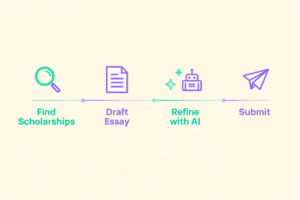
3. The 7 AI Tools Worth Using in 2026 (And Exactly How to Use Each One)
Not all AI tools carry the same risk, and not all of them serve the same function. Here’s your practical toolkit—matched to the stage of your application where each one actually helps.
Tool 1: ChatGPT or Claude (For Research and Brainstorming)
Use these to understand what a specific scholarship values. Prompt them like this:
“What does the Chevening Scholarship value in applicants? What are the four core criteria they evaluate?”
This is research. It’s the equivalent of reading the scholarship’s website more thoroughly—which you should also do. Then take that information and think about how your story connects to those values.
What you should never do: Paste the scholarship prompt and ask for a personal statement. Even if you plan to rewrite it, starting from AI scaffolding makes it genuinely difficult to return to your authentic voice.
Tool 2: Grammarly (For Language Polish)
Grammarly is arguably the safest AI-adjacent tool for scholarship applicants. It corrects grammar, suggests cleaner phrasing, and flags awkward constructions—without replacing your ideas or your voice.
For African applicants writing in English as a second or third language, Grammarly is genuinely equalizing. Use the free version at minimum. The premium version also gives you tone suggestions and clarity scores.
One practical tip: turn off Grammarly’s “full sentence rewrites” suggestions. Accept only corrections to grammar, spelling, and punctuation. This keeps your sentence structure—and your voice—intact.
Tool 3: Claude (For Essay Feedback)
Claude, built by Anthropic, is particularly strong at giving nuanced essay feedback without rewriting your work. After you’ve written your personal statement, paste it into Claude and ask:
“What is the central argument of this essay? Does it come through clearly? Are there any paragraphs that feel vague or disconnected?”
You’re using AI the way you’d use a thoughtful reader. The writing stays yours. You’re just getting feedback you can choose to act on.
Tool 4: Notion AI or Google Gemini (For Organization)
Scholarship applications involve a lot of moving parts—deadlines, document checklists, essay drafts, referee contact details, portal logins. Use AI-powered productivity tools to keep this organized, not to write your essays.
Notion AI can help you build a scholarship tracker. Gemini can summarize long scholarship guidelines into clear checklists. Neither of these is a disqualifying use of AI—they’re just smart project management.
Tool 5: DeepL or Google Translate + Grammarly (For Multilingual Applicants)
If English is not your first language, here’s a legitimate workflow: write your personal statement in your strongest language first, translate it using DeepL (which preserves nuance better than Google Translate), then refine the English version until it sounds natural. Run it through Grammarly for final polish.
This is your authentic voice, translated—not an AI’s voice substituted for yours. That distinction matters both ethically and practically. The ideas, the story, and the emotional truth are yours. The translation is a tool.
Tool 6: Hemingway Editor (For Clarity)
The Hemingway Editor highlights sentences that are too long, passive voice constructions, and unnecessary adverbs. It doesn’t rewrite anything—it just shows you where your writing gets complicated.
Scholarship readers review hundreds of applications. Clear, direct writing is not just stylistically preferable—it’s strategically superior. Use Hemingway to tighten your prose without sacrificing personality.
Tool 7: Perplexity AI (For Fact-Checking and Research)
Perplexity AI gives you cited answers to research questions, which makes it ideal for verifying claims before you make them in your application. If your personal statement references a problem in your field or country, verify your facts with Perplexity before committing them to paper.
Inaccurate statistics in scholarship essays are a subtle red flag. They signal carelessness—or worse, fabrication.
4. Where the Line Is: The Exact Boundary Between Ethical and Disqualifying AI Use
Let’s draw this line as clearly as possible, because ambiguity here is expensive.
| Ethical AI Use ✅ | Disqualifying AI Use ❌ |
|---|---|
| Using AI to research scholarship criteria | Asking AI to write your personal statement |
| Using Grammarly to fix grammar errors | Submitting AI-generated text as your own |
| Using AI to brainstorm topics you then write | Using AI phrasing and “personalizing” it slightly |
| Getting AI feedback on your essay structure | Using AI to fabricate experiences or achievements |
| Using AI to organize your application timeline | Running AI-generated content through a “humanizer” tool to evade detection |
| Translating your authentic voice into English | Having AI rewrite your essay “in your style” |
That last row in the disqualifying column deserves its own spotlight.
The “AI Humanizer” Trap
In 2026, a whole category of tools exists specifically to take AI-generated text and alter it so that AI detectors score it as human-written. Tools with names like “Undetectable AI,” “Humanize AI Text,” and similar services are marketed directly at students.
Do not use these tools for scholarship applications. Here’s why:
First, they don’t reliably work. AI detection tools are also improving, and many scholarships now use multiple overlapping detection systems. Second, and more importantly, these tools take already-generic AI writing and make it more confusing, not more authentic. The result often reads strangely—with abrupt tonal shifts and disconnected ideas.
Third—and this is the ethical core of it—if you need a tool to hide what you’ve done, you already know it crosses the line.
The scholarship is investing in you. Let the application reflect you.
5. How AI Detection Works in 2026 (So You Know What You’re Actually Up Against)
You don’t need a computer science degree to understand this, but knowing the basics will help you make smarter choices.
AI detection tools work by measuring “perplexity” and “burstiness.”
Perplexity measures how predictable or surprising the next word in a sentence is. AI-generated text tends to choose statistically safe, predictable words. Human writing is more surprising—more varied in word choice and sentence length.
Burstiness measures how much sentence length varies. Humans write short sentences. Then longer, more complex ones. Then medium ones. AI tends to write sentences of remarkably similar length.
Here’s the practical implication: even if you use AI to draft something and then edit it, if you don’t substantially vary your sentence rhythm and word choice, the text may still flag as AI-generated. Light editing isn’t enough.
This is one more reason why starting from your own draft is always safer than editing an AI draft.
What Committees Do When AI Is Detected
Policies vary by program, but in 2026 the most common responses are:
- Automatic disqualification (especially for programs with explicit AI policies)
- Request for a follow-up interview to verify the work is yours
- Referral for academic integrity review if you’re already enrolled at a partner institution
- Lowered scoring in programs that don’t outright ban AI but penalize inauthenticity
The interview scenario is worth noting: if your written personal statement and your interview answers sound like two different people, the inconsistency itself disqualifies you. Write something you can speak to confidently in a 30-minute conversation.
6. Writing Your Personal Statement With AI Support: A Step-by-Step Process
Here’s exactly how to use AI ethically from blank page to final submission. This is the practical workflow that works.
Step 1: Reflect First, Before Any Tool Opens
Spend 20 minutes answering these questions in a notebook—not a document, not a phone, a notebook:
- Why do I want this scholarship right now?
- What has my life experience taught me that a classroom hasn’t?
- What will I do differently in my field because I’ve lived what I’ve lived?
- Why this specific program, and not another?
These raw, unpolished answers are your gold. Everything you write later should be built on this foundation.
Step 2: Research the Scholarship Using AI
Open ChatGPT or Perplexity and ask specific questions:
“What does the Mastercard Foundation Scholars Program look for in personal statements? What are their stated values?”
“What common mistakes do applicants make in Chevening Scholarship applications?”
Take notes. Then close the AI tool.
Step 3: Write Your First Draft Entirely Yourself
This is non-negotiable. Write a rough, imperfect first draft using only your own words.
It doesn’t need to be good. It needs to be yours. Set a timer for 45 minutes and write without stopping to edit. Get the real story onto the page—even if it comes out tangled and rough.
This draft is the irreplaceable raw material that no AI tool can generate for you.
Step 4: Use AI to Get Structural Feedback
Paste your draft into Claude or ChatGPT and ask:
“I’ve written a personal statement for a scholarship application. Can you tell me: (1) What is the main argument of this essay? (2) Which paragraph is weakest? (3) Does the conclusion feel earned? Don’t rewrite anything—just give me feedback.”
Read the feedback. Go back to your draft and revise based on your judgment of whether the feedback is accurate.
Step 5: Run It Through Grammarly
Fix grammar and spelling. Accept phrasing suggestions only when they make your meaning clearer without changing your voice. Reject any “full sentence rewrites.”
Step 6: Read It Aloud
Read your final draft aloud—the whole thing. This is not an AI tool, but it’s the single most effective editing technique available to you. If you stumble over a sentence, rewrite it. If a paragraph doesn’t sound like you, rewrite it. Your voice is the instrument. Tune it.
Step 7: Run It Through Hemingway Editor for Final Clarity
Paste your final version into the Hemingway Editor. Address any “hard to read” sentences. Then submit.
⚠️ 5 AI-Related Mistakes That Cost Scholarship Applicants (Avoid These)
- Submitting an AI-generated essay with only minor edits — Detection tools and interview follow-ups will expose this
- Using an “AI humanizer” tool to evade detection — These tools are unreliable and their use is inherently dishonest
- Letting AI choose your essay angle — AI will suggest the most common, most generic story arc; your real story is your competitive advantage
- Over-polishing with Grammarly until your voice disappears — A technically perfect essay with no personality is forgettable
- Using AI to fill in experiences you don’t actually have — Fabricated achievements will unravel in an interview in the first five minutes
7. Positioning Your Story So No AI Could Have Written It
This is where African applicants have a genuine, underutilized advantage—and where the right use of AI actually helps you discover it.
The most compelling scholarship essays are specific in ways that AI cannot generate. They name the village. They describe the smell of the market. They reference the professor who said something that changed everything. They admit the year things fell apart and explain what was rebuilt.
AI cannot write these details because they exist only in your life. And scholarship committees—who read thousands of applications—notice immediately when an essay is specific versus when it’s assembled from plausible-sounding generalities.
The “Only I Could Have Written This” Test
Before you submit, ask yourself: Could any other applicant in any country have written this exact essay?
If the answer is yes, keep rewriting. Your goal is an essay so specifically yours that it functions as fingerprint evidence of who you are.
Here are three frameworks for finding that specificity:
Framework 1: The Turning Point
Identify one specific moment—a conversation, a failure, a discovery—that redirected your path. Build your essay around that moment. Don’t summarize your entire life. Zoom into the scene.
Framework 2: The Problem I’ve Already Been Solving
Show how your life before this scholarship was already pointing toward the work you want to do. Frame the scholarship as acceleration, not rescue. This signals to committees that you don’t need saving—you need resources.
Framework 3: What I Know That Studies Can’t Teach
Articulate something you understand from lived experience that a classroom couldn’t have shown you. This is where African applicants—who often navigate complex social, economic, and political realities before age 25—can speak with genuine authority.
Here’s the difference between a generic approach and a specific one:
Generic (sounds like AI wrote it): “I am passionate about sustainable development and believe that education is the key to transforming communities in Africa.”
Specific (sounds like a human lived it): “In 2022, I watched three boreholes in my district run dry in the same year for the third time in a decade. I was the one explaining to the village council why this kept happening. I didn’t have the technical answer yet. That’s why I need this program.”
The second version cannot be generated from a prompt. It comes from a life. That’s what you’re protecting when you write your own essay.
8. What Happens in a Scholarship Interview When Your Essay Might Have Been AI-Written
In 2026, many competitive scholarship programs—including Chevening, DAAD, and the Mastercard Foundation—use interviews precisely to verify that the person they read in the application is the person sitting in front of them.
Interviewers are trained to ask follow-up questions that require granular, experiential knowledge. “You mentioned in your essay that you led a community health project. Walk me through a specific obstacle you hit and what you decided to do.”
If you wrote your own essay, this question is an invitation. You know the obstacle. You remember the decision. You can tell the story with the texture of someone who was actually there.
If an AI wrote your essay, this question is a trap. You’ll hesitate, generalize, or contradict details you submitted in writing. Interviewers notice all three.
The simple protection against this scenario is the same advice this entire guide builds toward: write your own essay, use AI only to make it clearer and stronger, and never claim an experience that isn’t yours.
9. Fully Funded Scholarships That Explicitly Welcome Authentic Applications in 2026
Here’s a practical list of fully funded scholarships you should research as you build your application—each one chosen because of its openness to African applicants and its emphasis on authentic personal narrative.
Chevening Scholarship (UK Government)
Funded by the UK Foreign Commonwealth & Development Office, Chevening is one of the most prestigious fully funded scholarships for emerging leaders globally. It covers tuition, living expenses, travel, and an arrival allowance.
Chevening explicitly values leadership potential and asks four separate essay questions—each of which requires specific, personal examples. An AI-generated application would fail these questions because each one asks for demonstrated, real-world behavior (“Tell me about a time when you…”).
Chevening accepts applications from over 160 countries, including all African nations.
You can explore the official Chevening scholarship application guidelines to understand exactly what they require.
Mastercard Foundation Scholars Program
This program partners with universities across Africa, Canada, and the US to provide fully funded scholarships to academically talented students from Africa who demonstrate leadership and commitment to giving back to their communities.
Mastercard Foundation explicitly prioritizes students who have overcome barriers and who can articulate a clear commitment to African development. This is a program where your authentic, lived story is the application. No AI tool can manufacture that story.
DAAD Scholarships (Germany)
The German Academic Exchange Service (DAAD) offers a range of fully funded scholarship opportunities for African students at the graduate level. DAAD emphasizes academic excellence and cross-cultural engagement.
DAAD applications include academic work samples, research proposals, and personal statements—documents that require specific intellectual engagement with your field. AI-generated research proposals are typically identifiable by their generic framing of research problems.
African Union Scholarships
The African Union Commission runs internship and scholarship programs prioritizing Pan-African development goals. These programs are particularly well-suited to applicants whose work explicitly connects to regional development challenges—the kind of connection that requires authentic personal context, not AI-generated aspiration.
Commonwealth Scholarship Commission
The Commonwealth Scholarship and Fellowship Plan funds students from Commonwealth countries—including 19 African nations—for graduate study in the UK. The application process includes detailed academic references and a development impact statement that must connect your proposed study to your home country’s development needs.
You can verify current Commonwealth Scholarship opportunities through the official Commonwealth Scholarship Commission portal.
10. The 2026 Scholarship Application Timeline
Use this as your planning backbone. Adapt it to each specific scholarship’s deadlines.
| Date Range | Milestone |
|---|---|
| January – February 2026 | Research and build your scholarship shortlist; begin gathering documents |
| February – March 2026 | Request academic transcripts and reference letters early |
| March – April 2026 | Write first drafts of personal statements; get AI-supported feedback |
| April – May 2026 | Submit early-deadline applications (Chevening opens August, but preparation begins now) |
| August – September 2026 | Chevening and most UK scholarship portals open; submit applications |
| September – October 2026 | DAAD and Commonwealth deadlines fall in this window |
| November – December 2026 | Mastercard Foundation and African university program deadlines |
| January – March 2027 | Interview periods for major programs |
| April – June 2027 | Final decisions announced for most programs |
| August – September 2027 | Program start dates for most recipients |
Note: Set calendar reminders six weeks before every deadline. Gathering transcripts, notarized documents, and reference letters takes far longer than most applicants expect—especially across African postal and administrative systems. Do not underestimate this.
Frequently Asked Questions
Can I use ChatGPT to help write my scholarship application without getting disqualified?
Yes—if you use it correctly. Using ChatGPT for research, brainstorming, or feedback on your draft is generally acceptable. Submitting AI-generated text as your personal statement is not. The rule of thumb: if ChatGPT wrote it, you didn’t. Write your own essay, then use AI to make it better.
How do scholarship committees detect AI-written essays in 2026?
Most competitive programs use AI detection tools like GPTZero, Turnitin’s AI detection, or Copyleaks. These tools measure how predictable and uniform the writing is. They’re imperfect, but they flag suspiciously smooth, low-variation text. Interviews are the final verification—if you can’t speak to your essay in detail, the inconsistency surfaces quickly.
What if English is not my first language—can I use AI translation tools?
Yes. Translating your authentic ideas from your home language into English using DeepL or Google Translate is not the same as having AI write for you. Write in your strongest language, translate, then refine. This keeps your voice and your story intact while using technology to bridge a language gap.
Will using Grammarly get my scholarship application rejected?
No. Grammarly is a grammar and spelling correction tool—the equivalent of a spellchecker. No scholarship policy prohibits grammar correction. Use it freely, but reject full sentence rewrites that might replace your natural phrasing with generic alternatives.
What if my scholarship application asks me to confirm the work is entirely my own?
Take this declaration seriously. If you’ve used AI only for research, grammar checking, and feedback—and the writing, ideas, and experiences are genuinely yours—you can sign that declaration honestly. If AI wrote significant portions of your essay, you cannot. Sign a false declaration and you risk disqualification and potential bans from reapplication.
Can I reapply for a scholarship if I was rejected or disqualified for AI use?
Rejection and disqualification are treated differently. Standard rejections almost always allow reapplication in future cycles. Disqualification for academic integrity violations—including fraudulent AI use—may carry multi-year or permanent bans depending on the program. Always check the program’s reapplication policy before assuming you can try again.
Are AI-written scholarship essays easy to spot in an interview?
Yes—more than applicants expect. Scholarship interviewers ask follow-up questions about specific claims, examples, and experiences mentioned in personal statements. If your essay describes an experience you didn’t have, you’ll struggle to provide authentic detail under questioning. Interviewers read hundreds of applications and are skilled at recognizing disconnects between written and spoken voice.
Your story is already scholarship-worthy. No AI tool made it that way—you did.
Your Action Plan: What to Do This Week
You’ve read this guide. You understand where the line is. You know which tools help and which ones hurt. The question now is whether you close this tab and wait for “the right time”—or whether you treat right now as the starting line.
Doubt is normal. The applicant who wins a fully funded scholarship isn’t the one who doubts least—it’s the one who moves anyway. Your age, your gaps, your non-linear path, your accent, the village you come from or left—none of these are liabilities in a well-written application. They are the application.
Here are your three next steps, each one specific and immediately doable:
- Open a new document right now and answer these four questions in raw, unpolished language: Why do you want this scholarship? What has your life taught you that school didn’t? What will you do differently in your field because of your lived experience? Why this program, this year? Save it. This is your personal statement foundation—protect it.
- Build your scholarship shortlist today. Visit the Chevening, Mastercard Foundation, DAAD, and Commonwealth Scholarship websites. For each one, download the application guidelines and eligibility criteria into a single folder on your device. Note deadlines in your calendar with six-week-early reminders for document gathering.
- Map out your document timeline this week. List every document you’ll need—transcripts, English test scores, reference letters, proof of employment or community involvement. Contact the relevant institutions to understand processing times. Many African university registrar offices require 4–8 weeks. Start now, not when the deadline appears.
You are not too late, too old, too complicated, or too overlooked. You are exactly the kind of applicant that the best scholarship programs in the world were designed to find. The only thing standing between you and a fully funded opportunity is a well-prepared, honestly written application that lets them see who you actually are.
Go write it.
