
Saudi Arabia Fully Funded Scholarship 2026: Your Complete Guide
Introduction: The Fully Funded Scholarship That Most Students Walk Right Past
Every year, the Saudi Arabian government funds thousands of international students to study at some of the most well-resourced universities in the Arab world—covering tuition, housing, meals, a monthly stipend, flights, and health insurance. All of it. Every cost.
And every year, the vast majority of eligible African students never apply—not because they were rejected, but because they didn’t know the scholarship existed.
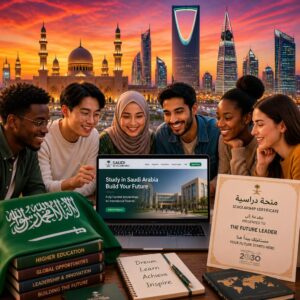
If you’ve spent any time researching fully funded scholarships, you’ve probably bookmarked Chevening, circled DAAD deadlines, and mentally rehearsed your Mastercard Foundation personal statement. Those are excellent programs. But while everyone is crowding around those same well-lit doors, a quieter, extraordinarily well-funded door is standing wide open—and almost nobody from your campus, your city, or your country is walking through it.
This guide changes that.
By the time you finish reading, you’ll understand exactly what the Saudi Arabian Government Scholarship covers, who qualifies in 2026, how to apply from any African country, what to expect during the selection process, and how to position yourself as the kind of candidate this program was built to fund. You’ll also get a realistic, step-by-step timeline and a plain-language breakdown of every document you’ll need to gather.
The opportunity is real. The funding is substantial. And the competition is far lower than you’d expect for a program this generous.
📌 Quick Summary
- What this guide covers: The Saudi Arabian Government Scholarship 2026—what it is, what it covers, who qualifies, and how to apply as an African student
- Key benefits you’ll gain: You’ll understand a fully funded scholarship that most of your peers have never heard of, giving you a genuine competitive advantage
- How to use this post: Read the program overview first to confirm your interest, then use the eligibility checklist and application steps to build your submission plan
1. Why This Scholarship Flies Under the Radar—And Why That’s Your Advantage
Here’s the uncomfortable truth about scholarship awareness: the most popular programs are not always the best opportunities. They’re just the most loudly marketed ones.
The Saudi Arabian Government Scholarship—formally administered through the Saudi Arabian Cultural Mission (SACM) and the Ministry of Education—has been running continuously for decades. Saudi Arabia funds international students at its major universities including King Saud University, King Abdulaziz University, Islamic University of Madinah, Umm Al-Qura University, and King Fahd University of Petroleum and Minerals, among others.
These are not obscure institutions. King Saud University regularly appears in global university rankings. King Fahd University of Petroleum and Minerals is considered one of the strongest engineering universities in the Middle East. The Islamic University of Madinah has an international student body that draws from over 100 countries—a significant portion of them from Africa.
So why haven’t you heard more about this scholarship?
Three reasons. First, Saudi Arabia doesn’t aggressively market its scholarships through the international platforms that African students most commonly use—like Scholars4Dev, OpportunityDesk, or Afterschool Africa. Second, many African educational advisors and university guidance counselors focus their awareness on Western-destination scholarships (UK, USA, Germany, Canada) and overlook Arab world opportunities. Third, language assumptions—a widespread but incorrect belief that all Saudi university instruction is in Arabic—create a psychological barrier that keeps students from even investigating the programs.
The reality is that many Saudi universities now offer programs fully taught in English, particularly in STEM, medicine, business, and engineering. And for programs taught in Arabic, the scholarship itself includes funded Arabic language instruction—meaning you can arrive with no Arabic and still succeed.
That combination of low awareness and genuine funding generosity creates a gap. And that gap is where smart applicants plant their flags.
2. What the Saudi Arabian Government Scholarship Actually Covers
Before you get excited—or dismiss this—you need a clear-eyed understanding of exactly what “fully funded” means in this context. The Saudi government scholarship is one of the most comprehensive packages available to international students anywhere in the world, and its coverage is worth spelling out precisely.
A standard Saudi Arabian Government Scholarship award includes:
- Full tuition: All academic fees for the duration of your degree program—undergraduate, master’s, or doctoral
- Free university accommodation: On-campus housing provided at no cost, or a monthly housing allowance if on-campus accommodation is unavailable
- Monthly stipend: Approximately SAR 850–1,000 per month for undergraduate students (approximately $225–$265 USD), with higher amounts for postgraduate students
- Free meals or meal allowance: Many Saudi universities provide subsidized or free cafeteria access for scholarship students
- Annual round-trip airfare: One international return ticket per academic year to your home country
- Free healthcare: Full medical coverage through the university health system for the duration of your study
- Arabic language training: For students admitted to Arabic-medium programs, a fully funded preparatory Arabic language year is included before degree coursework begins
- Books and learning materials: A modest annual allowance for academic materials
What the Saudi Scholarship Typically Does Not Cover
- Visa application fees ($50–$200 depending on your country of origin)—you’ll pay this before receiving your scholarship documentation
- Personal travel beyond the annual airfare provision
- Dependent costs if you bring family members
- Private health expenses outside the university health system
How This Compares to Other Fully Funded Programs
Two honest comparisons:
The Chevening Scholarship (UK) covers tuition, a living allowance, and return flights—but living costs in the UK are substantially higher than in Saudi Arabia, meaning the equivalent monthly stipend doesn’t stretch as far. Chevening scholars in London regularly report that the stipend covers basics with limited surplus.
The Islamic University of Madinah Scholarship, which operates as a parallel track to the broader Saudi government scholarship, covers the same categories—tuition, housing, meals, stipend, and flights—but is exclusively for students interested in Islamic and Arabic studies programs, making it distinct from the general government scholarship available across disciplines.
The bottom line: what the Saudi scholarship covers in combination makes it one of the most financially complete scholarship packages available to African students in 2026. Understanding every component of what’s covered helps you plan realistically and apply with confidence.
3. Who the Saudi Arabian Government Scholarship Is Actually For
This is where many students eliminate themselves prematurely—by assuming they don’t qualify without actually checking.
The Saudi Arabian Government Scholarship targets international students from Muslim-majority and Muslim-minority countries worldwide, with significant annual quotas allocated to African nations. Countries with large Muslim populations—Nigeria, Ghana, Senegal, Mali, Egypt, Sudan, Ethiopia, Somalia, Tanzania, Uganda, and Kenya, among others—receive consistent annual allocations.
But here’s the critical clarification: while the scholarship prioritizes Muslim applicants for religious studies programs, many universities under the Saudi government scholarship umbrella accept non-Muslim applicants for general academic programs—particularly in STEM, medicine, engineering, and business. If you’re applying for Islamic studies or Arabic language programs at institutions like the Islamic University of Madinah, Muslim faith is typically required. For secular academic programs at King Saud University, King Abdulaziz University, or King Fahd University of Petroleum and Minerals, the religious requirement varies by program and institution.
Always confirm the specific religious eligibility requirement of your target institution and program before applying.
The Age Question
Unlike many scholarships that quietly favor 21-to-24-year-olds, the Saudi government scholarship program does not uniformly exclude mature-age applicants. Undergraduate programs typically prefer applicants under 25, though exceptions are made. Postgraduate programs—master’s and doctoral—are open to applicants well into their 30s and sometimes 40s, with work experience viewed positively rather than suspiciously.
If you’re over 25 and targeting a postgraduate track, your age and professional experience are more asset than liability in this program’s evaluation framework.
4. The Five Saudi Universities You Should Know About Before Applying
Not all Saudi universities are the same, and not all of them offer the same programs or the same application experience for international students. Here are the five institutions most relevant to African scholarship applicants.
1. King Saud University (Riyadh)
King Saud University is Saudi Arabia’s oldest and largest university and consistently ranks among the top universities in the Arab world. It offers a wide range of undergraduate and graduate programs across medicine, engineering, sciences, humanities, and business.
Language of instruction: Mix of Arabic and English, depending on the program. Many graduate science and engineering programs are delivered in English.
Why it matters for African applicants: King Saud University receives some of the largest international scholarship allocations, including significant numbers from African nations. The international student community is substantial, making the transition easier for new arrivals.
2. King Abdulaziz University (Jeddah)
Located in Jeddah—Saudi Arabia’s most cosmopolitan city and a major hub for the African diaspora—King Abdulaziz University offers strong programs in science, engineering, business, and medicine.
Language of instruction: Arabic with an increasing number of English-medium graduate programs.
Why it matters: Jeddah’s cultural diversity and its historical connections to East and West Africa make it a genuinely welcoming environment for African students. The city’s large African community significantly eases cultural adjustment.
3. Islamic University of Madinah
The Islamic University of Madinah is one of the most sought-after scholarship destinations for Muslim students worldwide, and it maintains an exceptionally large international student body—reportedly over 80% international students at any given time.
Language of instruction: Arabic, with a funded language preparation year for non-Arabic speakers.
Programs offered: Islamic studies, Arabic language, Quranic studies, Sharia, and related disciplines.
Who this is for: If your academic and professional interest lies in Islamic scholarship, Arabic language, or related fields, this institution offers one of the most comprehensive and culturally rich environments available anywhere in the world. The scholarship package here is among the most complete in Saudi Arabia’s portfolio.
4. King Fahd University of Petroleum and Minerals (Dhahran)
KFUPM, as it’s commonly known, is the highest-ranked technical university in Saudi Arabia and one of the strongest engineering and petroleum science universities in the world. It focuses narrowly on engineering, science, and business disciplines.
Language of instruction: English. This is significant—KFUPM is one of the few Saudi universities where nearly all instruction is delivered in English, making it accessible to applicants without Arabic language background.
Why it matters for African applicants: For students in engineering, computer science, mathematics, or petroleum-related fields, KFUPM represents a genuinely world-class educational experience with fully funded support. Competition is higher here than at general universities, but the quality of the outcome justifies the investment.
5. Umm Al-Qura University (Makkah)
Umm Al-Qura University is located in Makkah and offers programs across a wide range of disciplines including engineering, medicine, education, and Islamic studies. It’s particularly notable for its large African scholarship cohort, with significant annual allocations for students from West and East Africa.
Language of instruction: Primarily Arabic, with language preparation available.
Why it matters: The African student community at Umm Al-Qura is one of the most established in Saudi Arabia, meaning networks, cultural support structures, and peer mentorship are readily available for new arrivals.
5. How to Find and Apply for the Saudi Scholarship: A Systematic Approach
The application process for the Saudi Arabian Government Scholarship varies slightly depending on which pathway you use. There are two main routes, and understanding both gives you the best chance of securing a place.
Route 1: Through the Saudi Arabian Cultural Mission (SACM) in Your Country
The Saudi Arabian Cultural Mission operates in most African countries with significant Muslim populations. The SACM is the official administrative body responsible for processing international scholarship applications to Saudi universities.
Step 1: Locate the SACM in your country
Search for “Saudi Arabian Cultural Mission” plus your country name to find the nearest office. If there is no SACM in your country, your application routes through the Saudi embassy or consulate.
Step 2: Download and complete the official scholarship application form
The SACM provides standardized application forms. These are available at the SACM office or—increasingly—through the SACM’s online portal. Complete every section accurately. Incomplete forms are typically returned without review.
Step 3: Gather your supporting documents
You’ll need: a certified copy of your most recent academic transcripts, your secondary school certificate (for undergraduate applicants) or bachelor’s degree certificate (for postgraduate applicants), a valid passport with at least 18 months remaining validity, a medical fitness certificate from a licensed physician, a good conduct certificate from your local police authority, passport-size photographs, and a personal statement or motivation letter (required by many programs).
Step 4: Submit to the SACM by the stated deadline
The SACM typically processes applications between November and March for programs beginning the following academic year. Deadlines vary by country—confirm the specific deadline for your country’s SACM office directly.
Step 5: Wait for shortlisting and university placement
The SACM reviews applications, shortlists candidates, and forwards successful applications to specific Saudi universities for final review. You may be placed at a university different from your first preference—this is common and normal in government scholarship programs.
Route 2: Direct University Application
Some Saudi universities—particularly KFUPM and King Abdulaziz University—accept direct international scholarship applications through their own admissions portals, independent of the SACM pathway.
This route allows you to target a specific institution and program, but it requires you to navigate the university’s own application system. Visit the official King Fahd University of Petroleum and Minerals admissions portal to explore direct scholarship application options for international students.
Verifying the Scholarship Is Legitimate
A note on scams: the Saudi government scholarship is real, but scammers regularly impersonate it. Verify these three things before submitting any application or payment:
- The application is submitted through the official SACM office in your country or the university’s official .edu.sa domain website—never through a third-party website
- No application fee is charged at any stage by the SACM or the university
- You receive communication from an official SACM or university email address, not a Gmail or Yahoo account
Your curated, verified scholarship database is your first line of defense against wasted time and fraudulent schemes. Build it using only official government and university sources.
6. Saudi Scholarship Eligibility: The Complete Checklist for African Applicants
Let’s walk through every eligibility criterion so you know exactly where you stand before you invest time in a full application.
Core Eligibility Requirements
- Nationality: You must be a citizen of a country that maintains diplomatic relations with Saudi Arabia—which includes virtually every African nation
- Religious affiliation: Muslim faith is required for Islamic studies programs at institutions like the Islamic University of Madinah; for general academic programs at secular universities, requirements vary—confirm with the specific institution
- Academic qualification: For undergraduate programs, you need your secondary school (O-level/WAEC/KCSE/Matric/Baccalaureate) certificate with competitive grades; for postgraduate programs, you need a completed bachelor’s degree with a minimum of a second-class result or equivalent
- Age: Undergraduate applicants are typically expected to be under 25; postgraduate applicants—master’s and PhD—can be significantly older, with no stated upper age limit for doctoral programs
- Academic standing: You must not be currently enrolled in or receiving funding from another scholarship program
- Medical fitness: A clean bill of health from a licensed physician; Saudi scholarship recipients undergo medical screening
- Good conduct: A police clearance or good conduct certificate confirming no criminal record
- Language: Arabic language tests are not typically required at the application stage since many programs include a funded language year; English proficiency may be required for English-medium programs
Adult-Specific Eligibility Flags
Employment gaps between your degree and your application are not penalizing factors for postgraduate Saudi scholarship applicants. In fact, professional experience in a relevant field strengthens your application narrative—particularly for programs in engineering, medicine, education, and business.
Prior informal Islamic education (Quranic school, madrasa attendance, community religious instruction) is viewed positively, not as a substitute for formal academic qualifications, but as evidence of cultural and intellectual commitment.
Non-traditional academic paths—mature entry, part-time study, community college transfers—are accommodated in the application process. The Saudi scholarship system evaluates your most recent and highest formal qualification, not the linearity of how you got there.
Are You Eligible? Quick Self-Assessment
Question 1: Are you a citizen of an African nation with diplomatic relations with Saudi Arabia?
→ Yes for virtually all African nations. Confirm your specific country’s bilateral standing if in doubt.
Question 2: Do you hold the minimum academic qualification—secondary school certificate for undergraduate, bachelor’s degree for postgraduate?
→ If yes, you meet the academic entry threshold. Note your grade classification for the application.
Question 3: Are you applying within the age range appropriate for your target program level?
→ Under 25 for undergraduate, generally flexible for postgraduate. Confirm with your target institution.
Question 4: Can you obtain a medical fitness certificate and police clearance certificate within the next four to six weeks?
→ These documents take time—start the process before you think you need them.
If you answered yes to all four: begin your application today. If no to one or two: investigate the specific exception pathways that may still make you eligible.
Clarity about where you stand enables the confidence to move forward. Don’t self-eliminate based on assumptions—check the actual criteria.
7. The 5 Types of Saudi Scholarship Awards African Students Actually Win
The Saudi Arabian Government Scholarship isn’t a single monolithic award. It distributes funding across several distinct tracks, each with different institutions, disciplines, and applicant profiles. Knowing which track fits you best is the difference between a targeted application and a scattershot one.
Type 1: General Government Scholarship (Secular Universities)
Who funds it: The Saudi Ministry of Education through SACM offices in partner countries.
What makes adult applicants competitive: Strong academic transcripts, clear professional purpose, and a well-articulated motivation letter that connects your field of study to development goals in your home country.
Typical award: Full tuition + housing + monthly stipend (SAR 850–1,200) + annual flights + health insurance.
Acceptance rate: Varies by country and field of study; countries with larger Muslim populations typically receive larger annual quotas.
Real example: Nigerian students admitted to King Saud University’s engineering and science programs through the SACM Nigeria office—a consistent annual pathway that multiple Nigerian graduates have documented publicly.
Type 2: Islamic University of Madinah Scholarship
Who funds it: The Islamic University of Madinah, with funding directly from the Saudi government.
What makes adult applicants competitive: Demonstrated commitment to Islamic scholarship, prior Quranic or Arabic language study, and character references from recognized Islamic scholars or community leaders.
Typical award: Full tuition + housing + meals + monthly stipend + return flights + health coverage—one of the most comprehensive individual scholarship packages in the program.
Acceptance rate: Highly competitive globally; the university’s reputation and comprehensive funding attract applications from across the Muslim world.
Real example: Students from Senegal, Mali, Nigeria, Kenya, and Tanzania are consistently represented in the Islamic University of Madinah’s international student cohort.
Type 3: King Fahd University (KFUPM) Technical Scholarship
Who funds it: KFUPM through a combination of direct government funding and institutional research budgets.
What makes adult applicants competitive: Strong STEM academic performance, clear engineering or scientific research goals, and—for graduate programs—a research proposal aligned with KFUPM’s faculty research areas.
Typical award: Full tuition + housing allowance + monthly stipend calibrated to graduate student needs.
Acceptance rate: Competitive; KFUPM’s reputation attracts strong technical applicants globally.
Real example: African graduate students in petroleum engineering, mechanical engineering, and computer science are consistently present in KFUPM’s postgraduate programs.
Type 4: Bilateral Country-Specific Scholarship Quotas
Who funds it: The Saudi government through bilateral educational agreements with specific African countries—Nigeria, Senegal, Egypt, Sudan, and Kenya have historically maintained formal educational agreements with Saudi Arabia.
What makes adult applicants competitive: Meeting the country-specific criteria set by your national education ministry in coordination with the Saudi embassy; these programs often favor teachers, government employees, and professionals seeking qualification upgrades.
Typical award: Equivalent to the general government scholarship package.
Real example: Sudanese and Egyptian students have historically benefited from direct bilateral scholarship agreements that allocate dedicated annual places separate from the general SACM quota.
Type 5: Graduate Research Fellowships at Saudi Universities
Who funds it: Individual Saudi university faculties and research centers, using institutional and government research funding.
What makes adult applicants competitive: A strong research background, a published or publishable academic record, and a research proposal that aligns with the faculty’s existing research priorities. Working professionals with applied research experience are particularly competitive here.
Typical award: Full tuition + research stipend + laboratory access + publication support.
Real example: KFUPM’s graduate school and King Abdullah University of Science and Technology (KAUST) both offer research fellowships to international postgraduate students, including Africans, through competitive application processes.
Whatever your background, whatever your field, there is a track within the Saudi scholarship ecosystem that was designed for someone with your profile. Winning is within reach when you apply to the right one.
8. Building Your Saudi Scholarship Application: Step-by-Step
A strong Saudi government scholarship application follows a predictable structure, and understanding that structure before you begin removes most of the uncertainty.
Step 1: Confirm Your Target Institution and Program (Week 1)
Before you open any application form, decide which Saudi university you’re targeting and which academic program within that institution. This seems obvious, but many applicants fill out forms before they’ve made this decision—resulting in vague, unfocused applications.
Research three universities. Identify two programs that match your academic background. Choose one primary target. Start your application for that specific combination.
Step 2: Contact the SACM in Your Country (Week 1)
You’ll find the SACM office contact through the Saudi embassy website for your country or through a direct internet search for “Saudi Arabian Cultural Mission” plus your country name. Contact them by email or phone to confirm:
- The current application cycle status for 2026
- Your country’s specific application deadline
- Whether applications are submitted physically, digitally, or both
- Any country-specific documentation requirements beyond the standard list
This call or email takes 15 minutes and saves you weeks of confusion.
Step 3: Gather All Required Documents (Weeks 1–4)
You’ll gather these documents simultaneously with your other preparation steps—because some of them take weeks to process:
- ✅ Completed and signed SACM scholarship application form
- ✅ Certified copy of secondary school certificate (for undergraduate) or university degree certificate (for postgraduate)
- ✅ Official academic transcripts stamped by your institution’s registrar
- ✅ Valid passport (minimum 18 months remaining validity beyond your intended program start date)
- ✅ Medical fitness certificate from a licensed physician
- ✅ Police clearance/good conduct certificate from your national police authority
- ✅ Passport-size photographs (typically 6–8, with specific background color requirements)
- ✅ Personal motivation letter or statement of purpose
- ✅ Academic or professional reference letters (typically two)
- ✅ Proof of Islamic faith (for programs requiring it)—typically a letter from your imam or mosque leadership
Request your transcripts, medical certificate, and police clearance on the same day you begin your application. These are the documents most likely to cause delays—and delays in this program are unforgiving.
Step 4: Write Your Motivation Letter With Saudi Program Alignment (Weeks 2–3)
Your motivation letter for a Saudi government scholarship should accomplish three things: establish your academic background and credentials clearly, articulate why your chosen field of study connects to something meaningful in your professional and community life, and explain how the specific university you’ve selected is the right environment for your goals.
For programs at the Islamic University of Madinah: your motivation letter should speak to your journey with Islamic scholarship, your relationship with Arabic language or Quranic study, and what you intend to do with advanced Islamic education when you return home.
For programs at KFUPM or King Saud University: your motivation letter should focus on academic and professional ambition—what you’ve studied, what you’ve done, why advanced training in your field is the natural next step, and how you’ll apply it.
Step 5: Submit Through the Official Channel (Week 4 or Before Deadline)
Submit your application—physically or digitally as required by your SACM office—at minimum one week before the stated deadline. Follow up with the SACM office to confirm receipt. Keep copies of everything you submit.
⚠️ 5 Mistakes That Cost Saudi Scholarship Applicants (Avoid These)
- Applying to a faith-restricted program without meeting the religious eligibility requirement — Confirm whether your target program requires Muslim faith before investing weeks in an application
- Submitting uncertified document copies — The Saudi scholarship system requires officially stamped and certified documents; photocopies submitted without institutional stamps are typically rejected without review
- Missing the country-specific SACM deadline — The SACM deadline in your country may be earlier than the general program deadline advertised online; always confirm locally
- Writing a generic motivation letter — A motivation letter that could have been written by any applicant for any institution signals low genuine interest; name the university, the program, and the specific reasons you chose both
- Ignoring the medical and police clearance timeline — These documents require appointments, processing times, and sometimes multiple offices; applicants who start them late frequently miss deadlines
9. Why Your Age and Experience Make You the Right Saudi Scholarship Candidate
Here’s what most applicants get wrong about positioning themselves for a government scholarship: they think younger is better. They minimize their years. They rush to mention their most recent academic achievement and tuck their professional life into a footnote.
That is precisely backwards for a program that values contribution and purpose.
The Saudi government funds international students not just to educate them but to build long-term people-to-people relationships and to strengthen the capacity of scholars who will return home and contribute to their fields. A 32-year-old with six years of professional experience and a clear vision for what advanced study will enable them to do is a more investable candidate than a 21-year-old who chose Islamic studies because their family expected it.
Your years, your professional context, your community roots, your accumulated clarity about what you want and why you want it—these are not things to apologize for. They are the substance of a compelling application.
“I applied for the Saudi scholarship twice before I stopped writing about my grades and started writing about my community. The third year, I wrote about the Islamic school in my neighborhood that had no qualified teachers, and what an advanced Islamic education from Madinah would mean for that school. That was the application that worked.” — Ibrahim M., Islamic University of Madinah Scholar, 2024, age 31
Three Essay Frameworks That Work for Saudi Scholarship Applications
Framework 1: The Community Mandate
Identify a specific gap or need in your community—a school without qualified Islamic teachers, a hospital without Arabic-speaking doctors, an engineering project without local technical leads—and frame your proposed study as the direct response to that gap. This framework is powerful for Saudi scholarship applications because the program’s stated purpose is to build human capacity that returns home.
Framework 2: The Knowledge Journey
Trace the intellectual or spiritual journey that brought you to this field of study. What did you read? Who did you learn from? What question have you been sitting with for years that advanced study will help you answer? This framework works particularly well for Islamic studies and Arabic language programs, where personal intellectual and spiritual development is part of the selection narrative.
Framework 3: The Professional Pivot
If you’re a working professional returning to formal education, frame the scholarship as the next logical step in a professional journey already underway. Show the committee that you haven’t been waiting to start your life—you’ve been living it—and that this advanced qualification is the tool that unlocks the next level of the contribution you’re already making.
Generic vs. Specific: The Gap That Determines Selection
Generic: “I wish to study Islamic sciences at the Islamic University of Madinah because I believe it is an excellent institution that will help me grow in my faith and my knowledge.”
Specific: “I have led Friday prayer and Quranic instruction for 140 families in my neighborhood for five years. I have reached the limits of what I can teach without formal advanced training. I am applying to the Islamic University of Madinah’s Faculty of the Holy Quran because I intend to return home as a scholar who can establish a proper Islamic school—not just a room with a teacher who is learning alongside his students.”
The second version tells a committee exactly who you are, what you’ve already done, and why this scholarship is a sound investment. No AI tool and no generic template can write that paragraph—because only you have lived it.
10. The 2026 Saudi Scholarship Application Timeline
Use this as your planning map. Confirm country-specific SACM deadlines directly with your local office, as they vary by nation.
| Date Range | Milestone / Action |
|---|---|
| September – October 2025 | Contact SACM in your country to confirm 2026 application cycle status |
| October – November 2025 | Begin gathering documents: transcripts, medical certificate, police clearance |
| November 2025 | Islamic University of Madinah direct applications typically open |
| November – December 2025 | Write and finalize motivation letter; brief references |
| December 2025 – January 2026 | SACM application submissions open for most African countries |
| January – February 2026 | Most SACM country-office deadlines fall in this window |
| February – March 2026 | KFUPM and King Saud University direct application windows |
| March – April 2026 | SACM reviews and forwards shortlisted applications to Saudi universities |
| April – May 2026 | University-level review and preliminary decisions |
| May – June 2026 | Acceptance letters and scholarship documentation issued |
| August – September 2026 | Arabic language preparation year begins for language-track students |
| September – October 2026 | Main academic programs commence for English-track students |
Note: The Islamic University of Madinah and KFUPM direct application routes may have different timelines from the SACM route. If you’re applying directly to a university, confirm their specific 2026 intake calendar independently.
Set phone reminders six weeks before every deadline. Police clearance certificates and medical fitness documentation involve bureaucratic processes that routinely take longer than expected across African administrative systems. Start both before you feel ready.
Proactive planning is what separates the applicants who submit complete files from those who miss deadlines by a document.
Frequently Asked Questions
Do I need to be Muslim to apply for the Saudi Arabian Government Scholarship?
It depends on the program and institution. Islamic studies programs at the Islamic University of Madinah and similar institutions require Muslim faith. General academic programs at King Saud University, KFUPM, and King Abdulaziz University may be open to non-Muslim applicants depending on the specific program. Always confirm religious eligibility directly with your target institution before applying.
Can I apply for the Saudi scholarship if I’ve been working for several years after my degree?
Yes. Postgraduate Saudi scholarship programs do not penalize work experience between your degree and your application—they value it. A professional background that connects meaningfully to your proposed field of study strengthens rather than weakens your application, particularly for master’s and doctoral programs.
Do I need to speak Arabic to study in Saudi Arabia on this scholarship?
Not necessarily. Many programs—especially at KFUPM and in graduate STEM disciplines—are fully taught in English. For Arabic-medium programs, the scholarship typically includes a funded Arabic language preparation year before your main degree begins. You can arrive without Arabic and still complete your degree.
What if there is no Saudi Cultural Mission office in my country?
If there is no SACM office in your country, your scholarship application routes through the Saudi Arabian embassy or consulate. Contact the Saudi embassy in your capital city for guidance on the application process specific to your country. Some universities also accept direct online applications from countries without SACM representation.
How long does it take from application submission to receiving a scholarship decision?
The Saudi government scholarship cycle typically runs four to six months from application close to final decision. Applications submitted in January or February usually receive decisions by May or June for programs starting in August or September. The process can take longer for applicants requiring additional document verification.
Can I reapply for the Saudi scholarship if I was rejected in a previous year?
Yes. Rejection in one cycle does not affect your eligibility for future cycles. Many successful Saudi scholarship recipients applied two or three times before being accepted. Use the gap between cycles to strengthen your application—improve your academic standing, deepen your professional experience, and sharpen your motivation letter.
Can I bring my family with me if I receive the Saudi scholarship?
The scholarship itself does not cover costs for dependents. Some Saudi universities permit married scholars to bring spouses, but dependent costs are the scholar’s personal responsibility. Accommodation provisions are typically single-occupancy. If you have family responsibilities, factor this into your planning before accepting an offer.
Every question you’ve just read through is evidence that you’re taking this seriously—and seriousness, translated into a well-prepared application, is what wins.
Your Action Plan: The Scholarship That’s Waiting for You to Notice It
Most of the students who will read this guide today will close it, think “interesting,” and never apply. Not because they’re not qualified. Not because the scholarship isn’t real. But because there’s always something more familiar to pursue, always another deadline to wait for, always a reason to let one more cycle pass.
You’ve already done something different—you read to the end. That’s not a small thing.
The Saudi Arabian Government Scholarship is one of the most generous fully funded scholarships available to African students in 2026, and it is genuinely undersubscribed relative to its annual allocation because of the awareness gap this guide is designed to close. Your competition is smaller than you think. Your eligibility is stronger than you’ve assumed. And your story—however long it’s taken you to get here—is exactly the kind of story that a thoughtful selection committee wants to read.
Here are your three immediate action steps:
- Today, identify the SACM office for your country. Search “Saudi Arabian Cultural Mission” plus your country name, find their contact information, and send an email confirming whether the 2026 application cycle is open, the specific deadline for your country, and whether applications are submitted physically or digitally. This single email is the most important thing you can do in the next 24 hours.
- This week, visit a licensed physician and your national police authority to begin your medical fitness certificate and police clearance applications. Both take longer than expected. Starting them before you need them is the single most practical advantage you can give yourself in this process.
- Within the next two weeks, write a first draft of your motivation letter. Use Framework 1—the Community Mandate—as your starting point. Write it roughly and honestly. Don’t edit as you write. The first draft just needs to exist. Everything else is refinement.
You are not too old, too unknown, or too far from Saudi Arabia for this scholarship to be yours. The funding is real. The quota is open. The committee is waiting to read your application.
Go write it.
