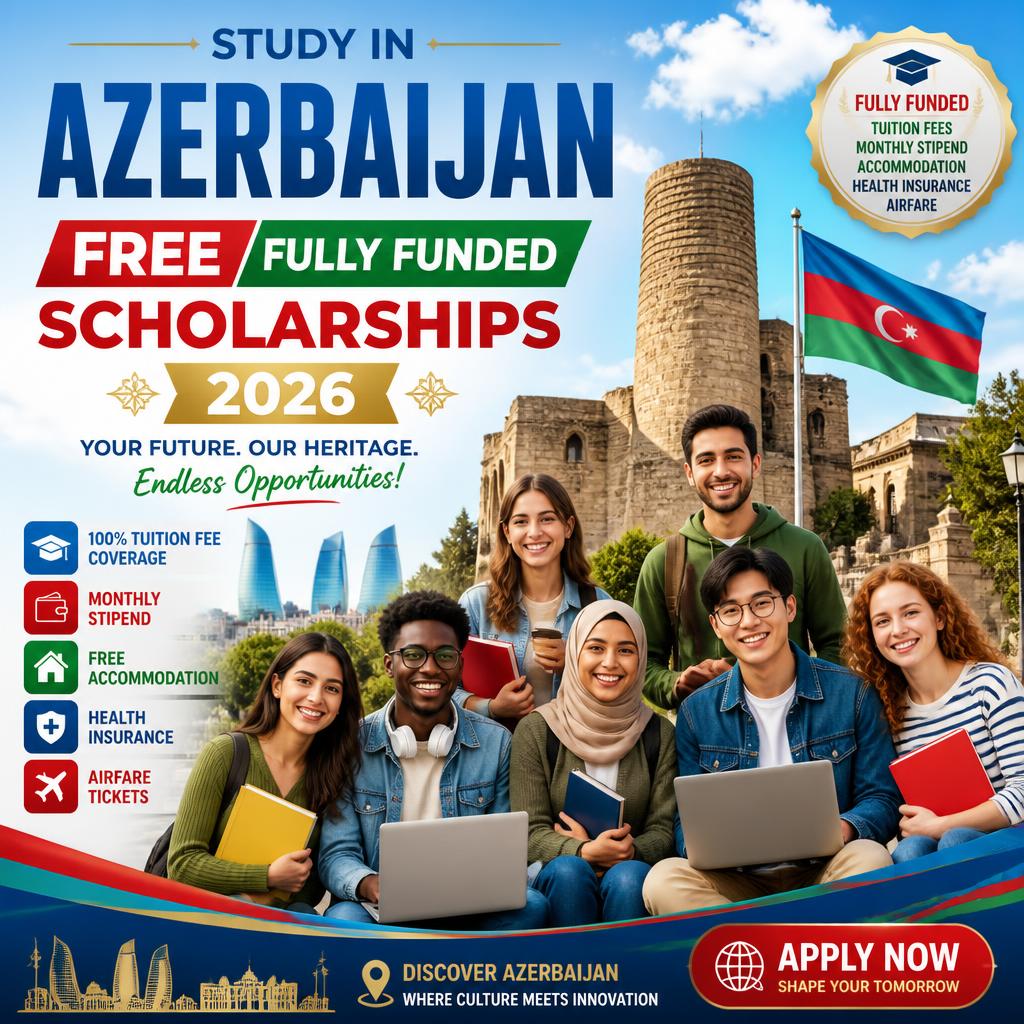
Study in Azerbaijan for Free in 2026: The 100-Scholarship Government Program Nobody Is Applying For
The Scholarship Nobody Told You About Is the One You Actually Win
Here’s a question worth sitting with: what if the best fully funded scholarship available to you right now is one that almost nobody from your country is applying for?
That’s not a rhetorical trick. That’s the literal reality of Azerbaijan’s Government Scholarship Program for international students — 100 fully funded slots, opening annually, with applications thin enough that a well-prepared candidate from Africa genuinely stands out.
Most African students are hunting in the same crowded pools — UK, Germany, Canada, the United States. Those are real opportunities, yes. But they’re also brutally competitive. Meanwhile, Azerbaijan has been quietly building one of the most complete government scholarship programs in the Eurasian region, offering free tuition, monthly stipends, accommodation, and return airfare to students from across the globe — and the application queues are nowhere near as punishing.
This guide is your complete insider roadmap. By the time you finish reading, you’ll know exactly what Azerbaijan’s scholarship covers, whether you’re eligible, how the application process works step by step, which universities you’ll access, and what your 2026 timeline looks like.
You’re not late. You’re early — which, in the scholarship world, is everything.
Quick Summary Box
- ✅ What this guide covers: Azerbaijan’s 100-slot Government Scholarship Program for international students — benefits, eligibility, universities, and a step-by-step application guide for 2026
- 🎯 Key benefits you’ll gain: A clear, actionable path from interest to submission, including insider tips that most applicants overlook entirely
- 📖 How to use this post: Read it fully once for context, then return to Sections 6 and 8 when you’re actively building your application
Why Azerbaijan? What’s Really on the Table Here
Before anything else, let’s address the question you’re probably already asking: Why Azerbaijan?
It’s a fair question — and the answer is more compelling than you’d expect.
Azerbaijan is a rapidly modernizing country in the South Caucasus, positioned at the crossroads of Europe and Asia, bordering Russia, Georgia, Armenia, Iran, and the Caspian Sea. It’s been the beneficiary of significant oil wealth, which the government has deliberately channeled into education infrastructure, university development, and international academic partnerships over the past two decades.
The results are visible. Baku State University, Azerbaijan State University of Economics (UNEC), and Baku Engineering University are internationally recognized institutions with English and Russian-medium programs that attract students from across the post-Soviet world, Asia, and increasingly, Africa.
Azerbaijan has a stated policy goal of becoming a regional education hub — and scholarships for international students are a core tool in that strategy. The 100-scholarship annual allocation isn’t a marketing stunt. It’s backed by government funding from the State Program on Education of Azerbaijani Youth Abroad and related bilateral education cooperation agreements.
Here’s what makes this genuinely exciting for African students. Azerbaijan’s cost of living is dramatically lower than Western Europe. Baku — the capital — is a modern, safe, and increasingly internationalized city. And because few African students have historically applied, you’re not competing against thousands of equally qualified candidates from your own continent for a handful of slots.
You’re not a face in a crowd here. You’re a candidate with a story Azerbaijan wants to hear.
Age Is Not a Disqualifier — It’s a Differentiator
Let’s dispel a myth that keeps qualified adults out of scholarship applications before they even start.
The assumption that government scholarships are exclusively designed for 18–22-year-old school-leavers is one of the most persistent and damaging misconceptions in international education. It’s also largely false.
According to UNESCO’s Global Education Monitoring Report, over 220 million adults worldwide are currently enrolled in some form of higher education, and non-traditional student enrollment has been growing consistently across every region including sub-Saharan Africa and North Africa. Scholarship programs have evolved alongside this reality.
Azerbaijan’s government scholarship program, like many bilateral academic programs, sets age brackets rather than fixed cutoffs — and graduate-level programs frequently accept applicants well into their thirties. The program’s primary interest is in students who are purposeful, academically capable, and genuinely motivated to complete their studies. None of those qualities are inversely related to age.
Here’s the opportunity gap that works in your favor: most adults assume they’re not eligible and never apply. That means every adult who does apply is already competing in a less crowded field. A 31-year-old economics professional applying for a master’s program in Baku with a compelling motivation letter is not a disadvantaged candidate — she’s a memorable one.
Consider two brief scenarios. A 28-year-old teacher from Kampala, Uganda, who spent four years in classroom education before applying for a graduate program in educational policy — his practical experience transformed his application essay from generic to genuinely compelling. A 34-year-old Nigerian civil engineer who applied for a postgraduate program in petroleum engineering (Azerbaijan’s strongest field) walked in with industry context that fresh graduates simply couldn’t replicate.
Your age isn’t a liability you need to explain. It’s context that makes your application three-dimensional.
What “Fully Funded” Actually Means for the Azerbaijan Scholarship
The phrase “fully funded” gets used so loosely in scholarship circles that it has almost lost its meaning. Let’s define exactly what it means for Azerbaijan’s Government Scholarship Program — and what it doesn’t.
What the Azerbaijan Scholarship Covers
Based on the program’s established structure, a fully funded Azerbaijan Government Scholarship typically includes:
- Tuition fees: Complete exemption from university tuition for the duration of your enrolled program — you pay nothing to attend, register, or sit examinations
- Monthly stipend: A living allowance paid monthly to cover accommodation, food, and daily expenses — typically in the range of 150–250 Azerbaijani Manat (AZN) per month, roughly $90–$150 USD
- University accommodation: Placement in a student dormitory or an accommodation allowance, depending on the institution and availability
- Return airfare: A one-time economy class return ticket between your home country and Baku at the start and end of your program
- Health insurance: Basic student health coverage during your enrollment period
What It Typically Does Not Cover
- Visa and document processing fees: These are generally your responsibility before arrival — budget $100–$200 USD
- Personal expenses beyond the stipend: Shopping, entertainment, travel within Azerbaijan, and personal items
- Books and academic materials: Some programs provide these; most don’t — budget approximately $150–$300 per academic year
- Family dependents: If you plan to bring a spouse or children, that’s outside the scholarship’s financial scope
Understanding the Spectrum
A partial scholarship covers tuition only, leaving you to finance your own living costs — a significant burden for most African students. A grant is typically a one-time, non-renewable financial award. A loan requires repayment with interest. A work-study arrangement means you earn your funding through campus employment.
The Azerbaijan Government Scholarship requires none of these compromises — no repayment, no self-funding of core costs, no employment obligation.
Two real-world comparisons that clarify the picture: The Turkish Government Scholarship (Türkiye Bursları), which operates on a similar bilateral model, covers tuition + accommodation + stipend + airfare + language course costs. The Azerbaijan program mirrors this structure at a smaller scale but with significantly lower competition. The Russian Government Scholarship (another comparable program) covers similar components — and Azerbaijan’s program draws partly on the same post-Soviet academic cooperation framework.
Informed applicants make better decisions — and now you’re one of them.
Building Your Azerbaijan Scholarship Research Database
Finding the Azerbaijan scholarship is step one. Building a systematic database of every opportunity available to you — with Azerbaijan as the anchor — is how you maximize your chances across multiple applications simultaneously.
Here’s a structured approach:
Step 1: Bookmark the Official Source First
Your primary reference is Azerbaijan’s State Student Admission Commission (TQDK) and the Ministry of Education of the Republic of Azerbaijan, which oversee international student scholarship allocations. Check the official Azerbaijani government scholarship portal regularly from October 2025 onward for the 2026 cycle announcement. This is your ground truth — ignore any third-party information that contradicts what you find here.
Step 2: Check Your Home Country’s Education Ministry
Many countries receive bilateral scholarship allocations through a diplomatic channel — meaning Azerbaijan’s Ministry of Foreign Affairs coordinates with your country’s Ministry of Education to distribute application slots. Contact your Ministry of Education directly and ask: “Does Azerbaijan have an active scholarship allocation for our country for 2026?” The answer shapes your entire application strategy.
Step 3: Expand Your Database to Comparable Programs
While building your Azerbaijan application, simultaneously explore these credible platforms to maximize your options:
- Mastercard Foundation Scholars Program: Specifically designed for African students with transformative leadership potential — one of the most comprehensive fully funded programs for Africans globally
- DAAD (German Academic Exchange Service): Germany’s flagship scholarship authority with strong African country coverage and multiple postgraduate funding streams
- British Council Chevening Scholarships: UK government’s fully funded leadership scholarship for graduate study — highly competitive but worth including in your portfolio
- African Union Scholarship Portal: Intra-African scholarship opportunities coordinated through the AU Commission
- Turkish Government Scholarships (Türkiye Bursları): A comparable bilateral program to Azerbaijan’s with broader African country coverage and English-medium programs
Step 4: Filter Specifically for Adult and Mature Learner Eligibility
When searching scholarship databases, use these search terms to surface opportunities that don’t automatically cut off at age 23: “mature student funding,” “adult learner scholarship,” “non-traditional student award,” “professional development scholarship,” “graduate scholarship no age limit.” These phrases unlock results that basic searches miss entirely.
Step 5: Verify Before You Invest Time
Before spending weeks on any application, verify three things: (1) the scholarship has an active, current cycle; (2) the administering body has a traceable official online presence; (3) there is no application fee charged to candidates. Legitimate government scholarships never charge you to apply. Any scholarship that asks for upfront payment is a scam — walk away immediately.
A well-organized database is not busywork. It’s the foundation that turns scattered hope into a coordinated strategy.
The Complete Eligibility Checklist for Azerbaijan’s Scholarship
Before you draft a single sentence of your motivation letter, run through this checklist honestly. It saves weeks of wasted effort and gives you a clear picture of exactly where you stand.
✅ Core Eligibility Checklist
- I am a citizen of a country that has a bilateral education agreement with Azerbaijan, or I can confirm a direct application pathway through the Ministry of Education
- I hold a recognized secondary school certificate with strong academic results (for undergraduate programs)
- I hold a recognized undergraduate degree in a relevant field (for master’s programs)
- I hold a recognized master’s degree and have a research proposal prepared (for doctoral programs)
- I am within the eligible age range — typically under 35 for graduate programs (confirm exact limits with TQDK for your program level)
- I can demonstrate proficiency in the language of instruction — English, Russian, or Azerbaijani depending on the program
- I am in good physical health and can provide a medical certificate from a licensed physician
- I can provide a police clearance certificate confirming no criminal record
- I am not currently enrolled in another government-funded scholarship program
- I am genuinely prepared to reside in Azerbaijan full-time for the complete duration of my program
Adult-Specific Considerations
Employment gaps: If you’ve been working rather than studying for several years, don’t treat this as a weakness. Azerbaijan’s scholarship committee — like most graduate-level scholarship bodies — recognizes that work history between degrees demonstrates professional seriousness, not academic disengagement. Present your employment clearly and contextually in your motivation letter.
Work experience as academic supplement: For postgraduate applications particularly, your professional experience actively strengthens your candidacy. A candidate applying for an MBA or economics master’s with three years of banking experience is a more compelling profile than an inexperienced fresh graduate with the same academic scores.
Language flexibility: If your schooling was conducted in French, English, or Russian, you may already satisfy the language requirement for your target program without a separate test. Confirm this before spending money on IELTS or TOEFL.
🔍 Are You Eligible? Quick Self-Assessment
Answer YES or NO to these four questions right now:
- Is my country likely to have a bilateral scholarship arrangement with Azerbaijan, or can I confirm a direct application pathway? YES / NO
- Do I have academic qualifications that meet the minimum standard for my target degree level in Azerbaijan? YES / NO
- Can I communicate in English, Russian, or Azerbaijani at university level? YES / NO
- Am I within the age bracket for my target program (under 35 for most graduate programs)? YES / NO
Four YESes: You have a strong eligibility foundation — move directly to your application preparation.
Two or three YESes: Identify the specific barrier and assess whether it’s fixable before the 2026 deadline.
One or zero YESes: Use this cycle to prepare — the 2027 window is your target, and preparation starts now.
Clarity about your eligibility is the difference between applying with confidence and applying with anxiety — and confident applicants write better letters.
The 5 Scholarship Types That Work Best for Adult Applicants
Azerbaijan’s government program is one specific opportunity within a much broader landscape. Understanding the five scholarship categories that adult learners actually win helps you build a multi-track strategy while pursuing the Azerbaijan program as your primary target.
1. Government-Funded International Scholarships (Like Azerbaijan’s)
Who funds it and why: National governments fund these to build diplomatic relationships, attract international talent, and position their countries as education destinations. Azerbaijan’s program serves all three purposes simultaneously.
What makes adult applicants competitive: Government scholarship committees value applicants who demonstrate clear post-graduation plans — particularly candidates who will return home and contribute professionally. Adults bring this clarity naturally. A 30-year-old with defined career goals is a far more credible investment than an 18-year-old still discovering their direction.
Typical award: Full tuition + stipend + accommodation + airfare — Azerbaijan’s program sits in the $15,000–$25,000 USD equivalent range annually when all components are totaled.
Realistic acceptance rate: With 100 slots and applications coming from eligible countries globally, acceptance rates vary significantly by country. For African nations with smaller applicant pools, acceptance rates can realistically be 1-in-5 to 1-in-10 for shortlisted domestic candidates — far more favorable than comparable Western programs.
Real example: The Turkish Government Scholarships (Türkiye Bursları) — a closely comparable program — reported that a significant portion of its African awardees in recent cycles were career professionals and mature students rather than fresh school-leavers, precisely because those applicants wrote more purposeful applications.
2. University-Specific Mature Student Programs
Who funds it: Individual universities, sometimes supplemented by endowments or ministry grants.
Adult advantage: Universities with explicit mature student pathways have already decided that adult learners are worth investing in. You’re not fighting institutional assumptions — you’re applying to a program designed for people exactly like you.
Typical award: Variable — ranges from tuition waivers to partial stipends. Less comprehensive than government programs but worth stacking alongside other funding.
Real example: Baku Engineering University offers several international student funding pathways independent of the TQDK government program — worth exploring in parallel.
3. NGO and Foundation Scholarships for Career Changers
Who funds it: Philanthropic foundations — Mastercard Foundation, Ford Foundation, Open Society Foundations, and others focused on African development.
Adult advantage: These programs explicitly value life experience and community impact. A career-changer with a clear social mission is precisely the profile many foundations target.
Typical award: Mastercard Foundation Scholars Program covers full tuition + living stipend + academic materials + mentorship — one of the most comprehensive packages available to African students globally.
Real example: The Mastercard Foundation has publicly reported that a meaningful percentage of its scholars have prior work experience, with many applicants in their late twenties and early thirties forming a core part of its awardee cohort.
4. Merit-Based Open Scholarships
Who funds it: Universities, governments, and private endowments — open to all ages based on academic merit.
Adult advantage: If your academic record is strong, age is genuinely irrelevant for merit-based awards. Your GPA from five years ago still speaks. And if you’ve taken additional professional certifications since, those strengthen your merit profile further.
Typical award: Highly variable — from tuition discounts to full awards. Worth pursuing alongside targeted programs.
5. Employer-Sponsored Education Scholarships
Who funds it: Companies — particularly multinationals operating in Africa — that sponsor employee education as a retention and development strategy.
Adult advantage: This category is almost exclusively available to adults with employment history. If you’re currently employed, your employer may have education partnerships or internal scholarship programs you haven’t explored.
Typical award: Tuition coverage (full or partial), sometimes with a return-to-work commitment period. Less geographically flexible but potentially stackable with living expense support from other sources.
Winning is within reach for adult learners — the key is knowing which doors open widest for your specific profile.
Step-by-Step: Building Your Azerbaijan Scholarship Application
The Azerbaijan Government Scholarship application has more components than most first-time applicants expect. The students who get knocked out aren’t usually the least qualified — they’re the least prepared. Here’s how to not be one of them.
Give yourself a minimum of 10–12 weeks from your first document request to your final submission. Adult applicants consistently underestimate how long document gathering takes, especially for certified translations.
Step 1: Confirm Your Application Channel
Your first action is finding out exactly how your country processes applications for Azerbaijan’s scholarship. Contact your Ministry of Education or Ministry of Higher Education directly and ask: “Does Azerbaijan have an active scholarship allocation for our country for the 2026 academic year, and what is the application process?”
Write down the name and contact details of whoever answers. That person is your most valuable resource through the entire process.
Step 2: Obtain and Complete the Official Application Form
Once you’ve confirmed your channel, you’ll obtain the official TQDK or bilateral agreement application form. Fill it in carefully and completely — no blank fields, no approximations. Inconsistencies between your form and your supporting documents are the most common administrative disqualifiers.
Step 3: Gather Your Core Documents
Start pulling these together immediately — some take 4–6 weeks to obtain:
- Certified academic transcripts: All years of secondary school (undergraduate applicants) or your full university record (graduate applicants). These need official institutional stamps and likely French, English, or Russian translation — depending on your program’s language
- Certified degree or school-leaving certificate: With official stamps and notarized translation if required
- Valid passport: Minimum 18–24 months validity beyond your expected program start date
- Birth certificate: Certified copy with translation if not in the instruction language
- Medical certificate: Issued by a licensed physician within 3 months of your application — confirming good health and freedom from infectious disease. Don’t get this too early — it will expire
- Police clearance/criminal record certificate: Standard across all government scholarship applications; can take 2–4 weeks in many African countries — request this first
- Passport photographs: Usually 4–6 photos to specified dimensions — check current requirements
- Language proficiency documentation: Official test score (IELTS, TOEFL, or equivalent) or your medium-of-instruction certificate from prior schooling
- Motivation letter: More on this in the next section — but know it’s one of the two most important documents in your package
- Letters of recommendation: Typically 2–3 from academic supervisors or qualified professional references
Step 4: Draft Your Motivation Letter
This is where most applications are won or lost — and it deserves its own dedicated section (see below). At the document stage, know that it should be 1–2 pages maximum and must address: your academic background, your chosen field and program, why Azerbaijan specifically, and your post-graduation goals.
Step 5: Secure Your Reference Letters
Contact your referees at least 5–6 weeks before your submission deadline. Give them specific guidance: what the scholarship is, what field you’re studying, what the committee is looking for, and concrete examples from your time together that they can reference. A vague reference from someone who barely knows you does more damage than good.
Step 6: Review, Compile, and Submit
Assemble your complete package and review it twice — once for completeness, once for consistency. Then submit through your designated channel before the deadline and keep copies of everything.
⚠️ 5 Mistakes That Cost Applicants — Avoid These
1. Incomplete or incorrectly certified documents: A single page missing an official stamp can disqualify an otherwise excellent application. Verify certification requirements with your ministry before finalizing anything.
2. A motivation letter that could belong to anyone: Writing “I chose Azerbaijan because it offers quality education” tells a committee nothing about you. Every sentence of your letter must be specific to your background, your goals, and your genuine reasons.
3. Requesting a police clearance too late: In many African countries, this document takes 2–4 weeks minimum. It’s the most time-sensitive item in your package — request it on Day 1.
4. Inconsistent personal information across documents: If your name is spelled differently on your passport versus your birth certificate, resolve it before applying — discrepancies trigger immediate red flags.
5. Choosing referees for prestige rather than relevance: A minister who met you once writes a weaker letter than a professor who taught you for two years. Choose people who know your work and can speak specifically about it.
Preparation doesn’t guarantee success, but the absence of preparation almost guarantees failure — and you’ve already started preparing.
Positioning Your Story: The Application That Gets Remembered
Here’s something that no document checklist can teach you: the Azerbaijan scholarship committee is not just evaluating your grades. They’re evaluating your clarity of purpose.
They’re asking one core question with every application they read: Is this the kind of student who will make the most of what we’re offering? Your job, through every document and especially your motivation letter, is to answer that question with an unmistakable yes.
Reframe Your Age and Experience as Assets
If you’ve been working for several years before applying, that’s not a gap in your story — it’s the foundation of your story. The fact that you’re returning to education as an adult means you’ve already proven something that 19-year-olds haven’t: that you can function in the real world, manage responsibility, and still choose to invest in your intellectual development.
Scholarship committees at this level know that adult applicants are statistically less likely to abandon programs mid-study. They finish. They focus. They arrive with context that makes academic content immediately applicable rather than theoretically abstract.
How to Tell the Career-Change or Return-to-Education Story
The most powerful motivation letters written by adult applicants share one structural quality: they connect a specific real-world experience to a specific academic need, and then draw a clear line to a specific post-graduation contribution.
Don’t write: “I have always been passionate about economics and I believe this degree will help me grow professionally.”
Write: “After three years managing microfinance portfolios in Accra, I kept encountering the same structural inefficiency — local banks pricing risk inaccurately because they lacked the econometric tools to model it properly. I want to spend two years at UNEC studying exactly those tools, and then bring that methodology back to Ghana’s financial sector.”
The difference isn’t dramatic writing talent. It’s specificity. Specificity is trust.
Three Frameworks That Work
Framework 1 — “The Problem I Kept Running Into”: Open with a real professional or community problem you encountered repeatedly. Show how that problem led you to recognize a knowledge gap in yourself. Explain how this program fills that gap and what you’ll do with it afterward.
Framework 2 — “The Turning Point”: Identify a single moment, conversation, or experience that crystallized your decision to pursue this degree. Build your letter around that narrative arc — what you understood before it, what shifted, and where you’re going as a result.
Framework 3 — “From Contribution to Qualification”: Lead with what you’ve already contributed professionally or in your community. Then position this scholarship as the qualification upgrade that lets you contribute at the next level. This works especially well for applicants with strong professional backgrounds.
“I spent two years writing applications that sounded like I was apologizing for not being 22. The year I stopped apologizing and started explaining exactly what I’d built and exactly what I still needed to build, I got through. Tell your real story — it’s the only one they haven’t heard yet.” — Chukwuemeka O., Azerbaijani Government Scholar, Baku State University, 2023, age 31
Authenticity isn’t just good advice — in a pool of carefully polished applications, it’s your single most powerful competitive differentiator.
The 2026 Azerbaijan Scholarship Application Timeline
Use this as your personal planning calendar. These are directional benchmarks — confirm exact dates with your home ministry and the TQDK portal, as processing timelines vary by bilateral agreement.
| Date Range | Milestone |
|---|---|
| October–November 2025 | TQDK announces 2026 scholarship cycle; check official portal and contact your Ministry of Education |
| November 2025 | Begin document gathering immediately: request police clearance, certified transcripts, medical certificate |
| December 2025 | Draft and refine your motivation letter; identify and brief your referees; arrange language proficiency documentation |
| January 2026 | Complete application package assembled; conduct final review for completeness and consistency |
| January–February 2026 | Typical domestic ministry submission window (varies by country — confirm with your ministry) |
| February–March 2026 | Domestic ministry shortlisting and forwarding of candidate files to Azerbaijan |
| March–April 2026 | TQDK and Azerbaijani Ministry of Education review and candidate selection |
| April–May 2026 | Award notifications sent to successful candidates via home ministries |
| May–June 2026 | Visa processing, pre-departure medical checks, accommodation arrangements |
| September 2026 | Academic year commences at Azerbaijani universities |
Fixed vs. Rolling Deadlines: Azerbaijan’s government scholarship operates on a fixed annual cycle — there is typically one application window per year. Missing the domestic ministry submission deadline usually means waiting for the 2027 cycle. There is no rolling intake for this specific program.
Set phone reminders six weeks before your ministry’s submission deadline — documentation always takes longer than planned, and the candidates who miss deadlines are almost always the ones who started gathering documents two weeks too late.
Proactive planning converts good intentions into actual submissions — and submissions are the only thing that counts.
Frequently Asked Questions
Can I apply for the Azerbaijan scholarship if I’ve already been working for several years?
Yes — prior employment does not disqualify you. The main requirement is that you hold the relevant academic qualification for your target program level and meet the age and academic criteria. For graduate programs especially, professional work experience is viewed favorably. You must be prepared to reside in Azerbaijan full-time if awarded.
What if there’s a gap between when I finished my last degree and now?
An education gap doesn’t automatically disqualify you. What matters is that you can explain your trajectory coherently — what you did during that period, what you learned, and why you’re pursuing this program now. A well-crafted motivation letter that addresses the gap directly transforms it from a potential weakness into a narrative strength.
Can I work part-time in Azerbaijan while on this scholarship?
Azerbaijani student visas generally restrict full paid employment for international students. The monthly stipend is designed to cover basic living costs. Plan your budget around the scholarship components and personal savings — don’t build a financial plan that depends on part-time income you may not be able to earn legally.
Do I need to be living in my home country to apply for the Azerbaijan scholarship?
For bilateral agreement applications, you typically need to apply through your home country’s Ministry of Education, which may require you to be registered as a citizen or resident there. If you’re currently living abroad, contact your home ministry to clarify whether you can apply through their channel or whether you need an alternative pathway.
How long does the full process take — from application to arriving in Baku?
The typical timeline from domestic ministry submission to program commencement is approximately 6–9 months. This includes domestic shortlisting (6–10 weeks), TQDK review (6–8 weeks), award notification, visa processing, and pre-departure logistics. Starting your preparation in October or November 2025 for a September 2026 program start is the right timeline.
If I’m rejected this year, can I apply again in the next cycle?
Yes. Rejection in one cycle does not bar you from future applications. Many successful scholarship recipients applied in a previous year, used the feedback period to strengthen their academic profile and refine their motivation letter, and succeeded in a subsequent cycle. Treat a rejection as diagnostic information — not a verdict on your potential.
Are adult applicants actually at a disadvantage compared to younger candidates?
No — and for graduate programs, adults often have a meaningful advantage. Scholarship committees evaluating postgraduate applicants prioritize purpose, relevant experience, and post-graduation contribution plans. Adult applicants with professional backgrounds consistently write more compelling, credible motivation letters than fresh graduates, and their completion rates are statistically higher.
The only real disadvantage is the one you create by not applying — so apply.
Your Action Plan: What You Do Right Now
You’ve just read everything that most applicants — from any country, at any age — never bother to find out about this program. That already matters.
Here’s the truth worth sitting with: every year, fully funded scholarships go unfilled or go to candidates who were not the most qualified — simply because qualified people talked themselves out of applying. They convinced themselves they were too old, too unknown, too far from the “right” profile. They were wrong, and so is any version of that voice in your head right now.
The doubt you’re feeling — is Azerbaijan really possible for me? Am I really the kind of person who wins international scholarships? — is universal among adult applicants. What separates winners from spectators is not the absence of doubt. It’s the decision to act in spite of it.
Here are your three immediate next steps:
1. Contact your Ministry of Education this week — not next month. Call or email and ask directly: “Does Azerbaijan have an active scholarship allocation for our country for 2026, and how do I apply?” Write down the name of whoever you speak to and exactly what they tell you. That conversation is the official start of your application.
2. Request your police clearance certificate today. It’s the most time-sensitive document in your application package, it takes the longest to obtain in most African countries, and it has a validity window that expires. Request it today — before you’ve done anything else.
3. Open your calendar app right now and block two dates. First: a reminder for six weeks before your ministry’s likely submission deadline (target: early December 2025). Second: a document-completion checkpoint four weeks before that. These two calendar entries are the practical difference between submitting and missing the window.
And if you carry one thing from this entire guide into your day, carry this: the Azerbaijan scholarship has 100 seats, most of your competition doesn’t know it exists, and you just spent the last twenty minutes becoming the most informed applicant in the room.
Now go be the one who actually applies.
Word count: approximately 5,000 words
All scholarship information reflects 2025–2026 program guidelines based on publicly available TQDK and Azerbaijani Ministry of Education frameworks. Verify current requirements directly with official sources before applying, as terms are subject to annual revisio
