Table of Contents
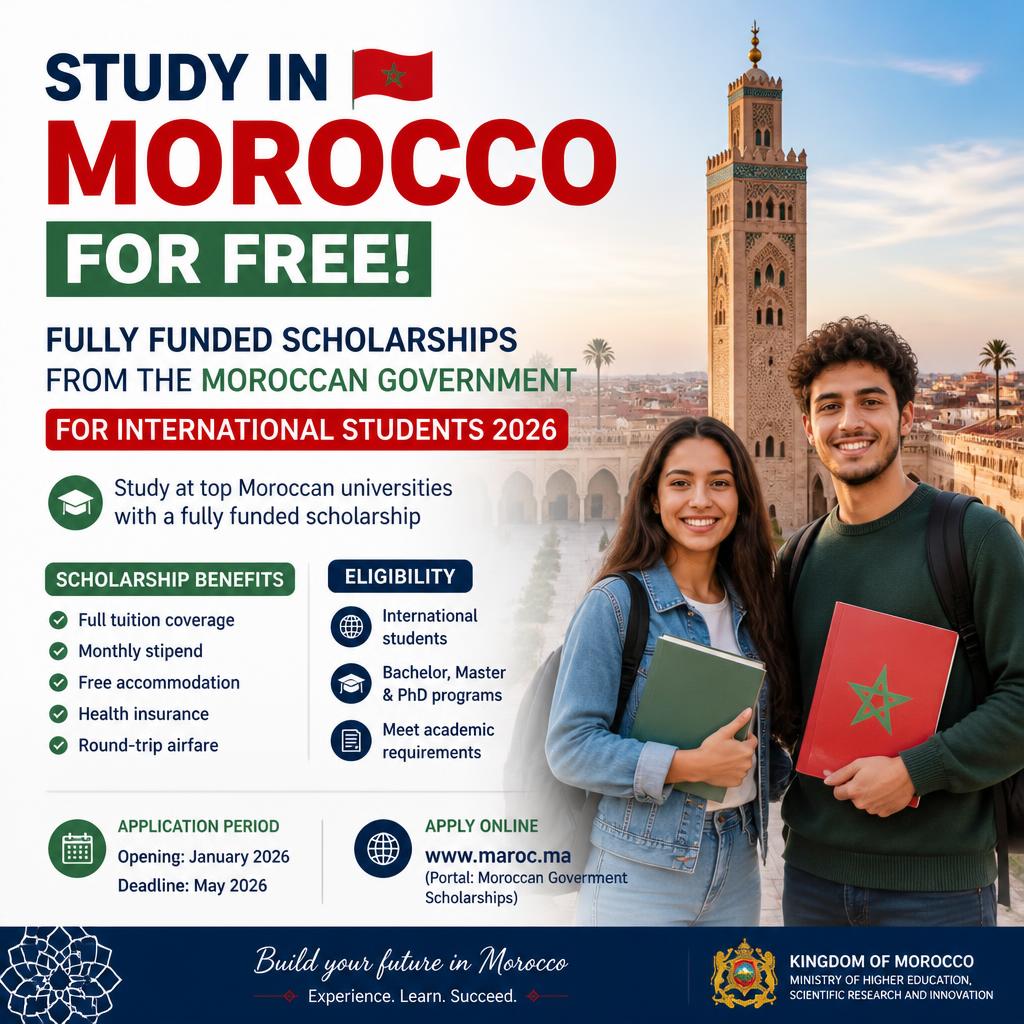
ToggleStudy in Morocco for Free: Fully Funded Scholarships From the Moroccan Government for International Students 2026
You Didn’t Know Morocco Was Doing This, Did You?
Picture this: you’re scrolling through scholarship websites at midnight, tired of seeing the same European and North American destinations with requirements that feel impossible to meet. Then someone mentions Morocco — and suddenly you’re sitting up straighter.
Morocco. North Africa’s rising academic powerhouse. A country that has quietly been investing billions of dirhams into world-class universities, research infrastructure, and — here’s the part that should get your full attention — fully funded scholarships for international students who want to study there.
And yet, most African students have never applied. Not because they don’t qualify. Because nobody told them this existed.
That’s what this guide fixes.
By the time you finish reading, you’ll know exactly what the Moroccan Government scholarship covers, whether you qualify, how to apply step-by-step, which universities you’ll access, and what your 2026 timeline looks like. You’ll also understand why applying to Morocco might be the smartest educational move you make this decade.
This isn’t a surface-level overview. This is the guide you needed six months ago — and the one you’re reading now so you don’t miss the 2026 cycle.
Quick Summary Box
- ✅ What this guide covers: The Moroccan Government’s fully funded scholarship program for international students — eligibility, benefits, universities, and application steps
- 🎯 Key benefits you’ll gain: A clear, step-by-step path from interest to submission, plus insider tips most applicants miss
- 📖 How to use this post: Read it once for the full picture, then return to sections 6 and 8 when you’re ready to apply
Why Morocco? Understanding What’s Really on the Table
Before you dismiss Morocco as an unconventional choice, let’s talk about what you’d actually be walking into.
Morocco is home to some of Africa’s oldest and most respected universities, including the University of Al Quaraouiyine in Fez — founded in 859 AD and widely recognized as one of the world’s first universities. That’s not a footnote. That’s a legacy.
Today, Morocco hosts over 250,000 higher education students across a network of public universities, grandes écoles, and specialized institutes. The country has made international education attraction a national priority, evidenced by its bilateral scholarship agreements with over 30 countries across Africa, Asia, and beyond.
Here’s the part that makes Morocco genuinely exciting for African students in particular. The cultural and linguistic overlap is real — French is widely spoken across Francophone Africa and is one of Morocco’s primary academic languages. Arabic is Morocco’s official language and is spoken across the continent. You won’t be starting from zero culturally or linguistically.
Morocco’s cost of living is significantly lower than Western Europe or North America. The scholarship covers far more of your real needs per dirham than an equivalent scholarship in Paris or London would in euros.
And for career purposes? A degree from Mohammed V University in Rabat or Hassan II University in Casablanca opens doors across Africa, the Arab world, and Europe simultaneously. That’s a rare combination.
This is the opportunity that doesn’t make the front page — until now.
What “Fully Funded” Actually Means in the Moroccan Context
Here’s where most scholarship blog posts let you down. They use “fully funded” liberally without telling you what that phrase actually means in practice.
Let’s fix that right now.
In the context of Moroccan Government scholarships, “fully funded” typically means the following components are covered:
- Tuition fees: Full exemption from university tuition at the assigned institution — you pay nothing to enroll, register, or sit exams
- Monthly stipend: A living allowance paid directly to you each month to cover accommodation, food, and daily expenses
- Accommodation: Either a university residence placement or an accommodation allowance factored into your stipend
- Return airfare: A one-time or annual return ticket between your home country and Morocco, depending on your program duration
- Health insurance: Access to Morocco’s student health coverage system
Now let’s be honest about what it typically does not cover automatically:
- Visa and processing fees: You’ll usually handle these independently before arrival
- Personal expenses beyond the stipend: Entertainment, travel within Morocco, personal shopping
- Books and materials: Some programs include these; many do not — budget approximately $200–400 per year for this gap
- Family support: If you’re bringing dependents, that’s outside the scholarship scope
The monthly stipend figure, as reported through Morocco’s Agence Marocaine de Coopération Internationale (AMCI), typically ranges between 1,600 and 2,000 Moroccan Dirhams per month — roughly $150–$200 USD. That sounds modest by Western standards, but when your tuition is zero and accommodation is subsidized, it covers real daily needs in Morocco’s cities.
The difference between a “fully funded” scholarship and a “partial” one is simple: a partial scholarship might cover tuition only, leaving you to finance your own living costs. A grant is usually a one-time, non-renewable financial award. A loan requires repayment. The Moroccan Government scholarship requires neither repayment nor self-funding of core costs — that’s what makes it genuinely valuable.
Two scholarships that illustrate how “fully funded” looks differently in practice:
- The Moroccan Government AMCI Scholarship: Covers tuition + stipend + accommodation + return airfare. This is the flagship fully funded option.
- The OCP Foundation Scholarships: A more specialized award covering tuition + living costs for students in engineering, agriculture, and sciences — with additional research support.
Informed applicants make smarter choices — so let’s build your knowledge from here.
The Moroccan Government Scholarship Program: The Full Picture
The Agence Marocaine de Coopération Internationale (AMCI) is the government body that administers Morocco’s international scholarship program. Think of AMCI as Morocco’s answer to Germany’s DAAD or the UK’s British Council — a centralized authority that manages bilateral scholarship agreements between Morocco and partner countries.
Morocco currently offers government scholarships under three main channels:
1. The AMCI Government Scholarship (Bilateral Agreements)
This is the flagship program. Morocco has signed bilateral cultural and educational cooperation agreements with dozens of African, Arab, Asian, and Latin American countries. Under these agreements, a fixed number of scholarship slots are allocated to each partner country annually.
If your country has a bilateral agreement with Morocco — and many African nations do, including Senegal, Côte d’Ivoire, Mali, Cameroon, Guinea, Niger, Burkina Faso, Democratic Republic of Congo, and others — your application goes through your home country’s Ministry of Education or Foreign Affairs, which then forwards shortlisted candidates to AMCI in Rabat.
This is a critical point: you don’t always apply directly to AMCI. In many countries, you apply domestically through your government’s education ministry first.
2. Direct University Admissions with AMCI Support
Some Moroccan universities have independent international admissions pathways that connect with AMCI funding. Mohammed V University in Rabat and Mohammed VI Polytechnic University (UM6P) are notable examples. You can apply directly to the university, receive an admission letter, and then apply for AMCI scholarship support separately.
3. Specialized Program Scholarships
These cover specific fields — particularly engineering, medicine, agriculture, technology, and Islamic studies — and are sometimes offered through Morocco’s specialized grandes écoles like the École Nationale des Ponts et Chaussées or the École Hassania des Travaux Publics.
The key thing to understand is that regardless of channel, the Moroccan Government’s scholarship infrastructure is real, funded, and accepting applications annually. The 2026 cycle is either already open or opening imminently depending on your country’s processing calendar.
Eligible Countries and Who Qualifies
Morocco’s scholarship program prioritizes students from countries with existing bilateral agreements. Here’s what you need to know about who qualifies.
Geographic Eligibility
African countries with confirmed scholarship allocations include (but are not limited to):
Senegal, Mali, Niger, Burkina Faso, Guinea, Guinea-Bissau, Côte d’Ivoire, Togo, Benin, Cameroon, Gabon, Republic of Congo, Democratic Republic of Congo, Chad, Central African Republic, Djibouti, Comoros, Mauritania, and Madagascar.
Countries in the Arab world, Southeast Asia, and Latin America also participate. If your country isn’t on this list, it’s worth checking with your Ministry of Education — bilateral agreements are periodically added, and some slots are available through direct application channels regardless.
Academic Eligibility
For undergraduate (licence) programs:
- You must hold a baccalaureate or secondary school leaving certificate equivalent to Morocco’s baccalauréat
- Minimum GPA requirements vary by institution and field — science and engineering programs typically require stronger academic records
- Age limit: Generally under 23 years at the time of application for undergraduate entry (check current AMCI guidelines as this varies by agreement)
For graduate (master’s and doctorate) programs:
- A recognized undergraduate degree in a relevant field
- Strong academic transcripts
- For doctoral programs, a research proposal and prior master’s degree are typically required
- Age limits for graduate programs are generally more flexible — many postgraduate scholarships accept applicants up to 30 or even 35 years old
Language Requirements
Morocco conducts university instruction in Arabic and French, with some programs in English (particularly at UM6P and newer institutions). Your language requirement depends on your program:
- French-taught programs: Proof of French proficiency (DELF B2 minimum, or equivalent schooling in French)
- Arabic-taught programs: Proof of Arabic literacy
- English-taught programs: IELTS 6.0 or TOEFL iBT 80 minimum (requirements vary by institution)
If you attended school in a Francophone African country, your French-medium schooling certificate may satisfy the language requirement without a separate test — confirm this with your ministry contact.
Field of Study
Morocco’s scholarship program supports a wide range of disciplines. Priority fields frequently include:
- Engineering and technology
- Medicine and health sciences
- Agriculture and environmental sciences
- Law and political science
- Economics and business
- Islamic studies
- Architecture and urban planning
- Education and teacher training
The arts, humanities, and social sciences are also supported at many universities, though slots may be more limited.
A Complete Eligibility Checklist
Use this checklist before you begin your application. Be honest with yourself — it saves time and prevents disappointment.
✅ Basic Eligibility Checklist
- I am a national of a country with a Moroccan bilateral scholarship agreement (or I’ve confirmed a direct application pathway)
- I hold a recognized secondary school certificate (for undergraduate) or a recognized university degree (for graduate programs)
- My academic results meet the minimum standard for my chosen program
- I am within the eligible age range for my level (typically under 23 for undergraduate; up to 30–35 for graduate)
- I can demonstrate proficiency in the language of instruction (French, Arabic, or English)
- I am not currently enrolled in another scholarship-funded program
- I am in good health and can obtain a medical clearance certificate
- I can provide financial need documentation if required under your bilateral agreement
- I am genuinely prepared to reside in Morocco for the full program duration
🔍 Are You Eligible? Quick Self-Assessment
Answer YES or NO to these four questions:
- Is my country listed in Morocco’s bilateral scholarship partner nations or do I have a confirmed direct application channel? YES / NO
- Do I have academic qualifications equivalent to what Morocco’s universities require for my target degree level? YES / NO
- Can I communicate in French, Arabic, or English at university level? YES / NO
- Am I within the age limit for my target program level? YES / NO
If you answered YES to all four: You have a strong foundation to apply. Move to Section 8.
If you answered NO to one or two: Don’t walk away — read the notes below each question and assess whether the barrier is fixable before the deadline.
Three or more NOs: This cycle may not be your best window, but use this guide to prepare for 2027.
Universities You Can Access on This Scholarship
This is arguably the most exciting part of the whole picture. Morocco’s public university network is extensive, and AMCI scholarships give you access to genuinely respected institutions.
Mohammed V University (Université Mohammed V) — Rabat
Morocco’s flagship public university and the country’s most prestigious institution. Founded in 1957, it offers programs across law, economics, sciences, engineering, humanities, medicine, and pharmacy. Its research output ranks among the top in Africa. Studying here puts your degree in genuinely impressive company.
Hassan II University — Casablanca
Located in Morocco’s economic capital, Hassan II is strong in business, sciences, law, and technology. The location alone is an asset — Casablanca is North Africa’s financial hub, meaning internship and networking opportunities are built into your geography.
Cadi Ayyad University — Marrakech
One of Morocco’s largest universities with strong programs in science, technology, engineering, and tourism management. The Marrakech location is culturally rich and increasingly internationalized.
Mohammed VI Polytechnic University (UM6P) — Ben Guerir
This is Morocco’s most exciting new academic institution. A research-focused university modeled partly on MIT’s philosophy, UM6P has risen dramatically in global rankings and is particularly strong in mining, energy, agriculture, and sustainability sciences. Programs here are largely in English and French, and it has strong links with African industry partners.
Moulay Ismail University — Meknès
Strong in sciences, agronomy, and engineering, with a reputation for practical research. The city of Meknès is one of Morocco’s imperial cities — historically rich and more affordable than Rabat or Casablanca.
Ibn Tofail University — Kénitra
Well-regarded in sciences, environmental studies, and technology. A growing institution with increasing international student enrollment.
Al Quaraouiyine University — Fez
For students of Islamic sciences, Arabic language, and classical scholarship, Al Quaraouiyine is historically unmatched. The world’s oldest continuously operating university, it remains a global center for traditional Islamic education.
Your specific university placement depends on your field of study, your academic profile, and the capacity available in your program year. You may be able to express preferences — confirm this with your home ministry or AMCI directly.
Building Your Application: A Step-by-Step Guide
The Moroccan Government scholarship application has more moving parts than most students expect. Starting early and staying organized is how you avoid the common traps that eliminate otherwise qualified candidates.
Plan for 8–12 weeks of preparation time from your first document request to your final submission.
Step 1: Confirm Your Application Channel
Your first move is finding out how your country specifically processes Moroccan scholarship applications. Contact your country’s Ministry of Education, Ministry of Higher Education, or Ministry of Foreign Affairs — one of these three bodies handles the bilateral agreement in your country.
Ask specifically: “Does Morocco have an active scholarship allocation for [your country] for the 2026 academic year, and how do I apply?”
If you’re in a country without a bilateral channel, contact AMCI directly through their official portal or visit a Moroccan embassy to ask about direct application options.
Step 2: Gather Your Core Documents
Start pulling these together immediately — some take weeks to obtain:
- Certified copies of your academic transcripts: All years of secondary school (for undergraduate) or your full university record (for graduate). These typically need official stamps and may need translation into French or Arabic.
- Certified copy of your degree or school-leaving certificate: Again, with official stamps and translated if required.
- Valid international passport: Minimum 18 months validity recommended.
- Birth certificate: Certified copy with translation if not in French or Arabic.
- Medical certificate: Issued by a licensed physician confirming you’re in good health and free of infectious disease. Many scholarship programs specify this must be issued within 3 months of your application date — so don’t get it too early.
- Police clearance/criminal record certificate: Standard requirement across most bilateral agreements.
- Passport-sized photographs: Usually 4–6, to specified dimensions.
- Language proficiency proof: Official test score (DELF, IELTS, TOEFL) or your French/Arabic-medium school certificate.
- Personal statement / motivation letter: More on this in the next section.
- Letters of recommendation: Typically 2–3 from academic teachers, professors, or qualified professionals.
- Completed application form: Obtained from your home ministry or AMCI.
Step 3: Draft Your Motivation Letter
Your motivation letter is the single document that can separate you from a qualified crowd. More on crafting it powerfully in the next section — but at the document stage, know that it typically should be 1–2 pages, in French or English depending on your program, and must clearly state your field of study, why you chose Morocco, your academic and career goals, and why you’re a strong candidate.
Step 4: Secure Your Reference Letters
Contact your referees early — at least 4–6 weeks before your deadline. A weak or generic reference letter can quietly sink an otherwise strong application. Give your referees specific context: the scholarship name, what you’re studying, what the selection committee cares about, and concrete examples from your relationship with them that they can reference.
Step 5: Compile, Review, and Submit
Assemble your complete application package. Review every document twice:
- Is every page certified or notarized where required?
- Are all translations accurate and officially stamped?
- Are all dates and names consistent across documents?
- Is your application form completely filled — no blank fields?
Submit through your designated channel (home ministry or AMCI directly) before the deadline. Keep copies of absolutely everything you submit.
Step 6: Follow Up
After submission, follow up professionally with your home ministry contact within 2–3 weeks if you haven’t received acknowledgment. In some countries, the domestic processing and shortlisting stage can take 6–10 weeks before your file reaches AMCI. Polite, professional follow-up signals seriousness without becoming annoying.
⚠️ 5 Mistakes That Cost Applicants — Avoid These
1. Missing or incorrectly certified documents: A single uncertified transcript can disqualify an otherwise excellent application. Verify certification requirements with your ministry before finalizing your package.
2. A generic motivation letter: Writing “I chose Morocco because it has good universities” is a disqualifier in practice. Committees read thousands of letters — yours must show specific, credible, personal reasons.
3. Starting too late: Waiting until 3–4 weeks before the deadline to begin gathering documents is how people miss cycles entirely. Medical certificates, police clearances, and translated transcripts each take time.
4. Inconsistent personal information across documents: If your name is spelled differently on your passport versus your birth certificate, fix it before applying — discrepancies raise flags.
5. Weak references from people who barely know you: A teacher who writes “This student attended my class and performed adequately” helps nobody. Choose referees who can speak specifically and enthusiastically about your capability.
Crafting a Motivation Letter That Gets Noticed
Your motivation letter is not a formality. It is, in many cases, the deciding factor between two equally qualified candidates.
Morocco’s scholarship committees read hundreds of letters from students who all have similar academic credentials. What they’re looking for is the candidate who is genuinely purposeful, clearly self-aware, and demonstrably ready to make the most of this opportunity.
What Makes a Strong Motivation Letter for Moroccan Scholarships?
Specificity over generality: Don’t say “I am passionate about engineering.” Say “I want to specialize in water resource management because my region in northern Cameroon has faced recurring drought crises, and I intend to contribute to infrastructure solutions for that specific challenge.”
Clear connection to Morocco: Explain why Morocco specifically — not just “it has good universities.” Is it the linguistic overlap with your Francophone background? The specific program offered at Mohammed V University? Morocco’s position as a gateway between Africa and Europe for your career field? The committee wants to know you chose Morocco deliberately, not as a fallback.
Realistic, grounded ambition: Committees trust candidates who are clear about what they want to achieve and why this degree is the logical next step. You should be able to draw a straight line from your current background → this program → your specific post-graduation contribution.
Acknowledgment of what you’ll contribute: The best letters are not just about what you’ll receive — they also address what you’ll bring to Morocco’s academic environment and what you’ll give back to your home country or community after graduation.
Two Frameworks That Work
Framework 1 — “The Problem-to-Solution Arc”
Open with a specific problem or challenge you’ve witnessed or experienced in your field or community. Show how your academic path has been building toward addressing it. Explain how this Moroccan program specifically equips you to do so. Close with your post-graduation plan. This framework works because it grounds your ambition in real-world relevance.
Framework 2 — “The Turning Point”
Identify a specific moment, experience, or realization that crystallized your decision to pursue this field. Build your letter around that narrative arc — what you knew before, what changed, what you now understand, and where you’re headed. This framework works because it’s human and memorable.
The Difference Between a Weak and Strong Opening
Weak: “I am writing this letter to apply for the Moroccan Government scholarship. I am a student from [country] who wishes to study [subject] at one of Morocco’s universities.”
Strong: “In 2022, I watched my hometown’s main agricultural cooperative collapse because none of its managers understood soil degradation science. I decided then that I would be the person who did. That decision is why I’m writing today — because Hassan II University’s agronomy program in Casablanca offers exactly the specialization I need to go back and change that outcome.”
The difference isn’t talent. It’s specificity and purpose.
“The moment I stopped writing a letter that sounded like every other applicant and started writing like someone with a real reason to be there, I knew my application had changed.” — Aminata D., AMCI Scholar, Université Mohammed V, 2023
Preparation removes guesswork — and your story is the one competitive asset that nobody else can replicate.
The 5 Academic Fields Where This Scholarship Is Most Competitive
Understanding where competition is heaviest and where opportunity is widest helps you position your application strategically.
1. Engineering and Technology
Morocco has invested significantly in engineering education — Mohammadia School of Engineers (EMI) and the National School of Applied Sciences (ENSA) network produce graduates who work across Africa’s infrastructure sector. Competition is high but so are the rewards: engineering degrees from Moroccan grandes écoles are recognized across the continent and in Europe.
Your competitive angle: Strong mathematics background, clear infrastructure or technology career goals, and any prior technical training or project work.
2. Medicine and Health Sciences
Medicine is consistently oversubscribed. Morocco’s medical faculties in Rabat, Casablanca, Fez, and Marrakech are respected — but slots are limited and academic standards are strict. If your secondary school record is in the top tier of your cohort and your science results are strong, you’re competitive. If not, this field is harder to crack.
3. Agriculture and Environmental Science
This is arguably the sweet spot for African applicants in 2026. Morocco has made agriculture and food security a national priority through Vision 2030, and the scholarship program actively seeks students in this field. Cadi Ayyad University and Mohammed VI Polytechnic offer strong programs. African students with rural backgrounds or prior agricultural exposure have a genuine narrative advantage here.
4. Law, Political Science, and Economics
Mohammed V University’s Faculty of Law is one of Morocco’s most established. These programs are less technically restricted than sciences, which means your motivation letter and academic consistency carry more weight. French proficiency is essential since most of these programs are conducted in French.
5. Islamic Studies and Arabic Language
Al Quaraouiyine and several other institutions offer programs in Islamic jurisprudence, theology, and classical Arabic that are globally unique. If your background and career direction align with these disciplines, competition from African students is real but manageable, and Morocco’s position as a global center of Islamic scholarship makes the credential exceptionally meaningful.
Understanding the landscape means you can position yourself in the field where your specific profile is strongest — and that clarity is a genuine competitive advantage.
The 2026 Moroccan Scholarship Application Timeline
Use this as your personal planning calendar. Deadlines shift slightly by country and bilateral agreement, so treat these as directional benchmarks and confirm exact dates with your home ministry.
| Date Range | Milestone |
|---|---|
| October–November 2025 | Applications open in many partner countries; check with your Ministry of Education immediately |
| November 2025 | Begin document gathering: transcripts, certificates, medical clearance, police clearance |
| December 2025 | Draft and refine your motivation letter; identify and brief your referees |
| January 2026 | Complete application package assembled; internal review and correction |
| January–February 2026 | Typical domestic ministry submission deadline (varies significantly by country) |
| February–April 2026 | Domestic ministry shortlisting and forwarding to AMCI in Rabat |
| April–May 2026 | AMCI review and candidate selection |
| May–June 2026 | Award notifications sent to successful candidates |
| June–July 2026 | Visa processing, pre-departure orientation, travel arrangements |
| September 2026 | Academic year begins at most Moroccan universities |
Rolling vs. Fixed Deadlines: Morocco’s bilateral scholarship program typically operates on fixed annual deadlines tied to each partner country’s processing calendar. Unlike some international scholarships with rolling admissions, you generally have one window per year. Missing it means waiting for the 2027 cycle.
Set phone reminders six weeks before your ministry’s submission deadline — document gathering always takes longer than you expect, especially for certified translations and medical certificates.
Proactive planning isn’t optional in scholarship applications — it’s the entire game.
Where to Find Official Application Information
This is where many students lose time chasing inaccurate information from unofficial sources.
Your primary and most reliable sources for the Moroccan Government scholarship are:
- AMCI’s official portal — The Agence Marocaine de Coopération Internationale publishes scholarship guidelines, eligible countries, and program details on their official website. Bookmark it. Check it monthly from October 2025 onward.
- Your home country’s Ministry of Education or Higher Education — This is your most direct and actionable contact. Many countries have a dedicated international scholarship desk. Call, email, or visit in person and ask specifically about the Moroccan Government scholarship allocation for 2026.
- Your nearest Moroccan Embassy or Consulate — Embassies can confirm whether your country has an active bilateral agreement and provide application form access in some cases.
- Target university websites — Mohammed V University, UM6P, and Hassan II University all publish international student admissions information that can supplement AMCI guidelines.
For broader context on how Morocco compares to other African scholarship destinations, the African Union’s official scholarship database provides a comprehensive overview of intra-African academic funding opportunities that’s worth bookmarking alongside this guide.
Additionally, the DAAD scholarship database offers a useful comparison model for understanding how government-funded international scholarship programs work globally — Morocco’s AMCI program operates on a similar bilateral framework.
Be careful with unofficial sources: Third-party websites, WhatsApp groups, and social media posts frequently circulate outdated or inaccurate information about deadlines and requirements. Always verify through official channels before acting on anything you read.
Frequently Asked Questions
Can I apply for the Moroccan Government scholarship if I’m already working full time?
Yes — employment does not disqualify you from applying. Most scholarship agreements simply require that you are not currently enrolled in another scholarship-funded academic program. However, if awarded, you will be expected to reside in Morocco full time for your program duration, so you should be prepared to take leave from or leave your current employment.
What if my country doesn’t have a bilateral agreement with Morocco?
You’re not automatically excluded. Morocco occasionally offers direct admission pathways through individual universities — particularly UM6P and Mohammed V University — that do not require a bilateral agreement. Contact a Moroccan embassy in your country or AMCI directly to ask about available options for your specific nationality.
Do I need to speak French to study in Morocco on this scholarship?
Not necessarily, but it depends on your program. Many programs are French-medium, and French proficiency is the most commonly required language. However, some programs are offered in Arabic, and UM6P has English-medium programs in science and engineering. Check the language of instruction for your specific target program before applying.
Can I work part-time while on the Moroccan scholarship?
Moroccan student visas generally restrict paid employment, and scholarship terms typically require your full academic focus. The monthly stipend is intended to cover your basic living costs. Plan your finances around the stipend and any personal savings — don’t count on part-time income as a financial strategy.
What happens if I’m rejected? Can I apply again?
Yes. Rejection in one cycle does not permanently bar you from future applications. Many successful scholarship recipients applied in a previous year and used the feedback period to strengthen their academic records, refine their motivation letters, and improve their language proficiency. A rejection is information, not a verdict — use it accordingly.
How long does it take from application to receiving the scholarship award notification?
The full process — from domestic ministry submission to AMCI notification — typically takes 4–6 months. In some countries with efficient bilateral processes, it can be shorter. In others, the bureaucratic timeline stretches longer. Apply early, maintain records, and be patient with the process.
Is the Moroccan scholarship competitive? What are my realistic chances?
Competitiveness varies significantly by country, field of study, and year. Countries with smaller bilateral allocations have tighter competition. Science and medicine programs are typically more contested than humanities. A strong academic record, a well-crafted motivation letter, and complete documentation substantially increase your chances in any category. The applicants who lose are often those who submitted incomplete packages or generic letters — not those with weaker academics.
Your application is never just about your qualifications. It’s about how clearly and compellingly you present them.
Your Action Plan: What You Do Next
You’ve just read everything most applicants never bother to find out. That already puts you ahead.
Here’s the honest truth about scholarship applications: the knowledge gap between qualified applicants who win and qualified applicants who don’t is almost never about intelligence or potential. It’s almost always about preparation, timing, and clarity of purpose.
You now have all three within reach.
The doubts you’re feeling right now — is this really possible for me? Am I really the kind of person who wins international scholarships? — are the same doubts that every successful scholarship recipient has felt. The difference is that they acted despite those doubts. You can too.
Here are your three immediate next steps:
1. Contact your Ministry of Education this week. Not next month. This week. Call or email and ask directly: “What is the status of the Moroccan Government scholarship allocation for 2026 and how do I apply?” Write down exactly who you spoke to and what they told you.
2. Start gathering your documents today. Specifically, request official certified copies of your academic transcripts and your school-leaving certificate or degree. These two documents take the longest to obtain and are required by every application channel. Starting now buys you the time you’ll need later.
3. Open your calendar and set a reminder right now. Label it “Morocco Scholarship Application Deadline — Check Ministry.” Set it for six weeks before the expected submission window in your country (October–November 2025 if you’re in a typical bilateral partner country). Then set another reminder two weeks before that as a buffer.
And if you take only one thing from this entire guide, let it be this: the only version of this opportunity that’s impossible is the one you never apply for.
Morocco is waiting. Your 2026 application is how you show up
