Table of Contents
ToggleStudy in Turkey for Free: Turkish Government Scholarships 2026 — Your Complete Guide
Turkey Is Handing Out Full Scholarships. Are You Going to Take One?
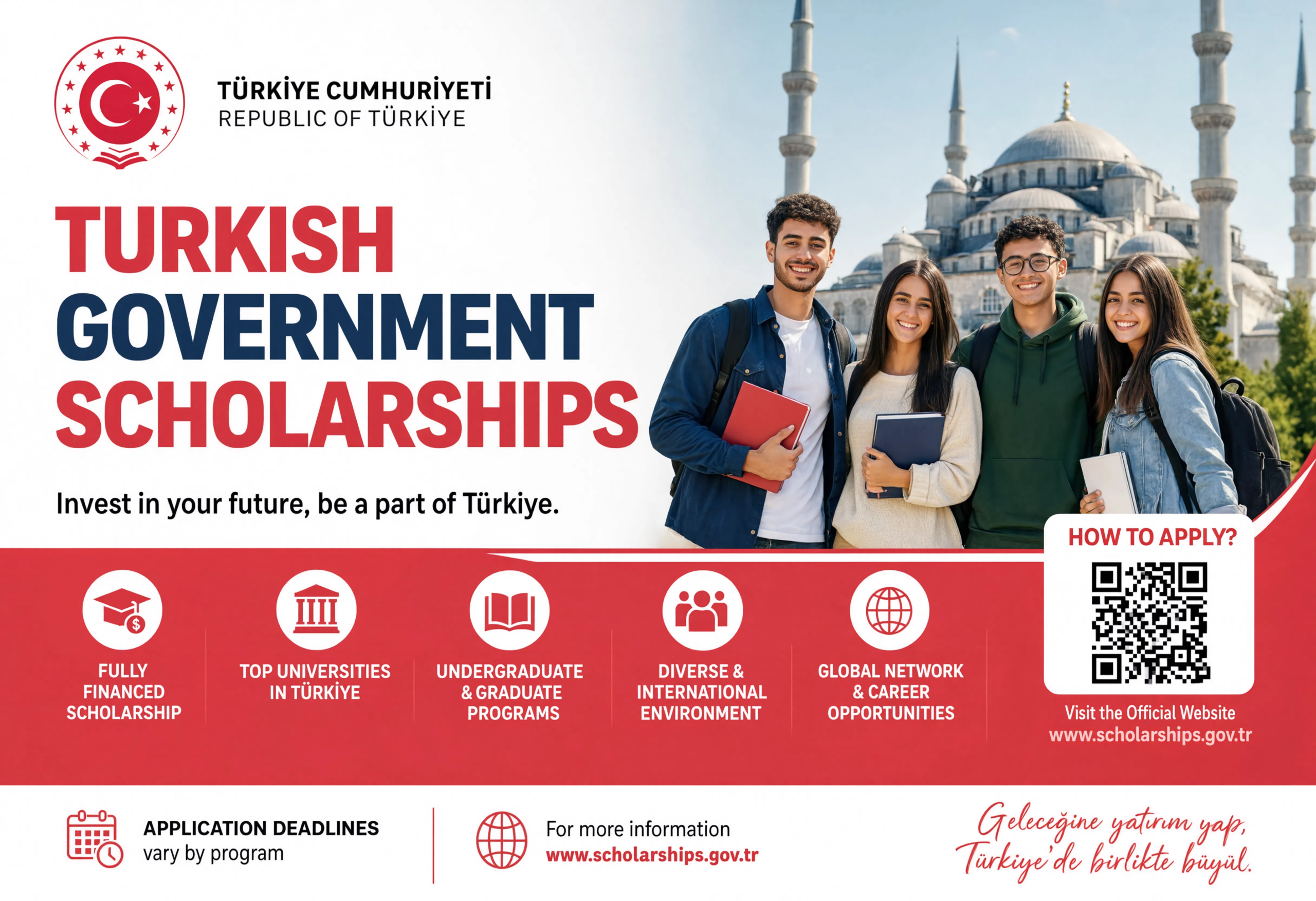
Picture this: you’re studying at a top university in Istanbul or Ankara — tuition paid, accommodation sorted, monthly stipend in your account, and a plane ticket that cost you nothing. You’re not dreaming. You’re on the Türkiye Bursları — the Turkish Government Scholarship, one of the most genuinely generous fully funded scholarships available to students from all nationalities in 2026.
Every year, Turkey funds thousands of international students through this program, and every year, thousands of eligible African students don’t apply — because they assumed it wasn’t for them, didn’t know the deadline, or convinced themselves they weren’t competitive enough.
This guide is here to fix all three of those problems.
By the time you finish reading, you’ll understand exactly what the Turkish Government Scholarship covers, whether your profile qualifies, how to build a strong application as an adult or career-changer, and what steps to take today — not “when the time feels right,” but right now, while the 2026 window is open.
You’ll also learn why adult applicants from African countries are increasingly competitive for this award — and how to position your experience so that selection panels choose you.
📋 Quick Summary Box
What this guide covers: The complete picture of Turkey’s fully funded scholarships for 2026 — eligibility, what’s covered, how to apply, and how to win as an adult applicant from Africa or another developing nation.
Key benefits you’ll gain: A step-by-step application roadmap, an eligibility self-assessment, essay frameworks tailored to your life experience, and a 2026 scholarship timeline you can act on immediately.
How to use this post: Read it through once for the full picture, then return to Sections 5, 6, and 8 as your hands-on working reference during your actual application process.
Why Your Age Is Your Secret Advantage for the Turkey Scholarship
Let’s get something out of the way immediately: the Türkiye Bursları scholarship does not discriminate against adult applicants. For undergraduate programs, the age limit is 21. For master’s programs, it’s 30. For doctoral programs, it extends to 35. And unlike many scholarship programs that quietly penalize non-traditional paths, Turkey’s scholarship system is designed to recognize demonstrated ability — which adult applicants have built over years.
The misconception that these scholarships are only for bright-eyed 19-year-olds fresh out of secondary school keeps an enormous number of qualified African adults from applying. That misconception is doing them — and you — a disservice.
Consider what UNESCO’s 2023 Global Education Monitoring Report confirmed: non-traditional and mature students now represent nearly 40% of global tertiary enrolment growth, with African nations showing some of the fastest increases. Scholarship bodies are responding to this shift. Turkey’s program, which welcomed over 180,000 applicants from 180+ countries in its most recent cycle, actively seeks applicants with leadership profiles — qualities that accumulate through living, not just through studying.
Here’s the competitive reality most people miss: adult applicants face far less competition within their age cohort. Fewer people apply in the 28–35 age bracket than in the 18–22 bracket — which means if your profile is strong, you’re competing in a less crowded pool for the same full package.
Fatima K., a 29-year-old public health officer from Senegal, spent five years managing rural vaccination programs before applying for the Türkiye Bursları master’s scholarship in 2023. She almost didn’t apply because she thought her gap year and non-linear academic record would count against her. They didn’t. She’s now completing a Master’s in International Health at Hacettepe University — fully funded, including accommodation and a monthly stipend.
Or consider Emmanuel T., a 33-year-old engineer from Ethiopia who worried his undergraduate degree (earned eight years prior) made him a weak candidate. His professional experience in infrastructure development was precisely what made his doctoral scholarship application compelling.
In 2026, your years of experience are not a handicap — they are your application’s strongest argument.
What “Fully Funded” Actually Means With the Turkey Scholarship
Before you spend a minute on your application, you need to know exactly what you’re getting — because “fully funded” means different things in different programs, and knowing the specifics protects you from unpleasant surprises mid-program.
The Türkiye Bursları scholarship is one of the most comprehensively funded programs in the world. Here’s what it covers at the master’s level specifically:
- ✅ Full tuition: Paid directly to your university. You owe nothing.
- ✅ Monthly stipend: 700 Turkish Lira per month at undergraduate level; 950 TL at master’s; 1,400 TL at doctoral level (figures subject to annual adjustment — verify on the official portal).
- ✅ Accommodation: Free university dormitory accommodation provided.
- ✅ Round-trip airfare: One economy-class return ticket between your home country and Turkey, per academic year.
- ✅ Health insurance: Full coverage throughout your program.
- ✅ Turkish language training: A free one-year preparatory Turkish language course before your program begins, if your program is taught in Turkish.
Now, here’s what the scholarship does not automatically cover — and what catches people off guard:
- ❌ Visa application fees (typically $50–$150 depending on your passport)
- ❌ Personal shopping, clothing, and entertainment
- ❌ Family expenses if you have dependents at home
- ❌ Optional travel outside Turkey during your program
How do you read a scholarship description to know what’s really covered? Look for explicit mentions of the words stipend, accommodation provided, health insurance included, return airfare covered, and tuition waived. If any of these are absent or vague, email the scholarship body directly before applying.
To make the comparison concrete:
The Chevening Scholarship (UK) covers tuition, living allowance, economy airfare, and arrival allowances — but stipend amounts vary significantly by city, and London’s cost of living often makes it feel less “free” than Turkey’s all-in package.
The DAAD Scholarship (Germany) covers tuition where applicable, a monthly stipend of €861–€1,200, travel allowances, and health insurance — generous, but Germany’s cost of living means the stipend stretches thinner than Turkey’s fully accommodated model.
The Turkey scholarship’s dormitory inclusion makes it one of the most financially stress-free fully funded programs available to African students in 2026. Understanding exactly what you’re receiving lets you plan, budget, and apply with full confidence.
Building Your Turkey Scholarship Database: A Systematic Approach
Finding the right scholarship tracks within Turkey’s program — and pairing it with backup opportunities — requires a system. Here’s the step-by-step approach that keeps your search focused and your applications strong.
Step 1: Start at the official source.
Everything begins at turkiyeburslari.gov.tr — the official Turkish Government Scholarships portal. This is where you create your account, check open programs, review university placements, and submit your application. Bookmark it now. The 2026 application window typically opens in January and closes in February — missing this narrow window means waiting a full year.
Step 2: Identify your program type and university preferences.
Turkey hosts over 200 universities. Some are research-intensive (Boğaziçi, METU, Istanbul Technical University); others are newer but rapidly growing. Through your scholarship application, you’ll list up to 12 universities in order of preference. Research each one’s department strength for your chosen field before you rank them — a strategic list significantly improves your placement chances.
Step 3: Build a parallel scholarship pipeline.
Don’t put all your hope in one program. Pair your Turkey application with these equally credible opportunities:
- Mastercard Foundation Scholars Program — targets African students specifically; evaluates leadership and community impact
- DAAD Scholarships — strong for research-based postgraduate programs; particularly accessible for STEM and development fields
- British Council Chevening — requires 2+ years of work experience; adult applicants are naturally competitive
- African Union Intra-African Academic Mobility Scheme — funds African students studying within Africa; less competitive than global programs
- OIC Scholarship Programme — Organisation of Islamic Cooperation scholarships available to eligible African nationals
- Fulbright Foreign Student Program — U.S. government-funded; open to citizens of most African nations for graduate study
- Government-to-government bilateral agreements — check your national education ministry’s scholarship board (Nigeria’s FSB, Ghana’s Scholarship Secretariat, South Africa’s NSFAS) for Turkey-specific agreements that receive almost no publicity
Step 4: Filter specifically for adult-friendly programs.
When searching any external scholarship database, use search terms like “mature student,” “professional experience required,” “open to working professionals,” “non-traditional applicant.” These surface opportunities that younger applicants aren’t even looking for.
Step 5: Verify every program before investing time.
Legitimate scholarships — including Türkiye Bursları — never charge application fees. Confirm every program by checking that the URL matches the official institution’s domain, cross-referencing the scholarship on the host university’s financial aid page, and Googling “[scholarship name] + scam 2025” to check for red flags from past applicants.
Step 6: Build and maintain a personal tracker.
Create a spreadsheet: Scholarship Name | Deadline | Eligibility | Documents Required | Status | Notes. Update it every week. A curated, verified database is worth more than any single application tip.
Turkish Government Scholarship Eligibility Checklist
This is where applicants get confused — and where adult African students often disqualify themselves unnecessarily. Let’s go through the actual criteria carefully.
Standard eligibility requirements:
- ✅ Nationality: Open to citizens of all countries except Turkish nationals. Every African passport is eligible. Dual nationals should check whether their secondary nationality affects eligibility.
- ✅ Academic standing: Minimum academic score requirements vary by program level — 70% for undergraduate applicants, 75% for master’s applicants, and 75% for doctoral applicants in most fields. Medical programs require 90%. Your most recent degree transcript is what matters.
- ✅ Age limits: Maximum 21 for undergraduate programs; 30 for master’s programs; 35 for doctoral programs. These apply to the year of application — not the year your program begins.
- ✅ Language proficiency: Programs taught in Turkish require completion of the free language preparation year. Programs taught in English require proof of English proficiency — IELTS, TOEFL, or institutional medium-of-instruction letter. Check your preferred university’s language of instruction carefully.
- ✅ Health requirements: Applicants must confirm they are in good health. Some programs request a general health declaration; others require a medical certificate post-award.
- ✅ Prior study in Turkey: Applicants who have previously studied in Turkey on a Turkish government scholarship are generally ineligible to reapply at the same level. A master’s scholar can later apply for doctoral funding.
Adult-specific flags — and why they work in your favor:
Employment gaps: The Türkiye Bursları application includes a detailed personal statement section. A gap between your undergraduate degree and your current application is an opportunity — not a problem — to explain professional growth, community leadership, or family responsibility.
Non-linear academic history: If you attended multiple institutions, studied part-time, or transferred programs, explain this in your application. Turkish scholarship evaluators are accustomed to reviewing applications from diverse educational contexts across 180+ countries.
Work experience as a substitute for academic recency: For doctoral applicants especially, significant research or professional experience in your field can strengthen an application where your academic scores sit at the minimum threshold.
✅ Are You Eligible? Quick Self-Assessment
Answer yes or no. Be honest — this takes 60 seconds.
- Do you hold a non-Turkish passport from any country? (Yes/No)
- Are you under 30 (master’s) or under 35 (doctoral) in the year you’re applying? (Yes/No)
- Do you have an academic average of 75% or above in your most recent qualification? (Yes/No)
- Can you articulate a clear, specific reason for choosing Turkey and your chosen field of study — beyond “I want a free education”? (Yes/No)
If you answered Yes to 3 or 4: You are competitive for the Türkiye Bursları 2026. Your next step is building your application — this guide shows you exactly how.
If you answered Yes to only 1–2: You have specific gaps to close. Sections 8 and 9 of this guide will help you present your strongest possible profile.
Knowing where you stand removes the paralysis of “maybe I’m not eligible” — and replaces it with a clear path forward.
The 5 Scholarship Types African Adult Learners Actually Win
Turkey’s scholarship is your primary target, but understanding the full landscape ensures you never rely on a single application. Here are the five categories where adult African applicants consistently succeed — including where Turkey fits within this map.
Type 1: Government-Funded National Scholarships (Like Türkiye Bursları)
Who funds them: National governments investing in international soft power and educational diplomacy — Turkey, Germany, UK, USA, Japan, China, France.
What makes you competitive: These programs want scholars who will return home and contribute to national development. A 32-year-old professional with a clear development agenda is a far more convincing candidate than a 20-year-old with ambitions but no track record.
Typical award: Fully funded — tuition, accommodation, stipend, travel, health insurance. Turkey’s package is among the most comprehensive globally.
Acceptance rate: Türkiye Bursları receives 180,000+ global applications and funds approximately 5,000–6,000 scholars annually — a raw rate of roughly 3%, but country-specific quotas make individual national competition far more manageable.
Example: Nigeria, Ethiopia, and Kenya each have dedicated allocation quotas within the Türkiye Bursları program, meaning you compete against your compatriots — not all 180,000 global applicants.
Type 2: University-Specific Mature Student Programs
Who funds them: Individual universities drawing from endowments, government widening-participation funding, or alumni donations.
What makes you competitive: These programs exist specifically for people returning to education after a career break or non-traditional path. You are their intended recipient.
Typical award: Partial to fully funded; ranges from covering tuition only to full packages. Varies significantly by institution.
Acceptance rate: Generally 10–20% for shortlisted candidates — higher than national scholarship programs.
Example: Several Turkish universities within the Türkiye Bursları network — including Boğaziçi University and Istanbul University — maintain separate departmental scholarships for exceptional international applicants that complement the government award.
Type 3: NGO and Foundation Scholarships for Career Changers
Who funds them: Development-focused foundations — Mastercard Foundation, Open Society Foundations, Ford Foundation, Mo Ibrahim Foundation.
What makes you competitive: These bodies fund transformation, not just education. Your professional pivot story, your community leadership, your resilience through hardship — these are exactly the narratives foundation scholarship panels respond to most strongly.
Typical award: Fully funded, often with leadership development programming embedded in the award.
Acceptance rate: Competitive but strategic. The Open Society Foundations have historically funded fellows from 30+ developing countries specifically in human rights, governance, and public policy — fields where professional experience isn’t just helpful, it’s expected.
Type 4: Merit-Based Scholarships Open to All Ages
Who funds them: Universities, professional associations, private donors, and industry bodies.
What makes you competitive: Merit here encompasses both academic achievement and professional accomplishment. Your career record is part of the merit calculation — not an afterthought.
Typical award: $5,000 to fully funded; varies by institution and field.
Example: The Commonwealth Scholarship Commission consistently reports that a significant share of its annual cohort are professionals in their 30s pursuing development-related master’s degrees — not recent undergraduates looking for their first qualification.
Type 5: Employer-Sponsored Education Scholarships
Who funds them: Multinational corporations, banks, energy companies, healthcare organizations, and professional associations operating across Africa.
What makes you competitive: You’re already a known quantity in your organization. You’re not a risk — you’re a retention strategy.
Typical award: Full or partial tuition coverage, sometimes with continued salary during your study period.
Example: Several multinational firms operating in Nigeria, Kenya, South Africa, and Ghana maintain staff development funds covering postgraduate education — funds that frequently go unclaimed because employees never ask. Check your HR department’s learning and development policy before looking anywhere else.
The scholarship landscape is wider than you imagined — and adult African applicants are far more competitive within it than they realize.
Crafting Your Turkey Scholarship Application: Step-by-Step
The Türkiye Bursları application is done entirely online through the official portal. Here’s how to move through it without panic, shortcuts, or costly mistakes.
Step 1: Create your portal account immediately.
Go to turkiyeburslari.gov.tr and create your account the moment the 2026 window opens — typically in January. Don’t wait until your documents are ready. Creating the account early lets you see exactly what information and uploads the system requires, so you can gather everything without last-minute scrambling.
Step 2: Gather your academic transcripts.
You’ll upload official transcripts from your secondary school and every university you’ve attended. If you graduated years ago, request certified copies from your institutions now — processing can take 4–8 weeks, sometimes longer if the institution has moved, merged, or operates slowly. Adult applicants with degrees from multiple institutions consistently face this bottleneck. Start here first.
Step 3: Compile your professional and supporting documents.
You’ll prepare your updated CV (academic and professional), employment verification letters confirming your roles and service dates, any professional certifications relevant to your field of study, and evidence of community or leadership involvement. For doctoral applicants, you’ll also need a research proposal — give this document significant attention; it can be the deciding factor in competitive fields.
Step 4: Draft your personal statement.
The portal requires a personal statement explaining your academic background, your motivations for studying in Turkey, your chosen field and program, and your plans after graduation. This is your most important document. We’ll cover exactly how to write this as an adult applicant in Section 9 — don’t skip that section.
Step 5: Prepare your university preference list.
You’ll list up to 12 universities in ranked order of preference. Research each university’s departmental reputation in your field before you rank them. A strategic, well-researched preference list significantly increases your chances of optimal placement — don’t treat this as an afterthought.
Step 6: Review your application as an outsider.
You’ll read your entire application as if you are the selection committee — checking for consistency between your CV, transcript, essay, and stated university preferences. Have one trusted person review your personal statement before submission. Check every upload for file format compliance (the portal is specific about PDF requirements).
Step 7: Submit early, then document everything.
You’ll submit before the deadline — never on the final day, when servers often experience traffic overloads. Save your submission confirmation email, screenshot your application summary, and log the date in your tracker.
Give yourself 8–10 weeks minimum — adult applicants consistently need more time than recent graduates to compile professional documentation.
⚠️ 5 Mistakes That Cost Turkey Scholarship Applicants (Avoid These)
1. Generic motivation statements. “I want to study in Turkey because it is a great country with good universities” is not a personal statement — it’s a placeholder. Tell the panel why this program, why Turkey, why now, and what you’ll do when you return home.
2. Ignoring the university preference list. Randomly ranking 12 universities without researching their departments is a missed opportunity. Your placement depends partly on how strategically you’ve ranked your choices.
3. Uploading low-quality document scans. Blurry transcripts or illegible certificates get flagged or rejected. Scan everything at 300 DPI minimum, convert to PDF, and name files clearly.
4. Weak or irrelevant references. A reference from a professor who barely remembers you is less powerful than one from a supervisor who directly observed your professional growth. Choose people who know your work intimately.
5. Applying without checking the age cutoff. The age limits (21 for undergraduate, 30 for master’s, 35 for doctoral) are strict and non-negotiable. If you’re applying at the boundary age, verify that your birthdate falls within the required range for the year of application.
A prepared application doesn’t just reduce anxiety — it removes the uncertainty of wondering whether you gave it your best.
Positioning Your Story: Why You’re the Right Turkey Scholarship Candidate
Here’s what separates the scholars Turkey actually funds from the applicants who get filtered out in the first round: the funded ones tell a story that is specific, honest, and forward-looking. You have the raw material for exactly that kind of story. The question is how to shape it.
The temptation — especially if you’ve been out of academia for years — is to minimize your background. To focus only on your academic scores and quietly hope no one probes the decade between graduation and application. Resist this instinct completely.
“I used to think my age made me less competitive. When I started framing my seven years in public administration as preparation rather than delay, my application became completely different — and so did the outcome.” — Aisha M., Türkiye Bursları Master’s Scholar, 2024, age 31, studying Public Policy at Ankara University
Aisha’s experience captures something the scholarship rubric actually rewards: applicants who can explain not just what they want to study, but why the timing is right, why Turkey specifically, and what they’ll do with the knowledge when they return. That trifecta of clarity takes years to develop — and you have it.
How to translate your life experience into compelling application content:
Your work history isn’t a gap in your education journey — it’s evidence of your ability to function in the real world, make decisions under pressure, lead people, and solve problems that textbooks don’t cover. When you write that you “coordinated health outreach for 3,000 residents across five districts,” you’re demonstrating program management, community engagement, and sector expertise. Translate everything specific into the application.
Three essay frameworks that work especially well for adult applicants to Turkey:
🔹 “The Professional Problem I Couldn’t Solve Without More Education” — Identify a concrete limitation you hit in your career — a gap between your current skills and what the job actually required. Show exactly how your chosen program in Turkey fills that gap. This framework is direct, credible, and impossible to fake.
🔹 “The Long Game” — Trace a clear line from your early career choices through your current work to the specific graduate program you’re applying for. Show that this scholarship is not a detour — it’s the logical next chapter in a journey that was always heading here.
🔹 “The Community Return Pledge” — Turkey’s scholarship program specifically values applicants who commit to returning home and contributing to national development. Frame your personal statement around the specific impact you’ll create in your community or country once you return with your Turkish degree. Be concrete — name organizations, sectors, or policies you’ll influence.
The difference between generic and powerful:
❌ Generic: “I am applying for the Türkiye Bursları scholarship to further my studies in international relations and improve my career prospects.”
✅ Powerful: “After six years negotiating cross-border agricultural trade agreements for the Nigerian Ministry of Commerce, I know exactly where policy knowledge ends and practical authority begins. A master’s in International Relations at METU gives me the analytical framework to bridge that gap — and the specific expertise to reform how Nigeria approaches bilateral trade with emerging markets.”
Same field. Completely different impact. The most funded applicants are the most honest ones — honest about their journey, their gaps, and their goals.
The 2026 Turkey Scholarship Application Timeline
Timing is everything with Türkiye Bursları. The application window is narrow — typically six to eight weeks — and missing it means waiting a full year. Here’s your complete planning timeline.
| Date Range | Milestone |
|---|---|
| October – December 2025 | Research programs, university rankings in your field, and language of instruction for preferred departments. Begin drafting your personal statement. |
| January 2026 | Türkiye Bursları 2026 application portal opens. Create your account immediately. Review all document requirements. |
| January – February 2026 | Gather transcripts, employment letters, certificates, and references. Request documents now — don’t wait. |
| February 2026 | Application window closes (typically mid-to-late February — confirm the exact date on the official portal). Submit at least 5 days early. |
| March – April 2026 | Pre-selection screening begins. Some applicants receive early rejection notifications. |
| May – June 2026 | Interview invitations sent to shortlisted candidates (interviews are conducted in-country through Turkish embassies or online). |
| July – August 2026 | Final selection results announced via the portal and email. |
| September – October 2026 | Accepted scholars begin Turkish language preparation year (if applicable) or receive university placement confirmation. |
| September/October 2027 | Academic program begins for most 2026-cycle Türkiye Bursları scholars. |
Adult-specific note: Unlike rolling-deadline programs (which suit people balancing work and applications), Türkiye Bursları operates on a fixed, non-negotiable annual deadline. Mark it on every calendar you own.
Set phone reminders 6 weeks before the application deadline — adult applicants consistently underestimate how long it takes to compile professional documentation.
The scholars who win in July are the ones who started preparing in October — that’s you, starting today.
Frequently Asked Questions
Can I get the Turkish Government Scholarship if I’ve been working full-time for 10 years?
Yes — and your work experience can actually strengthen your application. The Türkiye Bursları evaluates applicants on academic achievement, personal motivation, and future contribution to their home country. A decade of relevant professional experience gives your personal statement a depth and clarity that recent graduates simply cannot match. Meet the age and academic requirements, and apply confidently.
What happens if there’s a gap between my undergraduate degree and my application?
A gap doesn’t disqualify you. You’ll address it directly in your personal statement — explaining what you did during that period (professional work, caregiving, entrepreneurship, community service). The Turkish scholarship system evaluates applicants from 180+ countries with vastly different educational contexts. A purposeful gap, clearly explained, can be a compelling part of your story rather than a weakness.
Can I work part-time while on the Turkish Government Scholarship?
Technically, international students in Turkey are permitted to work part-time with a valid student work permit after their first year of enrollment. However, the scholarship stipend is designed to cover your basic living costs, and most scholars find that managing coursework and a part-time job simultaneously is challenging. Check your specific scholarship agreement and Turkish labor law for current conditions.
Do I need to be living in my home country when I apply for the Turkey scholarship?
You must be a citizen of an eligible country, but you do not necessarily need to be physically residing there at the time of application. However, the interview stage — conducted through Turkish embassies or consulates — typically requires you to attend in-person in a country where Turkey has a diplomatic presence. Plan for this logistically if you’re currently abroad.
How long does it take from submitting my application to knowing the final result?
The Türkiye Bursları cycle runs approximately five to six months from application close to final notification. Applications typically close in February; final results are announced in July or August. That’s roughly six months from submission to confirmation — plan your life timeline accordingly, including visa processing, which begins after award acceptance.
Can I reapply for the Turkey scholarship if I’m rejected?
Yes — and many eventual scholars applied multiple times before winning. Turkey’s scholarship body does not permanently flag rejected applicants. Use a rejection as diagnostic feedback: identify your weakest element (usually the personal statement or reference quality), strengthen it deliberately, and return the following year with a sharper, more targeted application. Per the official Türkiye Bursları comprehensive scholarship guide, reapplication is explicitly permitted.
Are older applicants at a disadvantage compared to younger ones for Turkey scholarships?
No — within the eligible age brackets, older applicants often hold a structural advantage. The evaluation criteria reward clarity of purpose, demonstrated leadership, and a convincing post-graduation plan. These are qualities that accumulate with experience, not with youth. A 34-year-old doctoral applicant with a strong research record and a precise development agenda is a stronger candidate — not a weaker one — than a 26-year-old with excellent grades but no professional context.
Every question you’ve just answered is one barrier fewer standing between you and your application to study in Turkey for free.
Your Action Plan: What You Do Next
You’ve just spent time with the full picture of what studying in Turkey for free actually looks like in 2026 — the coverage, the eligibility, the application process, and how your adult profile isn’t a disadvantage but a distinct competitive edge. Now comes the part that separates readers from applicants.
You might be feeling a familiar tension right now: real excitement at what’s possible, layered with real anxiety about whether you’re ready, whether your profile is strong enough, whether the timing is right. That tension is not a sign to wait. It’s a sign that you’re taking this seriously — which is exactly the right posture for someone about to do something that changes the trajectory of their life.
Here are your three non-negotiable next steps — do all three before the end of this week:
1. Create your Türkiye Bursları account today.
Go to turkiyeburslari.gov.tr right now. Open the account. Review the full document checklist for your intended program level (undergraduate, master’s, or doctoral). Screenshot the list. This single action transforms you from someone thinking about applying into someone who has started.
2. Request your official transcripts within 48 hours.
Email or call every institution you attended — secondary school and university. Request official certified transcripts and ask for the processing timeline in writing. If any institution is slow or complicated, start chasing it now, not in January. This is the document that most often delays adult applicants.
3. Mark the application deadline on every calendar you own — then count back 42 days.
That 42-day mark (six weeks before the deadline) is your personal submission target. Work backward from it: Week 6 = documents gathered. Week 4 = personal statement drafted. Week 2 = application reviewed and references confirmed. Week 1 = final submission.
According to the official Türkiye Bursları scholarship portal’s comprehensive program information, the 2026 application window opens in January — which means your preparation window is open right now, today, at this exact moment.
The scholarship exists. The eligibility fits you. Turkey is waiting. The only variable left is whether you decide to show up.
Found this guide useful? Share it with one person in your network who needs to read it — because access to information like this is how the gap closes.
