Table of Contents
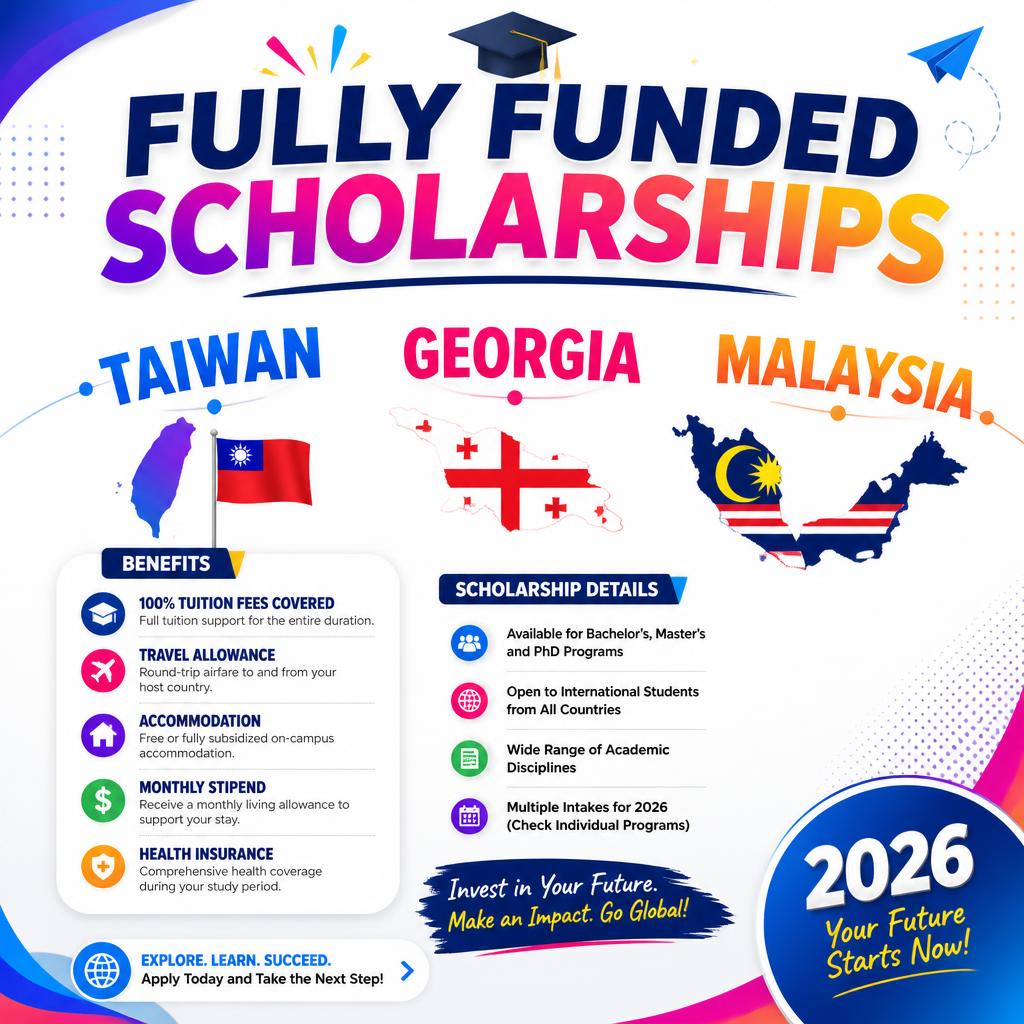
ToggleTaiwan, Georgia, and Malaysia: The Hidden Scholarship Powerhouses Offering Fully Funded Education to International Students in 2026
You’ve Been Looking in the Wrong Direction
You’ve researched the UK. You’ve bookmarked American university pages. You’ve applied—maybe twice—to programs in Canada and Germany, only to hit walls made of rejection letters and visa complications.
Meanwhile, three countries have been quietly offering some of the most generous, least competitive, and most welcoming fully funded scholarships in the entire world—and almost no one from your country is talking about them.
Taiwan. Georgia. Malaysia.
These aren’t consolation prizes. They’re deliberate, government-backed investments in international talent. And right now, in 2026, they are actively looking for students exactly like you.
This post will walk you through everything: what these scholarships actually cover, who qualifies, how the application works, and how to position yourself so you’re not just applying—you’re winning.
Quick Summary Box
- What this guide covers: Fully funded scholarship opportunities in Taiwan, Georgia, and Malaysia specifically relevant to African students in 2026
- Key benefits you’ll gain: Clarity on what’s covered, which programs suit your profile, and exactly how to apply with confidence
- How to use this post: Read straight through for the full picture, or jump to the country or section most relevant to your situation
Why These Three Countries Are Hiding in Plain Sight
Most African students—and honestly, most scholarship advisors—default to the same geography. Europe. North America. Australia. It makes cultural sense: familiar languages, famous universities, strong diaspora networks that make the transition feel safer.
But here’s what nobody tells you: that familiarity creates competition so fierce that academically strong students get screened out simply due to volume.
The UK Chevening program, for example, receives over 60,000 applications annually for roughly 1,800 spots. That’s a 3% acceptance rate before your essay is even read.
Now consider this: Taiwan’s Ministry of Education Scholarship program, one of the most comprehensive funding packages in Asia, receives a fraction of that competition from African applicants—despite offering full tuition, monthly stipends, and return airfare. Georgia, the country nestled between Europe and Central Asia, has built its entire higher education expansion strategy around attracting international students, and its application pools from Sub-Saharan Africa remain genuinely thin. Malaysia, home to several top-200 QS-ranked universities, funds international scholars through government and university programs with acceptance rates that would seem impossible in a Western context.
The opportunity isn’t smaller. The crowd is.
You’re not reading this guide because you lack ambition. You’re reading it because nobody handed you this map before now. That changes today.
Understanding the Landscape: What “Fully Funded” Actually Means Here
Before you get deep into applications, let’s be precise about what “fully funded” means—because the term gets used loosely, and loose terms cost people money.
A genuine fully funded scholarship covers four core categories: tuition fees for your entire program, monthly living allowance (called a stipend), round-trip airfare to and from your home country, and health insurance coverage during your stay. Some programs also include a one-time settlement allowance when you first arrive.
A partial scholarship covers only tuition—meaning you’re still responsible for housing, food, transport, and insurance out of your own pocket.
A grant is a one-time financial award that doesn’t necessarily renew each academic year.
Here’s the critical reading skill: when you see a scholarship described as “full tuition waiver plus stipend,” that is not the same as fully funded unless the stipend actually covers your cost of living in that city. Always research the average monthly living cost at your destination and compare it directly to the stipend amount offered.
For example, Taiwan’s Ministry of Education Scholarship offers NT$25,000 per month—approximately USD $770—which comfortably covers rent, meals, and transport in most Taiwanese cities outside Taipei. That’s meaningfully different from a “stipend” in London or Sydney that evaporates before the month ends.
Georgia’s State Scholarship offers tuition coverage plus accommodation in many cases, while Malaysia’s programs through institutions like Universiti Malaya include allowances for books and academic materials on top of tuition.
What these programs typically don’t cover: visa application fees (usually $50–$150), personal entertainment, international travel during academic breaks, and phone plans. Budget for these separately.
Making informed choices starts with reading the fine print before you fall in love with the headline.
Taiwan: Asia’s Best-Kept Secret for African Scholars
Taiwan might not be the first name that comes up at your family dinner table, but it should be. This island nation of 23 million has invested billions in higher education infrastructure, and it has made recruiting international graduate and undergraduate students a national priority.
The Taiwan Ministry of Education (MOE) Scholarship
The flagship program is the Taiwan Ministry of Education Scholarship, formally known as the Taiwan Scholarship Program. It is one of the most straightforward, well-structured fully funded opportunities available to African students right now.
Here’s what it covers:
- Full tuition at your enrolled institution
- NT$25,000/month stipend for graduate students; NT$15,000/month for undergraduates
- One-time round-trip economy airfare
- Duration: 1–4 years depending on your degree level
The program runs through Taiwan’s overseas representative offices—which function as embassies in countries where Taiwan doesn’t have formal diplomatic relations, including most of Africa. You apply through your nearest Taiwan representative office, not directly to the university.
Who qualifies? You need to be a non-Taiwanese national, hold a strong academic record (usually GPA equivalent of B+ or above), have no prior degree from a Taiwanese institution, and be applying to a recognized Taiwanese university. There is no hard age ceiling in the official program documentation, which makes this especially relevant if you’re a professional considering a master’s or doctoral degree.
The Taiwan ICDF Scholarship
This is a second, parallel program—run by the International Cooperation and Development Fund rather than the Ministry of Education—and it specifically targets students from developing nations, including many African countries.
The ICDF scholarship is arguably more generous, because it is explicitly need-aware and development-focused. It targets fields like agriculture, public health, engineering, and information technology—disciplines where Taiwan has genuine technical leadership and where African graduates are needed most.
Coverage includes tuition, accommodation in a dedicated international student dormitory, a monthly stipend, health insurance, and airfare. The monthly allowance is adjusted periodically and typically sits around NT$15,000–NT$25,000 depending on your degree level.
Accepted countries include Nigeria, Kenya, Ghana, Senegal, Eswatini, and several others—but the eligible list shifts slightly each year, so confirm your country’s status on the official ICDF portal before investing application time.
Why African Students Win Taiwan Scholarships
Taiwan values diversity in its classrooms—genuinely. International offices at universities like National Taiwan University, National Cheng Kung University, and National Taiwan Normal University actively recruit from underrepresented regions.
More practically: your competition pool in Taiwan’s scholarship selection from Africa is dramatically smaller than you assume. Cultural unfamiliarity with Taiwan as a destination creates a gap that benefits the few African students who do apply thoughtfully.
The language of instruction is increasingly English-taught, particularly at graduate level, with hundreds of fully English-medium programs across disciplines. You do not need Mandarin proficiency to qualify for most graduate programs, though learning basic Mandarin is warmly encouraged and will significantly enrich your two to four years there.
Georgia: Europe’s Doorstep and an Overlooked Gold Mine
When most people hear “Georgia,” they think of a U.S. state. But Georgia the country—positioned at the intersection of Eastern Europe and Western Asia—is running one of the most ambitious international student recruitment campaigns on the planet, and African students are barely scratching the surface of what’s available.
Why Georgia Decided to Open Its Doors
In 2012, Georgia liberalized its higher education system and began aggressively modernizing its universities to meet European standards. The government’s strategy was direct: bring in international students, raise academic rankings, build cultural exchange, and grow tuition revenue from a larger global base.
The result is a higher education environment that is genuinely welcoming to international students in ways that many established Western destinations are not—with lower bureaucratic friction, faster visa processing, and university administrations that are actively incentivized to recruit from abroad.
The Georgian Government Scholarship for International Students
The Georgian Government Scholarship is the primary fully funded pathway for international students. Administered through the Georgian National Center for Educational Quality Enhancement, it targets students for bachelor’s, master’s, and doctoral programs at Georgian state universities.
Coverage includes:
- Full tuition fees
- Monthly stipend (approximately GEL 500–800, equivalent to roughly USD 185–300 depending on exchange rates)
- Accommodation assistance at university dormitories
- Health insurance
The stipend is modest compared to Taiwan’s. Georgia’s cost of living, however, is also dramatically lower—Tbilisi, the capital, consistently ranks among Europe’s most affordable cities, where a comfortable room and full meals can be managed on under $400 a month. The scholarship’s coverage, in real terms, goes further than the numbers suggest.
Eligible fields in 2026 include medicine, engineering, social sciences, economics, arts, and law. The medical programs in Georgia deserve special mention—Georgian medical degrees are recognized by the Medical Council of India, the World Health Organization, and the Educational Commission for Foreign Medical Graduates in the United States, making Georgian medical education a globally portable credential that is dramatically cheaper than equivalent training in the UK or US.
Private University Scholarships in Georgia
Beyond the government program, Georgian private universities—including Caucasus University, Ilia State University, and the University of Georgia (Tbilisi)—offer their own institutional scholarships, many of which include tuition waivers of 50–100% for high-performing international students.
These private scholarships are often more accessible than the government program because the application volume is lower and the decision-making is faster. Several African students have entered Georgia on institutional scholarships, demonstrated academic excellence in their first year, and subsequently transitioned to government funding or research grants.
The Practical Reality of Studying in Georgia
Georgia is a Muslim-majority-friendly, culturally diverse country—nearly 10% of the population is Muslim, and major cities have active mosques, halal restaurants, and multicultural social environments. For students from West Africa, East Africa, or North Africa, this matters.
English-taught programs are expanding rapidly, particularly in health sciences, business, and engineering. Visa processing for African nationals is generally efficient—typically 15–30 business days—and the Georgian government has demonstrated a clear bureaucratic preference for simplifying processes rather than adding friction.
The one challenge worth naming honestly: Georgia’s internet connectivity and library resources vary across institutions. If you’re entering a research-intensive doctoral program, investigate your specific institution’s infrastructure before committing.
Malaysia: World-Class Universities, Tropical Climate, and Serious Funding
Malaysia is the third hidden powerhouse—and it’s arguably the most immediately familiar to African students in terms of cultural overlap, language, and lifestyle. English is widely spoken. Islam is the national religion. The food is extraordinary. And the universities are genuinely ranked among Asia’s best.
Why Malaysia Makes Sense for African Students
Universiti Malaya (UM) ranks in the top 70 universities globally in several QS subject categories. Universiti Putra Malaysia (UPM), Universiti Teknologi Malaysia (UTM), and Universiti Kebangsaan Malaysia (UKM) all hold strong regional and global rankings, particularly in engineering, agriculture, Islamic studies, and environmental science.
The academic credentials you earn here are recognized internationally and respected in African professional licensing contexts, including engineering boards in Nigeria, Ghana, Kenya, and South Africa.
The Malaysian International Scholarship (MIS)
The Malaysian International Scholarship is the Malaysian government’s flagship fully funded program for international postgraduate students, administered by the Ministry of Higher Education.
Coverage includes:
- Full tuition fees at any Malaysian public university
- Monthly stipend of MYR 1,500–2,000 (approximately USD 320–430)
- Round-trip economy airfare
- Health insurance
The MIS prioritizes students from OIC (Organisation of Islamic Cooperation) member countries—which includes Nigeria, Senegal, Sierra Leone, Uganda, Tanzania, Somalia, Cameroon, Gambia, and many more African nations. This is a structural advantage that African applicants should recognize and use directly in their applications.
Fields prioritized include: science and technology, engineering, social sciences, Islam-related disciplines, business and economics, and environmental studies.
University-Level Scholarships in Malaysia
Individual Malaysian universities run their own international scholarship programs that sit alongside the government scheme. Universiti Malaya’s Graduate Research Assistantship (GRA) program, for example, funds doctoral students in exchange for research contributions—and the monthly allowance is competitive relative to the cost of living in Kuala Lumpur.
UiTM (Universiti Teknologi MARA) runs the International Excellence Scholarship specifically designed for students from developing nations, including African OIC members. Tuition waivers of up to 100% are available, with additional accommodation support.
The Cost of Living Advantage
Kuala Lumpur is not cheap by developing-nation standards, but it is dramatically more affordable than London, Sydney, or Toronto. A comfortable room in a shared apartment near a university costs MYR 600–900 per month. Full meals at local hawker centers—arguably some of the world’s best street food—cost under MYR 10. Your stipend, combined with disciplined budgeting, goes a meaningful distance.
The practical logistics work in your favor too. Malaysia has one of the most efficient international student visa systems in Southeast Asia, with institutional support officers at major universities explicitly assigned to guide international applicants through the process.
Eligibility Breakdown: Do You Actually Qualify?
Let’s get granular. Across Taiwan, Georgia, and Malaysia, the eligibility landscape shares certain common threads—but the specifics matter.
Common Eligibility Requirements Across All Three Countries
- ✅ You must be a citizen of an eligible country (check each program’s current eligible country list—these shift annually)
- ✅ Academic transcripts showing strong performance (typically B+ average or above; roughly 3.0+ on a 4.0 GPA scale)
- ✅ A completed degree for graduate applications (bachelor’s for master’s programs; master’s for doctoral programs)
- ✅ English language proficiency evidence—IELTS 6.0–6.5 or TOEFL 80+ for most programs; some institutions accept institutional English tests or medium of instruction letters
- ✅ A clear, compelling study plan or research proposal (for graduate applicants)
- ✅ Two to three strong reference letters from academic or professional supervisors
- ✅ Valid passport with at least 18 months remaining at time of application
Country-Specific Flags
Taiwan: Applicants cannot currently be enrolled at a Taiwanese institution. The ICDF program specifically requires your country to be on its eligible nation list—confirm this annually.
Georgia: Some programs require a minimum age of 18 with no maximum age ceiling. Medical programs may require specific prerequisite coursework. Language of instruction matters—confirm whether your program of interest is English-taught or Georgian-medium before applying.
Malaysia: The MIS requires you to have a job offer or university acceptance from a Malaysian public university before applying for the scholarship. This sequential requirement trips up many applicants—get your university acceptance first, then apply for the scholarship.
Are You Eligible? Quick Self-Assessment
Answer yes or no to each question:
- Is your country on the eligible list for at least one of these three programs? (Check Taiwan MOE, Georgian Government Scholarship, and MIS eligible country lists separately)
- Do you have a completed degree with a GPA or equivalent of B+ or above?
- Do you have an IELTS score of 6.0 or above, a TOEFL of 80+, or documentary evidence of English-medium prior education?
- Are you prepared to commit to 1–4 years of study outside your home country?
If you answered yes to questions 1, 2, and 4, you are likely eligible for at least one program. Begin there.
Building Your Application: Step by Step
Applications for fully funded scholarships aren’t won in a day. But they are absolutely winnable with the right preparation and sequencing.
Here’s how you work through it:
Step 1: Confirm Your Target Country and Program
Before doing anything else, decide which country and which specific program fits your academic level, field of study, and personal readiness. Don’t apply to all three simultaneously on your first attempt—go deep on one rather than shallow on three.
Step 2: Gather Your Academic Documents
You’ll need official transcripts from every institution you’ve attended, stamped and signed. If any institution has closed or merged, contact the relevant ministry of education in your country for certified copies. This step takes longer than you expect—start it immediately.
Step 3: Prepare Your English Proficiency Evidence
If you attended a university where instruction was exclusively in English, request a “Medium of Instruction” letter from your registrar. Many programs accept this in lieu of an IELTS score. If you need to sit IELTS or TOEFL, book your test date at least three months before your target application deadline.
Step 4: Write Your Study Plan or Research Proposal
This is where most applications are lost or won. Your study plan must answer three questions precisely: Why this field? Why this country and institution specifically? How does this degree connect to your career and community goals after graduation? Vague answers eliminate you. Specific, grounded answers advance you.
Step 5: Secure Your Reference Letters
You need referees who know your academic work or professional capabilities directly—not just your name. A letter from a professor who supervised your thesis carries far more weight than a character reference from someone who knows you socially. Brief your referees clearly on the scholarship’s values and let them know your application deadline with at least six weeks’ notice.
Step 6: Complete and Submit the Online Portal Application
Each program has its own portal. Taiwan MOE applications go through overseas representative offices. Georgian Government Scholarship applications use the National Center portal. MIS applications are submitted through the Malaysian Ministry of Higher Education’s designated system. Fill out every field completely. Incomplete applications are rejected automatically in most systems.
Step 7: Follow Up and Prepare for Interview
Some programs include an interview stage—Georgia’s government scholarship and Taiwan’s ICDF program both conduct interviews for shortlisted candidates. Prepare to explain your study plan verbally, articulate why you chose this specific country, and demonstrate that you’ve researched the institution you’re applying to.
5 Mistakes That Cost Applicants Scholarships (Avoid These)
1. Submitting a generic study plan. “I want to study engineering to develop my country” is not a study plan. Name the specific research lab, faculty member, or methodology you intend to work with.
2. Ignoring the eligible country list. Programs update their eligible country lists annually. Don’t assume last year’s list still applies—check the official source every time.
3. Underestimating documentation time. Official transcripts, attestations, and apostilles take weeks in many African countries. Give yourself a minimum of eight weeks for document gathering.
4. Choosing referees who don’t know your work. A famous name with a generic letter hurts more than it helps. Choose referees who can speak specifically about your capabilities.
5. Missing the sequential requirement in Malaysia. The MIS requires university acceptance before scholarship application. Applying for the scholarship first is a disqualifying error.
Positioning Your Story: Why You’re the Right Candidate
Here’s what separates the finalists from the rest of the application pool: the applicants who win don’t just describe their qualifications—they tell a coherent story about why this scholarship, this country, and this moment in their life make undeniable sense together.
This matters especially for applicants who have taken non-linear paths—who have worked for several years between degrees, changed fields, or come from institutions that aren’t internationally famous.
Your work experience is not a liability. It’s context. A 30-year-old applying for a master’s program in public health who spent five years working at a community health clinic in Lagos brings something that a 22-year-old fresh out of undergraduate education simply cannot: proof that the problem is real to them and that the academic work will directly address something they’ve already lived.
Use essay frameworks that structure your narrative rather than leaving it open-ended:
Framework 1 – “The Turning Point”: Identify the specific moment, case, experience, or realization that made returning to school not just desirable but necessary. Make it concrete, not abstract.
Framework 2 – “The Incomplete Bridge”: Describe the gap between where your career or community is now and where it needs to be—and position this scholarship as the bridge that completes the crossing.
Framework 3 – “Roots and Return”: Articulate clearly how your study abroad will connect back to your home country or community—not because scholarship committees require it (though many do), but because genuine community connection reads authentically and differentiates you from applicants who appear to be seeking immigration pathways rather than knowledge transfer.
“I stopped writing about what I had studied and started writing about what I had seen that needed to change. That’s when the scholarship committee started paying attention.”
— Amara S., Malaysian International Scholarship Recipient, 2023, Public Health, University of Malaya
The difference between a forgettable essay and a memorable one is specificity. Don’t say you want to “improve healthcare in your country.” Say you want to apply precision epidemiology methods to reduce maternal mortality in the specific region of your country where you worked, using the exact research framework taught by the faculty member you’ve already identified at your target institution.
Authenticity, precision, and purpose—these three elements together make your application impossible to ignore.
The 2026 Application Timeline
| Date Range | Milestone |
|---|---|
| January – February 2026 | Taiwan MOE and ICDF scholarship portals open; begin document preparation immediately |
| February – March 2026 | Georgian Government Scholarship application window typically opens; confirm dates on official portal |
| March 2026 | Malaysian International Scholarship application cycle opens for September 2026 intake; ensure university acceptance is in hand before applying |
| March – April 2026 | University-level scholarship deadlines for Taiwan institutions (varies by school—check each directly) |
| April – May 2026 | Shortlisting and initial notifications for Taiwan MOE program |
| May – June 2026 | Georgian Government Scholarship interview periods for shortlisted candidates |
| June 2026 | MIS final award notifications typically released |
| July – August 2026 | Visa application windows open; begin health checks, background documentation |
| September 2026 | Most programs commence; orientation periods for international students |
Note: Rolling application windows exist in some Malaysian institutional scholarships—these are better suited to applicants with flexible timelines. Set phone reminders six weeks before every hard deadline—documentation processing in many African countries takes longer than you expect, and this step is not one you want to rush.
Proactive planning isn’t just helpful here. It is the difference between applying and enrolling.
Frequently Asked Questions
Can I apply for these scholarships if I’ve never studied outside my home country before?
Yes, absolutely. Taiwan, Georgia, and Malaysia actively recruit first-time international students. You don’t need prior international study experience to qualify. What matters is your academic record, your study plan’s quality, and your ability to demonstrate genuine purpose. Many successful scholarship recipients apply from their home country with no prior overseas exposure.
What if I graduated several years ago and my GPA wasn’t exceptional?
A lower undergraduate GPA doesn’t automatically disqualify you. Several programs, particularly at the graduate level, weigh your professional accomplishments, research proposal quality, and references heavily alongside your GPA. Frame your professional experience as evidence of applied learning—and if possible, demonstrate academic capability through a strong research proposal or relevant publications.
Can I work part-time while on one of these scholarships?
It depends on your specific program and host country regulations. Taiwan permits international students to work up to 16 hours per week on a student visa with work authorization. Malaysia permits part-time work for students at registered institutions under limited conditions. Georgia’s rules are less standardized. Always confirm with your university’s international office before accepting any paid work—violating your visa conditions can affect your scholarship.
Do I need to return to my home country after completing the scholarship?
Most government-funded programs include a return obligation—a contractual or moral expectation that you use your degree in service of your home region. The MIS explicitly states this expectation. Some programs are less formal about enforcement, but misrepresenting your post-graduation plans in your application is ethically problematic and could affect alumni references in future applications.
How long does the full process take from application to starting classes?
Budget for a minimum of 6–9 months from your first application submission to your first day of classes. Document preparation, scholarship review, university acceptance, visa processing, and travel logistics stack sequentially. Applicants who underestimate this timeline often miss intake cycles and must wait a full year for the next opening.
Can I reapply if my application is rejected this cycle?
Yes—and you should. Scholarship committees frequently note improvement between application cycles. Request feedback where possible (Taiwan’s representative offices are sometimes responsive to this request). Use the intervening year to strengthen weak areas: improve your language scores, secure a stronger reference, or refine your study plan with more institutional specificity.
Are students from smaller African countries at a disadvantage compared to applicants from Nigeria or Kenya?
Not necessarily—and in some cases, the reverse is true. Programs seeking regional diversity may actively favor applicants from underrepresented countries. If you’re from a country with fewer applicants, name that context in your application as evidence of the unique perspective you bring to an international classroom. Your country of origin is part of your story, not a footnote.
Every rejection is information, not a verdict. Use it, adjust, and reapply.
Your Action Plan: What to Do Before This Week Is Over
You’ve just read everything you need to take this seriously. The countries are real. The funding is real. The opportunity is genuinely available to you—not just theoretically, but practically, right now, in 2026.
Here’s what you do next:
Action 1: Visit the official Taiwan Ministry of Education Scholarship portal today and confirm whether your country is on the current eligible list. Bookmark the page. Note the application opening date. Add it to your calendar.
Action 2: Request your official academic transcripts from every institution you’ve attended by the end of this week. Send the email or make the phone call today. This step alone takes weeks, and it cannot be shortcut.
Action 3: Open a dedicated folder—on your computer, your drive, wherever you work—titled “2026 Scholarship Application.” Place every document, note, draft, and deadline in it. The physical act of creating this folder is a commitment to yourself that this is happening.
Also read our guide to writing a study plan that wins scholarship committees over—because your documents can be perfect and your essay can still sink you.
You’ve been told, implicitly and explicitly, that the best-funded education is for someone else—someone younger, someone from a better institution, someone in a better-connected country.
Taiwan, Georgia, and Malaysia are proof that this story was never true.
The scholarship that changes your life is waiting. Go claim it.
All scholarship details reflect publicly available information as of early 2026. Application requirements, stipend amounts, and eligible country lists are subject to annual updates. Always verify current terms directly through official program portals before submitting your application.
