Table of Contents
ToggleMauritania Fully Funded Scholarship 2026: The Overlooked African Government Program Covering 100% of Your Costs
Introduction: The Scholarship Nobody’s Talking About — But Everyone Should Be
Imagine this: you’ve been scrolling through scholarship lists for months. Chevening. Rhodes. Mastercard Foundation. You know them all by heart. You’ve read the eligibility requirements so many times you could recite them in your sleep. And every single time, something doesn’t quite fit—your age, your field, your country, your circumstances.
Then someone mentions Mauritania. And you think, Mauritania?
Yes. Mauritania.
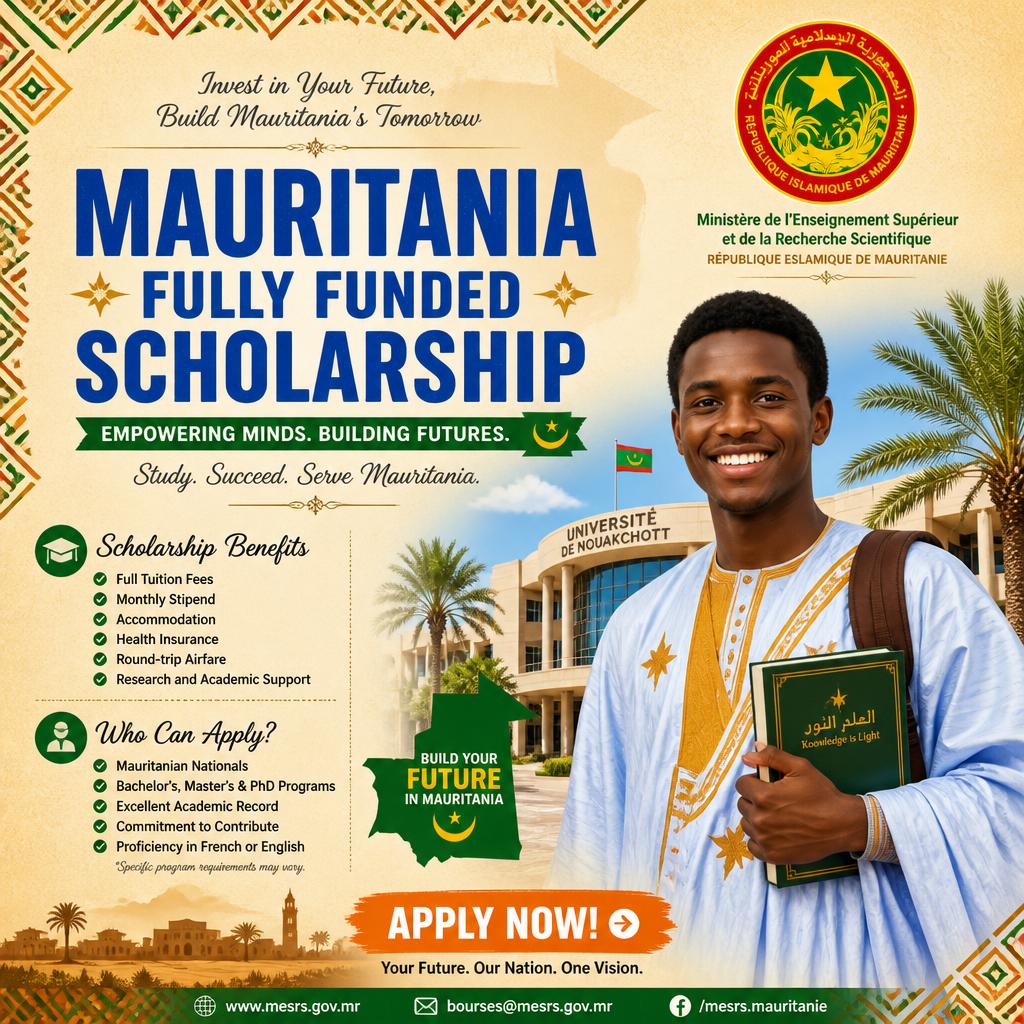
The Mauritania fully funded scholarship 2026 is one of the most underutilized, least competitive, and most genuinely comprehensive government scholarship programs available to African students today. It covers tuition, accommodation, travel, and living expenses—the whole package. And because most African students have never heard of it, you’re not competing with tens of thousands of applicants. You’re walking into a room that most people didn’t even know existed.
This guide exists to change that.
By the time you finish reading, you’ll know exactly what this scholarship covers, whether you qualify, how to apply step by step, and how to position yourself as the kind of candidate Mauritanian authorities are actively searching for. You’ll also understand why this program represents one of the most strategic scholarship moves an African student can make in 2026.
No fluff. No vague advice. Just everything you need to go from curious to confident.
Quick Summary Box:
- ✅ What this guide covers: The full scope of the Mauritania scholarship 2026—eligibility, coverage, application process, and insider positioning tips
- ✅ Key benefits you’ll gain: A clear, step-by-step roadmap to applying for a 100% funded education opportunity most applicants have overlooked
- ✅ How to use this post: Read straight through for the full picture, or jump to the section most relevant to where you are in the process right now
Why Mauritania? Understanding This Rare Scholarship Opportunity
Before we dive into the mechanics, let’s deal with the question sitting in the back of your mind: Why would Mauritania offer scholarships to African students, and why should I care?
It’s a fair question—and the answer is more strategic than you might expect.
Mauritania has been expanding its academic diplomacy program as part of its broader commitment to pan-African solidarity and South-South cooperation. Like Morocco, Tunisia, Egypt, and Algeria before it, Mauritania has recognized that investing in African student education builds long-term cultural, economic, and diplomatic ties across the continent. These scholarships aren’t charity—they’re strategic partnerships dressed in academic clothing.
The Islamic Republic of Mauritania hosts several institutions of higher learning, including the University of Nouakchott Al-Asriya, which offers programs in law, economics, science, Arabic language, and Islamic studies. The Mauritanian government, through its Ministry of Higher Education and Scientific Research, periodically extends scholarship offers to students from fellow African Union member states—particularly those with existing bilateral education agreements.
Here’s what makes this program genuinely different from the scholarships you’ve already applied to: the competition is remarkably low. While a fully funded Chevening scholarship in the UK attracts 65,000+ applications annually for roughly 1,800 spots, Mauritanian scholarship programs receive a fraction of that interest. Many eligible students simply never find out the opportunity exists.
That information gap is your advantage.
Mauritania also occupies a fascinating cultural crossroads—bridging Arab North Africa and sub-Saharan West Africa. If you’re studying Arabic, Islamic jurisprudence, African governance, economics, or North African history, studying in Mauritania gives you an authenticity of context that no European university can match. Your degree carries the lived experience of being immersed in one of Africa’s most culturally layered nations.
Additionally, Mauritania’s scholarship program aligns with several African Union Agenda 2063 objectives around intra-African mobility and human capital development. This means the program isn’t going away—if anything, it’s likely to grow.
The bottom line? Most students overlook Mauritania because it doesn’t appear on the glossy scholarship lists dominated by Western institutions. That’s exactly why you should pay attention.
What “Fully Funded” Really Means in the Mauritanian Context
Let’s be precise, because “fully funded” is one of the most misused phrases in the scholarship world. It’s thrown around loosely, and it has cost applicants real money when they arrive expecting full coverage and discover gaps they didn’t plan for.
For the Mauritania scholarship program, “fully funded” typically means the following components are covered:
- Tuition fees — all academic fees for your registered program of study
- Monthly living stipend — a modest but functional allowance to cover daily expenses
- University accommodation — on-campus housing provided or a housing allowance for approved off-campus options
- Round-trip airfare — international travel from your home country to Mauritania at program start and end
- Health coverage — basic medical care through university-affiliated health services
This is meaningfully different from a partial scholarship, which might only cover tuition while leaving you to fund your own accommodation, food, and travel. A partial scholarship sounds generous until you realize the remaining costs can equal or exceed the tuition savings.
It’s also different from a grant, which is a one-time financial award not tied to enrollment. A grant might give you $2,000 toward study expenses. A fully funded scholarship gives you the entire infrastructure of your academic life.
Here’s a side-by-side reality check:
| Scholarship Type | What It Covers | What You Still Pay |
|---|---|---|
| Fully Funded | Tuition + housing + stipend + flights + health | Personal items, visa application fees, minor incidentals |
| Partial Scholarship | Tuition only (sometimes partial) | Housing, food, transport, flights, everything else |
| Grant | One-time cash amount | Almost everything beyond the grant value |
| Loan-Based Aid | Nothing upfront—borrowed funds | Full repayment with interest after graduation |
What fully funded typically does NOT cover, even in generous programs like Mauritania’s:
- Visa application and processing fees (usually $50–$150)
- Personal shopping and entertainment
- Family dependents’ expenses
- Optional study trips or conferences outside the curriculum
- Personal health items beyond basic medical care
This is important, because you’ll need a small personal financial buffer—approximately $500–$800 USD—to cover these incidentals without stress.
Two reference points worth studying: The African Union Scholarships and Fellowships Program offers a useful model for understanding what “fully funded” means at the continental government level. Similarly, Egypt’s government scholarship program through Al-Azhar University—which shares structural similarities with Mauritania’s approach—covers tuition, accommodation, and monthly stipends as its core pillars.
The clearer you are about what’s covered before you apply, the better your financial planning—and the better your application answers will be. Scholarship committees can tell when an applicant has done their homework.
Building Your Scholarship Intelligence: Finding the Mauritania Opportunity and Others Like It
One of the reasons the Mauritania scholarship flies under the radar is structural—it’s not listed on the major Western scholarship aggregators that dominate Google search results. If you’ve been searching “scholarships for African students” and clicking the first three results, you’ve been fishing in an overfished pond.
Here’s the systematic approach that actually surfaces opportunities like the Mauritanian program:
Step 1: Start with Government-to-Government Channels
The Mauritania scholarship is coordinated at the ministerial level. Your first stop should be your own country’s Ministry of Education or Ministry of Foreign Affairs. Many African governments receive scholarship quota notifications directly from partner governments—including Mauritania—and post them through official channels that don’t get indexed by general scholarship databases.
Check your national education ministry’s official website and social media pages weekly. Subscribe to their newsletter if one exists.
Step 2: Contact the Mauritanian Embassy in Your Country
This is the single most direct and underused tactic available to you. The Mauritanian Embassy in your country receives official scholarship circulars from Nouakchott and is often the first point of contact for eligible applicants. A polite, professional email inquiry asking about scholarship opportunities for the 2026 academic year takes 20 minutes to write and could open a door that no Google search would find.
Step 3: Monitor Arabic-Language African Scholarship Platforms
Because Mauritania operates in both Arabic and French, many of its scholarship announcements appear first on Arabic-language platforms before being translated or shared on English sources. Platforms like منح دراسية (Scholarships in Arabic, also known as drasa.com) and منح.كوم regularly list North African government scholarships including those from Mauritania, Algeria, and Tunisia.
Step 4: Track These Core Scholarship Databases
For building your broader scholarship portfolio alongside the Mauritanian program, use these verified platforms:
- Mastercard Foundation Scholars Program — focused on African students with demonstrated financial need and leadership potential
- DAAD (German Academic Exchange Service) — daad.de; strong postgraduate options for African applicants
- British Council Chevening — chevening.org; UK master’s programs for emerging leaders
- African Union Commission Education Portal — au.int; intra-African scholarship listings
- Study in Africa Portal — growing database of intra-continental opportunities
- Your national education ministry portal — consistently underutilized, often most relevant
Step 5: Verify Before You Invest Time
Scholarship scams targeting African students are real and sophisticated. Before spending a single hour on an application, verify the scholarship through at least two independent sources. Legitimate scholarships never ask for application fees, never promise guaranteed admission, and always have verifiable institutional contact information.
A curated, verified database of 10–15 real opportunities—including Mauritania—is worth more than a frantic search through 200 unvetted listings. Build yours carefully, and protect your time.
Eligibility for the Mauritania Scholarship 2026: Your Complete Checklist
Let’s get practical. Before you spend weeks crafting a personal statement, spend 10 minutes running through this eligibility assessment. The Mauritanian government scholarship program has specific criteria, and knowing where you stand early saves you enormous effort.
Core Eligibility Requirements:
- ☐ African Union Member State Citizenship — You must hold citizenship in an African country that maintains diplomatic relations with Mauritania. Most AU member states qualify.
- ☐ Age Range — Typically 17–35 for undergraduate programs; 22–40 for postgraduate programs. Exact ranges vary by academic year—confirm with the Mauritanian Embassy.
- ☐ Academic Qualifications — A certified secondary school leaving certificate (baccalaureate or equivalent) for undergraduate programs; a recognized bachelor’s degree for postgraduate applications.
- ☐ Language Proficiency — Instruction at Mauritanian universities is conducted primarily in Arabic and French. Proficiency in at least one of these languages is essential. Arabic-language certification (CEFR B2 or equivalent) strengthens your application significantly.
- ☐ Medical Fitness — A clean bill of health from a recognized medical practitioner, confirming fitness to study abroad.
- ☐ Character References — Typically two academic or professional references attesting to your suitability for international study.
- ☐ Field of Study Alignment — Programs available at Mauritanian institutions (law, economics, sciences, Arabic language and literature, Islamic studies, engineering, medicine at select institutions). Your chosen field must be offered.
- ☐ No Concurrent Scholarship — You must not be currently benefiting from another government-funded scholarship.
Adult-Specific Considerations:
If you’re a mature applicant returning to education after a period of work experience, the Mauritanian program evaluates your profile holistically. Employment experience is not a disqualifier—in many cases, it functions as evidence of seriousness and life readiness. A 32-year-old with five years of professional experience in development work applying for a law degree carries a narrative weight that an 18-year-old simply cannot.
Employment gaps, family responsibilities, or non-linear educational paths should be addressed honestly in your personal statement. Mauritanian scholarship committees, much like those at African Union-aligned programs, respect authenticity and are not looking for idealized, Western-style academic profiles.
Are You Eligible? Quick Self-Assessment
Answer these four questions honestly:
- Do you hold citizenship in an AU member state? (Yes/No)
- Do you hold the academic qualification required for your target program level? (Yes/No)
- Do you have functional proficiency in Arabic or French? (Yes/No)
- Is your intended field of study available at a Mauritanian institution? (Yes/No)
If you answered Yes to all four, you’re eligible to apply. If you answered No to question three, that’s your most actionable preparation task before the 2026 cycle opens—start Arabic or French language study immediately.
Knowing exactly where you stand transforms anxiety into a to-do list. That’s the power of an honest eligibility assessment done early.
The 5 Scholarship Types African Students Actually Win — And Where Mauritania Fits
Understanding the broader scholarship landscape helps you see why the Mauritanian government program is such a strategic find. Here are the five scholarship types that African students actually win—and how Mauritania compares across each dimension.
1. Government-to-Government Bilateral Scholarships
Who funds them: National governments offering placements to citizens of partner countries as part of diplomatic exchange programs.
What makes African applicants competitive: Government scholarships prioritize cultural exchange and academic merit. African students bring diversity of perspective, genuine academic hunger, and often outstanding performance relative to applicants from wealthier nations.
Typical award: Full coverage—tuition, accommodation, stipend, airfare.
Realistic acceptance rates: 15–40%, depending on the program. Bilateral programs often have smaller applicant pools than global scholarships.
Real example: The Mauritania Government Scholarship 2026 is precisely this type—a bilateral program extended to fellow African nation citizens, with full coverage and relatively low competition. Egypt’s Al-Azhar scholarships and Morocco’s scholarship programs through the Mohammed VI Foundation follow the same structural model.
Adult advantage: Government scholarships evaluate your country’s future human capital needs. A 30-year-old professional with clear plans to return home and contribute to national development is often more compelling to government scholarship committees than a fresh secondary school graduate with no professional anchor.
2. University-Specific Mature Student Programs
Who funds them: Individual universities with specific funding pools for non-traditional or mature student enrollment.
What makes African applicants competitive: Life experience, professional clarity, and often above-average academic motivation once returned to study.
Typical award: Varies widely—from partial tuition waivers to full scholarships with stipends.
Realistic acceptance rates: 20–45% at programs specifically designed for mature applicants.
Real example: University of Nouakchott Al-Asriya offers faculty-level merit grants to exceptional international students alongside the government program. Combined, these awards can create a comprehensive funding package.
Adult advantage: Mature student programs exist specifically because universities recognize that adult learners outperform traditional students in completion rates and professional outcomes. Your age isn’t a liability in these programs—it’s the qualification.
3. NGO and Foundation Scholarships for Career Changers
Who funds them: International foundations, development organizations, and philanthropic bodies focused on African leadership and human capital.
What makes African applicants competitive: Personal narrative of impact, community embeddedness, and demonstrated leadership under constraint.
Typical award: $5,000–$50,000 USD, sometimes full coverage for prestigious programs.
Realistic acceptance rates: 2–8% for high-profile programs like Mastercard Foundation; higher for smaller regional foundations.
Real example: The Mastercard Foundation Scholars Program partners with universities across Africa and internationally. It specifically values applicants with demonstrated leadership and financial need—criteria that adult applicants with real-world experience often meet more authentically than younger applicants.
Adult advantage: Your career pivot story, if told compellingly, is your differentiator. A foundation funding African leaders wants to understand why now, why this, why you—and adult applicants have richer, more textured answers to those questions.
4. Merit-Based Scholarships Open to All Ages
Who funds them: Governments, universities, and foundations using academic merit as the primary criterion.
What makes African applicants competitive: Strong academic performance, research potential, and professional letters of reference.
Typical award: Varies—partial to full coverage.
Realistic acceptance rates: 5–25%, depending on competitiveness and field.
Real example: DAAD (German Academic Exchange Service) offers merit-based postgraduate scholarships with no strict upper age limit. DAAD reports that professionals returning to academia for graduate study represent a growing proportion of their African scholarship recipients—a trend that reflects the global recognition of adult learner value.
Adult advantage: Your undergraduate GPA matters, but professional publications, work achievements, and research experience carry equal or greater weight at the postgraduate level.
5. Employer-Sponsored Education Scholarships
Who funds them: Corporations, government employers, and development organizations sponsoring staff education as workforce investment.
What makes African applicants competitive: You’re already an employee—the selection process is internal, the competition is limited to colleagues, and the sponsor’s ROI is clear.
Typical award: Partial to full tuition, sometimes with salary continuation.
Realistic acceptance rates: Varies enormously by employer and program.
Real example: African Development Bank, World Food Programme, and numerous African government ministries offer sponsored study programs for existing staff pursuing development-relevant qualifications.
Adult advantage: This is the one scholarship type where being an adult with existing employment is an explicit requirement. If you’re currently employed, ask your HR department—many organizations have underpublicized scholarship programs that staff don’t know exist.
The right opportunity exists for every adult learner. Mauritania is your starting point—not your ceiling.
How to Apply for the Mauritania Scholarship 2026: Step-by-Step
This is where preparation becomes action. Follow these steps in sequence, and you’ll submit an application that stands out for all the right reasons.
Step 1: Establish Your Contact Points (Weeks 1–2)
Your first action is to contact two institutions simultaneously: the Mauritanian Embassy in your country and your own national Ministry of Education’s scholarship desk. Request written confirmation of the 2026 scholarship intake, official application guidelines, and deadlines.
Keep records of every communication. Screenshot emails. Note names of contacts. Government processes move slowly, and documented follow-up is your friend.
Step 2: Gather Your Academic Documentation (Weeks 2–4)
You’ll need the following, certified and officially translated where required:
- Original academic transcripts from all institutions attended (secondary through postgraduate if applicable)
- Degree certificates or diplomas, certified as authentic
- National identity document or passport (valid for at least 18 months beyond your intended enrollment date)
- Birth certificate, officially certified
If you studied at multiple institutions or have a non-linear academic path, gather documentation from each. A notarized explanation of any gaps or transfers, written calmly and factually, is better than silence.
Step 3: Prepare Your Language Proficiency Evidence (Weeks 3–5)
If Arabic is your intended language of instruction, gather any formal certification you hold. If you don’t hold a formal certificate, contact the Mauritanian Embassy for guidance on what language evidence they accept—some bilateral programs conduct their own internal language assessment rather than requiring DELF or CEFR certification.
If you don’t yet have the required language proficiency, start now. Six months of dedicated Arabic or French study is achievable and can position you for the 2026 cycle.
Step 4: Secure Your References (Weeks 3–5)
You’ll need two references. For adult applicants, the ideal combination is one academic reference and one professional reference. Your academic referee should speak to your intellectual ability; your professional referee should speak to your leadership, character, and real-world impact.
Brief both referees fully—share your personal statement draft, the scholarship details, and specific points you’d like them to address. A reference letter that accidentally contradicts your personal statement is worse than no letter at all.
Step 5: Write Your Personal Statement (Weeks 4–7)
This is your most important document. We cover the full positioning strategy in the next section, but the structural requirements for Mauritanian scholarship applications typically include:
- Your academic background and why you chose your field
- Your reasons for choosing Mauritania and its institutions specifically
- Your post-scholarship plans and how this education serves your country and community
- Any relevant professional experience or life circumstances that shape your motivation
Write in the language of your intended instruction (Arabic or French) if at all possible. An application submitted in the review committee’s working language demonstrates linguistic preparedness and cultural respect. It also eliminates translation ambiguity.
Step 6: Complete the Official Application Form and Submit (Weeks 7–9)
Complete the official form using the exact format specified by the Mauritanian Embassy or your national education ministry. Double-check every field. Attach all documents in the order specified. Submit both digital and physical copies if both are requested.
Give yourself 8–10 weeks minimum from information gathering to submission. Adult applicants frequently underestimate how long official document certification takes—especially if you need to retrieve records from institutions you attended years ago.
⚠️ 5 Mistakes That Cost Applicants — Avoid These
- Submitting uncertified document copies. Mauritanian authorities require official certification. Photocopies, even clear ones, are grounds for immediate disqualification.
- Writing a generic motivation letter. “I want to study in Mauritania to expand my horizons” tells the committee nothing. Specific, personal, and purposeful wins.
- Choosing weak references. A reference from someone who barely knows you—however impressive their title—is obvious and damaging. Choose people who can speak concretely about your capabilities.
- Ignoring the language requirement. Applying for an Arabic-instruction program without addressing your Arabic proficiency, even briefly and honestly, signals poor preparation.
- Missing the deadline by a day. Government scholarship offices do not grant extensions. Late applications disappear without acknowledgment.
Preparation is what separates hopeful applicants from successful scholars. The more thoroughly you prepare, the less the outcome depends on luck.
Positioning Your Story: Why You Are Exactly What Mauritania Is Looking For
Here’s the truth that most scholarship guides won’t tell you: the strongest applications aren’t written by the most academically gifted applicants. They’re written by people who understand who they are, why they’re applying, and what they’ll do with the opportunity—and who can articulate that with clarity and honesty.
The Mauritania scholarship committee is reading hundreds of applications. They’re looking for evidence that you’ve chosen Mauritania specifically—not as a fallback option, but as a deliberate, informed decision. They’re looking for someone whose educational goals align with what Mauritanian institutions actually offer. And they’re looking for someone whose story they can believe.
Reframe Your Background as a Strength
If you’re a mature applicant—someone who worked for five years before applying, someone who raised children while trying to find educational opportunities, someone who changed careers and is now pursuing alignment between vocation and qualification—your non-linear path is not a weakness you need to explain away. It is the story that makes you unforgettable.
Committees reviewing applications from fresh 18-year-olds often encounter promising potential with no evidence of follow-through. When they read your application—with its concrete experiences, tested resilience, and hard-won clarity of purpose—they’re reading confirmed potential. That’s a different and more compelling category.
The Career-Change and Return-to-Study Narrative
If you’re returning to education after a period in the workforce, your personal statement needs to answer one question above all others: Why now?
Not “why eventually” or “why someday.” Why now, in 2026, in Mauritania, in this specific program.
Your answer might be:
- A gap in your professional knowledge that you’ve identified through work experience
- A specific project or ambition that requires the credential you’re pursuing
- A life event that clarified your direction in ways that earlier education couldn’t have
- A recognition that the foundational skills you need are best acquired through structured study
Whatever your honest answer is, name it directly. The worst personal statements dance around the why now question. The best ones land on it in the first paragraph and spend the rest of the essay proving it.
Essay Frameworks That Work
Try one of these proven structural approaches for your personal statement:
1. “The Turning Point”
Describe a specific moment—a professional experience, a conversation, a failure, or a revelation—that crystallized why this education matters to you. Then trace the logical line from that moment to this application.
2. “The Knowledge Gap”
Identify a specific limitation in your current expertise that formal education in your field would address. Show how the Mauritanian program fills that gap in ways that alternatives don’t. This works especially well for professional applicants with a clear skills-to-study rationale.
3. “From Stability to Purpose”
If you’re leaving a stable career to pursue something more meaningful or more aligned with your values, own that story. Explain what stability taught you, why it’s no longer enough, and what you’re moving toward. Committees find this narrative compelling because it demonstrates that you’ve counted the cost—and chosen deliberately.
Here’s the difference between a generic statement and one that works:
Generic: “I have always been passionate about law and believe that studying in Mauritania will help me achieve my goals.”
Specific and compelling: “Five years as a community land-rights mediator in rural Senegal taught me that the disputes I resolved each week stemmed from the same source: legal systems that communities couldn’t access or understand. I’m applying to study law at Mauritania’s University of Nouakchott because its curriculum explicitly addresses Islamic jurisprudence and customary land law—the two frameworks that govern the communities I serve.”
One of those statements is forgettable. The other gets you remembered.
“When I stopped apologizing for being 32 and started explaining why I was ready, everything changed. The committee didn’t need a younger version of me—they needed someone who’d already lived the problem they were funding me to solve.”
— Kwame A., DAAD Scholar, 2024, age 32
Authenticity is not a soft advantage—it is your sharpest competitive edge.
The 2026 Scholarship Timeline: When to Move and What to Expect
Government scholarship cycles follow predictable rhythms. Here’s your planning framework for the Mauritanian scholarship 2026 cycle.
| Date Range | Milestone |
|---|---|
| October–December 2025 | Application window announcement; contact Mauritanian Embassy for official notification |
| January–February 2026 | Official application portal/form opens; begin document certification immediately |
| February–March 2026 | Language proficiency evidence deadline (internal to application submission) |
| March 2026 | Typical submission deadline window for most bilateral scholarship intakes |
| April–May 2026 | Application review and shortlisting by Mauritanian Ministry |
| May–June 2026 | Interview period (conducted in-country or via designated Embassy) |
| June–July 2026 | Final acceptance notifications issued |
| August–September 2026 | Pre-departure orientation; visa and travel arrangements |
| September–October 2026 | Academic year begins at Mauritanian institutions |
Important notes for adult applicants:
- Government scholarship timelines are firm. A deadline of March 31 means March 31.
- Document certification—especially for older academic records—can take 4–8 weeks. Start this process the moment you confirm your intention to apply.
- Rolling elements of the application (like reference letters) should be requested from your referees no later than 6 weeks before the submission deadline.
Set phone reminders now for each major milestone. Adult applicants often underestimate documentation time because their records are distributed across multiple years and institutions. Build in buffer.
Proactive planning is what separates applicants who submit polished, complete applications from those who scramble at the last minute and miss their chance.
Frequently Asked Questions About the Mauritania Scholarship 2026
Can I apply for the Mauritania scholarship if I’ve been working for several years and haven’t studied recently?
Yes, absolutely. The Mauritanian government scholarship evaluates your current academic qualifications, not when you last studied. If you hold the required academic credentials and meet the other eligibility requirements, a gap between your studies and your application is not disqualifying. Explain your professional experience briefly and honestly in your personal statement.
What if I don’t speak Arabic or French fluently—can I still apply?
Fluency in Arabic or French is a practical requirement because instruction at Mauritanian institutions is conducted in these languages. You can still apply if you’re in the process of developing proficiency, but you should be honest about your current level. Starting language study now—even six months before the deadline—demonstrates initiative and increases your realistic chances of success.
Can I work part-time while on the Mauritania government scholarship?
Government-funded scholarships typically prohibit formal employment alongside your studies, as the scholarship is designed to fund your full academic engagement. However, policies vary. You should confirm the specific terms with the Mauritanian Embassy or the scholarship administration office before making plans that depend on supplementary income.
Do I need to be living in my home country to apply for this scholarship?
Generally, yes—bilateral government scholarships require applications to be channeled through your country’s Ministry of Education or the Mauritanian Embassy in your home country. Applicants currently residing abroad in third countries should contact both the Mauritanian Embassy in their country of residence and their home country’s education ministry for specific guidance.
How long does it take from application to receiving a decision?
Based on comparable bilateral African government scholarship programs, the typical timeline is 4–6 months from the application deadline to final acceptance notification. Given a March 2026 deadline, you should expect decisions by June–July 2026. Build your planning around this timeline and avoid making irrevocable professional commitments until your decision arrives.
Can I reapply if my 2026 application is not successful?
Yes. Rejection from one scholarship cycle does not bar you from future cycles. Many successful scholarship recipients applied more than once. Use any feedback available—and if no feedback is provided, review your application critically for the weaknesses discussed in this guide—and reapply with a strengthened submission in the next intake.
Are African students at a disadvantage compared to Arab applicants for the Mauritania scholarship?
No. The Mauritanian bilateral scholarship program is specifically designed for non-Mauritanian students, including African students from sub-Saharan nations. Mauritania’s cultural identity as both an Arab League member and an African Union member means the country values both dimensions of its continental relationships. Being African is not a disadvantage—it’s an explicit eligibility criterion. Sub-Saharan African students bring perspectives that North African applicants cannot, and Mauritanian institutions value that diversity of representation.
The right application, submitted at the right time, can come from anyone ready to seize this opportunity.
Your Action Plan: The Next Steps You Take Today
If you’ve read this far, something shifted. Maybe it was the realization that Mauritania was never on your radar—and now it is. Maybe it was recognizing that your work experience and non-linear path, things you’d been quietly worried about, are actually compelling parts of your story. Maybe it was just the relief of having a clear, concrete plan laid out in front of you.
Whatever moved you, don’t let it sit idle.
Here’s what you do next—specifically, today or this week:
Action 1: Build your scholarship intelligence dossier.
Open a dedicated folder—digital or physical—for your Mauritania scholarship application. Inside it, place the contact details for your country’s Ministry of Education scholarship desk and the Mauritanian Embassy. Draft and send your introductory inquiry email this week. Also bookmark the African Union’s official education and scholarships portal and check it weekly—it lists current scholarship opportunities from AU member states including bilateral programs.
Action 2: Gather your documents now, before the window opens.
Don’t wait for the official application form to start collecting your transcripts, degree certificates, and identity documents. Begin the certification process immediately. Contact every institution you attended and request certified copies of your academic records. If any records are from more than five years ago, start this process first—it will take the longest.
Action 3: Map your 2026 scholarship timeline on your calendar.
Using the timeline table above, mark every major milestone in your phone’s calendar with a reminder set 14 days in advance. Then add one more reminder for October 2025 to check for the official application announcement from the Mauritanian government. Scholarship opportunities don’t wait—but prepared applicants don’t have to scramble either.
Also read our guide on crafting a personal statement as a career-changer—it will help you build the narrative foundation that transforms a competent application into a winning one.
You’ve spent years accumulating experience, resilience, and purpose that most 18-year-old scholarship applicants simply haven’t had time to develop yet. The Mauritania fully funded scholarship 2026 is a real program, with real funding, and a real chance for applicants who find it before everyone else does.
The room is open. Most people don’t even know it exists. You do now—so walk through the door.
Disclaimer: Scholarship details, eligibility criteria, and deadlines are subject to change by the awarding institution. Always verify current information directly with the Mauritanian Embassy in your country or your national Ministry of Education before submitting an application. This guide is intended as an informational resource and does not constitute official scholarship application guidance.
