Table of Contents
ToggleUntapped Fully Funded Scholarships in China 2026 That Remarkably Pay ¥50,000 Monthly Stipend — Applications Open Now
You’ve Been Sleeping on China. Here’s Why That Ends Today.
Let’s be honest with each other for a moment.
You’ve heard about scholarships in the UK, the US, Canada, Germany — the usual suspects that crowd every scholarship Facebook group and WhatsApp forward you’ve ever received. You’ve probably applied to a few, gotten rejected, and quietly shelved the idea of studying abroad like a dream that belongs to someone else.
But here’s the thing nobody is talking about loudly enough: China is quietly funding African students at a scale that would make your jaw drop — and most of your competition hasn’t figured it out yet.
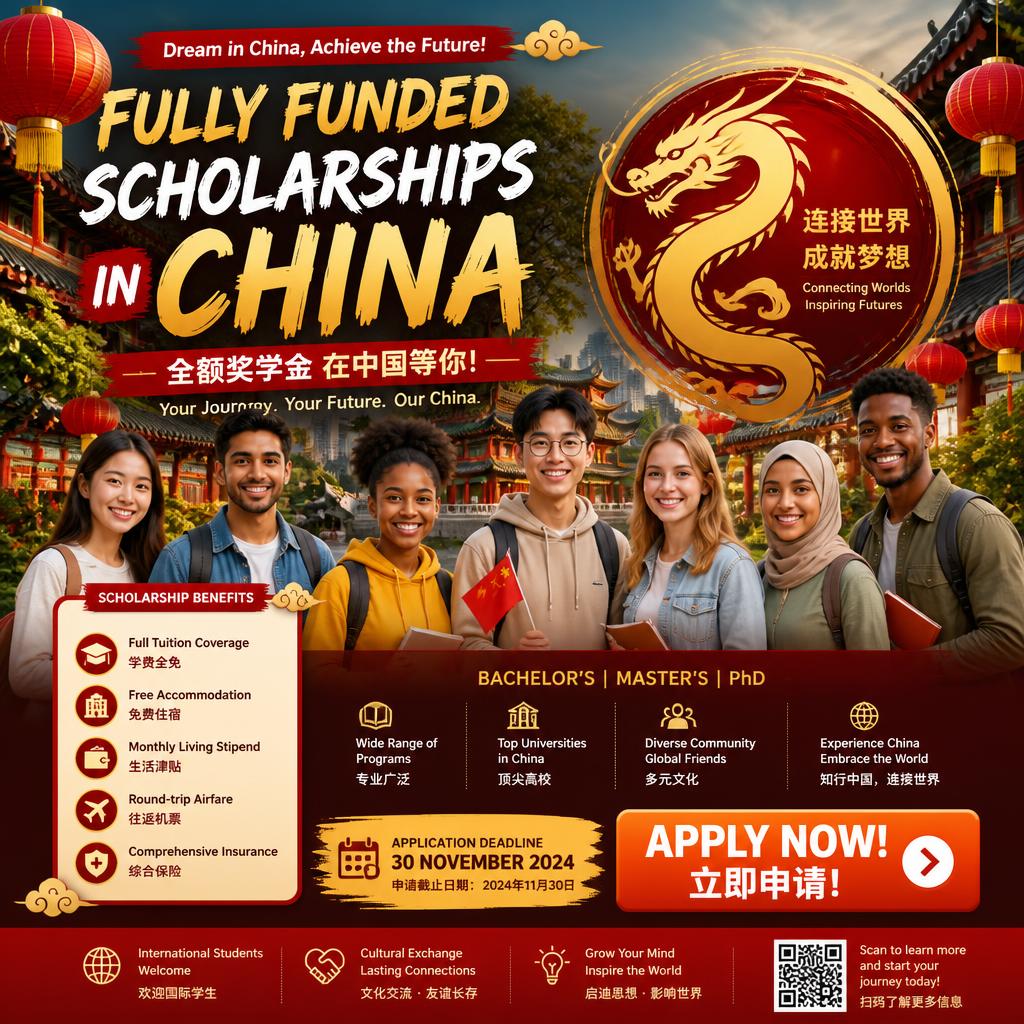
We’re talking about fully funded scholarships in China for 2026 that cover your tuition completely, house you in comfortable university accommodation, give you a monthly living stipend that can reach ¥50,000 (yes, that’s roughly $6,900 USD per month for certain programs), and in some cases even fly you there and back home again.
These programs exist. They’re real. They’re actively seeking African applicants. And applications are open right now.
This post is your complete, no-nonsense guide to understanding exactly which China scholarships are available in 2026, what they actually cover, who qualifies, and — most importantly — how you apply strategically to give yourself the strongest possible shot at winning one.
Here’s your Quick Summary:
- ✅ What this guide covers: The top fully funded China scholarships for African students in 2026, including stipend details, eligibility requirements, and application walkthroughs
- ✅ Key benefits you’ll gain: You’ll know which programs match your profile, what documents you need, and how to position yourself as a standout applicant
- ✅ How to use this post: Read straight through once, then return to the eligibility checklist and action plan with your documents beside you
Why China? The Case That Will Change How You Think About Studying Abroad
Before we dive into the individual scholarships, you need to understand why China has become one of the most generous scholarship destinations on earth for African students — because that context will shape how you write your applications.
China’s investment in African education isn’t charity. It’s strategy. Through its Belt and Road Initiative and decades of South-South cooperation frameworks, China has committed to educating hundreds of thousands of students from developing nations, with Africa receiving a disproportionately large share of those seats.
The numbers are staggering. In 2023 alone, China hosted over 77,000 African students — more than any other destination outside of the African continent itself. The Chinese government has pledged to expand that number significantly through 2026 and beyond, which means scholarship quotas are growing, not shrinking.
Here’s what that means for you practically: the competition for China scholarships, relative to the funding available, is far lower than for European or North American programs. You’re not competing against the entire world with equal information access. You’re entering a market where awareness gaps still work in your favor.
China’s universities have also climbed global rankings aggressively. As of 2024, seven Chinese universities rank in the global top 100, with Tsinghua University, Peking University, and Fudan University now competing seriously with institutions in the UK and Australia. A degree from these institutions opens doors in China, across Africa, and globally in ways that simply weren’t possible fifteen years ago.
And then there’s the stipend question — the one that probably brought you to this post in the first place.
The ¥50,000 monthly figure is real, but it requires context. Most standard fully funded China scholarships offer stipends between ¥1,700 and ¥3,500 per month depending on your level of study. The higher figures — reaching ¥50,000 — apply to elite presidential and governmental special programs, certain provincial scholarships with premium packages, and specialized research fellowships. We’ll break down exactly which programs pay what in the sections ahead.
The point is this: whether you’re looking at the standard package or the premium tier, China’s scholarship ecosystem offers some of the most comprehensive financial coverage available to African students anywhere in the world.
Understanding “Fully Funded” — What China Scholarships Actually Cover (And What They Don’t)
The phrase “fully funded” gets thrown around so loosely that it’s lost almost all meaning. You need to know exactly what you’re getting before you invest months into an application.
A genuinely fully funded scholarship covers four core categories: tuition fees, accommodation, a monthly living stipend, and typically some form of travel support. When China’s scholarship programs say “fully funded,” they mean this comprehensively — and most of China’s top programs are among the most genuinely complete packages you’ll find globally.
Here’s how the spectrum actually breaks down:
Full Scholarships eliminate tuition entirely and provide living support. China’s flagship Chinese Government Scholarship (CSC) falls here. It covers tuition 100%, provides free or heavily subsidized university accommodation, delivers a monthly stipend, and includes a one-time travel allowance.
Partial Scholarships cover only certain costs — maybe tuition but not living expenses, or a stipend but not accommodation. Several provincial-level China scholarships work this way. They’re still valuable, but don’t confuse them with the full package.
Grants are one-time or fixed payments, not ongoing support. Some Chinese university excellence awards work like this.
Loans require repayment. If anyone offers you a “scholarship” that requires repayment, that’s a loan dressed in better clothing.
Now, what does “fully funded” typically not cover in the Chinese context? Health insurance is usually provided, but personal expenses, visa application fees, airport transfers, and study materials beyond a basic allowance are typically your responsibility. Budget roughly ¥500–¥1,000 per month for these extras depending on your lifestyle and city.
Let’s look at two real programs to make this concrete:
The Chinese Government Scholarship (CSC): Covers tuition in full, provides free university dormitory accommodation (or a housing stipend of ¥600–¥1,500/month if you live off-campus), delivers monthly stipends of ¥1,700 (undergraduate), ¥2,000 (master’s), or ¥2,500 (doctoral), and includes comprehensive medical insurance. Travel support is a one-time allowance, not a reimbursement for premium flights.
The Bilateral/Presidential Special Scholarship Programs: These elite-tier programs — often negotiated directly between African governments and China — can include premium stipend packages, research budgets, and conference travel allowances that push the monthly support figure significantly higher. These are the programs where the ¥50,000 figure becomes relevant for certain research categories.
The rule of thumb: Always download the official scholarship handbook for any program you’re considering and read the coverage table line by line. What you find in the detailed documentation is often more generous — and occasionally more limited — than the headline advertising suggests.
The Fully Funded China Scholarships You Need to Know in 2026
This is the section you’ll bookmark and return to. Here are the primary fully funded scholarship pathways for African students targeting 2026 enrollment, with honest detail on what each offers.
1. The Chinese Government Scholarship (CSC Scholarship)
This is the crown jewel — China’s most widely available and most established fully funded scholarship for international students, administered by the China Scholarship Council under the Ministry of Education.
The CSC scholarship is available at three academic levels (undergraduate, master’s, and doctoral) across more than 300 designated Chinese universities. African students from virtually every country on the continent are eligible to apply, and China has bilateral agreements with dozens of African nations that create reserved quota seats specifically for your country.
What it covers:
- Full tuition waiver
- University accommodation or housing allowance (¥600–¥1,500/month)
- Monthly stipend: ¥1,700 (undergraduate), ¥2,000 (master’s), ¥2,500 (doctoral)
- Comprehensive medical insurance
- One-time travel allowance (economy class reimbursement)
Application channels: You can apply through your home country’s Chinese Embassy (Type A), directly through a designated Chinese university (Type B), or through your home government’s education ministry if a bilateral agreement exists. Using all three channels simultaneously — where permitted — multiplies your chances significantly.
Deadline: Most CSC scholarship cycles open between October and March for September enrollment. For 2026 enrollment, expect the main application window to open between November 2025 and March 2026. Check the official CSC scholarship portal for your country-specific deadline.
2. The Provincial Government Scholarships
Here’s a category that shockingly few African applicants know about: individual Chinese provinces run their own international scholarship programs entirely separate from the national CSC.
Provinces like Guangdong, Zhejiang, Jiangsu, Fujian, Hunan, and Shandong each have their own scholarship funds targeting international students — including African applicants — and these programs are dramatically less competitive than the flagship CSC because awareness is so much lower.
The Guangdong Government Scholarship, for example, covers tuition and provides stipends at rates comparable to the CSC program. The Jiangsu Government Scholarship (Jiangsu Provincial Government Foreign Students Scholarship) is another strong option with generous coverage.
Your move: Search “[Province Name] government scholarship for international students 2026” and visit the provincial education department website directly. These are hidden gems with shorter application queues.
3. The University President Scholarships
Almost every top-ranked Chinese university administers its own merit-based fully funded scholarship program for exceptional international applicants — and “exceptional” doesn’t always mean the grades you think it does.
Tsinghua University’s Scholarship for International Students, Peking University’s Presidential Scholarship, Fudan University’s International Students Excellence Scholarship, Shanghai Jiao Tong University’s scholarships, and Zhejiang University’s international programs all fall into this category.
These are typically the programs where premium stipend packages exist. Research fellowships at doctoral level at Tsinghua or Peking, for instance, can include research project allowances, conference budgets, and supplementary stipends from supervisors that significantly exceed the base CSC rate.
For doctoral applicants especially: securing a supervisor who has independent research funding before submitting your application can unlock stipend supplements that bring your monthly support into ranges far exceeding the standard packages.
4. The Confucius Institute Scholarship (Chinese Government Scholarship — Chinese Language Programs)
If you’re interested in studying the Chinese language, Mandarin teacher training, or pursuing a degree taught in Chinese, the Confucius Institute Scholarship is specifically designed for you.
This program targets students who want to develop Chinese language proficiency and covers tuition, accommodation, and a monthly stipend for language-focused programs. It’s one of the easier entry points into the China scholarship ecosystem because language programs have lower academic entry requirements than STEM or business degree programs.
Importantly: demonstrating Mandarin language interest in any China scholarship application is a competitive advantage. It signals commitment to genuine integration, not just benefit extraction.
5. African Union–China Cooperation Scholarships
Under the Forum on China-Africa Cooperation (FOCAC) framework, China has committed to providing thousands of scholarships specifically for African students across every FOCAC member state. These are allocated to African governments, who then manage the local selection process.
This is the channel where bilateral quota seats exist. Contact your country’s Ministry of Education, Ministry of Foreign Affairs, or Chinese Embassy directly to find out how many seats your country has been allocated for 2026 and what the local application requirements and deadlines are.
Countries like Nigeria, Ethiopia, Kenya, Ghana, South Africa, Egypt, and Tanzania typically have significant quota allocations. Smaller nations sometimes have fewer seats but face far less local competition for them.
The ¥50,000 Stipend: Separating Reality From Headlines
Let’s give this the honest treatment it deserves, because you came here partly because of that number.
¥50,000 per month is not the standard CSC stipend. The standard monthly stipend for doctoral students is ¥2,500. Let’s be absolutely clear about that so you’re not blindsided.
However, ¥50,000 total monthly support is achievable through a combination of sources that stacks legally and legitimately:
Layer 1 — Base CSC or University Stipend: ¥2,000–¥3,500/month depending on program
Layer 2 — Supervisor Research Allowance: Doctoral students whose supervisors have active National Natural Science Foundation of China (NSFC) grants often receive additional monthly payments of ¥3,000–¥8,000 or more from project budgets
Layer 3 — Teaching/Research Assistant Positions: Many Chinese universities pay international doctoral students ¥2,000–¥5,000/month for TA or RA roles
Layer 4 — Excellence and Performance Bonuses: Universities award annual or semester excellence stipends of ¥5,000–¥30,000 to top-performing international students
Layer 5 — Provincial Supplements and Special Program Bonuses: Elite programs and government-to-government special scholarships add additional monthly or annual supplements
When you add all these layers together for a high-performing doctoral student in a well-funded research group at a top Chinese university, total monthly financial support can legitimately reach or exceed ¥50,000. Some specialized programs — particularly in science, technology, and engineering research — package these benefits into a single headline stipend figure.
The honest takeaway: pursue the CSC or university scholarship as your foundation, get admitted to a strong research group with an active supervisor, perform excellently once enrolled, and the higher figures become genuinely accessible over the course of your program.
Eligibility Checklist: Do You Qualify for China’s Fully Funded Scholarships?
Before you spend a single hour on application documents, run yourself through this checklist. Being organized here saves you from painful surprises later.
Standard Eligibility Requirements
✅ Citizenship/Nationality:
You must hold citizenship of a country that is not China. For African students, this covers the entire continent. Most programs specifically invite applications from African Union member states.
✅ Age:
- Undergraduate applicants: typically under 25 years old
- Master’s applicants: typically under 35 years old
- Doctoral applicants: typically under 40 years old
- Some provincial and presidential scholarships extend these limits. Always check program-specific rules.
✅ Academic Background:
- Undergraduate: High school diploma with strong grades (typically top 20–30% of your graduating class)
- Master’s: Bachelor’s degree — typically minimum GPA of 3.0/4.0 or equivalent
- Doctoral: Master’s degree — strong academic record plus research proposal
✅ Health:
A physical examination using the Chinese government’s prescribed health form is mandatory for all applicants. HIV, tuberculosis, and certain other conditions are listed as disqualifying under current regulations — check the specific form requirements at your Chinese Embassy.
✅ Language Requirements:
- Programs taught in Chinese: HSK (Chinese proficiency test) scores are typically required, usually HSK 4 or HSK 5 depending on program level
- Programs taught in English: IELTS (typically 6.0+) or TOEFL (typically 80+), or an English-medium study certificate from your previous institution. Many Chinese universities accept a letter confirming your previous degree was taught in English as a language waiver.
✅ No Existing Scholarship:
Most CSC and government scholarship programs require that you are not currently receiving another government-funded scholarship. Check this carefully if you hold other funding.
Are You Eligible? Quick Self-Assessment
Answer these four questions honestly:
- Do you hold a completed academic qualification at the appropriate level for the program you want to apply for? (Yes/No)
- Are you within the age limit for your target program? (Yes/No)
- Can you provide evidence of English or Chinese language proficiency? (Yes/No)
- Are you a non-Chinese citizen from an eligible country? (Yes/No)
If you answered Yes to all four: you meet the baseline eligibility threshold and should begin your full application immediately.
If you answered No to any: identify specifically what’s missing, create a plan to address it (language test, completing a qualification, etc.), and target the next available intake rather than rushing unprepared.
One thing adult applicants often worry about unnecessarily: employment gaps between degrees. Chinese scholarship programs typically view gaps positively when you can explain them — work experience, family responsibility, and entrepreneurship all read as maturity signals to selection committees accustomed to reviewing younger applicants with thinner profiles.
Building Your Scholarship Database: A Systematic, Organized Approach
Finding scholarships is not the problem. Finding the right scholarships for your specific profile, then tracking them systematically, is where most applicants fall short. Here’s how to do it properly.
Step 1: Start with the Official CSC Portal
Visit Campus China, the official Chinese Government Scholarship application and information platform. This is the authoritative source for CSC scholarship details, designated universities, and application timelines. Bookmark it. Return to it weekly during application season.
Step 2: Contact Your Chinese Embassy
Find the education section of the Chinese Embassy or Consulate in your country. Request the current list of scholarships available to your nationality for 2026 intake, including bilateral quota details and country-specific deadlines. Do this by email and follow up in person if possible — the information available in person often exceeds what’s published online.
Step 3: Identify Your Target Universities and Apply Directly
Choose 5–8 Chinese universities that offer strong programs in your field. Visit each university’s international students office website and locate their scholarship page. Look specifically for “President’s Scholarship,” “International Excellence Award,” or “University Self-Funded Scholarship” options. Apply to the university directly in addition to submitting through the CSC portal — this dual application approach is permitted and actively encouraged.
Strong starting targets for African students by field:
- STEM/Engineering: Tsinghua University, Shanghai Jiao Tong University, Harbin Institute of Technology
- Business/Economics: Peking University, Fudan University, Renmin University
- Medicine/Public Health: China Medical University, Peking Union Medical College
- Agriculture/Environmental Science: China Agricultural University, Zhejiang University
- Social Sciences/International Relations: Peking University, East China Normal University
Step 4: Check Your Home Government Education Ministry
In countries including Nigeria, Ghana, Kenya, South Africa, Ethiopia, Egypt, Tanzania, and Rwanda, the national Ministry of Education manages FOCAC and bilateral scholarship allocations. These seats are often announced through local channels — newspapers, ministry websites, and embassy notices — rather than international scholarship platforms. Set up a Google Alert for “[Your Country] China scholarship 2026” to catch these announcements automatically.
Step 5: Verify Before You Invest
Before spending time on any application, verify the scholarship is legitimate. Legitimate China scholarships will:
- Be listed on the official CSC portal or an official university website
- Never ask for application fees
- Have a verifiable institutional contact email (not a Gmail or Yahoo address)
- Provide clear documentation of what’s covered and selection criteria
If a “scholarship” asks for money upfront, has vague contact information, or promises guaranteed placement — walk away. These scams specifically target African students, and they’re more common than scholarship Facebook groups acknowledge.
Step 6: Build Your Tracking Spreadsheet
Create a simple spreadsheet with columns for: Scholarship Name | University | Application Channel | Deadline | Documents Required | Status. Update it weekly. Your scholarship search is a project — treat it like one.
The 5 Scholarship Types African Students Actually Win in China
Understanding the landscape means knowing not just which scholarships exist, but which categories give you the strongest competitive position as an African applicant.
Type 1: Chinese Government (CSC) Bilateral Scholarships
Who funds it: The Chinese central government through the China Scholarship Council
Why African applicants are competitive: Bilateral agreements create reserved seats for your nationality — you’re competing within a smaller national pool, not against the world
Typical award: Full tuition + accommodation + ¥2,000–¥2,500/month stipend + insurance + travel allowance
Acceptance rate: Varies significantly by country quota and applicant pool size; bilateral quota recipients often have acceptance rates of 15–40% within their national application pool
Real example: Ethiopia received 1,500 CSC scholarship slots for the 2023–2024 academic year under FOCAC commitments — one of the highest per-country allocations in Africa
Type 2: University President and Excellence Scholarships
Who funds it: Individual Chinese universities from their own institutional budgets
Why African applicants are competitive: Universities have international diversity targets; African students from underrepresented countries benefit from geographic diversity quotas
Typical award: Varies from tuition-only to full packages; top-tier universities offer full coverage with enhanced stipends
Acceptance rate: Highly competitive at top-10 universities; more accessible at strong regional universities
Real example: Zhejiang University’s “International Students Excellence Scholarship” offers full tuition waivers plus monthly stipends to top-ranked applicants across all academic levels
Type 3: Provincial Government Scholarships
Who funds it: Provincial governments of major Chinese economic regions
Why African applicants are competitive: Low awareness among African applicants means genuinely less competition; provinces actively seek diversity
Typical award: Full tuition plus stipends comparable to CSC rates
Acceptance rate: Often higher than CSC due to lower application volumes
Real example: The Guangdong Provincial Government Scholarship has funded hundreds of African students in fields ranging from business to engineering, with English-taught programs available
Type 4: Research Supervisor Fellowships (Doctoral Level)
Who funds it: Individual Chinese professors using National Natural Science Foundation grants, university research budgets, or international collaboration project funding
Why African applicants are competitive: Research supervisors care most about your research potential and proposal quality — age, nationality, and background become secondary to competence
Typical award: Base stipend plus research allowances that can add ¥3,000–¥15,000+ per month
Acceptance rate: Competitive but based heavily on research fit and supervisor preference
Real example: Doctoral students in competitive research groups at Tsinghua, Peking, and Shanghai Jiao Tong routinely receive combined monthly support packages exceeding ¥8,000–¥15,000 through stacked funding sources
Type 5: Confucius Institute and Language-Focused Scholarships
Who funds it: Hanban (Chinese International Chinese Education Foundation) through Confucius Institutes globally
Why African applicants are competitive: Strong demand exists for Mandarin proficiency across Africa; your dual-language capability is a genuine asset
Typical award: Full tuition for language programs plus monthly stipend of ¥1,400–¥2,000
Acceptance rate: Relatively accessible as an entry point; strong pathway to longer-term degree scholarships
Real example: The Confucius Institute Scholarship has Confucius Institutes in over 20 African countries serving as local application points, making access dramatically more practical than purely online portals
How to Apply: Your Step-by-Step Application Walkthrough
The application process for China’s fully funded scholarships has a specific rhythm. Follow it in sequence and you’ll avoid the documentation chaos that derails most applicants.
Step 1: Choose Your Programs and Channels (Weeks 1–2)
Decide which scholarship category you’re targeting and which universities you’ll apply to. Identify whether you’ll apply through the CSC portal (Type A or Type B), through your home embassy, your Ministry of Education, or directly to the university — or all channels simultaneously where the rules permit.
Write this down explicitly. Vague intentions produce abandoned applications.
Step 2: Gather and Authenticate Your Academic Documents (Weeks 2–4)
You’ll need official transcripts from every institution you’ve attended, authenticated by the issuing institution and — for most programs — notarized or apostilled. Start this immediately. Authentication processes in many African countries take 2–6 weeks, and this single step causes more missed deadlines than any other factor.
Documents you’ll typically need:
- Official transcripts (certified copies)
- Degree certificates/diplomas (notarized)
- National ID or passport (valid for at least 18 months beyond your intended start date)
- Passport-sized photographs (the specific dimensions matter — get them right)
- Physical examination form (completed by a certified physician using the official Chinese government form)
Step 3: Prepare Your Language Documentation (Weeks 2–3)
If your target programs require IELTS or TOEFL, book your test immediately — test dates fill up quickly in major African cities. If you’re claiming an English-medium exemption, request a formal letter from your previous institution confirming instruction language.
For Chinese-medium programs, register for the HSK exam at your nearest Confucius Institute.
Step 4: Write Your Personal Statement and Research Proposal (Weeks 3–6)
This is where applications are won and lost. We’ve dedicated the entire next section to this — read it carefully before you write a single word.
For now: give yourself no less than three weeks for drafting, feedback, and revision. One week produces a first draft. Two weeks produces a revised draft. Three weeks produces something competitive.
Step 5: Secure Your Reference Letters (Weeks 3–5)
Most programs require two to three reference letters from academic supervisors, employers, or professional mentors. Request these early — at least four weeks before your deadline. Brief your referees specifically on the scholarship you’re applying for, why you’re a strong candidate, and what aspects of your profile you’d like them to highlight.
A generic reference letter is nearly worthless. A specific, detailed reference letter tailored to the scholarship criteria can move you from the middle of the pile to the top.
Step 6: Complete the Online Application Portal (Weeks 6–8)
Create your account on the CSC portal (campuschina.org) and/or the specific university’s application portal. Fill in every section completely — leave nothing blank. Upload all documents in the required format (PDF typically, with specific file size limits).
Double-check every upload. Applications have been rejected for uploading the wrong document to the wrong field. Triple-check your passport number, date of birth, and programme code.
Step 7: Submit and Follow Up (Week 8–10)
Submit your application before the deadline — not on the deadline. Aim to submit 5–7 days early to allow time to address any technical issues.
Save your confirmation number. Follow up with the embassy or university’s international office 2–3 weeks after submission to confirm receipt.
⚠️ 5 Mistakes That Cost Applicants — Avoid These
1. Submitting un-authenticated documents: Unofficial transcripts or uncertified copies are immediate grounds for disqualification. Every document must be properly authenticated.
2. Generic personal statements: “I want to study in China because it is a great country with many opportunities” tells a selection committee nothing. You must be specific about your research focus, career intention, and why China specifically.
3. Ignoring program language requirements: Applying for a Chinese-taught program without HSK scores, or an English-taught program without IELTS/TOEFL, wastes everyone’s time including yours.
4. Applying to only one channel: Many successful applicants apply through both the CSC portal and directly to universities simultaneously. Don’t leave parallel pathways unexplored.
5. Missing your country’s local deadline: The CSC portal deadline and your Embassy’s submission deadline are often different — sometimes by weeks. Confirm your country-specific deadline directly with the Chinese Embassy in your capital.
Positioning Your Story: Why You’re Exactly the Candidate They Want
Here’s something selection committees know that most applicants don’t: the most technically qualified applicant rarely wins. The most compellingly positioned applicant does.
Your story — where you come from, why you want to study in China, what you’ve experienced, what you intend to do when you return — is not a formality. It is the deciding factor when two applicants have similar grades and test scores.
China’s scholarship selection process places significant weight on what they call “purpose clarity.” They want to fund students who know exactly why they’re coming, what they’ll study, and how their education will serve their communities and their countries after graduation. This is where you have an enormous advantage over younger applicants who haven’t yet lived enough of their professional or personal journey to articulate a genuinely compelling purpose.
If you’ve worked for five years and you’re now pursuing graduate study in public health, energy policy, agricultural science, or engineering — your work experience is not a detour on your academic journey. It is the reason your academic journey has arrived at this specific, powerful destination.
Here’s a quote that should shift something for you:
“I kept trying to make my application sound like I was a fresh graduate. When I finally wrote honestly about my seven years working in water infrastructure projects in rural Ghana and why that led me to want a master’s in environmental engineering from Tsinghua, I got three scholarship offers in the same cycle.”
— Abena K., CSC Scholar, Tsinghua University, 2023, age 34
Three frameworks for structuring your personal statement:
Framework 1 — “The Problem I Cannot Ignore”:
Open with a specific problem you witnessed in your professional or community life. Show how your proposed studies are your direct response to that problem. Connect your return plans to the solution.
Framework 2 — “The Turning Point”:
Identify the specific moment, experience, or realization that clarified your direction. Build your narrative around how everything since that moment has been preparation for this program.
Framework 3 — “From Where I Stand to Where I’m Going”:
Describe your current professional position and its limitations without the skills you’ll gain. Project forward to the impact you’ll make with your Chinese university credential and returned expertise.
The difference between a generic and a compelling statement is specificity. Don’t say “I want to contribute to my country’s development.” Say “I want to bring the precision irrigation modeling techniques pioneered at Zhejiang University’s hydrology department back to northern Nigeria’s smallholder farming communities, where I’ve spent four years watching droughts destroy crops that better water management could save.”
That’s not a scholarship application. That’s a mission statement. Those win.
The 2026 China Scholarship Application Timeline
Use this as your master planning calendar. Set phone reminders for each milestone — documentation delays are the number one reason qualified applicants miss deadlines they were fully capable of meeting.
| Date Range | Milestone |
|---|---|
| September–October 2025 | Research scholarship programs; identify target universities and fields; begin HSK or IELTS registration if needed |
| October–November 2025 | Contact Chinese Embassy in your country; request 2026 scholarship quota information and country-specific forms |
| November 2025–January 2026 | Begin document authentication process; request transcripts and degree certificates from previous institutions |
| December 2025–February 2026 | CSC portal opens for 2026 applications; begin university direct applications; email potential doctoral supervisors |
| January–February 2026 | Request reference letters from academic and professional referees; draft personal statement and research proposal |
| February–March 2026 | Complete and review full application packages; submit to embassy channel and university portal |
| March–April 2026 | Most embassy submission deadlines; some universities have late March or April 30 cut-offs — verify each |
| May–June 2026 | CSC reviews applications; preliminary notifications for some bilateral quota selections |
| June–August 2026 | Final admission notifications; visa application period; pre-departure preparation |
| September 2026 | Program commencement for most September-intake programs |
Rolling applications note: Some provincial scholarships and university direct scholarships accept applications on a rolling basis rather than a fixed deadline. These are particularly practical if your timeline is compressed. Check each program individually.
⏰ Set your phone reminders six weeks before each major deadline. Gathering authenticated academic documents alone often takes four to six weeks in many African countries. Build that time into your schedule explicitly — not optimistically.
Frequently Asked Questions
Can I apply for a Chinese Government Scholarship if I’m already working full-time?
Yes — your employment history is not a barrier. In fact, professional experience strengthens your application by demonstrating practical motivation for advanced study. You’ll need to arrange a study leave or resignation before enrollment, but the application process itself has no employment restriction. Many of China’s best-funded scholars were mid-career professionals when they applied.
What if there’s a gap between my last degree and now?
A gap in your academic record is not disqualifying for Chinese scholarships. You’ll address it in your personal statement by explaining what you did during that period — work, family, entrepreneurship, or personal development. Selection committees respond positively to honest, confident explanations. What they disqualify is unexplained inconsistency, not honest life experience.
Can I work part-time while on a Chinese Government Scholarship?
The CSC scholarship conditions technically restrict off-campus employment, but on-campus paid roles — teaching assistantships, research assistantships, and tutoring positions — are generally permitted and actively available. Many scholars supplement their stipend through on-campus roles with full university and scholarship administrator knowledge. Confirm the specific terms of your scholarship offer before accepting any paid position.
Do I need to be living in my home country when I apply?
For most channels, you apply through the Chinese Embassy of your home country, which typically requires you to be either a citizen or a current resident of that country. However, some university direct application channels (Type B) have no residency restriction. If you’re currently living outside your home country, focus on the university direct channel and verify eligibility with the specific institution’s international admissions office.
How long does the full process take from application to arriving in China?
For the standard CSC cycle targeting September 2026 enrollment, the application-to-arrival timeline is roughly 8–12 months. Applications open as early as November and close between March and April. Notifications arrive between June and August. Visa processing typically takes 4–8 weeks. Build your timeline with this arc in mind — starting in November 2025 for September 2026 enrollment is not early; it’s appropriate.
Can I reapply if I’m rejected?
Absolutely yes — and you should. Many of China’s most successful scholars were rejected in their first application cycle and succeeded in their second or third attempt. A rejection gives you valuable information: review the specific feedback if provided, strengthen the weakest elements of your application (usually the personal statement or missing documentation), and reapply the following cycle with a demonstrably improved package.
Are African applicants genuinely competitive, or does this only work for applicants from certain countries?
African applicants are specifically and actively recruited through China’s FOCAC framework, bilateral agreements, and the CSC program’s international diversity mandate. Every African Union member state has bilateral scholarship access. Some nationalities — particularly from countries with strong China-Africa diplomatic relationships — have reserved quota seats that specifically favor their citizens. Your African nationality is not a limitation in this context; it’s frequently an explicit advantage.
The only application that’s guaranteed to fail is the one you never submit.
Your Action Plan: What You Do Starting Today
Here’s the truth about scholarship success that no one tells you clearly enough: the difference between African students who study in China on full scholarships and those who don’t is almost never talent, intelligence, or even grades. It’s whether they started the process early enough and followed through with consistency.
You’ve just read everything you need to make a genuinely informed decision and take genuinely effective action. The knowledge is no longer the gap. The gap is now simply whether you act on what you know.
You might feel excited right now. You might feel slightly overwhelmed. Both are normal. Both are signs you understand the opportunity is real. The right response to both feelings is the same: take the first concrete step before that feeling fades.
Here are your three immediate, specific actions:
1. Build your scholarship database today (not this week — today):
Open a Google Sheet right now. Add columns for: Scholarship Name | University | Application Channel | Deadline | Documents Required | Status. Add the CSC Scholarship, two provincial scholarships from your field’s relevant provinces, and one presidential scholarship from a target university. You now have a working database. Add to it every week.
2. Begin your document authentication process this week:
Email your previous university’s registrar requesting official transcripts and a certified copy of your degree certificate. Ask about authentication and apostille procedures in the same email. This single step — started today — determines whether you make March deadlines or miss them. Nothing else has a longer lead time or more potential to derail a prepared applicant.
3. Create your 2026 deadline calendar today:
Using the timeline table above, enter every relevant milestone into your phone calendar as a recurring reminder. Set alerts 6 weeks before each major deadline and again 2 weeks before. This takes 15 minutes and eliminates the most common reason qualified applicants miss applications they were fully prepared to submit.
📖 For help writing your personal statement specifically for a China scholarship application as a career-focused or non-traditional applicant, read our guide on writing scholarship personal statements that selection committees remember.
The scholarship exists. The seat has your name written in pencil — your job is to ink it in.
China is investing in African futures with more financial commitment and institutional seriousness than almost any other destination on earth right now. You don’t need to be younger, richer, or more connected to access it. You need to be organized, prepared, and willing to begin.
That’s you. Start today.
