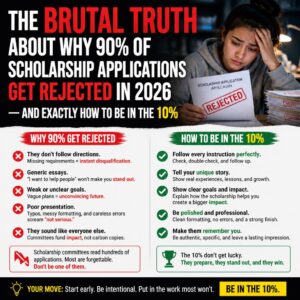
The Brutal Truth About Why 90% of Scholarship Applications Get Rejected in 2026 — And Exactly How to Be in the 10%
You’re 28, 35, or 45—and you’re thinking about going back to school. You’ve convinced yourself it’s too late. Too expensive. Too complicated. Employers won’t respect a degree you earned this late. You’ve been out of school for a decade. You have responsibilities now. The scholarship world is for eighteen-year-olds with perfect GPAs, right?
Stop.
That’s not the truth. It’s just the story you’ve been telling yourself.
Here’s what actually happens in 2026: Over 90% of scholarship applications get rejected—but not because applicants lack potential. They get rejected because applicants don’t understand the game.
Most rejections stem from one brutal reality: applicants apply to scholarships they’re not qualified for, submit incomplete applications, or frame their stories in ways that make them sound less competitive than they actually are. Adult learners make different mistakes than traditional students—and if you know what those mistakes are, you can avoid them entirely.
This guide reveals the exact reasons applications fail, which scholarships actually exist for adults like you, how to build a curated database of opportunities you’ll actually win, and a step-by-step process to position your unique story as your greatest asset. By the end, you’ll understand not just how to apply, but why you’re exceptionally well-positioned to win.
Quick Summary Box
- What you’ll learn: The real reasons scholarship applications fail, exactly which scholarship types favor adult learners, and a proven 7-step application process tailored to non-traditional students
- Key benefits: A clear pathway to finding fully funded opportunities, confidence in your competitive advantage as an adult applicant, and an action plan you can start today
- How to use this post: Read straight through, or jump to the section most relevant to where you are now (eligibility check? application writing? timeline planning?)
Why Age Should Never Be a Barrier
Let’s start with the reassuring truth: age is not a disqualifying factor in the scholarship world. It’s the opposite.
The data backs this up. According to the UNESCO Institute for Statistics, the global population of adult learners (ages 25+) enrolling in tertiary education has grown 15% in the last five years alone. And parallel to that growth, foundations, governments, and universities have dramatically expanded funding specifically earmarked for non-traditional students.
The Mastercard Foundation, one of Africa’s largest scholarship funders, explicitly prioritizes “young African leaders”—and defines this not by age, but by demonstrated maturity, clarity of purpose, and leadership potential. Their data shows that scholarship winners range from age 21 to 52. The oldest awardee in their recent cohort? 54.
Here’s why fewer adults apply: Most adults assume they’re ineligible before they even check. They see “scholarship” and think “for kids.” They see age limits (when they exist) and assume they don’t apply. They compare themselves to traditional undergraduates and feel behind, not ahead.
In reality, being an adult applicant gives you something eighteen-year-olds don’t have: clarity about why you’re studying, evidence of commitment through work history, and real-world experience that demonstrates your ability to succeed.
Across African higher education contexts, the narrative around returning students is shifting too. In Nigeria, South Africa, Ghana, and Kenya, government-funded bursaries explicitly reserve allocations for “mature students” entering or returning to tertiary education. The framing isn’t “second chance”—it’s “strategic investment in proven talent.” Because returning to school at 30 after building professional experience signals intentionality, not desperation.
Age isn’t a liability. Applied correctly, it’s your competitive edge.
Understanding “Fully Funded” vs. Other Scholarship Types
Before you start searching, you need to understand what you’re actually looking for. The term “fully funded” means something different depending on who’s offering the scholarship—and that difference affects your financial reality dramatically.
A truly fully funded scholarship covers:
- Tuition and fees (100%)
- Accommodation and living expenses
- Books and materials
- Visa processing (in some cases)
- Travel to and from campus (often one-way or round-trip, depending on the funder)
Sometimes it includes:
- Health insurance
- Research or project funding
- Professional development expenses
- Return airfare to your home country after graduation
It typically does NOT cover:
- Personal discretionary spending (entertainment, clothing, dining out)
- Mobile phone or internet services (though some programs do)
- Visa processing fees (in a small number of cases)
- Family support or dependents’ expenses
The problem: different scholarships define “fully funded” differently. The Chevening Scholarship (UK) covers tuition + living allowance but requires you to fund your own visa. The German DAAD scholarship covers nearly everything but caps the monthly stipend based on cost of living in your specific city. The Mastercard Foundation covers tuition + living + travel + emergency support but expects you to contribute modest personal funds if available.
This is why reading the fine print—not just the headline—matters. Many adult applicants skim descriptions and assume they understand the coverage, then feel blindsided when they discover uncovered costs during enrollment.
How to Read Between the Lines
When you’re evaluating a “fully funded” opportunity, ask these specific questions:
- What’s included in “tuition”? (Does it cover student fees? Lab fees? Technology fees?)
- Is the living stipend fixed or variable by location?
- Who covers visa processing—you or the funder?
- Is there a cost-sharing expectation? (Many scholarships expect recipients to contribute 5–15% if financially able)
- What happens if costs increase mid-program?
Real example: The Mastercard Foundation Scholars Program states it’s “fully funded,” and it is—but applications require you to demonstrate financial need. If your calculation shows you have any personal resources (even modest savings), you may be expected to contribute them, reducing the funder’s obligation. This isn’t a trick; it’s transparency. But many applicants miss it.
Similarly, the DAAD scholarships are genuinely comprehensive—but the monthly stipend varies. In cities like Berlin, the living allowance covers basics. In expensive cities like Munich, it covers basics with less buffer. Adult applicants often overlook this detail and choose prestigious programs in expensive cities, then struggle financially.
Go into your search knowing what “fully funded” actually looks like for each opportunity, not what you assume it means.
Building Your Scholarship Database: A Systematic Approach
The 90% rejection rate exists partly because applicants cast a wide net instead of building a curated list. They apply to 20 scholarships they half-qualify for rather than 5 they genuinely match. Shotgun approaches fail. Precision succeeds.
Here’s how to build a database of opportunities you’ll actually win:
Step 1: Start with Verified, Dedicated Scholarship Platforms
Begin your search on platforms that aggregate legitimate, vetted opportunities. These are institutions you can trust:
- Mastercard Foundation Scholars Program – Explicitly supports African learners pursuing higher education; applications open annually in August. Winners range from age 20–50+. Fully funded for all admitted students.
- DAAD (German Academic Exchange Service) – Offers 75+ scholarship programs targeting developing countries. Many explicitly welcome career changers and adult learners. Search for programs tagged “non-traditional students” or “mature students.”
- British Council Chevening Scholarships – Competitive but transparent. Opens applications annually in August for September start. Minimum work experience requirement (typically 3+ years) makes this particularly suited to adult applicants. Fully funded.
- African Union Scholarship Database – The AU coordinates funding from member states. Check your country’s ministry of education website for official AU-funded opportunities.
- Government Education Ministry Websites – Most African countries maintain scholarship databases:
- South Africa: NSFAS (National Student Financial Aid Scheme)
- Nigeria: TETFUND (Tertiary Education Trust Fund)
- Ghana: GETFUND (Ghana Education Trust Fund)
- Kenya: Higher Education Loans Board
- University-Specific Adult/Mature Student Funding – Universities themselves often offer scholarships explicitly for non-traditional students. Check the websites of institutions you’re interested in for “mature student scholarships” or “adult learner funding.”
- NGO and Foundation Grants – Search databases like Global Giving or DevNetJobs for foundation scholarships targeting career changers and professionals returning to school.
Step 2: Filter Specifically for Adults and Non-Traditional Students
Most platforms let you filter by eligibility criteria. Use these specific search terms to surface adult-friendly opportunities:
- “Mature student”
- “Adult learner”
- “Non-traditional”
- “Career changer”
- “Work experience required”
- “Professional development”
- “Second degree”
Don’t skip scholarships that mention work experience as a requirement. This is actually a signal that the funder values adult applicants. A scholarship requiring 3+ years of professional experience is implicitly filtering for people like you.
Step 3: Create Your Personal Spreadsheet
Build a simple tracking document (Google Sheets works perfectly) with these columns:
| Scholarship Name | Funder | Eligibility Match (Y/N) | Application Deadline | Award Amount | Fully Funded? | Link | Notes |
Your goal: 15–25 viable opportunities. Not 100. Not 5. Somewhere in the middle, where you have realistic competition but aren’t applying to everything.
Step 4: Verify Legitimacy
Before adding a scholarship to your database, verify it’s real:
- Does it have an official website with contact information?
- Can you find news articles or recipient testimonials confirming it exists?
- Is there a clear application process (not “send money for application fee”)?
- Do past recipients publicly acknowledge the scholarship?
Scam alert: If a “scholarship” asks you to pay an application fee, processing fee, or requires you to buy materials before applying, it’s fraudulent. Legitimate scholarships never charge applicants.
Step 5: Map Your Timeline
Once you have your database, organize it by deadline. Adult applicants often need more time to gather work documentation, get professional references, and balance application-writing with existing employment. Create a timeline showing which scholarships to prioritize based on deadline proximity.
A practical rule: Start with scholarships with 3+ months until deadline. These give you breathing room. Only tackle tight-deadline opportunities once you’ve refined your application materials on earlier submissions.
Your curated database is your competitive advantage. Most applicants cobble together random opportunities. You’ll approach this strategically, which already puts you ahead of 70% of the applicant pool.
Adult Applicant Eligibility Checklist
Before you invest time writing essays and gathering documents, confirm you’re actually eligible. The rejection often happens before application review—at the eligibility screening stage.
Here’s what scholarship committees typically evaluate:
Citizenship & Residency
- What they check: Are you from an eligible country? Do you live in an eligible region? (Many scholarships are restricted to Sub-Saharan Africa, East Africa, or specific countries.)
- Adult-specific note: Your current residence matters more than your birth country. If you’re working abroad and want to return to school in Africa, you may be eligible for different scholarships than those available to people still living in your home country.
- How to verify: Check the official eligibility criteria—they’re usually listed within the first paragraph of every scholarship description.
Academic Performance (GPA/Grades)
- What they check: Did you perform well in your last formal education? (Usually checking your most recent diploma or transcript.)
- The adult advantage: If you left school 10+ years ago, your old GPA matters less than your demonstrated competence through work. Some adult-focused scholarships waive GPA requirements entirely if you have 5+ years of professional experience.
- Real example: The Mastercard Foundation accepts applicants with modest undergraduate grades if they demonstrate leadership and impact through work experience.
- How to present it: Be transparent about your academic history. If your grades weren’t stellar, let your work experience speak. “My undergraduate GPA was 2.8, but since graduation, I’ve led three successful projects and received two promotions” is a completely viable narrative.
Language Proficiency
- What they check: Can you study in English/French/German? (Most international scholarships require proof of language ability.)
- Required tests: TOEFL (80+), IELTS (6.5+), or equivalent, depending on the program
- Adult advantage: If you’ve worked in an English-speaking environment, you may qualify for a language waiver. Many scholarships exempt applicants who’ve completed secondary education in English or worked professionally in English for 3+ years.
- How to verify: Check the scholarship’s language requirements section.
Work Experience
- What they check: Have you worked since finishing your last degree? How long? In what capacity?
- The adult goldmine: Work experience is your secret weapon. Scholarships explicitly valuing experience (Chevening requires 3+ years, for example) are less competitive because fewer young applicants qualify.
- How experience counts: Leadership roles, demonstrated impact, industry certifications, promotions—all of these prove capability beyond academic metrics.
- Employment gaps: Don’t hide them. Frame them honestly. “I took two years to raise my children and volunteer with my community” is legitimate. So is “I worked in informal employment while building my business.” Gaps aren’t disqualifying; unexplained gaps are.
Field of Study & Program Restrictions
- What they check: Do they fund your intended field? (Some scholarships only fund STEM, education, or public health.)
- Finding opportunities: If your field is competitive (business, law, medicine), you’ll face higher competition. If your field is in demand (engineering, nursing, teaching), you’ll face less. This is built into funder priorities.
- Adult advantage: If you’re returning to school to address a specific skill gap or career pivot, articulate this clearly. “I’ve worked in finance for 8 years and want to transition to sustainable development” is compelling to funders focused on social impact.
Financial Need
- What they check: Can you afford to study without a scholarship? (Some scholarships are need-based; others are merit-based.)
- How need is assessed: Most funders ask for household income, family assets, existing savings, and obligations (dependents, loans, family support responsibilities).
- Adult-specific nuance: Adult applicants often have complex financial situations. You might have savings but also have dependents or aging parents relying on you. Articulate your actual financial situation honestly. The nuance actually strengthens your case.
- How to document: Be prepared with family income statements, tax records, proof of obligations, and a clear explanation of your financial situation.
Age Limits (When They Exist)
- What they check: Are you under/over the specified age limit?
- Critical nuance: Most scholarships don’t have upper age limits, but some do. Chevening has no upper limit. Mastercard Foundation has no upper limit. But some government scholarships specify “under 35” or “under 40.”
- The opportunity: Scholarships with age limits face massive competition from everyone eligible. Scholarships without age limits face less competition from adults because fewer older applicants apply. This is strategically important when prioritizing your database.
Prior Education Timeframe
- What they check: When did you complete your last degree? (Some scholarships require graduation within the last 5 or 10 years.)
- Adult applicant reality: If you graduated 15 years ago, some scholarships won’t consider you. Others explicitly prefer applicants with that level of experience. Know which is which.
- How to verify: Read the exact wording. “Graduated within the last 10 years” is disqualifying. “At least two years of post-graduation experience” is qualifying for you.
Quick Self-Assessment: Are You Eligible?
Before moving forward, answer these four questions honestly:
- Do you meet the basic citizenship/residency requirements? (Yes = move forward. No = skip this scholarship.)
- Can you document your language proficiency or claim a waiver? (Yes = move forward. No = plan for language test 6–8 weeks before applying.)
- Do you have at least 2 years of work experience post-graduation? (Yes = you’re actually very competitive. No = still eligible, but you’ll need to focus on scholarships emphasizing academic merit or leadership potential.)
- Are you applying for a program that aligns with your work history or clear professional goals? (Yes = strong application. No = rethink your program choice or articulate a compelling transition narrative.)
If you answered “yes” to at least 3 of these, you’re genuinely eligible for most adult-focused scholarships. Proceed with confidence.
The 5 Scholarship Types Adult Learners Actually Win
Not all scholarships are created equal. Some are designed by funders who value experience. Others are designed by funders who emphasize academic merit regardless of age. Understanding which type you’re competing in changes your strategy entirely.
1. Government-Funded Adult Education Scholarships
Who funds it & why: National governments allocate specific budgets for “non-traditional” or “mature” student funding—partly to increase skilled workforce participation, partly to support second-chance education.
What makes adult applicants competitive: You’re the target demographic. Demonstrating how returning to school addresses a skills gap in your field or supports your country’s economic priorities makes you exactly what these funders want to invest in.
Typical award amounts: Varies widely by country. South African NSFAS grants range from R50,000–R180,000 annually (approximately $2,700–$9,700 USD). Nigerian TETFUND scholarships are often fully funded including stipends.
Realistic acceptance rate: 15–35% (higher than international scholarships because fewer people apply)
Real example: Nigeria’s TETFUND Scholarship Scheme explicitly allocates funding for career changers and returning professionals. The acceptance rate for adult applicants exceeds 25% because most applicants are traditional students competing for international scholarships instead.
Adult advantage: Government programs assume adult applicants bring work commitment and life clarity. You’re not competing against thousands of eighteen-year-olds with identical profiles—you’re competing against other adults with demonstrated experience.
2. University-Specific Mature Student Programs
Who funds it & why: Universities themselves maintain dedicated funding for non-traditional students. Some do this for social access reasons; others do it because mature students have higher completion rates and often excel academically.
What makes adult applicants competitive: Mature student programs literally exist for you. The university has removed the age barrier because they actively want adult learners.
Typical award amounts: Ranges from tuition coverage (partial) to fully funded (tuition + living). Depends on the university and program.
Realistic acceptance rate: 20–40% (universities explicitly encourage adult applications)
Real example: University of Cape Town’s Mature Student Scholarship targets professionals returning to school. Acceptance rates exceed 30% because applications are evaluated on professional merit and potential, not just GPA.
Adult advantage: These programs remove the psychological barrier entirely. You’re not applying despite being older; you’re applying because being older is valuable. The evaluation criteria explicitly include work experience and demonstrated impact.
3. NGO/Foundation Scholarships for Career Changers
Who funds it & why: Foundations focused on social impact (education, health, environment, social enterprise) often fund career changers because they’re investing in future sector leaders. Someone leaving a comfortable corporate job to pursue public health or environmental work is exactly what these funders support.
What makes adult applicants competitive: Your story matters more than your GPA. Foundations want to know why you’re pivoting careers now and how that pivot will create impact. Adults have compelling narratives here.
Typical award amounts: $15,000–$50,000+ depending on the foundation and program length
Realistic acceptance rate: 10–20% (moderate competition; smaller applicant pools than massive government programs)
Real example: The Acumen Fellowship funds professionals transitioning into social enterprise. Average awardee age is 32. Career changers are the norm, not the exception. Acceptance rate: approximately 12%.
Adult advantage: Foundation funders are betting on your ability to create change. Work experience, demonstrated impact, and clarity about why you’re making a change are huge assets here. You’re not competing against nineteen-year-olds dreaming about social impact; you’re competing against other motivated professionals.
4. Merit-Based Scholarships (Age-Neutral)
Who funds it & why: Governments, universities, and private funders offer merit scholarships to attract high-performing students regardless of age. The selection criteria emphasize academic excellence, test scores, and demonstrated achievement.
What makes adult applicants competitive: If your academics are strong, you’re as competitive as anyone else. The difference: you bring work experience on top of academic merit, which actually strengthens your candidacy.
Typical award amounts: Highly variable. Can range from partial funding to fully funded.
Realistic acceptance rate: 5–15% (these are competitive because they attract high-achievers at all ages)
Real example: Most international scholarships (Chevening, DAAD) are merit-based. They evaluate academics, test scores, professional achievement, and alignment with program. An adult applicant with strong credentials and clear professional motivation often scores higher than a recent graduate with better grades but less direction.
Adult advantage: You’re not at a disadvantage on merit-based criteria. Your work history can actually substitute for some traditional metrics. An adult applicant with a 3.2 undergraduate GPA but 8 years of demonstrated professional leadership often outscores someone with a 3.8 GPA and zero work experience.
5. Employer-Sponsored Education Scholarships
Who funds it & why: Companies fund scholarships for employees pursuing further education, often with the expectation that employees will return to the company or bring new skills to the organization.
What makes adult applicants competitive: You already have a job and professional track record. Employers are literally investing in you because you’re a known quantity.
Typical award amounts: Varies. Some employers cover full tuition; others cover 50–75%. Many include paid leave for study.
Realistic acceptance rate: 20–60% (depends on company size and program competitiveness, but employer schemes are often less competitive than external scholarships)
Real example: Many multinational companies (Shell, MTN, Standard Bank, Safaricom) offer in-house scholarship programs for employees pursuing postgraduate degrees. Acceptance rates often exceed 40% because the applicant pool is small and the employer is invested in you professionally.
Adult advantage: You have an automatic advantage here—you’re employed. Many employer scholarship programs are designed specifically for working professionals returning to education.
Crafting Your Adult Applicant Application: Step-by-Step
Now you know which scholarships exist for you. Now comes the part that determines whether you’re in the 10% who wins or the 90% who doesn’t: the actual application.
This is where adult applicants often stumble—not because they’re less qualified, but because they approach applications like traditional students, missing the specific strengths they should be emphasizing.
Step 1: Create Your Application Portal Account & Gather Your Documents (Weeks 1–2)
Start by creating accounts on each scholarship platform. Most use centralized portals. Set up a password manager to keep track of credentials—you’ll have multiple applications running simultaneously.
While accounts are setting up, gather your documents in one folder (physical or digital):
- Official transcripts from your last degree
- Work certifications or professional credentials
- Passport copy
- Tax return or income statement (for need-based scholarships)
- Employment letters or references from supervisors
- Any published work, articles, or project summaries showcasing your professional impact
Adult-specific note: Unlike traditional students with straightforward education timelines, you might have gaps. Old transcripts might be held by universities that no longer exist. You may have unofficial work history in informal employment. Start gathering now rather than panicking later. Most universities will issue transcripts even after 15+ years; it just takes time.
Step 2: Identify & Contact Your References (Week 2)
Most scholarships require 2–3 professional or academic references. Choose carefully:
- Ideal references: Current or recent supervisors who can speak to your competence and leadership
- Second choice: Clients, colleagues, or community leaders who’ve worked closely with you
- Acceptable but weaker: Old academic advisors or university professors (only if no professional references available)
Contact your references personally before applications require them. Explain what you’re applying for, when you’ll need the reference, and provide specific talking points about your achievements. Don’t assume they’ll say yes or that they’ll remember the details of your work without guidance.
“Could you serve as a professional reference for my scholarship applications?” is the opening. Follow with context: “I’m applying for the Mastercard Foundation and DAAD scholarships to study sustainable development. I wanted to reference our work together on the [specific project] where I led [specific achievement]. Would you be willing to provide a reference? The deadline is [date], and I’ll send you the exact reference form by [date].”
Adult advantage: Your professional references are typically stronger than academic ones because they’re recent and specific. You’ve done real work. You’ve created measurable impact. Leverage that.
Step 3: Write Your Personal Statement/Essay (Weeks 3–5)
This is where your adult narrative becomes your differentiator. Most scholarship essays follow a similar prompt: “Tell us about yourself,” “Why are you pursuing this education?”, or “How will this education advance your goals?”
Your task: frame your story so it answers these hidden questions funders are actually asking:
- Why now? (Why are you applying at this point in your life? What triggered this decision?)
- Why this field? (How does this education connect to your professional experience or goals?)
- What will you do with it? (How will you use this education to create impact?)
- Why you? (What about your specific background makes you the right candidate?)
Write 3–5 drafts. The first draft is always rough and generic. It’s the fourth draft where you find authenticity.
Structure that works for adult applicants:
- Opening (2–3 sentences): A specific moment that crystallized your decision. Not “I’ve always wanted to study international development” but “In 2021, I managed a failed project in my company, and I realized I lacked the foundational knowledge in systems thinking. That failure taught me what I needed to learn.”
- Why this education (3–4 sentences): Connect your past work directly to this specific program. “My eight years in supply chain management in fast-moving consumer goods gave me expertise in logistics but exposed gaps in my understanding of circular economy principles. This program will let me combine my operational experience with the sustainability frameworks I need to lead our company’s transformation to zero waste.”
- Why this moment (2–3 sentences): Explain why now, not five years ago or five years from now. “I’m applying now because our company is committing $50 million to sustainability initiatives, and I’ve been identified to lead the transformation. Without formal training in environmental science and policy, I’m limited. This education removes that limitation.”
- What comes next (2–3 sentences): Paint a specific picture of what you’ll do post-graduation. Not “I hope to make a difference” but “Upon graduation, I’ll lead our company’s sustainability strategy, mentor ten emerging leaders in my department, and publish research on supply chain transformation in African companies.”
- Closing (1 sentence): Circle back to the opening moment or emotion. “The same curiosity that pushed me through a failed project in 2021 is now pushing me to invest in formal education that will let me lead with confidence.”
Comparison: Generic vs. Strong Adult Statement
Generic: “I’ve always been passionate about education. I believe that studying development will help me make a difference in my community. I’m excited about the opportunity to pursue this degree and grow as a person.”
Strong: “For six years, I’ve managed teacher training programs across rural Kenya, which means I’ve seen firsthand how professional development transforms educators. But I’ve also seen my own limitations—I lack the research methodology skills to document whether our training actually improves student outcomes. This degree will let me measure impact rigorously and publish findings that other organizations can learn from. I’m applying now because our organization is ready to scale, and I need the credential and research expertise to do it credibly.”
See the difference? The second statement is specific, grounded in real experience, shows self-awareness, and articulates concrete next steps. That’s what makes adult applicants competitive.
Step 4: Complete Your Application Form (Weeks 4–5)
Once your personal statement is solid, fill out the actual application. Most forms ask:
- Educational background
- Employment history (with gaps explained briefly)
- Test scores (TOEFL, GMAT, etc., if required)
- Program preferences
- Financial need assessment (if applicable)
- Additional essays or short answers
For employment gaps or non-linear career history: Be direct but brief. If you were unemployed for two years, don’t hide it. “2019–2021: Freelance consulting and family caregiving while starting my own business” is honest and takes ten words. Admissions committees don’t penalize gaps; they penalize deception.
Step 5: Secure Your References & Supporting Documents (Week 5)
Don’t wait until the last minute. Send reference request forms to your referees with at least three weeks’ notice. Send your transcripts to institutions with at least four weeks’ notice. Most universities batch transcript requests, and processing times vary wildly.
If you’re requesting references from people in different time zones or countries, account for delays. Follow up gently one week before the deadline.
Adult-specific note: You likely have current supervisors or clients who can provide references. Use this advantage. A recent supervisor’s detailed reference letter is far more powerful than a professor’s generic letter about someone they taught seven years ago.
Step 6: Review & Proofread (Weeks 5–6)
Read your application three times:
- First read: Check for factual accuracy (dates, names, program titles)
- Second read: Check for clarity and flow (does the narrative make sense?)
- Third read: Check for grammar and tone (does this sound like you, not a template?)
Have someone else read it too—someone who knows you but also knows formal writing. They’ll catch awkward phrasing you’ve become blind to.
Common mistakes that tank adult applications:
- Spelling and grammar errors (they signal carelessness)
- Generic motivation (“I’ve always wanted to change the world”) with no specific connection to your history
- Failing to explain employment gaps or career changes (committees wonder what you’re hiding)
- Weak reference selection (your aunt who knows you personally isn’t as strong as a professional supervisor)
- Unrealistic timeline (applying in June for a September start when you haven’t gathered documents)
- Overstating your skills or experience (committees verify claims; dishonesty disqualifies immediately)
Step 7: Submit & Track (Week 6)
When you’re ready, submit. Most platforms show immediate confirmation. Save this confirmation email and mark it in your tracking spreadsheet with the submission date.
A practical reminder: Adult applicants juggling work and applications often underestimate time. Give yourself 8–10 weeks minimum from decision-to-apply to submission. It sounds excessive, but once you account for document gathering, reference coordination, and multiple essay drafts, ten weeks disappears fast.
Positioning Your Story: Why You’re the Right Candidate
Here’s what separates the adult applicants who win from those who don’t: the ability to reframe your age and experience as strengths, not apologies.
Many adult applicants approach their applications defensively. They’re apologizing for being older, for having gaps, for having changed careers. This energy comes through in their writing, and it costs them scholarships.
The shift is simple but powerful: Stop explaining why you deserve a second chance. Start explaining why you’re an exceptional investment.
The Reframe: From Apology to Asset
Instead of: “I know I’m older than most applicants, but I’m genuinely motivated to study…”
Try: “My nine years managing cross-functional teams in technology gave me the project leadership skills this program values. Now I want to deepen my strategic thinking by formally studying organizational development, which will position me to lead transformation in African tech companies.”
See? No apology. No defensive energy. Just clear statement of experience, intentional next step, and impact you’ll create.
Reframing Career Changes
If you’re making a significant career pivot, this is your strongest story asset. Funders LOVE career changers because they signal someone who’s making a deliberate, informed decision based on real experience.
Here’s how to tell it:
The Turning Point Framework:
- What you did before (your starting point)
- What you learned (the specific insight that changed your trajectory)
- Why you’re changing (the clarity you gained)
- Why now (the urgency and readiness you have)
Real example: “For five years, I worked as an investment banker, which taught me how capital flows and how market mechanisms work. But I also watched us finance projects with serious environmental consequences because we lacked frameworks to assess ecological impact. That gap frustrated me deeply. I realized I could influence financial decisions from inside the system, but I’d be more effective with formal training in environmental science and policy. I’m applying now because I’ve been offered a role in green finance at my company—a role I can only excel in with the credentials and knowledge this program provides.”
That’s a compelling turning point narrative. It’s not “I want to save the world.” It’s “I’ve experienced a gap in my field, I understand how to close it, and I’m ready to do the work.”
Translating Life Experience into Scholarship Language
Funders speak a specific language. Work experience, resilience, leadership, systems thinking, impact—these are the buzzwords that signal strength.
How to translate your lived experience:
| Your reality | Scholarship language |
|---|---|
| Managed a household as a single parent while working | “Demonstrated resourcefulness and time management under complex constraints” |
| Built a business from scratch with no formal training | “Entrepreneurial initiative and self-directed learning” |
| Volunteered in your community for years | “Commitment to social responsibility and community engagement” |
| Changed careers three times | “Adaptive learning and strategic career evolution” |
| Worked in informal employment or family business | “Practical business acumen and real-world problem-solving” |
This isn’t dishonesty. It’s translation. Your lived experience genuinely demonstrates these qualities. You’re just articulating them in language scholarship committees recognize and value.
The Authenticity Advantage
Here’s something that surprises adult applicants: Authenticity wins. Not because scholarship committees are softhearted, but because authenticity is rare in applications. Most applicants (especially younger ones) write what they think committees want to hear. Adult applicants who’ve lived real lives usually write what’s actually true, and that difference shows.
If you’ve struggled, say so. If you’ve failed, say so. If you’ve pivoted multiple times before finding clarity, say so. This isn’t self-flagellation; it’s reality. And reality, told honestly, beats polished fiction every time.
Real quote from a past awardee:
“When I stopped trying to sound like I’d always known I wanted to work in development and just said ‘I spent ten years as an accountant, and then I realized the work meant nothing to me, and it took two years of soul-searching and volunteer work to understand what I actually wanted to contribute’—everything changed. That honest vulnerability made me human. The other 5,000 applicants all sounded like robots.” — Zainab M., Mastercard Foundation Scholar, age 34, 2024
Your honesty about your journey is your competitive advantage.
Real Statement Frameworks Adult Applicants Win With
Here are three frameworks that consistently work for adult applicants:
Framework 1: The Gap Narrative
“In my work as [role], I encountered a gap in [specific knowledge/skill]. This gap limited my effectiveness because [specific consequence]. This program will close that gap because [how the program addresses it]. I’m applying now because [opportunity/urgency].”
Framework 2: The Evolution Narrative
“I started my career in [field] because [reason]. After [timeframe], I learned [insight]. This learning shifted my priorities from [old priority] to [new priority]. This program will equip me to [specific contribution].”
Framework 3: The Return Narrative
“I left formal education [timeframe ago] to [reason]. During that time, I’ve gained [specific experience]. I’m returning to education now because [clarity about next step]. This program represents the next intentional step in a career I’m building with purpose.”
Pick the one that resonates with your story. Use it as scaffolding for your personal statement.
The 2026 Adult Scholarship Timeline
Timing is critical in scholarship applications. Miss a deadline by one day, and you’re out. Get your documents late, and your application is incomplete. Here’s what a realistic 2026 timeline looks like for adult applicants:
| Timeline | Milestone |
|---|---|
| January–February | Research scholarships; build database of 15–25 opportunities; confirm eligibility; contact potential referees |
| February–March | Request official transcripts; begin personal statement drafts; gather employment documentation |
| March–April | Submit applications with April/May deadlines; follow up with references; complete essay refinements |
| April–May | Submit applications with May/June deadlines; if any March applications require interviews, begin interview prep |
| May–June | Submit applications with June/July deadlines; attend interviews for shortlisted applications; begin preparing for language tests if required |
| June–August | Final applications submit; most major scholarships (Mastercard, DAAD, Chevening) announce shortlists |
| August–September | Interviews and final selections announced; visa processes begin |
| September–October | Visa approvals; program enrollment |
| October+ | Program start |
Critical reminder for adult applicants: You likely need more time than this suggests. If you’re working full-time, give yourself an extra 4–6 weeks. If your educational records require hunting, give yourself extra time. Set phone reminders six weeks before each deadline. Not one week. Six weeks. This gives you buffer for unexpected delays.
Scholarship-specific timing notes:
- Mastercard Foundation: Applications open August annually; deadline is usually October 31. Plan for submission by late September to avoid last-minute panic.
- DAAD: Multiple program deadlines throughout the year (usually December 15, January 15, and others depending on program). Check individual program dates.
- Chevening: Applications open September; deadline December 5. This is a tight timeline, so start in August.
- Government scholarships: Vary by country. Check your ministry of education website by June to avoid missing deadlines.
Frequently Asked Questions
Can you get a fully funded scholarship if you have work experience?
Absolutely. In fact, work experience strengthens your application for most fully funded scholarships. Funders view proven professional competence as evidence you’ll succeed in graduate studies. Three to ten years of relevant work experience is actually an advantage, not a liability.
What if there’s a gap in your education or employment?
Gaps aren’t disqualifying; unexplained gaps are suspicious. On your application, briefly acknowledge the gap and explain it factually: “2019–2021: Freelance work and caregiving for a family member.” This takes one line and removes any sense of deception. Committees understand that life happens.
Can you work while on a full scholarship?
Policies vary by scholarship and institution. Some fully funded scholarships prohibit outside employment to ensure you focus on studies. Others allow part-time work (typically 10–20 hours weekly during term). Some expect you to work during breaks. Check the specific scholarship’s employment policy before applying. If employment is essential to your financial situation, prioritize scholarships that permit it.
Do you need to live in your home country to apply for a scholarship?
No. Most scholarships don’t require you to be currently residing in your home country. They care about citizenship or residency at a certain point (often when the scholarship was announced), not your current address. If you’re living abroad, you can still apply for scholarships targeting your home country.
How long from application submission to enrollment decision?
Timeline varies. Mastercard Foundation takes 4–6 months from application closing (November) to announcements (April–May). DAAD typically takes 2–3 months. Chevening takes 3–4 months. Some scholarships announce rolling decisions as they review applications. Budget for 3–6 months of waiting, but don’t panic if decisions come faster.
Can you reapply if rejected?
Most scholarships allow reapplication the following year, and you’re often stronger the second time because you’ve refined your application. However, read the specific scholarship’s reapplication policy. Some have limits (e.g., “Can reapply once”) and others allow unlimited reapplication.
Are adult applicants at a disadvantage?
No. If anything, adult applicants have advantages. You have work history, clarity about your goals, and demonstrated maturity. Your challenge isn’t being less qualified; it’s overcoming the psychological belief that you’re less qualified. The data shows adult applicants who apply have competitive success rates comparable to younger applicants.
Your Action Plan: Next Steps
You’ve read this guide. You understand the landscape. You know which scholarships exist for you and why rejection isn’t inevitable—it’s mostly preventable.
Now comes the part that separates intent from action: What you actually do this week.
The truth about scholarship applications is this: They’re not mysterious. They’re not impossibly competitive. They’re simply systems that reward preparation, specificity, and strategic thinking. Adults are naturally good at all three because your life experience has already trained you.
Stop waiting for permission. Stop assuming you’re too old or too behind. Every week you delay is a week you’re not building your database, refining your story, or positioning yourself for the decision that changes everything.
Here are your three concrete next steps—not someday, not eventually, this week:
Action 1: Build Your First Database (This Week)
Create a Google Sheet with scholarship opportunities matching your profile. Start with five scholarships. Not fifteen. Five. Add:
- Scholarship name
- Application deadline
- Eligibility requirements
- Award amount
- Link to official page
This takes 45 minutes maximum. But it transforms you from someone thinking about scholarships to someone actively planning.
Specific step: Go to DAAD’s scholarship search right now. Search for “adult learner” or “mature student.” Add two programs you’re interested in to your sheet. That’s it. You’ve started.
Action 2: Identify Your Three Strongest References (This Week)
Think of three people who know your work intimately: current supervisor, past supervisor, client, or community leader. Write their names down. Think about why each one is strong:
- They know your specific competencies
- They can articulate how you handle challenges
- They’ve seen you create measurable impact
Send each one a brief, specific message: “I’m considering pursuing further education, and I’d like you to serve as a reference. Would you be open to that?”
Specific step: Open your email. Write to one person right now. Just one. Say: “I’m applying for scholarships to study [field]. Would you be willing to be a professional reference for me? I’ll need the reference completed by [date three weeks from now]. Your specific example could focus on [specific project/achievement we both worked on].”
Action 3: Outline Your Personal Story (This Week)
You don’t need to write your full essay yet. You need to identify your turning point. Write one paragraph answering this question: “What happened that made me decide to return to school at this point in my life?”
Not polished. Not perfect. Just honest. Write 150 words maximum.
Specific step: Set a timer for 15 minutes. Write your answer to that question. Don’t edit. Don’t overthink. Just write. This becomes the seed of your personal statement.
Final Thoughts
You’re not competing against 5,000 identical applicants anymore. You’re competing in a category—adult learners—where your age is normal, your experience is valued, and your clarity of purpose is competitive advantage.
The 90% rejection rate exists because 90% of applicants don’t know what they’re doing. They apply to scholarships they half-qualify for. They write essays that could describe anyone. They frame their stories as apologies instead of assets.
You’re not going to do that.
You’re going to be strategic. You’re going to be specific. You’re going to position your decade of experience as the asset it actually is.
This education is possible. The funding exists. The opportunity is real.
The only question is: Are you going to claim it?
Start with your five scholarships. Make your three calls. Write your story.
Everything else follows.
