Table of Contents
ToggleHarvard University Fully Funded Scholarships 2026: Programs, Eligibility & Application Deadlines
You’ve Dreamed About Harvard. Here’s How Fully Funded Scholarships Make It Real.
Let’s be honest with each other for a moment.
You’ve typed “Harvard University” into a search bar more than once. Maybe late at night after a long day at work. Maybe sitting in a matatu in Nairobi, or at a café in Lagos, or on a lunch break in Accra. You’ve looked at that name—those seven letters—and felt two things at once: a pull toward it and a quiet voice whispering, That’s not for people like me.
That voice is wrong.
Harvard University offers some of the most generous fully funded scholarships in the world, and a meaningful number of them are explicitly designed to reach talented students from Africa, from low-income backgrounds, from non-traditional paths, and from communities that have historically been locked out of elite education. The money exists. The programs exist. What most people are missing is the roadmap.
This guide gives you that roadmap.
By the time you finish reading, you’ll know exactly which Harvard programs offer full funding in 2026, what each one covers, whether you’re eligible, and precisely when to submit your application. You won’t need to piece together scattered information from five different websites. Everything is here, organized the way a well-connected insider would explain it to a trusted friend.
Quick Summary Box
- What this guide covers: Harvard’s fully funded scholarship programs for 2026, eligibility requirements, and application deadlines
- Key benefits you’ll gain: A clear understanding of what’s funded, how to qualify, and when to act
- How to use this post: Read straight through for the full picture, or jump to the section most relevant to your stage of preparation
Why Harvard Scholarships Are More Accessible Than You Think
Here’s something Harvard’s own financial aid office states plainly: if you can get in, Harvard can help you pay for it.
That’s not a marketing slogan. It’s a structural commitment built into how Harvard approaches funding across nearly all of its schools. Harvard University’s endowment—the largest of any university in the world at over $50 billion—funds a financial aid system that has been deliberately designed to make cost a non-issue for qualified students.
The misunderstanding most African students carry is this: they assume Harvard is expensive, conclude they can’t afford it, and never apply. That assumption short-circuits the entire process before it even begins. The truth is that Harvard charges $0 in tuition to families earning below a certain threshold, and for international students, need-based and merit-based funding pathways exist across multiple schools and programs.
The opportunity gap here is real. Because so many talented students self-select out—convincing themselves they won’t qualify before reading a single eligibility requirement—the actual competition pool for need-based and international scholarships is smaller than you’d expect. Your application lands in front of a committee that is actively looking for diversity, global perspective, and lived experience from regions like Sub-Saharan Africa, East Africa, and West Africa.
Consider what Harvard University’s admissions data has consistently shown: international students from African countries are among the most academically competitive applicants globally, yet remain statistically underrepresented in applications relative to their talent pool.
You bring something Harvard genuinely wants. The question is whether you’ll show up to offer it.
Understanding “Fully Funded” at Harvard: What It Actually Covers
Before we go program by program, you need to understand what “fully funded” actually means in Harvard’s context—because it isn’t always identical across schools.
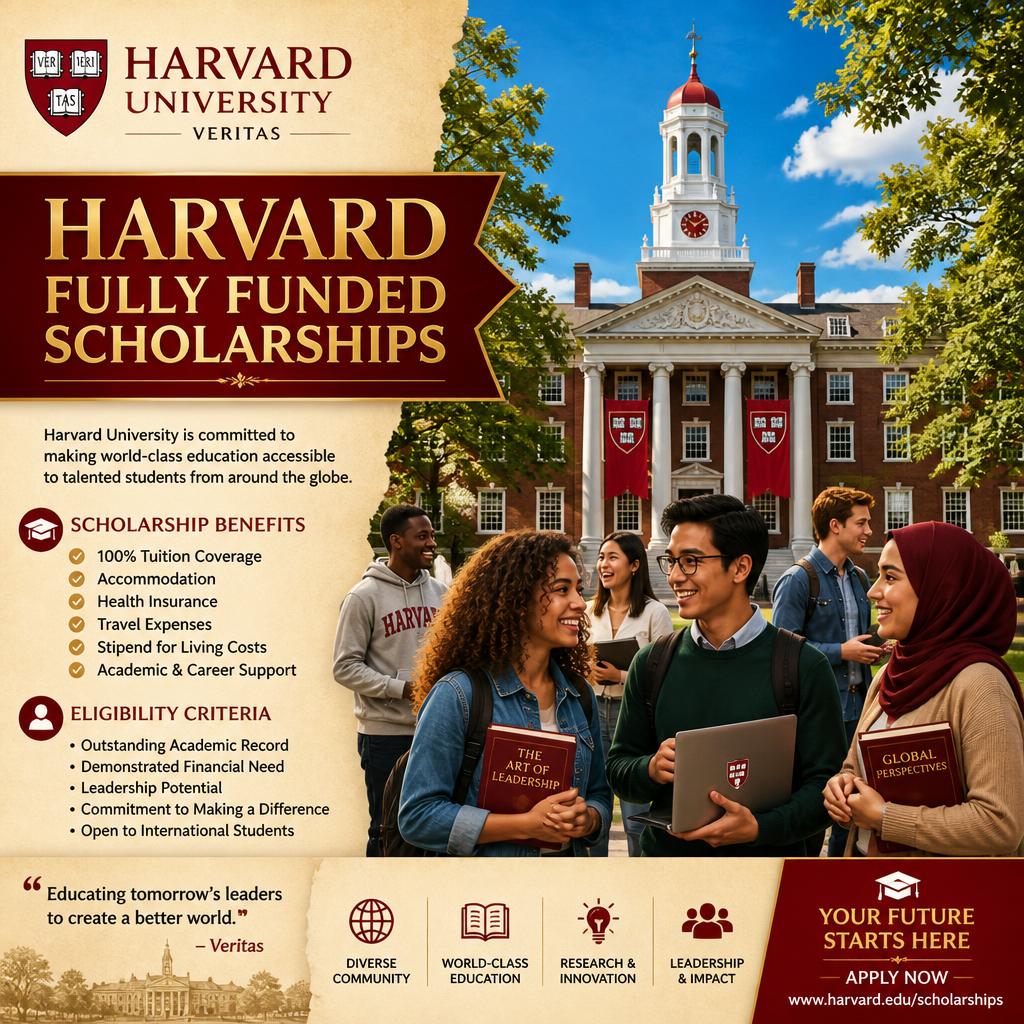
A true fully funded scholarship at Harvard typically covers: tuition, mandatory fees, a living stipend (for housing and food), health insurance, and in some cases, travel grants for international students. That’s the gold standard, and several Harvard programs meet it precisely.
Here’s the spectrum you’ll encounter:
Full need-based financial aid (Harvard College, Harvard Law, Harvard Kennedy School) means your entire demonstrated financial need is met through a combination of grants, work-study, and sometimes modest loans. For many African students, this translates to a package that covers virtually everything because demonstrated need is extremely high.
Named fellowships and fully funded graduate programs (Harvard PhD programs, certain Harvard Kennedy School fellowships) cover tuition plus a stipend, with no teaching or research obligation attached to some of them. These are the cleanest form of full funding.
Partial scholarships and merit awards cover tuition only, or tuition plus a partial living allowance—you’d be responsible for the remainder.
What “fully funded” typically doesn’t cover: international visa application fees (usually $160–$350), personal expenses beyond the stipend, and costs associated with dependent family members traveling with you.
When you’re reading scholarship descriptions, look specifically for the phrase “full financial support” or “tuition and stipend included.” If a scholarship only mentions “tuition waiver,” dig deeper before celebrating—you’ll still need to fund your living costs.
Two Harvard programs that genuinely meet the fully funded standard: the Harvard Kennedy School Mid-Career MPA fellowship, which covers tuition and living expenses for selected international students, and Harvard’s PhD programs across the Graduate School of Arts and Sciences, which fund admitted students for the duration of their doctoral study. Both are real, verifiable, and open to African applicants.
Harvard’s Fully Funded Scholarship Programs for 2026: A Complete Breakdown
This is the section you came for. Let’s go program by program, with everything you need to know about each one.
Harvard Kennedy School (HKS) Fellowships
The Harvard Kennedy School is arguably the most accessible Harvard school for African students seeking full funding in 2026, for one simple reason: it has built an entire infrastructure of named fellowships specifically designed for international public leaders.
The Kofi Annan Fellowship for Africa
Named for the late UN Secretary-General and Ghanaian diplomat, this fellowship is awarded to mid-career African leaders pursuing the Mid-Career Master in Public Administration (MC/MPA) program. It covers full tuition and provides a living stipend. You’ll need at least a decade of professional experience in public service, civil society, or the private sector with demonstrated public impact. This is explicitly for Africans, which means your geographic background is not just acceptable—it’s the entire point.
The HKS Fellowship for Emerging Market Leaders
This fellowship targets professionals from developing nations, including all African countries, who are transitioning into senior leadership roles in government, NGOs, or international organizations. Full funding is available for the one-year MC/MPA program, and HKS actively recruits from Sub-Saharan Africa.
The Mason Fellows Program
Every MC/MPA student at HKS is part of the Mason Fellows community. Financial aid at HKS for Mason Fellows is substantial—the school commits to meeting the full demonstrated financial need of admitted students. For African applicants from lower-income contexts, this practically translates to a fully funded year.
Harvard PhD Programs (Graduate School of Arts and Sciences)
Every admitted PhD student at Harvard receives full funding. This is a blanket institutional policy, not a competitive award you apply for separately. When Harvard’s Graduate School of Arts and Sciences admits you into a doctoral program, you receive:
- Full tuition coverage for the duration of your program
- An annual living stipend (approximately $40,000–$45,000 for 2025–2026 academic year)
- Student health insurance
- Research and conference funding
The fields open to African applicants include economics, political science, African and African American studies, history, anthropology, public health (through the Harvard T.H. Chan School of Public Health), and dozens more.
The critical thing to understand: the funding is automatic upon admission. Your goal is not to win a separate scholarship after getting in. Your goal is to get in—and then the funding follows.
Harvard College Financial Aid (Undergraduate)
If you’re looking at Harvard as an undergraduate destination, here’s what you need to know about Harvard’s undergraduate financial aid model.
Harvard College meets 100% of demonstrated financial need for all admitted students, including international students. Families with total income below $85,000 per year pay nothing. Families earning between $85,000 and $150,000 pay between 0% and 10% of their income. Above that threshold, the contribution scales gradually.
For most African families, this means a Harvard education is genuinely affordable—often more affordable than a private university in your home country, once the aid package is calculated.
Harvard College does not offer merit-only scholarships (where your grades alone earn you free tuition regardless of income). All aid is need-based. But the calculation of “need” is generous, and the commitment is absolute: Harvard will not ask a family to contribute more than they can reasonably afford.
Harvard Law School Fellowships and Scholarships
Harvard Law School (HLS) has several funding pathways relevant to African applicants.
The LL.M. Program Fellowships: HLS offers fellowships for its one-year Master of Laws (LL.M.) program, some of which are specifically directed toward international students from developing nations. These include the Chayes International Public Service Fellowship and several regionally targeted awards. Full funding at the LL.M. level is competitive but achievable, particularly for applicants with strong human rights, constitutional law, or international law backgrounds.
J.D. Financial Aid: Harvard Law’s J.D. program meets the full demonstrated financial need of admitted students, using a similar model to Harvard College. For African students from lower-income backgrounds, this translates to substantial grant-based aid.
The Low Income Protection Plan (LIPP): After graduation, Harvard Law’s LIPP program provides loan forgiveness for graduates who enter public interest careers—which is deeply relevant for African lawyers planning to return home to work in governance, civil rights, or international law.
Harvard T.H. Chan School of Public Health
The Chan School offers doctoral and master’s-level funding that is particularly competitive for African applicants given the school’s explicit focus on global health equity in Sub-Saharan Africa, East Africa, and West Africa.
The DrPH (Doctor of Public Health) program funds selected students through fellowships tied to global health research initiatives. The PhD in Population Health Sciences provides automatic full funding to all admitted students, matching the GSAS model.
At the master’s level (MPH and SM degrees), funding is more competitive and often assembled from fellowships, assistantships, and external scholarships. African applicants should look specifically at the Takemi Program in International Health, which funds one-year research fellowships for mid-career global health professionals from developing countries.
Harvard Business School (HBS) Fellowships
HBS takes a different approach. The school does not offer traditional merit scholarships, but it does have a robust fellowship system for students who demonstrate both financial need and exceptional leadership potential.
The HBS Fellowship Fund provides grants to admitted MBA students who would otherwise be unable to attend due to financial constraints. For African students admitted to HBS—a genuinely selective cohort—fellowship support can cover a significant portion of tuition and living expenses.
The HBS Africa Business Club Scholarship is a smaller, internally administered award that recognizes admitted HBS students with a demonstrated commitment to African business development. It’s worth knowing about and applying for during the financial aid process.
Eligibility Requirements: What Harvard Actually Looks For
Let’s be direct about eligibility, because misunderstanding this is where most applicants stumble.
Academic Requirements
Harvard does not publish a minimum GPA cutoff. What the admissions data tells us is that successful applicants typically have undergraduate GPAs in the top 10–15% of their institution’s grading scale. If you went to the University of Ghana, University of Lagos, Makerere, or University of Cape Town, your academic record will be evaluated in the context of that institution’s rigor—not compared blindly to a U.S. university’s grading system.
For graduate programs, a strong academic record in your field matters more than a universally perfect GPA. Harvard admissions committees read transcripts holistically.
Standardized Test Requirements
For undergraduate applicants: The SAT or ACT is currently test-optional at Harvard College through the 2025–2026 admissions cycle. You may submit scores, but they are not required.
For graduate applicants: Requirements vary by school.
- HKS (MC/MPA): Does not require the GRE or GMAT
- GSAS PhD programs: GRE requirements vary by department—check your specific department’s page
- Harvard Law LL.M.: Does not require the LSAT
- HBS MBA: Requires the GMAT or GRE
- Harvard Chan School PhD: GRE is required for most programs
English Language Proficiency
If your undergraduate degree was taught in English (which applies to most African university graduates), Harvard typically waives the English proficiency requirement. If your degree was in another language, you’ll need TOEFL (minimum score around 104) or IELTS (minimum band score around 7.0).
Work Experience Requirements
For undergraduate programs: not applicable.
For Kennedy School MC/MPA: a minimum of 7–10 years of professional experience is required. This is the most experience-heavy requirement across Harvard’s programs.
For HBS MBA: approximately 4–5 years of professional experience is the typical profile of admitted students.
For GSAS PhD programs: work experience is valued but not required. Your research background and academic record carry the most weight.
Financial Need Demonstration
For need-based aid, you’ll complete Harvard’s financial aid application forms, which typically include the CSS Profile (for undergraduates) or the school’s own financial documentation forms (for graduate students). You’ll submit documentation of your family’s income, assets, and expenses. Harvard’s aid office is experienced in evaluating financial situations from African countries—they understand currency differences, informal income structures, and the complexity of extended family financial obligations.
Are You Eligible? Quick Self-Assessment
- Do you have a strong academic record from an accredited university? (Yes/No)
- Do you meet the work experience requirement for your target program? (Yes/No)
- Is your English proficiency at an advanced level, whether formally tested or through instruction? (Yes/No)
- Can you demonstrate financial need or a compelling merit case for your target program’s funding criteria? (Yes/No)
If you answered “Yes” to three or four of these, you have a credible eligibility basis. One or two “Yes” answers means you have preparation work to do—but not disqualifying barriers.
Building Your Harvard Application: A Step-by-Step Approach
The Harvard application process can feel like climbing a mountain in dress shoes. Here’s how to make it feel like a well-planned hike instead.
Step 1: Identify Your Target Program (Weeks 1–2)
You’ll start by getting specific. “I want to go to Harvard” is a wish. “I want to apply to the Harvard Kennedy School MC/MPA program with the Kofi Annan Fellowship” is a plan.
Research which school aligns with your career goals, which funding mechanisms are available within that school, and whether the program’s timeline fits your professional situation. Don’t apply to Harvard broadly—apply to the right Harvard program with precision.
Step 2: Gather Your Academic Documentation (Weeks 2–4)
You’ll request official transcripts from every university you’ve attended. If your transcripts are in a language other than English, you’ll arrange certified translation. You’ll also gather any professional certifications, awards, or continuing education records that support your academic profile.
One thing African applicants frequently underestimate: international transcript verification takes time. Some universities in Nigeria, Kenya, Ghana, and Ethiopia have notoriously slow administrative processes. Start the transcript request process the moment you decide to apply—not when the deadline is three weeks away.
Step 3: Secure Your Recommenders (Weeks 3–5)
Harvard programs typically require 2–3 letters of recommendation. You’ll choose recommenders who can speak specifically to your intellectual capabilities, leadership qualities, or professional impact—not just your character.
For graduate programs, academic recommenders who can speak to your research potential are ideal. For professional programs like the Kennedy School or HBS, senior professional recommenders who have directly observed your leadership are more valuable.
Give your recommenders at least six weeks’ notice. Ask them early, follow up respectfully, and provide them with a brief document summarizing your application narrative—so their letter reinforces your story rather than contradicting it.
Step 4: Write Your Personal Statement and Essays (Weeks 4–8)
This is where most applications are won or lost, and we’ll address it in depth in the next section. But structurally: you’ll draft, revise, share with trusted readers, revise again, and finalize. Budget at least four weeks for serious essay work.
Harvard’s essay prompts vary by school:
- Harvard College: The Common Application essay plus several supplemental short answers
- HKS: A statement of purpose plus leadership essay
- GSAS PhD: A statement of purpose specific to your research area
- HBS: Two essay prompts focused on your impact and future contributions
- Harvard Law: A personal statement with optional addenda
Step 5: Complete the Financial Aid Application (Weeks 6–9)
You’ll complete Harvard’s specific financial aid forms, which are separate from the admissions application but typically submitted around the same time. For undergraduate applicants, this means the CSS Profile. For graduate applicants, each school has its own forms.
Don’t skip this step thinking you won’t qualify. Harvard’s financial aid office has seen every type of income situation imaginable. Let them make the determination—don’t make it for them by not applying.
Step 6: Final Review and Submission (Week 10)
You’ll do a complete read-through of every component before submission. Check that your essays answer the specific prompts given. Verify that your recommenders have submitted their letters. Confirm that your financial documents have been uploaded correctly.
Submit before the deadline—not on the deadline. Harvard’s application portals experience high traffic on deadline days, and a technical glitch is not an acceptable excuse for a missed submission.
5 Mistakes That Cost Harvard Applicants (Avoid These)
- Generic personal statements: Writing about “always dreaming of Harvard” without connecting your specific experience to Harvard’s specific program tells admissions nothing useful.
- Ignoring the financial aid application: Assuming you won’t qualify and not completing the aid forms means leaving money on the table that was designed for you.
- Weak recommender selection: Choosing recommenders based on their impressive titles rather than their direct knowledge of your work produces hollow letters.
- Transcript delays: Starting the transcript request process too late—especially from African universities with slow administrative systems—is one of the most preventable application failures.
- Applying to the wrong program: Harvard has over 12 schools and dozens of programs. Applying to the wrong one—or applying broadly without focus—wastes effort and reduces competitiveness.
Positioning Your Story: Why You’re Exactly Who Harvard Is Looking For
Here’s a truth that Harvard’s admissions office will never say out loud but that their decisions make plain: they aren’t just looking for academic brilliance. They’re looking for people who will do something remarkable with a Harvard education.
That changes everything about how you present yourself.
If you grew up in Kigali and worked in community health for six years before applying to Harvard’s School of Public Health, that context makes your research interests more credible, not less. If you managed a regional NGO in Kampala before applying to the Kennedy School, your policy instincts come from the field, not a textbook—and Harvard knows the difference.
The temptation for African applicants is to minimize their background. To write a personal statement that sounds like it could have been written by someone from anywhere. To apologize, implicitly, for not having studied at a Western institution before. Resist that temptation completely.
Your geographic and professional context is specific to you and impossible to replicate. Harvard can admit hundreds of applicants from wealthy Western prep schools every year. They cannot easily replicate the perspective of someone who has worked in healthcare delivery in rural Tanzania, negotiated community land rights in Zambia, or built a fintech product for unbanked populations in Senegal.
When you write your personal statement, lead with the specific. Not “I am passionate about development economics” but “After watching the informal credit system in my community collapse during the 2020 economic disruption, I spent two years documenting how micro-lenders recovered—and what I found changed how I understand financial resilience entirely.”
“When I stopped writing about what I wanted to study and started writing about what I had already lived and seen, everything changed. The specificity of my experience in Northern Ghana was exactly what the committee was looking for—not despite its regional focus but because of it.” — Abena M., Harvard Kennedy School MPA Graduate, 2024
Three Essay Frameworks That Work for African Applicants
Framework 1: The Inflection Point
Identify the specific moment—a policy failure, a community crisis, a professional decision—that redirected your path toward this program. Build your essay backward from that moment, showing what you observed, what you concluded, and what you now need Harvard to help you pursue.
Framework 2: The Gap Between Knowledge and Reality
Describe the mismatch you encountered between what formal training taught you and what your professional reality required. Use that gap as the entry point for explaining why advanced study at Harvard specifically closes it.
Framework 3: The Return
If you’re applying with the intent to return to your home country or region after graduation—which Harvard explicitly values in programs like the Kennedy School—structure your statement around that return. Who are you coming back for? What will you build? What problem will you solve that you couldn’t solve without this degree?
The difference between a generic statement and a powerful one isn’t vocabulary or structure. It’s the specificity of your experience, honestly told.
2026 Harvard Application Deadlines: The Complete Timeline
Timing is everything. Missing a Harvard deadline by one day means waiting an entire year.
| Date Range | Milestone |
|---|---|
| August–September 2025 | Application portals open for most Harvard schools; financial aid documentation becomes available |
| October 1, 2025 | Harvard College Early Action deadline (optional but recommended for international students) |
| October 15, 2025 | HKS MC/MPA Fellowship application opens; begin fellowship materials |
| November 1, 2025 | Harvard College Early Action deadline (final) |
| December 1, 2025 | Harvard Law LL.M. application deadline (Early Round) |
| December 15, 2025 | Harvard Kennedy School Round 1 deadline—highest fellowship funding availability |
| January 1, 2026 | Harvard College Regular Decision deadline; Harvard Business School Round 2 deadline |
| January 5, 2026 | Most GSAS PhD program deadlines cluster here (verify by department) |
| January 15, 2026 | Harvard Kennedy School Round 2 deadline; Harvard Law LL.M. final deadline |
| February 2026 | Shortlist notifications begin for Kennedy School fellowships |
| March 2026 | Harvard College admissions decisions released (late March); HKS admissions decisions |
| March–April 2026 | Interview periods for select HKS and HBS applicants |
| April 2026 | Final decisions released across most programs; financial aid award letters issued |
| May 1, 2026 | Universal enrollment deadline for most Harvard programs |
| August–September 2026 | Orientation and program start dates |
A note on Round 1 vs. Round 2: For fellowship-heavy programs like the Kennedy School, Round 1 applications receive priority consideration for full funding. Applying in Round 2 doesn’t disqualify you from funding, but the most prestigious fellowships—including the Kofi Annan Fellowship—are often allocated by the time Round 2 decisions are made. If your application is ready, apply in Round 1.
Set calendar reminders six weeks before every deadline above. African applicants in particular need that buffer for transcript requests, bank statement gathering, and recommender follow-up.
Frequently Asked Questions
Can I get a Harvard scholarship if I went to a university in Africa?
Absolutely yes. Harvard evaluates your transcript in the context of your institution. Graduates from the University of Cape Town, University of Lagos, Nairobi, Makerere, and other leading African universities are regularly admitted and funded. Harvard’s admissions committees include regional specialists who understand African academic systems. Where you studied doesn’t disqualify you—how you performed there does.
Do I need to be currently enrolled in school to apply for Harvard funding?
No. Most Harvard graduate programs—the Kennedy School, HBS, the Law School, and doctoral programs—admit working professionals who have been out of school for years. The Kennedy School’s MC/MPA program actually requires significant professional experience, which means you’re expected to have been working, not studying.
Can I work while on a Harvard scholarship?
It depends on your visa type and program. On an F-1 student visa, you’re generally permitted to work on-campus up to 20 hours per week during the academic term. PhD students often have teaching or research assistantships built into their funding package, which function as structured, paid work. Working off-campus commercially requires specific visa authorization.
Does Harvard offer rolling admissions for any of its funded programs?
A small number of programs use rolling review, but most Harvard schools have fixed round deadlines. For the best fellowship funding opportunities, treat Round 1 deadlines as your target—regardless of whether the program technically accepts later rounds.
What if my application is rejected—can I reapply?
Yes. Harvard does not prohibit reapplication, and admissions officers are experienced at evaluating returning applicants. If you reapply, your application must be meaningfully stronger—new achievements, stronger essays, or additional experience. A resubmission of the same application rarely produces a different result. Use the rejection feedback (if provided) and a gap year to build a more competitive profile.
Is financial aid at Harvard only for U.S. citizens?
No. Harvard’s need-based financial aid is explicitly available to international students, including African students. Harvard College’s financial aid covers international students on the same terms as domestic ones. Graduate program fellowships are likewise open to international applicants. Citizenship does not limit your access to need-based funding at Harvard.
How long does it take from application to enrollment decision?
For most Harvard programs, the timeline runs 3–4 months from application deadline to decision. Early Action applicants at Harvard College typically receive decisions in mid-December. Graduate program applicants typically receive decisions in February–April, depending on the school. Budget for a 4–5 month window from submission to enrollment confirmation.
The process takes time—but you have enough of it if you start now.
Your Action Plan: What to Do This Week
You’ve just spent time with a lot of information. Now let’s turn it into momentum.
If you’re sitting with a mixture of excitement and anxiety right now—that’s actually a good sign. It means you’re taking this seriously. The uncertainty you feel isn’t a signal that you’re not ready. It’s a signal that you’re standing at the beginning of something that matters.
Here’s what you’ll do next, specifically:
1. Build your target program shortlist today.
Open a spreadsheet and list the three Harvard programs that align most directly with your career goals. For each one, record the application deadline, the primary fellowship available, and the specific financial aid form required. You now have the information to do this accurately. Don’t let this stay conceptual—make it a document.
2. Start your transcript request this week.
Contact the registrar’s office of every university you attended. Request official transcripts in sealed envelopes addressed to Harvard. If translation is needed, identify a certified translation service now. This single step, done early, prevents the most common reason African applicants miss deadlines.
3. Map your application calendar against Round 1 deadlines.
Working backward from the Round 1 deadline for your target program, block time in your calendar for each major milestone: essay drafts, recommender outreach, financial aid documentation, and final review. Give yourself 10–12 weeks minimum. Put it in your phone today.
Read our guide to writing a compelling personal statement for international scholarship applications if you’re ready to start building your narrative.
The gates of Harvard are open wider than the world would have you believe. You have the background, the experience, and now the knowledge to walk through them—so walk.
References & External Resources
For Harvard’s official financial aid policies and program funding commitments, visit the official Harvard University financial aid overview, which provides the most current and comprehensive information on how Harvard meets 100% of demonstrated financial need for all admitted students, including international applicants.
For the Kennedy School’s fellowship programs, including the Kofi Annan Fellowship and the Mid-Career MPA funding structure, the official Harvard Kennedy School fellowships and financial aid page is your authoritative source for 2025–2026 application requirements and award structures.
All program details, deadlines, and funding amounts reflect information available as of 2025 for the 2025–2026 and 2026 admissions cycles. Always verify current requirements directly with the relevant Harvard school before submitting your application, as policies are subject to change.
