Table of Contents
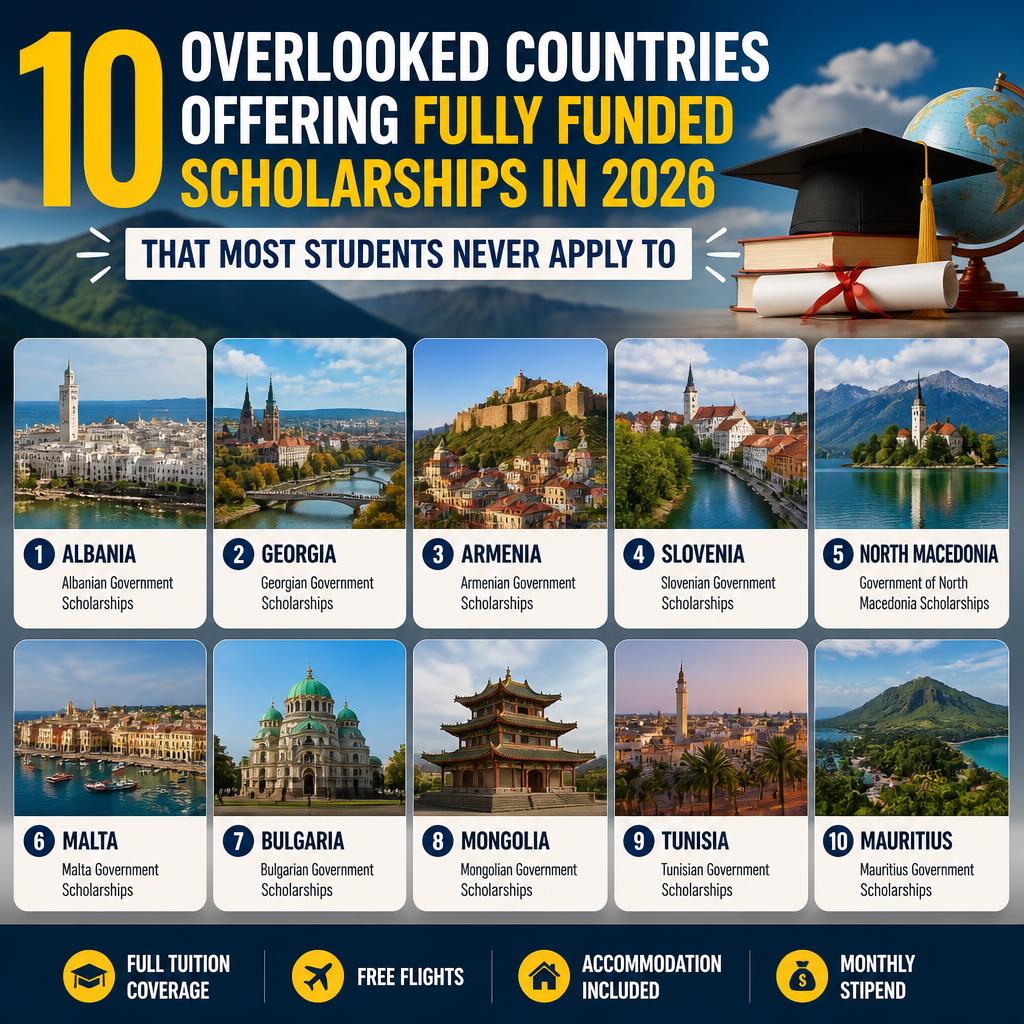
Toggle10 Overlooked Countries Offering Fully Funded Scholarships in 2026 That Most Students Never Apply To
You’ve Been Looking in the Wrong Places This Whole Time
Here’s a scenario that’s more common than you think.
You spend three exhausting months crafting the perfect application for a US or UK scholarship. You write and rewrite your personal statement. You chase down three reference letters. You sit with IELTS anxiety for weeks. Then you get a rejection email so short it doesn’t even explain why.
Meanwhile, thousands of fully funded scholarships go unclaimed every single year — not because students aren’t qualified, but because they simply don’t know those opportunities exist.
Most African students chase the same five destinations: the United States, the United Kingdom, Canada, Australia, and Germany. Those scholarships are real, competitive, and worth pursuing. But they’re also brutally competitive, with acceptance rates that would humble a medical school admissions committee.
The real opportunity? The countries no one is applying to.
This post will introduce you to 10 countries that consistently offer fully funded scholarships to international students — including African applicants specifically — with significantly less competition, genuinely generous packages, and surprisingly strong academic programs.
By the time you finish reading, you’ll know exactly which countries to research first, what their scholarships cover, how competitive they actually are, and how to position yourself as a standout candidate for programs that most students have never even heard of.
Quick Summary Box
- ✅ What this guide covers: 10 underrated countries with real, fully funded scholarship programs for 2026
- ✅ Key benefits: Less competition, generous packages, programs explicitly welcoming African students
- ✅ How to use this post: Read through all 10 countries, bookmark your top three, then jump to the action plan at the end
Why Everyone Applies to the Same Five Countries (And Why That’s Your Opportunity)
There’s a predictable gravity to scholarship applications. Students flock toward familiar names — Harvard, Oxford, University of Toronto — the way travelers crowd into famous airports. The familiarity feels safe. But safety in scholarship applications often translates directly into long odds.
The competition gap between “famous” and “overlooked” scholarship destinations is enormous. Chevening in the UK receives over 65,000 applications annually for roughly 1,500 awards. That’s less than a 2.5% acceptance rate. The Fulbright program in the US accepts about 8,000 students out of 24,000 applicants each year.
Now compare that to scholarships in Hungary, Slovakia, or China — countries with generous, government-funded programs where some fully funded slots go partially unfilled because awareness is so low.
The reason students cluster toward the same destinations comes down to three things: name recognition, social proof, and misinformation. Everyone knows someone who applied to a UK scholarship. Nobody talks about applying to a fully funded government scholarship in Turkey or the Czech Republic — even though those programs have been running for decades and actively recruit African students.
There’s also a language assumption at play. Many students assume that studying in a non-English-speaking country means learning the local language first. In reality, a growing number of these overlooked countries now offer entire undergraduate and postgraduate programs taught entirely in English — specifically to attract international talent.
For African students specifically, this creates a genuine competitive edge. Programs in countries like Hungary, China, or Poland often have dedicated African applicant quotas, regional partnerships with African governments, and scholarship committees actively trying to diversify their intake beyond European students.
Your “disadvantage” of being unfamiliar with these countries is actually your biggest advantage — because most of your competitors are equally unfamiliar and equally unlikely to apply.
What “Fully Funded” Actually Means for These Countries
Before diving into the list, let’s make sure you’re reading scholarship packages correctly. “Fully funded” sounds straightforward, but it means different things in different contexts.
At minimum, a genuinely fully funded scholarship covers tuition fees and a monthly living stipend. The best packages go significantly further — covering round-trip airfare, accommodation, health insurance, research materials, and sometimes even a settling-in allowance when you first arrive.
Here’s the spectrum you’ll encounter:
| Coverage Type | What It Includes |
|---|---|
| Tuition-only | Just your academic fees — you fund everything else |
| Partial funding | Tuition + partial stipend (covers maybe 40–60% of living costs) |
| Fully funded (standard) | Tuition + full monthly stipend + accommodation or accommodation allowance |
| Fully funded (comprehensive) | All of the above + airfare + health insurance + research budget |
For the 10 countries in this guide, most scholarships fall into the “fully funded (standard)” or “fully funded (comprehensive)” categories.
What fully funded typically doesn’t cover: personal shopping, entertainment, phone bills, visa application fees (those usually come out of pocket), and family member expenses if you bring dependants.
A practical tip — when you read a scholarship description, look specifically for these phrases: “monthly stipend,” “accommodation provided,” “return airfare,” and “health insurance.” If the scholarship description mentions all four, you’re looking at a comprehensive package. If it only mentions tuition waiver, keep reading the fine print carefully before celebrating.
Two quick examples to anchor this: China’s CSC Scholarship covers tuition, accommodation on campus, and a monthly living allowance ranging from ¥2,500 to ¥3,500 depending on your study level — that’s roughly $350–$490 USD monthly, which covers living costs comfortably in most Chinese cities. Hungary’s Stipendium Hungaricum covers tuition, accommodation, and a monthly allowance, making it a genuinely zero-cost-to-student program for qualifying applicants.
Knowing exactly what you’re getting before you apply saves you from nasty surprises on arrival.
The 10 Overlooked Countries Offering Fully Funded Scholarships in 2026
1. Hungary — Stipendium Hungaricum: Europe’s Best-Kept Scholarship Secret
Hungary doesn’t come up in scholarship conversations the way Germany or the Netherlands does. That’s a genuine oversight — and one you should exploit in 2026.
The Stipendium Hungaricum programme is a Hungarian government initiative that funds thousands of international students annually across more than 30 Hungarian universities. It covers tuition fees in full, provides free accommodation (or an accommodation allowance), and includes health insurance coverage. It’s administered through bilateral agreements between Hungary and partner countries — and several African countries including Ethiopia, Kenya, Tanzania, South Africa, Ghana, and Nigeria are on that partner list.
What makes this particularly compelling is the English-language program availability. Hungary now offers hundreds of degree programs at undergraduate, master’s, and doctoral levels taught entirely in English — particularly in medicine, engineering, business, and natural sciences.
The acceptance rate is meaningfully better than Western European equivalents. Hungary genuinely wants to attract African students as part of its international education strategy, which means your African nationality is an asset here, not a neutral factor.
For 2026, applications typically open between November 2025 and January 2026. You apply through your home country’s partner institution or directly via the Stipendium Hungaricum portal, depending on your country’s agreement structure.
One thing to note: some applicants report that accommodation quality varies by institution, so it’s worth researching specific university reviews before selecting your host institution preference.
2. China — CSC Scholarship: Massive Scale, Genuine Opportunity
China’s Chinese Government Scholarship (CSC) is one of the largest fully funded scholarship programs in the world, and yet it remains dramatically underrepresented in African student applications relative to its actual scale.
China funds over 50,000 international students annually through the CSC program. African students receive a dedicated portion of those placements through direct bilateral agreements — China has signed scholarship cooperation agreements with dozens of African countries as part of its broader education and development commitments.
The package is comprehensive: tuition, university accommodation, health insurance, and a monthly stipend between ¥2,500 and ¥3,500 (roughly $350–$490 USD). For doctoral students, the stipend reaches ¥3,500 monthly. That covers living comfortably in most Chinese cities outside Shanghai and Beijing.
The course options are extraordinary. China’s top universities — including Peking University, Tsinghua University, Fudan University, and Zhejiang University — all participate in CSC scholarships, and many offer programs in English, particularly at the master’s and doctoral level in STEM fields, economics, international relations, and public policy.
One critical reality check: Competition within the African quota is still significant because the CSC is well-known among students who know to look for it. Your edge comes from targeting less-applied-to universities (not everyone needs to aim for Peking University), writing a strong, specific research proposal, and applying through both the embassy channel and the university channel simultaneously when both are available for your country.
Mandarin language proficiency is not required for English-medium programs, though China Scholarship Council does offer free Chinese language training during your first year if your program requires it eventually.
3. Turkey — Türkiye Scholarships: Comprehensive and Criminally Underrated
Türkiye Scholarships (formerly called Turkish Government Scholarships) is one of the most comprehensive fully funded programs available to African students — and one of the least applied-to relative to its quality.
The package covers tuition, accommodation in government student dormitories, a monthly stipend (currently around $400–$550 USD equivalent depending on study level), return flight tickets, health insurance, and even a one-year Turkish language course before your degree program starts. That language course is paid for and counts as part of your funded period.
Turkey has over 200 universities, and while the language of instruction for many programs is Turkish (hence the mandatory language prep year), a growing number of graduate programs are offered in English — particularly in engineering, business, social sciences, and international relations.
African students are actively recruited. Turkey has established education partnerships across sub-Saharan Africa, and African applicants form a meaningful share of Türkiye Scholarships recipients. The acceptance rate, while not published officially, is estimated to be significantly more favorable than UK or US equivalents for African applicants specifically.
The application window for 2026 intake typically opens in January and closes in February, so you’ll want to start preparing your documents by November 2025 at the latest.
One practical note: the stipend covers basic living costs well, but Turkey’s cost of living has been affected by inflation in recent years. Budget carefully and plan for some personal supplementary funds if possible.
4. Slovakia — Slovak Government Scholarships: Eastern Europe’s Hidden Gem
Slovakia rarely appears on any scholarship list aimed at African students. That’s almost entirely an awareness problem — and it’s your opportunity.
The Slovak Government Scholarship Programme is funded through the Slovak Academic Information Agency (SAIA) and operates under bilateral agreements between Slovakia and partner countries globally. Slovakia has specifically worked to expand its African partnerships, and students from qualifying countries can access fully funded study and research placements at Slovak universities.
The program covers: monthly stipend, accommodation, and health insurance. Tuition fees are waived for scholarship holders. The stipend amount is modest by Western European standards — roughly €350–€500 monthly — but Slovakia’s cost of living is significantly lower than Western Europe, meaning your money stretches considerably further.
Slovak universities are increasingly offering English-language programs, particularly at the master’s and doctoral level. Fields like natural sciences, engineering, economics, and humanities have well-established English-medium tracks.
What’s especially interesting here is the research placement option. If you’re a postgraduate student or early-career researcher, Slovakia offers funded research placements at Slovak academic institutions — a less conventional path that faces even less competition than degree program applications.
Slovakia is also an EU member, which means your degree carries EU recognition, making it valuable for careers in Europe, the UK, or internationally. That’s a significant credential boost that many students overlook when they dismiss Eastern European institutions.
Applications for government scholarships typically open in the fall each year. Check SAIA’s official portal directly for 2026-specific dates.
5. Hungary’s Neighbor Worth a Look — Czech Republic: Central European Quality with Minimal Competition
The Czech Republic is punching well above its scholarship-awareness weight. It offers government-funded scholarships through the Czech Government Scholarship Programme, administered by the Centre for International Cooperation in Education (DZS).
Like Slovakia, the Czech Republic operates under bilateral education agreements, and several African countries are partner nations. The scholarship covers tuition, accommodation in student dormitories, and a monthly stipend — typically in the range of CZK 10,000–15,000 (approximately $450–$680 USD depending on exchange rates).
Charles University in Prague, one of the oldest universities in Central Europe founded in 1348, participates in government scholarship programs. So does Czech Technical University in Prague and Masaryk University in Brno. These are genuinely respected institutions with strong research outputs.
English-language programs have expanded dramatically over the last decade. Master’s programs in IT, engineering, economics, natural sciences, and social sciences are available entirely in English.
The competition reality here is favorable. Czech government scholarships are not widely publicized in African scholarship communities, which means the African applicant pool is smaller relative to available slots. That’s a straightforward competition advantage you should use deliberately.
The Czech Republic also has a stable, safe living environment, a relatively affordable cost of living by European standards, and strong transport links to the rest of Europe — practical factors that matter for your quality of life during a two-to-four-year program.
6. Japan — MEXT Scholarship: World-Class Education, Lower Competition Than You Think
Japan’s MEXT Scholarship (Monbukagakusho) is technically known among scholarship hunters, but it remains dramatically under-applied relative to its quality and the size of its intake. African students in particular apply at far lower rates than the program’s African quota would suggest.
MEXT is genuinely comprehensive. The scholarship covers tuition in full, provides a monthly stipend of ¥117,000–¥145,000 (roughly $780–$970 USD depending on your study level), covers round-trip airfare, and includes health insurance. That monthly stipend is genuinely liveable in Japan — Japan’s cost of living is high in Tokyo but very manageable in other cities.
There are multiple MEXT tracks: the research student track (for graduate-level applicants), the undergraduate track, and the teacher training track. African students apply predominantly through the Embassy Recommendation channel, where your country’s Japanese embassy selects candidates — which means doing your groundwork with the Japanese embassy in your home country is essential.
One distinctive feature: MEXT typically includes a Japanese language training period before your academic program begins. Even if your degree program is in English, you’ll gain basic Japanese language skills, which is both practically useful and personally enriching.
Japan’s top universities — including the University of Tokyo, Kyoto University, Osaka University, and Tohoku University — host MEXT scholars. These are globally ranked institutions that add genuine prestige to your academic profile.
The MEXT Embassy Recommendation cycle for 2026 typically opens mid-year 2025, so if you’re reading this in late 2025, act immediately — don’t miss the window.
7. Malaysia — Malaysian Government Scholarships and University Funding: Asia’s English-Friendly Option
Malaysia is significantly underrepresented in African scholarship conversations, and that’s a missed opportunity given how explicitly Malaysian institutions recruit African students.
Malaysia International Scholarship (MIS) is the flagship government-funded program, targeting high-achieving international students for postgraduate (master’s and doctoral) study at Malaysian public universities. It covers tuition fees, a monthly stipend, health benefits, and return airfare. Monthly stipends typically range from RM 1,500 to RM 3,500 (approximately $320–$750 USD), and Malaysia’s cost of living is low enough that this comfortably covers accommodation and living expenses.
Malaysia’s public universities — including Universiti Malaya (which consistently ranks among the top 150 globally), Universiti Putra Malaysia, and Universiti Teknologi Malaysia — conduct a significant portion of their postgraduate programs in English. This eliminates the language barrier entirely for most African applicants.
Beyond the government scholarship, individual Malaysian universities offer their own funded research assistantships and teaching assistantships that effectively create fully funded packages for doctoral students — a path that’s particularly accessible for science, technology, engineering, and mathematics fields.
The cultural proximity advantage: Malaysia has a multicultural, multi-faith society with significant African student communities at major universities. Halal food is widely available, and the living environment is considered welcoming and familiar by many African students who’ve studied there.
For 2026, MIS applications typically open between March and May. Check the official Malaysian Ministry of Higher Education portal for exact dates.
8. South Korea — Korean Government Scholarship Program (KGSP): Rising Star with Serious Funding
South Korea’s Global Korea Scholarship (GKS), formerly called KGSP, is one of the most generous fully funded programs operating in Asia — and African student awareness of it remains surprisingly low.
The GKS package is excellent: tuition, accommodation (or accommodation allowance), monthly stipend of KRW 900,000 for master’s/doctoral students (roughly $680 USD), return airfare, settlement allowance upon arrival, health insurance, and Korean language training during your first year. The settlement allowance alone — a one-time payment of KRW 200,000 upon arrival — signals how genuinely welcoming the program is.
South Korea has dedicated African country quotas within its GKS allocation. African students apply through either the Embassy Recommendation channel (through the Korean embassy in your country) or the University Recommendation channel (where specific Korean universities nominate international candidates). Both paths are genuinely accessible.
Korean universities participating in GKS include Korea University, Yonsei University, Seoul National University, and dozens of other strong institutions. Many offer English-medium postgraduate programs, particularly in engineering, business, public policy, and Korean studies.
A realistic competition note: GKS has become more widely known in parts of Africa over the last three years, particularly in West and East Africa. The competition is rising but still significantly lower than US, UK, or European equivalents. Your best edge is a sharp research proposal, strong academic record, and a well-matched faculty mentor at your target university.
Embassy Recommendation deadlines typically fall in September–October for the following year’s intake. Start building your application package by July if you’re targeting the 2026 cycle.
9. Romania — Romanian Government Scholarships: EU Education, Zero Fees, Almost Zero Competition
Romania might be the most genuinely overlooked country on this entire list for African scholarship applicants. And that’s almost exclusively an awareness problem.
The Romanian Government offers fully funded scholarships through the Ministry of Foreign Affairs specifically for citizens of developing countries — and African nations are explicitly listed among eligible nationalities. The scholarship covers tuition fees, accommodation in university dormitories or an accommodation allowance, a monthly stipend, and medical insurance.
Monthly stipends are modest — approximately €65–€85 per month, which sounds low. But here’s the critical context: accommodation is provided separately, and Romania has one of the lowest costs of living in the EU. Your stipend covers meals and personal expenses when housing is already covered. Many scholarship holders supplement through legal part-time work, which Romanian law permits for scholarship students.
Romanian universities offer a number of English-medium programs, particularly at postgraduate level in medicine, engineering, economics, and IT. The University of Bucharest, Babeș-Bolyai University in Cluj-Napoca, and Alexandru Ioan Cuza University in Iași all participate in these programs.
The EU credential value is real. A degree from a Romanian university carries full EU recognition, is accepted in ERASMUS+ programs for further mobility, and opens doors across European job markets.
Applications for 2026 open through Romania’s Ministry of Foreign Affairs scholarship portal, typically between March and April 2026. The competition from African applicants is genuinely low — which makes this one of the highest opportunity-to-effort scholarships on this list.
10. Russia — Russian Government Scholarships: Large Scale, True Zero Cost, Underestimated
Russia’s Government Scholarship for Foreign Citizens is one of the largest fully funded scholarship programs in the world by absolute numbers — yet it rarely appears in African scholarship guides aimed at students.
Russia allocates thousands of funded spots annually for international students across its universities, and African countries receive dedicated quotas. The scholarship covers tuition, accommodation in university dormitories, and a monthly stipend — typically around 1,500–2,000 rubles (the stipend amount has been subject to adjustment; verify current equivalents when you apply).
Hundreds of Russian universities participate in the program, including flagship institutions like Moscow State University, St. Petersburg State University, RUDN University (Peoples’ Friendship University of Russia, which has a historic and actively maintained commitment to African student education), and many specialized technical and medical universities.
RUDN University deserves specific mention. It was literally founded with a mission to educate students from Africa, Asia, and Latin America and has been doing so since 1960. Its Africa-specific scholarship history and infrastructure is unlike anything you’ll find in most other countries.
Language of instruction is predominantly Russian, which means most programs require you to complete a Russian language preparatory year — which is included in your funded period. A growing number of master’s programs at top Russian universities are now available in English, particularly in STEM and economics.
The geopolitical reality: Russia’s international position has shifted significantly since 2022, and it’s worth researching current conditions, visa availability from your country, and your home country’s official guidance before applying. For students whose countries maintain normal diplomatic relations with Russia, the scholarship remains a fully funded, legitimate opportunity. Approach it with clear eyes and current information.
How to Build Your Scholarship Application Strategy Around These Countries
Knowing 10 countries is useful. Having a system for applying strategically is what actually gets you funded.
Start by identifying your top three countries based on your field of study, language comfort level, and career goals. Don’t apply to all 10 — apply deeply and well to three.
Here’s a practical framework for narrowing down:
Step 1: Match your field. Some countries are stronger in specific disciplines. Japan and South Korea excel in engineering, technology, and natural sciences. Malaysia is strong in business and technology. Hungary is excellent in medicine and natural sciences. Romania and Russia have particularly strong medical education traditions.
Step 2: Check your country’s bilateral agreements. Most of these government scholarships operate through bilateral partnerships — meaning your country must be on the partner list. Before investing application effort, visit each country’s official scholarship portal and confirm your nationality qualifies.
Step 3: Assess language requirements honestly. If you prefer English-medium instruction, prioritize Malaysia, South Korea (GKS has English programs), Hungary, and the Czech Republic. If you’re open to a language prep year, Turkey, Japan, and Russia become strong options.
Step 4: Build your application timeline backward. Take the application deadline and count backward 10 weeks — that’s when you need to start. Factor in time to gather transcripts, request references, draft your statement of purpose, and complete language tests if required.
Step 5: Apply through multiple channels when available. Many of these programs offer both embassy recommendation channels and university direct application channels. Applying through both where permitted doubles your chances without doubling your work significantly.
According to the official Stipendium Hungaricum program portal, Hungary’s scholarship programme now covers over 180 institutions and 13,000 international scholarship holders — a scale that signals genuine government commitment rather than a token program.
What a Strong Application Looks Like for These Programs
The scholarship committees in these overlooked countries are often evaluating African applicants on a narrower field of competitors. That’s good news. But it doesn’t mean weak applications get through.
The single strongest differentiator for these programs is specificity of purpose. A committee reviewing applications for a Malaysian engineering scholarship isn’t impressed by a generic statement about “my passion for learning.” They want to know why you want to study at Universiti Malaya specifically, how their program connects to a real professional goal you have, and what you’ll do with the qualification in your home country or region.
Your personal statement should answer three questions clearly:
- Why this country and this institution specifically?
- What do you intend to study and why does your background qualify you?
- What will you do with this education — and how does it connect to something larger than yourself?
The third question matters especially for government-funded scholarships. Many of these programs have development mandates — they’re investing in students who will return home and contribute. If your study plans connect to development goals in your country or region, say so explicitly.
Academic transcripts matter, but they’re not the whole story. For students with strong professional experience and modest undergraduate GPAs, many of these programs weight motivation and professional trajectory heavily. A 3.0 GPA with a clear, compelling narrative often outperforms a 3.8 GPA with a generic application.
References should be specific and strategic. A generic “he is a good student” letter from a professor you barely interacted with will not serve you. A letter from a supervisor or professor who speaks directly to your research capacity, problem-solving skills, or leadership in professional contexts is significantly more powerful.
Are You Actually Eligible? A Quick Eligibility Self-Check
Before you spend weeks on an application, spend five minutes checking the basics.
Ask yourself these four questions:
- Is my country listed as a partner nation for this scholarship? (Yes/No — if no, move to the next country on your list)
- Do I meet the minimum academic requirement? (Most programs require a minimum GPA equivalent; check the specific threshold)
- Do I have the required language evidence? (IELTS or TOEFL for English-medium programs; check minimum scores)
- Am I within the age limit where one applies? (Some programs have upper age limits, commonly 35–40 for graduate scholarships; others have no limit)
If you answer yes to all four, you’re in the eligible pool. Now the work is making your application compelling enough to win.
For African applicants specifically, watch for these eligibility nuances:
- Bilateral agreement status: Your country must be a signatory to the partnership. This changes over time — a country that wasn’t on the list two years ago may be now. Always check the current year’s official documentation.
- “Developing country” classification: Several programs use World Bank or UN classifications of “developing country” as an eligibility criterion. Most African nations qualify automatically.
- Home country return commitment: Some scholarships (particularly government-funded ones) require you to commit to returning home after completing your studies. Read this clause carefully — it’s usually not enforced through legal mechanism but violations can affect future applications.
The 2026 Scholarship Application Timeline
Use this timeline to plan your year intelligently. The students who win these scholarships aren’t necessarily the most qualified — they’re the most prepared.
| Date Range | Action Milestone |
|---|---|
| September–October 2025 | Research your top 3 countries; check bilateral agreements; identify specific programs |
| October–November 2025 | Request transcripts; contact referees; begin statement of purpose drafting |
| November–December 2025 | Complete IELTS/TOEFL if required; finalize reference letters |
| December 2025–January 2026 | Submit Hungary (Stipendium Hungaricum) and Turkey applications (early openers) |
| January–February 2026 | Submit CSC (China) applications through embassy and university channels |
| February–March 2026 | Submit MEXT (Japan) embassy nomination applications |
| March–May 2026 | Submit Malaysia MIS and Romanian government scholarship applications |
| April–June 2026 | GKS Korea University Recommendation channel opens; submit Slovak and Czech applications |
| July–September 2026 | Shortlisting and interview notifications across most programs |
| October–December 2026 | Final decisions; visa applications; pre-departure preparation |
| September 2027 | Most programs begin for the 2026–27 cohort |
Note: Rolling applications exist within some of these programs — particularly university-direct channels in Malaysia and the Czech Republic. Rolling deadlines are genuinely more flexible for applicants managing full-time work or family responsibilities.
Set phone reminders six weeks before each submission deadline. Documentation gathering consistently takes longer than applicants expect — especially for notarized transcripts that need to be mailed internationally.
Frequently Asked Questions
Can I apply to these scholarships if I’m currently employed full-time in my home country?
Yes, absolutely. Most of these scholarship programs have no requirement that you be currently enrolled in school or unemployed. You apply as a prospective student. Resigning from your job (if required) only becomes relevant after you receive and accept an offer. Many successful applicants hold full-time jobs during the entire application process.
Do I need to speak the local language to study in these countries?
Not necessarily. Countries like Malaysia, South Korea, Hungary, and the Czech Republic offer significant numbers of English-medium programs, especially at postgraduate level. Countries like Turkey, Japan, and Russia typically require you to complete a funded language prep year before your degree starts. Always verify language requirements for your specific program, not just the country generally.
Are these scholarships legitimate — how do I avoid scams?
Verify every scholarship through the official government portal or official university website of the country offering it. Legitimate scholarships never ask you to pay an application fee to a private individual or third-party agent. The programs named in this guide — Stipendium Hungaricum, CSC, GKS, MEXT, Türkiye Scholarships — all have official government-hosted portals with verifiable contact information.
What if my undergraduate GPA isn’t strong — can I still compete?
Many of these programs weight motivation, professional experience, and research potential alongside GPA. A competitive GPA threshold of 3.0–3.3 applies to most programs (some set it lower). If your GPA is below threshold, focus on programs that explicitly value professional experience and career trajectory, and ensure your personal statement addresses your academic history with honesty and forward-looking clarity.
Can I apply to multiple countries’ scholarships at the same time?
Yes — and you should. Applying to three to five scholarship programs simultaneously is standard practice among successful scholarship applicants. Each application will require tailoring (your statement of purpose should be country and program specific), but your core documents — transcripts, references, CV — are the same. Managing multiple applications is effort-intensive but dramatically improves your overall probability of success.
How long does it take from application submission to enrollment?
Most of these government scholarship programs run on a 12–18 month cycle from application opening to program commencement. If you apply in January 2026 for a September 2027 start, that’s approximately 18 months. Some programs move faster — Malaysia’s MIS and university-direct channels in several countries can move within 6–9 months. Build your personal timeline with the longer estimate in mind to avoid planning stress.
Are African students at a disadvantage compared to European applicants in these programs?
For most of the programs on this list — no, and in many cases, the opposite is true. Hungary, Turkey, China, and Russia all have explicit African country quotas or bilateral agreements that create dedicated slots for African applicants. You’re not competing against European students for the same seats — you’re often competing within a separate African country allocation where the pool is smaller and the committee is actively trying to fill those spots.
The playing field is more level than you’ve been told — in some programs, it actively tilts in your favor.
Your Action Plan: Start Here, Start Now
You just covered a lot of ground. Ten countries. Dozens of programs. Eligibility criteria, timelines, application strategy, and package details. It’s a lot — and if you’re feeling the weight of the information, that’s normal.
Here’s what matters most: you now know something the majority of your competitors don’t know. You know that Hungary’s Stipendium Hungaricum is actively seeking African students. You know that Japan’s MEXT has an African embassy channel with real allocated spots. You know that Romania offers EU-recognized degrees at near-zero competition. That knowledge is only useful if you act on it.
So here are your three immediate next steps — specific, doable, and each completable within the next 48 hours:
- Visit the official Stipendium Hungaricum portal or the GKS Korea scholarship page today and confirm whether your country is on the partner list. This single check takes 10 minutes and immediately tells you which programs are live options for you. Bookmark the official page and note the application opening date.
- Email your undergraduate institution’s records office today and request official transcripts in sealed envelopes. If you completed any postgraduate work, request those too. Transcript processing takes weeks — sometimes months for African institutions — and it’s the most common reason applicants miss deadlines. Start the clock on this now.
- Open a blank document and write the answer to this question in your own words: “Why do I want to study [your field] at this stage of my life, and what will I do with it?” Don’t edit, don’t polish — just write honestly for 15 minutes. That raw document becomes the seed of every personal statement you’ll write. It’s the most important 15 minutes in your entire application process.
According to the QS World University Rankings guide to scholarship destinations, African students consistently underestimate the value and accessibility of scholarships in Asia and Central Europe — a gap that represents genuine opportunity for informed applicants.
The students who win these scholarships aren’t always the most brilliant people in the room. They’re the ones who looked where everyone else wasn’t looking — and then actually showed up.
That’s exactly what you’re about to do.
Have questions about a specific country’s scholarship program? Drop them in the comments — we respond to every one.
Share this post with one person in your network who’s been talking about studying abroad but hasn’t applied yet. You might just change the direction of their life.
