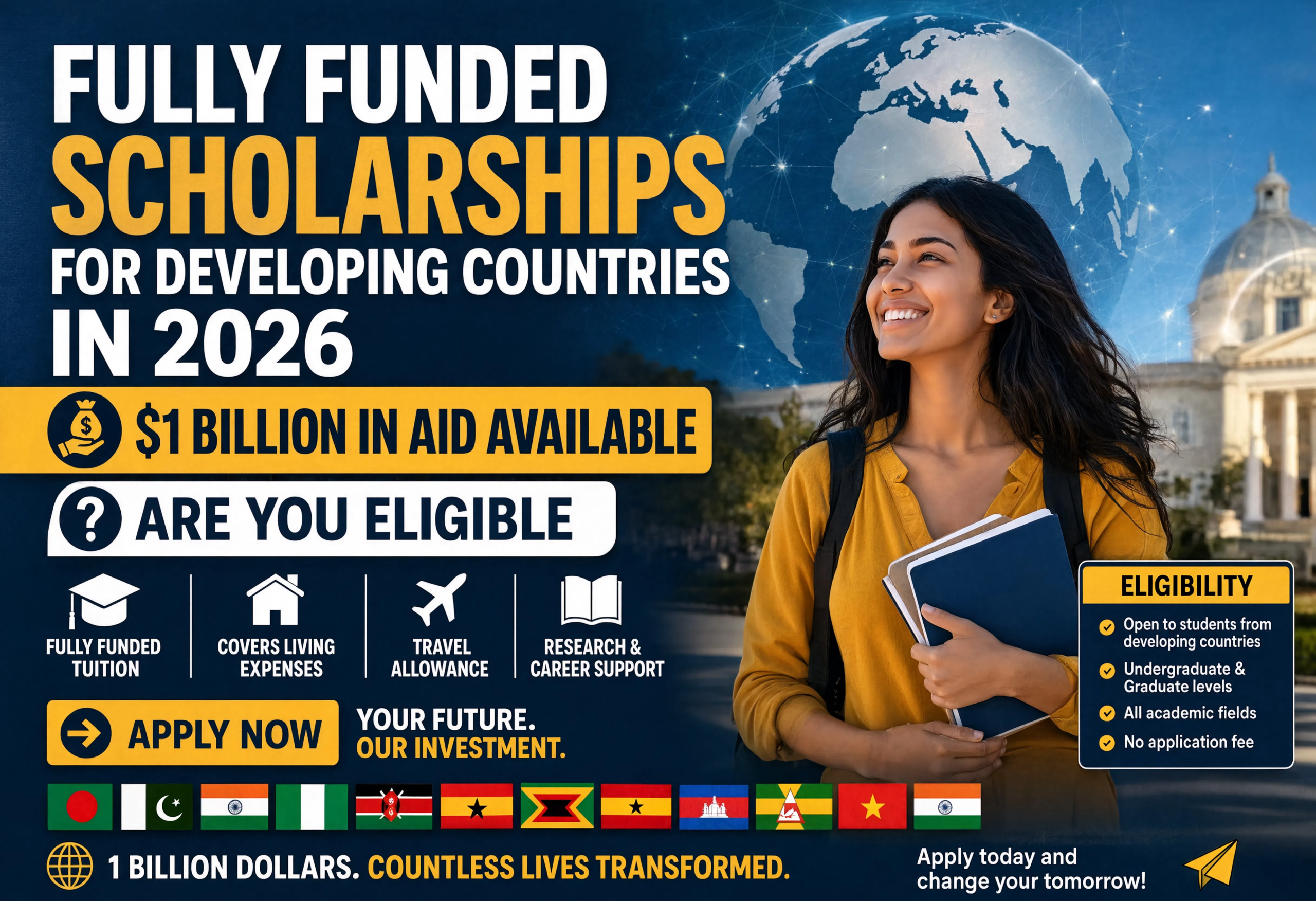
Fully Funded Scholarships for Developing Countries in 2026: $1 Billion in Aid Available — Are You Eligible?
You’ve Been Told the Money Isn’t There. It Is.
You’re sitting somewhere in Lagos, Nairobi, Accra, or Harare — and you’ve been thinking about it again. Going back to school. Finishing that degree. Pivoting into a career that actually lights you up. But every time the thought surfaces, a louder voice shuts it down: “You can’t afford it. That ship has sailed. Those scholarships are for younger people.”
That voice is wrong. And this guide exists to prove it.
In 2026, over $1 billion in fully funded scholarships is available specifically targeting students from developing countries — including you, whether you’re 24 or 54, whether you’ve been working for two years or twenty. Right now, thousands of these awards sit partially unclaimed because not enough eligible people know they exist, know they qualify, or know how to apply without making avoidable mistakes.
This guide changes that. By the time you reach the last line, you’ll know exactly which scholarship types fit your profile, how to build a targeted database of opportunities, what “fully funded” actually covers (and doesn’t), and how to position your life experience as your greatest competitive strength.
You’ll also be ready to take the first concrete step — today, not someday.
📋 Quick Summary Box
What this guide covers: The full landscape of fully funded scholarships for developing countries in 2026, including eligibility, application steps, and the five scholarship types adult learners actually win.
Key benefits you’ll gain: A vetted list of real scholarship platforms, a self-assessment tool, a 2026 application timeline, and essay frameworks tailored to adult applicants.
How to use this post: Read it straight through once, then return to Sections 5, 6, and 8 as your active working reference during your application process.
Why Age Is Not the Barrier You Think It Is
Let’s demolish this myth right now: scholarships are not reserved exclusively for students who just finished secondary school. That assumption keeps brilliant, experienced, capable adults on the sidelines every single year — and it is simply not accurate.
According to UNESCO’s 2023 Global Education Monitoring Report, non-traditional students now make up nearly 40% of tertiary enrolment globally, with the highest growth rates in Sub-Saharan Africa and South Asia. Major scholarship bodies have responded. Programs like the Mastercard Foundation Scholars Program explicitly recruit students who have demonstrated leadership through work and community — qualities that 18-year-olds rarely have in abundance.
Here’s the counterintuitive reality: because many adults assume they’re ineligible, they don’t apply — which means adult applicants face significantly less competition. Fewer competitors. Same pot of money. Better odds for you.
The African context matters here too. Across many communities on the continent, returning to school as an adult is viewed with immense respect — it signals sacrifice, seriousness, and purpose. Scholarship committees understand this. They know that a 35-year-old nurse from Zambia who wants to study public health policy isn’t chasing a degree for status. She’s chasing transformation — for herself and her community. That clarity is magnetic to selection panels.
Consider Amara D., a 38-year-old secondary school teacher from Sierra Leone who spent 12 years in the classroom before applying to the Chevening Scholarship in 2023. She almost didn’t apply because she assumed her age counted against her. It didn’t. She’s now completing a Master’s in Educational Leadership at the University of Edinburgh — fully funded.
Or think of Chidi O., a 31-year-old IT professional from Nigeria who felt his undergraduate degree (earned seven years prior) was “too old” to open doors. He won a DAAD scholarship in 2024. His work experience was the deciding factor in his application.
Your age is not a liability — it is documented proof that you can follow through on a commitment.
Understanding “Fully Funded” vs. Other Scholarship Types
Before you spend a single hour applying, you need to know exactly what you’re applying for. The phrase “fully funded” gets thrown around loosely, and misunderstanding it can lead to expensive surprises mid-program.
A truly fully funded scholarship covers tuition, accommodation, a monthly living stipend, round-trip airfare, and often health insurance — meaning you arrive at your university with your essentials covered and no student debt accumulating back home. That’s the gold standard, and it exists in more places than you’d expect.
Here’s how the funding spectrum breaks down:
- Fully funded scholarships: Cover everything listed above. You focus entirely on studying.
- Partial scholarships: Cover tuition only, or tuition plus a small stipend. You’ll need supplementary income or savings.
- Grants: One-time payments for specific research, projects, or costs — not ongoing support.
- Loans: Borrowed money you repay after graduation. Not scholarships at all, despite how some programs market themselves.
- Work-study programs: You work part-time on campus in exchange for tuition reduction. Viable, but not “free” — you’re trading labor.
What “fully funded” typically does NOT cover: visa application fees (usually $100–$300), passport renewals, personal clothing and toiletries, optional travel, and family expenses if you have dependents at home. Know this upfront so you’re not blindsided.
Here’s how to read a scholarship description like a professional: look for explicit mention of the words stipend, living allowance, travel grant, accommodation provided, and health insurance included. If you see only “tuition covered,” that is a partial scholarship, regardless of how it’s labeled.
Two real examples for context:
The Chevening Scholarship (UK government-funded) covers full tuition at any UK university, a monthly living allowance, an economy-class return flight from your home country, and arrival/departure allowances. It is genuinely fully funded.
The DAAD Scholarships (German Academic Exchange Service) cover full tuition (where applicable), monthly stipends ranging from €861 to €1,200 depending on your level, travel allowances, health insurance, and research subsidies. Also genuinely fully funded.
The more clearly you understand what you’re being offered, the smarter your choices become.
Building Your Scholarship Database: A Systematic Approach
Finding legitimate, adult-friendly fully funded scholarships isn’t about luck — it’s about having a system. Here’s the step-by-step approach that actually works.
Step 1: Start with the anchor platforms.
These are the most credible, highest-volume scholarship databases available to African students from developing countries:
- Mastercard Foundation Scholars Program — specifically designed for young Africans with leadership potential; accepts applicants up to age 35 at select partner universities
- DAAD (German Academic Exchange Service) — one of the most generous fully funded programs globally, with multiple tracks for professionals and researchers
- British Council Chevening Scholarships — UK government-funded; requires 2+ years of work experience, which actively favors adult applicants
- African Union Scholarships — the AU’s Intra-African Academic Mobility Scheme funds African students studying within Africa
- Fulbright Foreign Student Program — U.S. government-funded; open to professionals and graduate students from over 160 countries including most African nations
- Commonwealth Scholarships — funded by UK FCDO; targets students from Commonwealth nations across Africa, Asia, and the Caribbean
- Agence Française de Développement (AFD) scholarships — French development agency funding, particularly strong for Francophone African nations
Step 2: Check your government’s education ministry portal.
Nigeria’s Federal Scholarship Board (fsb.gov.ng), South Africa’s NSFAS (nsfas.ac.za), and Ghana’s Scholarship Secretariat (scholarship.gov.gh) all list government-to-government bilateral scholarship agreements that receive almost zero media coverage — and therefore almost zero competition.
Step 3: Go directly to university funding offices.
Many top UK, Canadian, Australian, and European universities maintain “mature student bursaries” or “adult learner funds” that never appear on aggregator sites. Search “[University name] + mature student scholarship 2026” directly.
Step 4: Filter specifically for adult-friendliness.
When searching any database, add these terms to your query: “mature student,” “non-traditional applicant,” “professional experience required,” “open to all ages.” These unlock a hidden layer of opportunities most young applicants don’t even see.
Step 5: Verify before you invest time.
Legitimate scholarships never ask for application fees. Verify every program by cross-referencing its official website (check the URL — it should match the institution’s domain), confirming the scholarship on the host institution’s financial aid page, and searching “[Scholarship name] + scam” to surface any red flags from past applicants.
Step 6: Build your personal tracker.
Create a simple spreadsheet: Scholarship Name | Deadline | Eligibility Summary | Documents Needed | Status. Update it weekly. A curated, verified database is the single most valuable asset in your scholarship search.
Adult Applicant Eligibility Checklist
Eligibility is where many adult applicants lose confidence unnecessarily. Let’s walk through the actual criteria — and show you exactly where your adult status becomes an advantage.
Standard eligibility criteria to check:
- ✅ Citizenship/Residency: Most developing-country scholarships require a passport from an eligible nation. Confirm your country is on the scholarship’s list before anything else.
- ✅ Academic performance: Most programs ask for a GPA equivalent of 3.0/4.0 or a Second Class Upper (2:1) UK equivalent. Some explicitly accept strong work experience as a substitute for a borderline GPA.
- ✅ Language proficiency: IELTS (minimum 6.5 overall) or TOEFL (minimum 90 iBT) is required by most English-medium programs. Some scholarship bodies waive this if your undergraduate degree was taught in English — check the fine print.
- ✅ Work experience: Chevening requires exactly 2 years; many others prefer it. This is where you shine.
- ✅ Age limits: Many scholarships list a maximum age of 35, 40, or have no limit at all. Read carefully — age caps are less common than you assume.
- ✅ Field of study restrictions: Some scholarships fund only STEM, public health, or development-related fields. Others are open. Narrow your list accordingly.
- ✅ Financial need: Some programs (particularly those targeting developing countries) actively weight financial need. Document yours honestly.
Adult-specific flags — and why they help, not hurt:
Employment gaps: Many scholarship committees interpret a gap between education and application as evidence that you entered the workforce, built real experience, and are now returning with purpose. Frame it that way in your personal statement — never apologize for it.
Non-linear education paths: If you studied part-time, transferred institutions, or took breaks, explain this briefly and confidently. Scholarship bodies from the Global North often find non-linear African educational journeys genuinely compelling.
How the Mastercard Foundation evaluates adult applicants: The program specifically assesses “transformative leadership,” which it defines partly through demonstrated community impact — something you build through years of living and working, not through a school club.
✅ Are You Eligible? Quick Self-Assessment
Answer yes or no to each question. Be honest — this takes 60 seconds.
- Do you hold a passport from a developing or low-to-middle-income country? (Yes/No)
- Did you complete (or are you completing) an undergraduate degree or equivalent professional qualification? (Yes/No)
- Do you have at least 2 years of professional, community, or leadership experience? (Yes/No)
- Can you demonstrate a clear reason for pursuing further education right now — not just “I want a degree”? (Yes/No)
If you answered Yes to 3 or more: You are a competitive candidate for multiple fully funded scholarships in 2026. Keep reading.
If you answered Yes to only 1–2: You have specific gaps to address — this guide will show you how.
Clarity about where you stand is the first step toward applying with confidence.
The 5 Scholarship Types Adult Learners Actually Win
Not all scholarships are built the same — and some are practically designed for people with your profile. Here are the five categories where adult applicants from developing countries consistently succeed.
Type 1: Government-Funded Bilateral Scholarships
Who funds them: National governments (UK, Germany, USA, Japan, China, France, Turkey) that maintain education agreements with developing nations.
What makes you competitive: Bilateral scholarships often prioritize applicants who will return home and contribute to national development — which makes experienced professionals far more convincing candidates than recent graduates.
Typical award: Fully funded, including tuition, stipend, travel, and health cover. Some include family allowances.
Acceptance rate: Varies by country and program; Chevening’s overall global acceptance rate is approximately 2–3%, but country-specific quotas mean Nigerian, Kenyan, or Ghanaian applicants face their own pool, not global competition.
Example: The Turkish Government Scholarship (Türkiye Bursları) explicitly welcomes applicants up to age 50 for graduate programs and covers tuition, accommodation, stipend, health insurance, and Turkish language training. It received over 180,000 applications globally in 2023 — but country-specific allocations kept individual competitions manageable.
Type 2: University-Specific Mature Student Programs
Who funds them: Individual universities, often from endowment funds or government widening-participation grants.
What makes you competitive: These programs exist specifically to recruit people like you. Universities benefit from diverse cohorts — your work experience enriches classroom discussion for everyone.
Typical award: £5,000–£20,000 per year (partial to full coverage); some are fully funded.
Acceptance rate: Typically higher than national scholarship programs — often 10–20% for shortlisted candidates.
Example: The University of Edinburgh’s Global Development Academy and several UK Russell Group universities offer “mature student bursaries” covering up to full tuition for international students demonstrating financial need and academic promise. Check each university’s Student Awards and Funding office directly.
Type 3: NGO and Foundation Scholarships for Career Changers
Who funds them: Development-focused foundations (Mastercard Foundation, Open Society Foundations, Ford Foundation, Wellcome Trust).
What makes you competitive: These bodies explicitly value transformation narratives. They want to fund people who will leverage education to drive social change — and that’s a story built from years of lived experience, not weeks.
Typical award: Fully funded, often including additional leadership development programming.
Acceptance rate: Competitive but manageable. The Ford Foundation International Fellowships Program (IFP) historically funded approximately 4,300 fellows across its lifetime — and explicitly targeted “exceptional individuals who have demonstrated their potential to be effective agents of change in their home countries.”
Example: The Open Society Foundations’ scholarships fund graduate study for applicants from 30+ developing countries with a specific focus on human rights, governance, and public policy — fields where professional experience is not just valued but expected.
Type 4: Merit-Based Scholarships Open to All Ages
Who funds them: Universities, private donors, professional associations, and industry bodies.
What makes you competitive: Merit here includes academic excellence AND demonstrated professional achievement. Your track record is part of the merit calculation.
Typical award: Varies widely — $5,000 to fully funded.
Acceptance rate: Highly variable; targeted applications to well-matched programs dramatically improve odds.
Example: The Commonwealth Scholarship Commission reports that a significant proportion of its awardees each cycle are professionals in their 30s pursuing development-related master’s degrees — not recent undergraduates.
Type 5: Employer-Sponsored Education Scholarships
Who funds them: Corporations (often multinational companies operating in Africa), professional associations, and industry bodies.
What makes you competitive: You’re already in the workforce. You’re not a risk — you’re an investment they understand.
Typical award: Full or partial tuition coverage, sometimes with continued salary during study.
Acceptance rate: Varies enormously; internal programs can be highly accessible.
Example: Several multinational energy, banking, and healthcare companies operating across Africa maintain staff development funds that cover postgraduate study — and these funds frequently go unused because employees don’t ask. Check your HR department’s learning and development policy before looking externally.
Winning a fully funded scholarship as an adult is not a long shot — it’s a strategic choice.
Crafting Your Adult Applicant Application: Step-by-Step
The application process can feel like scaling a wall when you’re looking at it from the outside. Once you’re inside the process, it’s actually a series of manageable doors. Here’s how you open each one.
Step 1: Create your portal account early.
Most scholarship programs use dedicated online portals (Chevening’s, DAAD’s, or university-specific systems). Create your account at least 10 weeks before the deadline — not to submit early, but to understand exactly what the system asks for so you can gather documents without scrambling.
Step 2: Gather your academic documents.
You’ll request official transcripts from every institution you attended — secondary school, undergraduate, and any professional certifications. If you attended institutions that no longer exist or have changed names, start this process immediately. It can take 4–8 weeks. Adult applicants with education from multiple institutions often face transcript delays they didn’t anticipate.
Step 3: Compile your professional documentation.
You’ll assemble your updated CV, employment letters confirming your roles and dates, any professional certifications (project management, clinical, technical — whatever is relevant to your field), and evidence of leadership or community involvement. This is where your years of experience become tangible assets on paper.
Step 4: Draft your personal statement and essays.
This is your most important document. You’ll address: why you’re pursuing this specific program, why now, how it connects to your professional trajectory, and what you’ll do with it when you return home. We’ll cover exactly how to frame this as an adult applicant in Section 9.
Step 5: Secure your references.
You’ll need 2–3 referees — and for adult applicants, a professional supervisor or senior colleague is often more powerful than an academic reference from a professor you studied under a decade ago. Approach referees at least 6 weeks before submission and give them a clear brief on what the scholarship committee is looking for.
Step 6: Review your application like an editor, not the author.
You’ll read your entire application as if you’re the selection committee — checking for consistency between your CV, essay, and references, ensuring every claim is specific and evidenced, and catching any spelling or grammatical errors. Ask one trusted person to read it before you submit.
Step 7: Submit — then record.
You’ll submit before the deadline (never on the day itself), save your confirmation email, screenshot your submission, and log the date in your tracker. Then you’ll follow up only if the program explicitly invites enquiries.
Give yourself 8–10 weeks minimum — adult applicants consistently need more time to gather professional documentation than recent graduates do.
⚠️ 5 Mistakes That Cost Adult Applicants (Avoid These)
1. Spelling and grammar errors. A single typo in your personal statement signals carelessness to a committee reading hundreds of applications. Proofread. Then proofread again.
2. Generic motivation. “I want to further my education” tells a selection panel nothing. Tell them why now, why this program, and why you specifically — or your application dies in the first review round.
3. Missing work experience details. Listing job titles without describing impact is a wasted opportunity. Quantify your contributions: “Managed a team of 12,” “Reduced operational costs by 18%,” “Trained 200 community health workers.”
4. Weak referee selection. A professor who barely remembers you is a weaker advocate than a direct supervisor who can speak to your leadership, discipline, and growth. Choose referees who know your work, not just your name.
5. Underestimating the timeline. Thinking you can complete a strong application in two weeks — especially while working full-time — is the most common and costly mistake adult applicants make.
Preparation doesn’t guarantee success, but it eliminates the uncertainty of wondering whether you did enough.
Positioning Your Story: Why You’re the Right Candidate
Here is the truth that most scholarship guides won’t tell you: selection committees are not looking for the most academically decorated applicant — they’re looking for the most compelling one. And compelling stories come from lived experience, which you have in abundance.
The temptation for adult applicants is to minimize their background — to focus entirely on academic achievements and quietly hope no one asks about the eight years between graduation and application. Resist this completely. The gap is your story. The detour is your credential.
“When I stopped apologizing for being 32 and started explaining why I was ready, everything changed.” — Kwame A., DAAD Scholar, 2024, age 32, studying Sustainable Energy Management in Berlin
Kwame’s insight captures something essential: scholarship committees don’t penalize clarity that comes later in life. They reward it. A 32-year-old who knows exactly why she’s returning to school and precisely what she’ll do with the education is a far safer investment than a 21-year-old who’s still figuring it out.
How to translate your experience into essay gold:
Your work history, family responsibilities, community service, and personal resilience are not just background details — they’re evidence of capability. When you write that you “managed household finances through a currency crisis,” you’re demonstrating financial literacy and crisis management. When you describe “leading a community clean-water initiative,” you’re demonstrating project management, stakeholder engagement, and social conscience. Translate everything.
Authenticity is non-negotiable. Don’t try to sound younger. Don’t minimize your age or professional background to seem more “traditional.” Scholarship readers are perceptive — they spot performed youth immediately, and it costs you credibility.
Three essay frameworks that work especially well for adult applicants:
🔹 “The Turning Point” — Identify one defining professional moment that revealed a gap in your knowledge or capability and sparked the decision to return to school. Build your entire statement around that moment.
🔹 “The Compound Investment” — Frame each chapter of your life (work, community, family) as a layer of preparation that makes this specific education the logical next step — not a detour, but a culmination.
🔹 “From Stability to Ambition” — Acknowledge that you had a stable career and chose to disrupt it deliberately. Explain what you’re willing to sacrifice, and why the long-term impact on your community justifies the sacrifice.
The difference between generic and powerful:
❌ Generic: “I am applying for this scholarship because I wish to further my studies in public health and contribute to my country’s development.”
✅ Powerful: “I spent six years managing primary health programs across three rural districts in Ghana, watching preventable deaths occur because frontline workers lacked policy literacy. This master’s is how I fix that — starting with the district I know best.”
Same field. Completely different impact. Authenticity isn’t just morally right — it’s your single greatest competitive differentiator.
The 2026 Adult Scholarship Timeline
Planning is everything. Here’s your master timeline for 2026 — bookmark this section and set phone reminders for each milestone.
| Date Range | Milestone |
|---|---|
| January – February 2026 | Major scholarship portals open (Chevening, DAAD, Commonwealth, Fulbright). Create your accounts now. |
| February – March 2026 | Begin gathering transcripts, employment letters, and professional certificates. Request references formally. |
| March – April 2026 | Draft personal statements and essays. Seek feedback from a mentor or advisor. |
| April – May 2026 | First wave of fixed deadlines closes (Chevening typically closes in early November for the following academic year — check current cycles). |
| May – June 2026 | Rolling deadline programs accept applications continuously. Mastercard Foundation partner universities open applications. |
| June – August 2026 | Shortlisting and interview invitations begin arriving for early-round applicants. |
| August – September 2026 | Interview rounds conducted (online or in-country). Final documentation requested from shortlisted candidates. |
| September – October 2026 | Final award notifications issued. Visa applications begin. |
| January / September 2027 | Program start dates for most 2026-cycle awards. |
Adult-specific note: Programs with rolling deadlines — including several DAAD tracks and some university-specific bursaries — are particularly well-suited to applicants balancing work and applications simultaneously.
Set phone reminders 6 weeks before each deadline — adult applicants consistently underestimate how long professional documentation takes to compile.
Proactive planning converts possibility into a plane ticket.
Frequently Asked Questions
Can I get a fully funded scholarship if I’ve been working for 10 years?
Yes, absolutely. Many fully funded scholarships — including Chevening, DAAD, and Commonwealth — explicitly require or value professional experience. Ten years of relevant work history often makes your application stronger, not weaker. Your career record demonstrates commitment and real-world impact that recent graduates simply cannot show.
What if there’s a gap in my education?
An education gap doesn’t disqualify you from most fully funded scholarships. You’ll address it briefly in your personal statement by explaining what you did during that period — work, community service, caregiving, entrepreneurship. Selection committees value transparency. A gap with purpose is far more compelling than no gap and no story.
Can I work while on a full scholarship?
It depends on the program and host country. Many fully funded scholarships discourage or restrict paid employment during the award period, since the stipend is designed to cover your needs. UK student visas currently permit up to 20 hours of part-time work per week. Always check your scholarship agreement and host country’s visa conditions before accepting paid work.
Do I need to be living in my home country to apply?
Most programs require you to be a citizen of an eligible developing country — but many do not require you to be physically residing there at the time of application. Chevening, for example, requires applicants to return to their home country for at least two years after the scholarship. Check each program’s residency requirements individually, as they vary significantly.
How long does it take from application to knowing if I’m enrolled?
Most fully funded scholarship programs operate on a 6–10 month cycle from application deadline to final award notification. Early-deadline programs (those closing in November or December) typically notify awardees by March or April. You should plan for a minimum 9-month lead time between starting your application and your program start date.
Can I reapply if I’m rejected?
Yes — and you should. Most fully funded scholarship programs explicitly permit and encourage reapplication. Chevening allows unsuccessful candidates to reapply the following year. Use rejection as a diagnostic: request feedback where available, strengthen your weakest element (usually the personal statement or reference quality), and reapply with a sharper application. Many eventual winners applied two or three times. Per the official Chevening website’s comprehensive guidance, reapplication is actively supported.
Are adult applicants at a disadvantage compared to younger candidates?
No — and in many programs, you hold a structural advantage. Scholarships targeting developing countries consistently prioritize demonstrated impact, clarity of purpose, and leadership potential. These are qualities that accumulate with time. Younger applicants may have stronger recent GPAs, but you have something harder to fake: a record of actually doing things in the world. Use it.
Every question you just answered is one fewer barrier standing between you and your application.
Your Action Plan: Next Steps
If you’ve read this far, you’re not casually curious — you’re seriously considering this. And that matters, because serious consideration is exactly one step from serious action.
You might be feeling a mixture of things right now: excitement at what’s actually possible, anxiety about where to start, uncertainty about whether your profile is “enough.” That mixture is not confusion — it’s readiness. It means you’re taking this seriously, which is exactly the right posture for someone about to do something that changes their life.
Here’s what you do next — not eventually, not when the timing is perfect. Now.
1. Build your scholarship shortlist today.
Open a new Google Sheet right now. Search “DAAD scholarship 2026 developing countries,” “Chevening 2026 eligible countries,” and “Commonwealth Scholarship 2026 [your country].” Add every program that matches your citizenship, field of study, and experience level. Aim for 8–12 programs in your initial list — you’ll narrow it to 3–5 strong applications.
2. Request your transcripts this week.
Contact every institution you attended and formally request official transcripts. Do this before anything else — transcript processing takes longer than any other document in your application package, often 3–6 weeks minimum.
3. Map your deadlines onto your calendar today.
Open your phone calendar. Add every scholarship deadline you identified in Step 1 — then set a secondary reminder exactly 6 weeks before each one. That 6-week mark is when your application should be 80% complete, not just started.
According to the official DAAD scholarship portal’s comprehensive scholarship database, 2026 application windows for several African-eligible programs open as early as August 2025 — which means your preparation window is right now, not later.
The funding exists. The eligibility criteria fit you. The only variable left is whether you choose to apply.
This post was written to serve African adults who are done waiting for permission and ready to claim the opportunity that’s already there. Share it with one person who needs to read it today.
